Best Robot Vacuums in 2026: iRobot Roomba vs Shark vs Eufy — Editorial Analysis Across $200–$1,500 Price Tiers
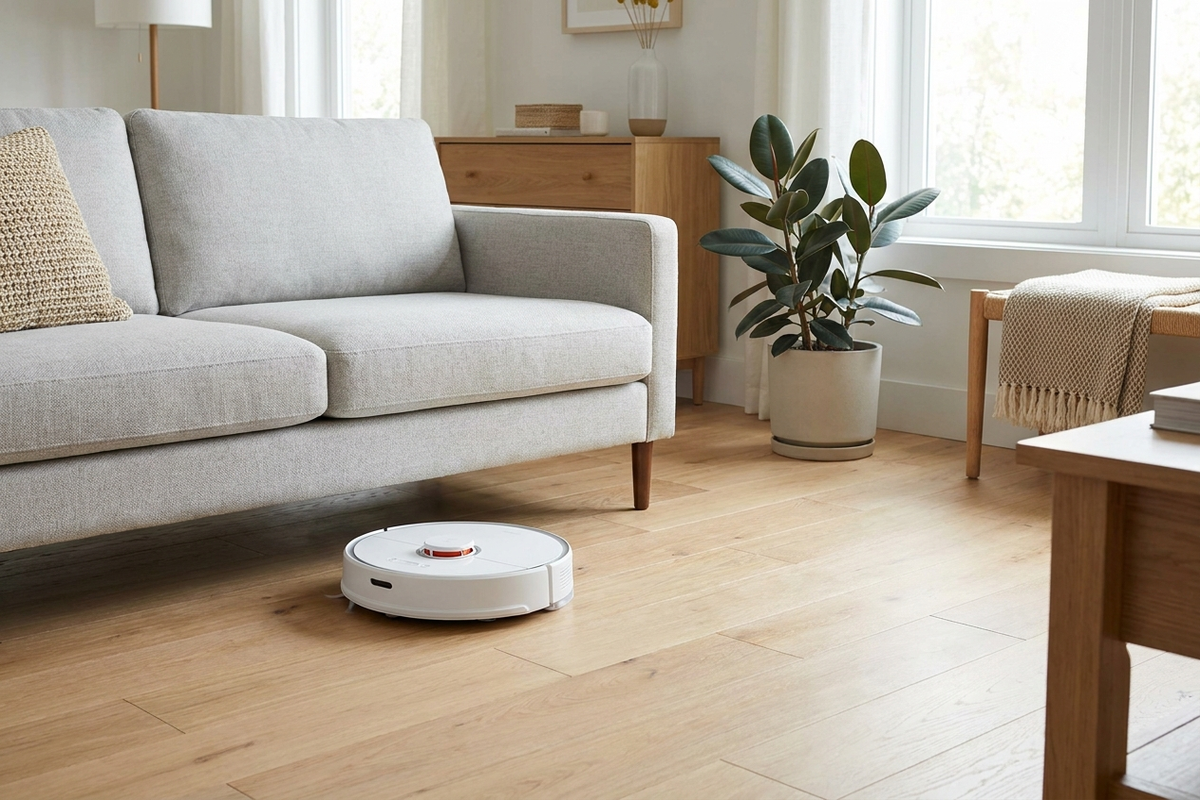
Robot vacuums have become one of Amazon’s most crowded categories, and 2026’s Prime Day event (June 23–26 this year) has pushed prices to their lowest points of the year. The trouble is that “robot vacuum” now spans a $1,300 gap — from a $160 puck that bumps around the room on a timer to a $1,500 flagship that mops with a heated roller, refills its own water, and empties itself for two months. Spending more is not automatically smarter. This guide breaks the category into four price tiers and explains what each tier actually buys you, using aggregated review data, independent lab testing, and manufacturer specifications, with iRobot, Shark, and Eufy as the three brands most US shoppers actually cross-shop on Amazon.
As an Amazon Associate, Arekore earns from qualifying purchases. The Amazon product links in this article may include our affiliate tracking ID and may earn us a commission if you buy through them, at no additional cost to you. See our Links Policy for details on how we select products and how commissions do not influence our recommendations.
TL;DR / Quick Verdict
- Best budget pick (~$200): the Eufy 11S Max — a no-app, quiet, slim puck that just vacuums hard floors well for the lowest price here.
- Best value with self-emptying (~$300–$400): the Eufy C10 — LiDAR mapping and a self-emptying base at a mid-tier price; Consumer Reports rates Eufy near the top for predicted reliability.
- Best mid-tier mapping vacuum (~$350–$450): the Shark AI Ultra (RV2502AE) — LiDAR navigation, true HEPA self-empty base, strong on pet hair, no mopping.
- Best mid-premium vacuum-and-mop (~$550–$800): the Eufy X10 Pro Omni — flagship-style dual spinning mops and an all-in-one station at roughly half a flagship’s price.
- Best hands-off combo when discounted (~$330–$900): the Shark PowerDetect 2-in-1 — strong hands-off vacuuming and mopping for under a grand, and a standout value on deal.
- Best-known premium combo (~$900–$1,000): the iRobot Roomba Combo 10 Max — excellent vacuuming, but reviewers flag dated navigation for the price.
- Flagship (~$1,300–$1,500): the Eufy S1 Pro Omni — heated roller-mop scrubbing and 3D obstacle vision for buyers who want the most capable mopper.
- The real choice: decide whether you need mopping and self-emptying before you decide on a brand. Those two features explain most of the price gap.
How We Reached These Conclusions (Methodology)
This is an editorial analysis, not a hands-on review. We did not personally test the products covered here. Instead, this guide synthesizes three kinds of public information: (a) aggregated amazon.com customer ratings and the substance of low-star reviews, sampled in June 2026; (b) independent third-party testing and reporting from RTINGS, Consumer Reports, Wirecutter (NYT), Tom’s Guide, TechRadar, and Vacuum Wars; and (c) manufacturer specifications and product listings. Where we cite a manufacturer figure — suction in pascals (Pa), runtime, self-empty capacity — we label it as a manufacturer claim rather than an independently verified result. Prices are amazon.com figures at the time of writing and change frequently, especially during Prime Day.
The US Robot Vacuum Market in 2026
The robot vacuum category has shifted under shoppers’ feet. The global robot vacuum market is estimated at roughly $7 billion in 2026, according to Mordor Intelligence, and Global Market Insights projects it to grow from about $14.4 billion in 2026 to $30.9 billion by 2035 at an 8.8% CAGR. Grand View Research reports that North America remains the category’s largest single region.
The more important shift is competitive. iRobot — the company that invented the consumer Roomba and held an estimated 85% of the North American market in 2017 — saw that share slide to around 75% by 2020 as Chinese challengers arrived, and the trend has continued since. By 2025, Beijing-based Roborock had grown to lead the global market by share, overtaking iRobot, according to industry trackers. The practical takeaway for shoppers: iRobot is no longer the default-best choice, and brands like Eufy (a sub-brand of Anker) and Shark now win plenty of head-to-head tests at lower prices. We focus on iRobot, Shark, and Eufy here because they are the three brands US Amazon shoppers most commonly compare, but the premium ceiling is increasingly set by Roborock and Dreame.
1. First, Decide What You Actually Need
Before comparing brands, settle the two questions that explain most of the price differences:
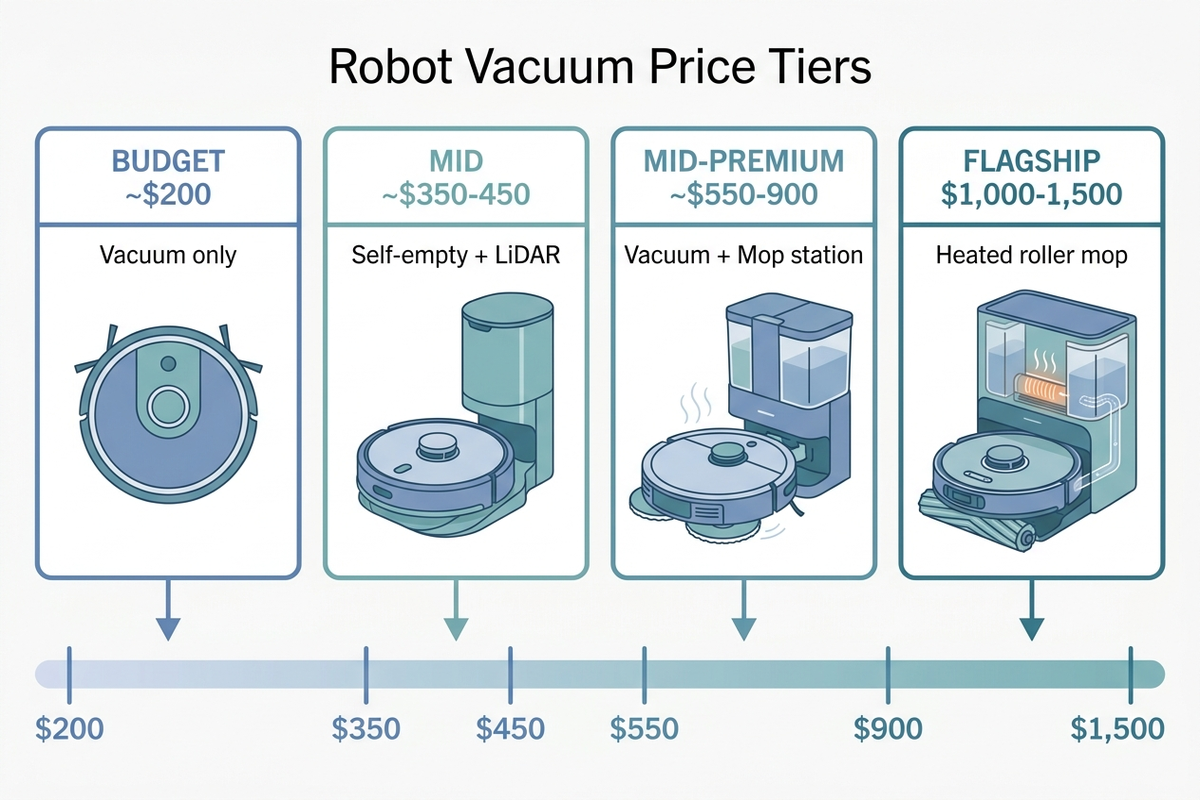
- Do you want it to mop, or only vacuum? Vacuum-only robots are cheaper and simpler. Vacuum-and-mop “combo” units add water tanks and either flat pads or spinning mop discs — and a much pricier dock to wash and dry those pads.
- Do you want it to empty itself? A self-emptying base lets the robot dump its own bin into a larger bag for weeks at a time. It is the single feature most owners say they would not give up — and it adds meaningfully to the price.
A useful rule of thumb from the aggregated reviews: pure vacuums start near $200, self-emptying vacuums land around $300–$450, vacuum-and-mop combos with a full self-cleaning station start around $550, and the heated-mop flagships run $1,000–$1,500.
2. Navigation: LiDAR vs. Camera (Why It Matters)
The second thing separating a frustrating robot from a good one is how it sees your home.
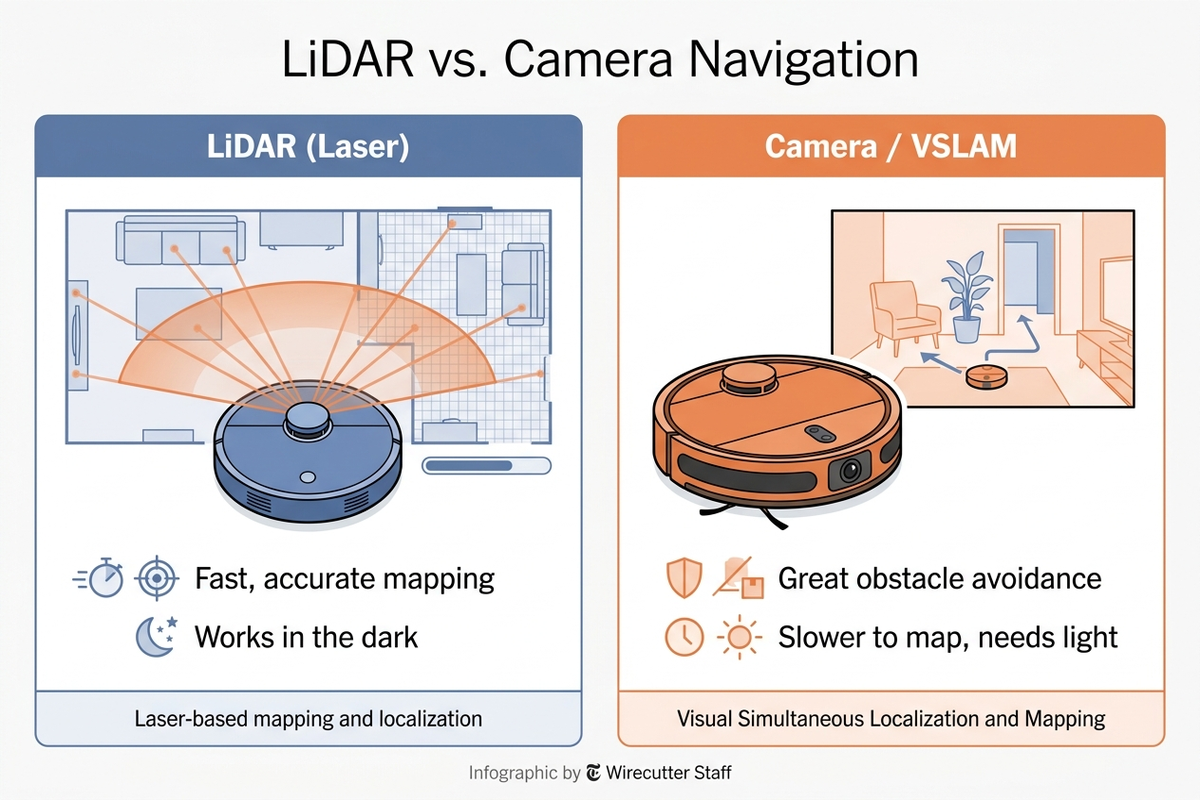
- LiDAR (laser) navigation spins a laser to build an accurate map fast, and works in the dark. It is now standard from the mid-tier up — the Eufy C10, Eufy X10 Pro Omni, and Shark AI Ultra all use it.
- Camera / VSLAM navigation uses a camera to recognize the room and obstacles. It can be excellent for object avoidance (cords, socks, pet waste) but is generally slower to map and depends more on lighting. iRobot’s Roomba Combo 10 Max relies on camera-based navigation, and multiple reviewers — TechRadar and Tom’s Guide among them — singled out its mapping as slow and bump-prone relative to its price.
- The current premium answer is “both”: the flagship Eufy S1 Pro adds a 3D depth-vision system (Eufy calls it 3D MatrixEye) on top of LiDAR for more precise obstacle detection. RTINGS, comparing the S1 Pro to the X10 Pro Omni, found the S1 Pro better built with fewer navigational issues.
Bottom line: at any given price, prefer LiDAR for reliable mapping. Camera systems can still win on dodging clutter, but they are harder to get right.
3. The Budget Tier (~$160–$300): Vacuum-First
If you have mostly hard floors and want the chore handled cheaply, you do not need a mop or a fancy dock.
Eufy 11S Max — a slim (2.85-inch) self-charging robot rated for up to ~100 minutes of runtime (manufacturer claim). It has no Wi-Fi or app: you run it with the included remote. That sounds like a downgrade, but it is exactly why it is reliable and cheap — fewer connected parts to fail. It is consistently one of the best-reviewed entry-level pucks on Amazon for quiet operation on bare floors. The trade-offs are obvious: random-ish navigation rather than mapping, no scheduling app, and no self-emptying.
Check the Eufy 11S Max on Amazon
Eufy C10 — a step up that adds the two things the 11S lacks most: laser (LiDAR) smart mapping and a self-emptying base that holds debris for up to roughly 8 weeks (manufacturer claim), plus a true app. Consumer Reports tested a C10 variant and praised its cleaning on bare floors; notably, in CR’s member surveys Eufy earns a near-top rating for predicted reliability — a meaningful edge in a category where docks and brushes are the usual failure points. This is the value sweet spot for most hard-floor homes that want hands-off operation without paying for mopping.
4. The Mid Tier (~$350–$450): Mapping + Self-Empty, Pet-Hair Focus
This is where most pet owners should look: real mapping, a big self-emptying base, strong suction, no mop to maintain.
Shark AI Ultra (RV2502AE) — LiDAR navigation, an XL HEPA self-empty base rated to hold up to 60 days of debris (manufacturer claim, HEPA filtration to 99.97% of dust and allergens), an “UltraClean” deep-cleaning mode, and roughly 120 minutes of runtime (manufacturer claim) with recharge-and-resume. Shark is a perennial value winner in this bracket: you get flagship-style mapping and a true HEPA dock for a mid-tier price, with the obvious omission being that it does not mop. Consumer Reports notes it tests Shark among its dozen-plus brands, and Shark’s self-empty robots are a recurring Wirecutter and Tom’s Guide value pick for pet households.
Check the Shark AI Ultra on Amazon
5. The Mid-Premium Tier (~$550–$900): Vacuum + Mop, Full Station
Here you start getting genuine mopping — spinning pads with downward pressure, plus a station that washes and dries those pads so you are not rinsing them by hand.
Eufy X10 Pro Omni — the value star of the combo class. It pairs 8,000 Pa suction (manufacturer claim) with dual spinning mop pads that exert about 1 kg (~2 lb) of downward pressure — more than most rivals — and 12 mm auto-lift so the mops raise over carpet. The all-in-one station auto-empties the bin, washes the mop pads with clean water, and dries them with heated air. List price is $799.99, but it frequently drops to the $550–$650 range on deal. TechRadar and Vacuum Wars both frame it as delivering “flagship features at half the cost,” and Homes & Gardens called it one of the best they had tested on both hard floors and carpet. RTINGS rates it a notch below the S1 Pro for build and navigation but a strong value.
Check the Eufy X10 Pro Omni on Amazon
Shark PowerDetect 2-in-1 — Shark’s hands-off combo, with a NeverTouch Pro base that self-empties, refills the water tank for up to ~30 days, and washes and dries the mop pad after each clean. Its “PowerDetect” system claims to sense hidden dirt, stuck-on stains, edges, and floor type and adjust automatically. Tom’s Guide reviewed it favorably as offering the performance of pricier $1,400 hybrids “for under $1K,” and during 2026 sale events it has dropped as low as the $330–$450 range — which makes it one of the best combo values when discounted. If you want a vacuum-and-mop that you truly leave alone for a month, this is the mainstream pick.
Check the Shark PowerDetect 2-in-1 on Amazon
6. The Premium / Flagship Tier (~$900–$1,500)
The top of the market is about mopping quality and obstacle intelligence, not vacuuming — by this tier they all vacuum well.
iRobot Roomba Combo 10 Max — iRobot’s flagship combo, with an AutoWash dock that self-empties, refills the bin, and washes and dries the mop pad, plus an auto-retracting mop that lifts onto the robot’s top over carpet so it never drags a wet pad onto your rug. Reviewers are split: TechRadar and Tom’s Guide praised its vacuuming and pet-hair pickup (top scores in deep-carpet and pet-hair tests) but criticized its camera-based navigation as slow and bump-prone and its mopping as merely adequate for the price. Launched near $1,399, it has since settled closer to $899–$999 and goes lower during Prime Day. It is a strong vacuum with a premium dock; just know you are paying iRobot brand premium for navigation that trails the best Eufy and Roborock systems. Worth noting: in Consumer Reports member surveys, iRobot earns only middling marks for reliability and owner satisfaction.
Check the iRobot Roomba Combo 10 Max on Amazon
Eufy S1 Pro Omni — the most capable mopper in this lineup. Instead of flat or disc pads, it uses a HydroJet roller mop that continuously rinses itself while scrubbing, applies about 1 kg of downward pressure, and is fed by ozonated (“Eco-Clean”) water. Its 3D MatrixEye depth-vision obstacle system sits on top of LiDAR, and its 10-in-1 station adds heated drying and detergent dispensing. RTINGS found it better built, better on bare floors, and less prone to navigation errors than the X10 Pro Omni — the case for paying its ~$1,300–$1,500 price rests almost entirely on superior mopping and obstacle avoidance. If mopping is your priority and budget is not, it is the standout; if you mostly vacuum, it is overkill.
Check the Eufy S1 Pro Omni on Amazon
7. Side-by-Side Comparison
| Model | ASIN | Tier | Type | Navigation | Self-empty | Approx. price (at writing) |
|---|---|---|---|---|---|---|
| Eufy 11S Max | B07R295MLS | Budget | Vacuum only | Bump/random | No | $160–$220 |
| Eufy C10 | B0GD1XTMFN | Budget+ | Vacuum only | LiDAR | Yes (~8 wk) | $300–$400 |
| Shark AI Ultra (RV2502AE) | B09J88GNW3 | Mid | Vacuum only | LiDAR | Yes (HEPA, ~60 day) | $350–$450 |
| Eufy X10 Pro Omni | B0CPFBBHP4 | Mid-premium | Vacuum + mop | LiDAR + AI | Yes (full station) | $550–$800 |
| Shark PowerDetect 2-in-1 | B0DCPX2M8N | Mid-premium | Vacuum + mop | LiDAR | Yes (NeverTouch, ~30 day) | $330–$900 |
| iRobot Roomba Combo 10 Max | B0D9ZRH61T | Premium | Vacuum + mop | Camera/VSLAM | Yes (AutoWash) | $899–$1,000 |
| Eufy S1 Pro Omni | B0CTY6VT8Y | Flagship | Vacuum + roller mop | LiDAR + 3D vision | Yes (10-in-1 station) | $1,300–$1,500 |
Suction, runtime, and capacity figures are manufacturer specifications. Prices fluctuate; verify the current amazon.com price and any strikethrough deal before buying.
8. What the Specs Actually Mean
A few numbers get over-marketed; here is how to read them:
- Suction (Pa). More pascals helps on carpet and with embedded debris, but past roughly 5,000–8,000 Pa the brush design and roller anti-tangling matter more than the headline number. Treat very high Pa claims as a ceiling, not a guarantee.
- Self-empty capacity (days). “60-day” or “8-week” capacity assumes a small home and light shedding. Pet households and larger homes fill the bag faster — plan for more frequent bag swaps than the box promises.
- Mop pressure and lift. Downward pressure (e.g., ~1 kg) is what actually scrubs stuck-on grime; mop lift height (e.g., 12 mm auto-lift) is what keeps a wet pad off your carpet. Both matter more than the number of pads.
- Runtime. A higher runtime claim matters most in large homes; recharge-and-resume makes it almost irrelevant in small ones, since the robot tops up and finishes the job either way.
- Navigation. LiDAR for reliable mapping; camera systems for clutter avoidance. This single factor drives the most low-star “it got stuck / it missed rooms” complaints.
9. How to Set Up and Maintain a Robot Vacuum
Maintenance — not suction — is the single most common theme in low-star reviews (tangled brushes, smelly mop pads, a dock that stops emptying). A few practical points drawn from manufacturer guidance and reviewer consensus:
- Tidy the floor first. Pick up cords, socks, and small toys before the first run; even good obstacle avoidance is not perfect.
- Empty and clean the dock on schedule. Swap the self-empty bag when full and wipe the wash tray; a neglected combo dock is what grows odor.
- Clean the brushroll and filter regularly. Hair wrap is the top cause of declining pickup. Models with anti-tangle combs help but still need periodic checks.
- Use clean water and the right solution in combo units. Avoid generic floor cleaner that foams; many docks specify their own or plain water.
- Run mapping in good light for camera-based models. LiDAR units map in the dark; camera/VSLAM robots map more accurately with the lights on.
10. Decision Flowchart
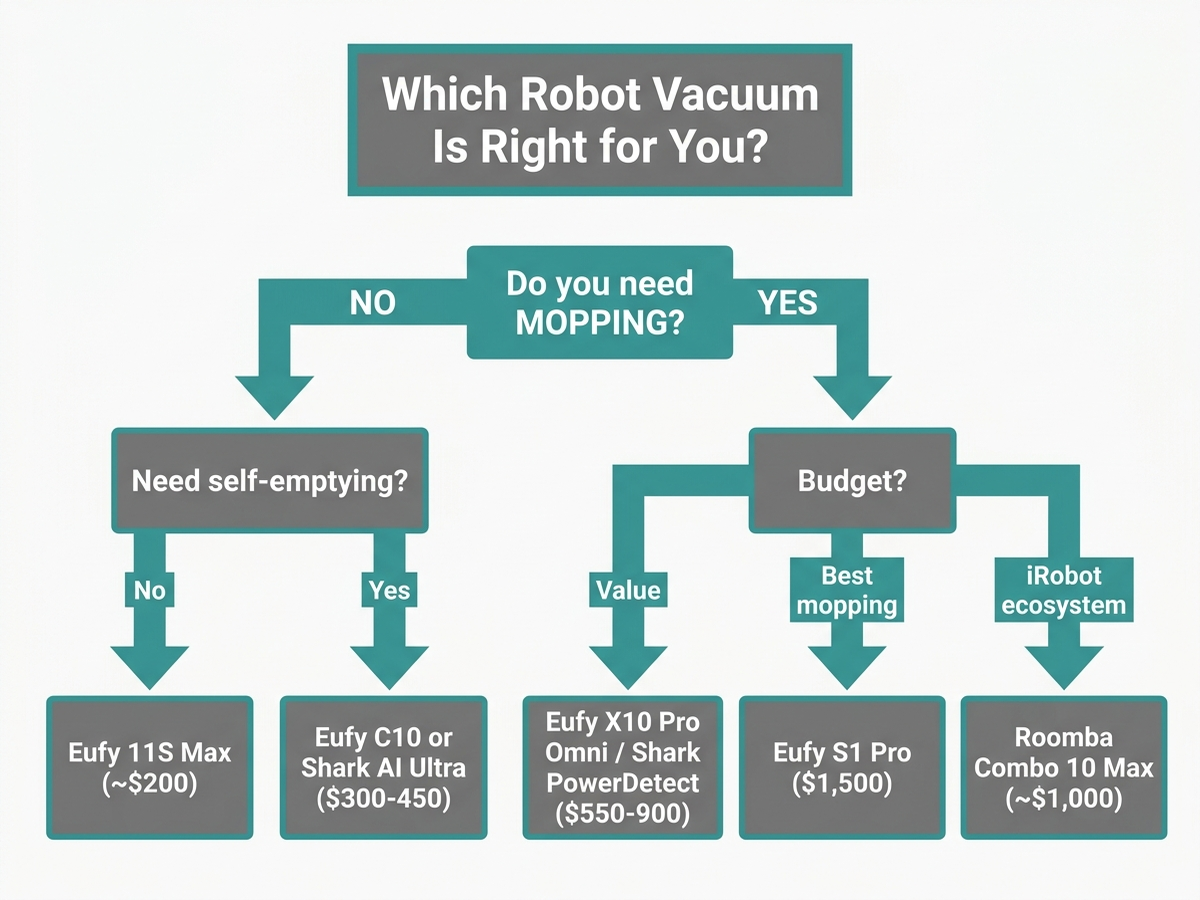
Work from features down to brand. If you only need to vacuum hard floors cheaply, get the Eufy 11S Max; add a budget and you get LiDAR and self-emptying in the Eufy C10. For a pet home that wants mapping and a HEPA dock but no mop, the Shark AI Ultra is the pick. If you want vacuuming and mopping with a self-cleaning station, the Eufy X10 Pro Omni (best value) or Shark PowerDetect 2-in-1 (best when on deal) cover most buyers. Only step up to the Roomba Combo 10 Max if you specifically want the iRobot ecosystem, or to the Eufy S1 Pro if best-in-class mopping is the goal.
11. Warranty and Support
Across this category, manufacturers commonly offer a 1-year limited warranty on the robot and dock (manufacturer terms; confirm at purchase). Because these machines are mechanically simple but maintenance-sensitive, most warranty issues trace to tangled brushes, clogged docks, and worn mop pads rather than manufacturing defects — which is another reason to clean on schedule and keep your receipt. Register the unit after purchase. Note that iRobot, Shark (SharkNinja), and Eufy (Anker) each run their own support channels separate from the Amazon return window, and that consumables (filters, brushes, mop pads, dust bags) are ongoing costs worth checking before you buy.
12. Editorial Recommendation by Use Case
- You want the cheapest robot that reliably vacuums hard floors: the Eufy 11S Max.
- You want LiDAR mapping and self-emptying without paying for a mop: the Eufy C10.
- You have pets and want a HEPA self-empty vacuum with real mapping: the Shark AI Ultra (RV2502AE).
- You want vacuuming and mopping with a self-cleaning station at the best price: the Eufy X10 Pro Omni (or the Shark PowerDetect 2-in-1 when it is deeply discounted).
- You specifically want the iRobot ecosystem and best-in-class pet-hair vacuuming: the iRobot Roomba Combo 10 Max, accepting its slower navigation.
- You want the most capable mopping and best obstacle avoidance, budget no object: the Eufy S1 Pro Omni.
- Everyone: clean the brushroll and empty the dock on schedule — it is the difference between a robot that lasts years and one that disappoints in months.
Limitations
This analysis relies on publicly available reviews, third-party reporting, and manufacturer specifications; we did not independently lab-test these units. Suction, runtime, self-empty capacity, and mop-pressure figures are manufacturer claims or come from cited third parties, and real-world results vary with floor type, home size, pet shedding, clutter, and unit-to-unit variance. The robot vacuum market moves quickly — flagships from Roborock and Dreame frequently top independent rankings such as RTINGS, and we have focused on iRobot, Shark, and Eufy because they are the brands US Amazon shoppers most commonly compare, not because they are the only strong options. Prices and availability were accurate to our research at the time of writing and change frequently, especially around Prime Day — verify current specs and pricing on the product page before purchasing.
Before you buy any of these, it pays to check that the listing’s reviews are genuine and the price is actually a deal — especially during a Prime Day rush. That is exactly what Arekore does: paste the Amazon URL and our AI analyzes review authenticity, surfaces the most useful low-star feedback, and compares pricing in about five minutes — so you end up with the right robot vacuum, not just the most heavily advertised one.