Best Robot Mops in 2026: iRobot vs Roborock vs Tineco
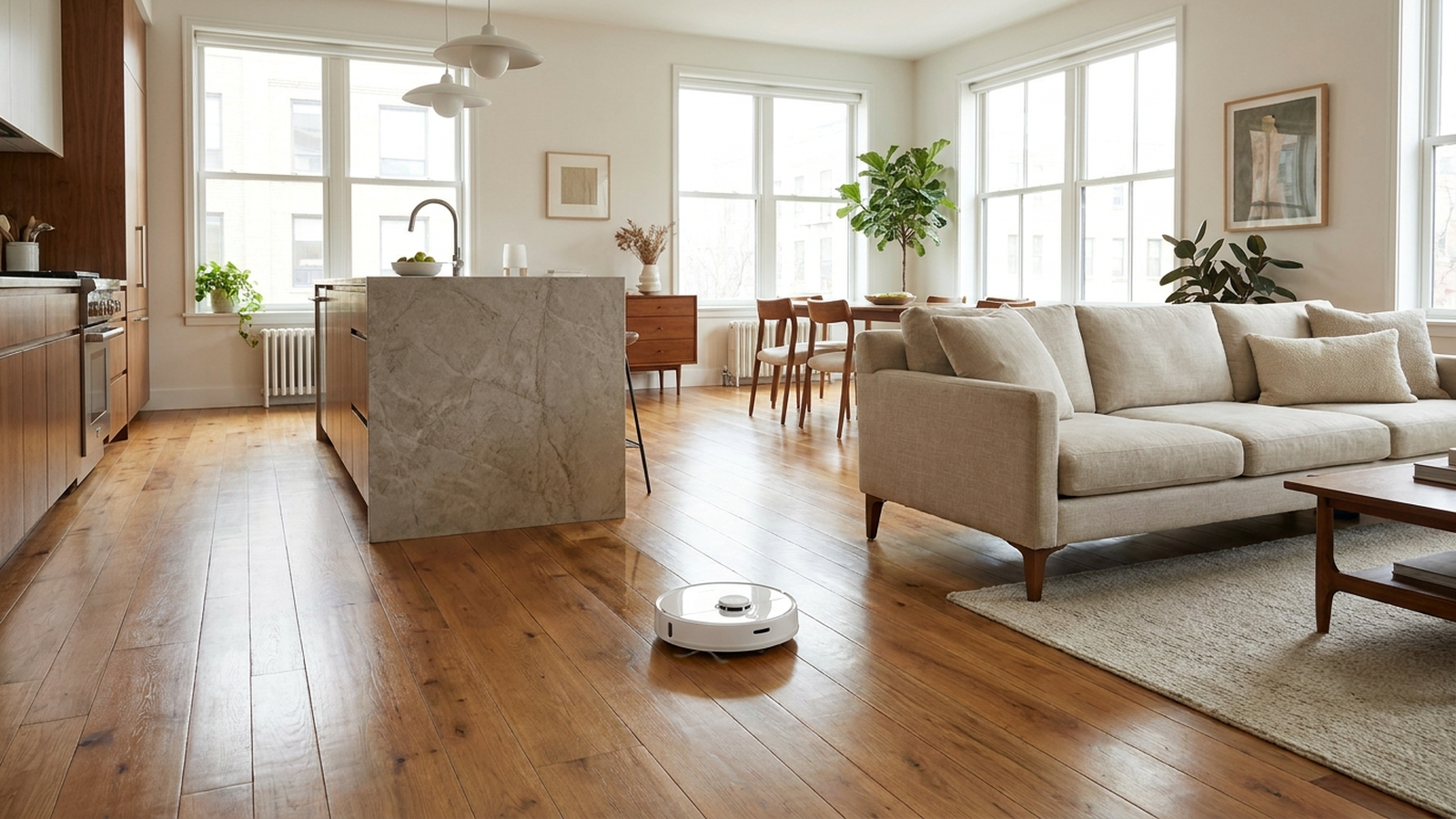
“Robot mop” is one of the most search-heavy phrases in home cleaning right now, but the three brands shoppers most often type into that search bar are not actually competing on the same turf. iRobot and Roborock build autonomous, self-navigating robots that vacuum and mop your whole home unattended. Tineco’s flagship “smart” products are cordless stick vacuum-mops you push by hand — genuinely excellent at what they do, but not robots in the self-navigating sense. Add in the fact that iRobot filed for Chapter 11 bankruptcy in December 2025, and a three-way comparison needs more nuance than a simple spec-sheet shootout. This guide synthesizes aggregated Amazon customer reviews, independent lab testing, and manufacturer data to sort out what each brand actually offers in 2026.
As an Amazon Associate, Arekore earns from qualifying purchases. The Amazon product links in this article may include our affiliate tracking ID and may earn us a commission if you buy through them, at no additional cost to you. See our Links Policy for details on how we select products and how commissions do not influence our recommendations.
TL;DR / Quick Verdict
- Best all-around robot mop: the Roborock Qrevo Curv — a true self-navigating robot with a mop that lifts and lowers automatically, plus a dock that washes and dries the pad with hot water.
- Best value robot mop: the Roborock Q10 S5+ — sonic scrubbing mopping and a 70-day self-emptying dock for roughly half the flagship’s price.
- Best-known name, but buy with caution: the iRobot Roomba Combo j9+ — a capable multi-surface mapper, but iRobot’s December 2025 Chapter 11 bankruptcy and 2026 ownership change to a Chinese manufacturer (Shenzhen PICEA Robotics) add real uncertainty around long-term app support and warranty service.
- Not actually a robot — but worth considering instead: the Tineco Floor One S9 Artist Steam — a hand-pushed, self-cleaning wet/dry vacuum-mop that Consumer Reports and other labs consistently rate above robot mops for actual floor cleanliness, because you steer it.
- The real choice: decide whether you want hands-off convenience (robot) or the best possible clean on demand (stick mop) before you decide on a brand — the two categories solve different problems.
How We Reached These Conclusions (Methodology)
This is an editorial analysis, not a hands-on review. We did not personally test the products covered here. This guide synthesizes three kinds of public information: (a) aggregated amazon.com customer ratings and the substance of low-star reviews, sampled in August 2026; (b) independent third-party testing from Consumer Reports, RTINGS, Tom’s Guide, TechRadar, Vacuum Wars, and TinyReno’s 11-week robot-mop test; and (c) manufacturer specifications and official product listings. Where we cite a manufacturer figure — suction in pascals (Pa), mop pressure, self-empty capacity — we label it as a manufacturer claim rather than an independently verified result. Prices are amazon.com figures at the time of writing and change frequently.
Why iRobot’s Bankruptcy Matters for This Comparison
Any 2026 robot-mop guide has to address this directly: iRobot Corporation, the company that invented the consumer Roomba, filed for Chapter 11 bankruptcy protection on December 14, 2025, after a Restructuring Support Agreement with Shenzhen PICEA Robotics Co., Ltd. Under the plan, Picea took 100% ownership of iRobot in exchange for canceling debt, and the Chapter 11 case was reported to be closing around February 2026. iRobot has stated that day-to-day operations, product support, and app functionality are continuing without disruption, and that new Roomba products are still planned for 2026. That is reassuring in the short term, but a change of ownership to an overseas manufacturer following a bankruptcy is exactly the kind of event that historically precedes reduced software support, discontinued spare parts, or an eventual brand wind-down. We are not predicting either outcome — we are flagging it as a real risk factor that did not exist for this brand a year ago, and one that should weigh into a purchase decision on a $700+ appliance you expect to use for years.
The Robot Mop Market in 2026
Hybrid vacuum-mop robots are the fastest-growing part of the robot vacuum category, expanding at roughly a 16.6% CAGR and expected to represent an estimated 60–70% of new robot vacuum unit sales by 2030, up from about 40–45% in 2026, according to market researchers tracking the category. US household penetration for robot vacuums broadly is estimated at roughly 18–22% in 2026. Within that growth, Roborock has emerged as one of the two most-tested brands in independent labs (alongside Dreame), while iRobot’s market position has weakened — a slide that predates the bankruptcy filing and is tied to intensifying competition from Chinese manufacturers and rising import tariffs (iRobot has cited roughly $23 million in added 2025 costs from Vietnam-sourced import duties). Tineco, meanwhile, has built its US reputation almost entirely in the cordless stick vacuum-mop segment rather than autonomous robots — Consumer Reports’ combo vacuum-mop recommendations for 2026 include multiple Tineco Floor One models, none of which are self-navigating robots.
1. Three Different Approaches to “Robot Mop”
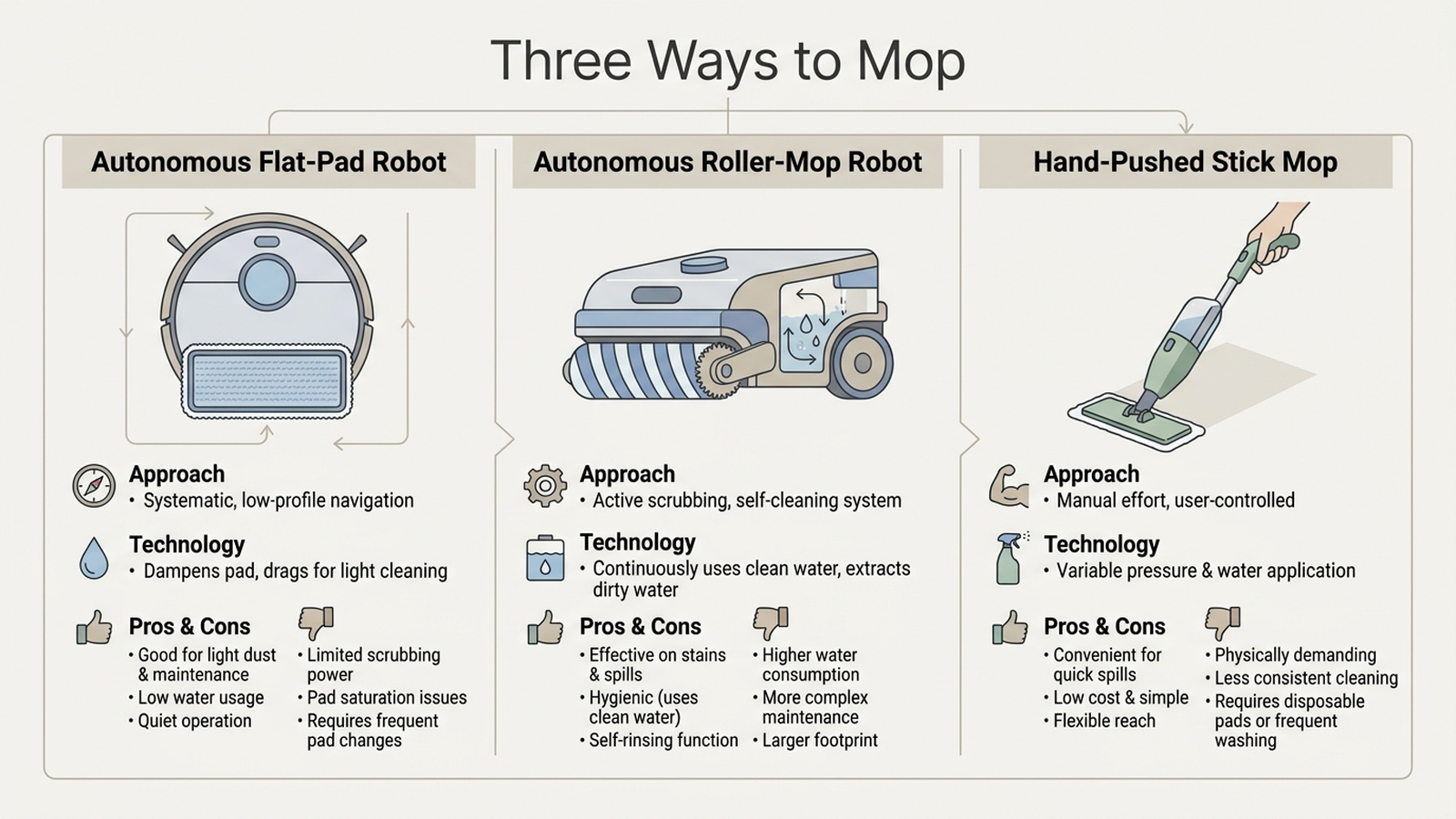
Before comparing specific models, it helps to separate what these machines actually are:
- Autonomous flat-pad or spinning-disc robots (Roborock, most iRobot Combo models). A LiDAR- or camera-guided robot drives itself around your home, wets a pad or spinning discs from an onboard tank, and scrubs as it drives. A dock washes and dries the pad between runs. This is the “set it and forget it” category.
- Autonomous roller-mop robots (higher-end Roborock and competitors). Instead of a flat pad, a continuously rotating, self-rinsing roller applies more consistent pressure and rinses itself mid-clean rather than dragging dirty water around — the mechanism most independent testers rate as the best mopping technology currently available in a robot.
- Hand-pushed cordless wet/dry vacuum-mops (Tineco’s Floor One line). You push these like a stick vacuum. They vacuum and mop hard floors in a single pass, self-clean their own brush roller and tubing at the dock, and — because a human is steering and applying pressure — consistently outperform robots on stubborn, localized messes. What they don’t do is run unattended.
Mixing these categories under one “robot mop” search is understandable — retailers and reviewers use the term loosely — but it explains why some of the “best robot mop” advice you’ll find recommends a machine that isn’t autonomous at all.
2. iRobot Roomba Combo j9+ — The Established Name
iRobot Roomba Combo j9+ (ASIN B0C415HQPX) uses iRobot’s PrecisionVision camera-based navigation to identify and route around common obstacles — cords, pet waste, socks, shoes — and its “Dirt Detective” feature (part of iRobot OS) prioritizes the dirtiest rooms first, a manufacturer claim. The Clean Base Auto-Fill dock empties the bin and refills the robot’s water tank automatically, and it is the only dock in this comparison with built-in storage for spare bags and mop pads. List price is $799 at the time of writing, though iRobot and third-party retailers run frequent promotions that push it into the $600s.
Independent testers give the underlying j-series mop mechanism credit: TinyReno’s 11-week test of a comparable iRobot Combo model rated it “the most reliable multi-floor mapper,” citing a mop-lift mechanism that reliably keeps the pad off carpet. The trade-off, echoed across multiple reviewers of iRobot’s camera-based navigation generally, is that camera/VSLAM systems map more slowly and depend more on ambient lighting than the LiDAR systems used by Roborock. Layer on the bankruptcy and ownership-change risk discussed above, and the j9+ is a capable robot bought with a clearer eye on long-term brand uncertainty than would have been true two years ago.
Check the iRobot Roomba Combo j9+ on Amazon
3. Roborock Qrevo Curv — The Flagship Mopping Robot
Roborock Qrevo Curv (ASIN B0D81675BQ) is Roborock’s answer to the mop-lift and edge-cleaning problem that has dogged robot mops for years. Its AdaptiLift chassis raises the mop pad up to 17 mm (manufacturer claim) over carpet, and a FlexiArm extension reaches the mop pad into corners and along baseboards that most robots miss entirely. It runs 18,500 Pa suction (manufacturer claim) with a zero-tangling brush design, and its dock washes the mop pad with hot water and dries it with heated air. List price is $1,599.99, though it regularly sells for $1,100–$1,300 on promotion.
Tom’s Guide and Vacuum Wars both reviewed the Qrevo Curv favorably, with Vacuum Wars calling it “a new benchmark” for combining strong suction with genuinely edge-reaching mop coverage — historically one of the biggest complaints about robot mops, since a flat pad mounted mid-chassis simply can’t reach a baseboard corner. A related model in the same generation, the Roborock G10S, was independently tested by TinyReno over 11 weeks and won on streak-free mopping across mixed flooring, with its self-clean cycle running roughly every 25 square meters and a two-hour post-clean hot-air dry cycle. Roborock’s broader lineup — reviewers have generally scored the Saros series highly across vacuuming, mopping, maintenance, and navigation in aggregated testing — reinforces that this is the brand most independent labs currently rate at or near the top of the category.
Check the Roborock Qrevo Curv on Amazon
4. Roborock Q10 S5+ — The Value Robot Mop
Not every household needs flagship pricing to get real mopping. Roborock Q10 S5+ (ASIN B0DWXBCQVP) carries over several flagship-tier features at a fraction of the Qrevo Curv’s price: 10,000 Pa suction (manufacturer claim), sonic mopping (a rapid back-and-forth scrubbing motion rather than a passive dragged pad), a dual anti-tangle brush design, auto mop lift over carpet, and a self-emptying dock rated for up to 70 days (manufacturer claim) between bag changes. It typically sells in the $400–$550 range, positioning it as the practical middle ground between a basic vacuum-only robot and a $1,500 flagship.
For households where the Qrevo Curv’s edge-reaching FlexiArm and top-tier suction are nice-to-haves rather than must-haves, the Q10 S5+ delivers the core “robot that both vacuums and mops without supervision” promise at roughly a third of the price.
Check the Roborock Q10 S5+ on Amazon
5. Tineco Floor One S9 Artist Steam — Not a Robot, But Worth Knowing About
Tineco Floor One S9 Artist Steam (ASIN B0DY7G7C8P) is the product most likely to show up when shoppers search “best robot mop” and land on a Tineco listing — and it’s important to be direct about what it is: a cordless, hand-pushed wet/dry vacuum-mop, not an autonomous robot. There is no LiDAR, no mapping, and no unattended operation. You steer it across hard floors like a stick vacuum.
What it does very well is single-pass hard-floor cleaning. Its steam function dispenses water heated to roughly 210°F (manufacturer claim), which loosens grease and dried-on stains that a robot’s room-temperature mop pad typically cannot touch. It uses iLoop smart-sensor technology to automatically adjust suction, water flow, and brush speed based on how dirty the floor is, and its self-cleaning dock flushes the brush roller and internal tubing with hot water and dries it with heated air — addressing the “smelly mop” complaint that dogs both robot and manual mops alike. List price is $899; runtime is rated at up to 52 minutes (manufacturer claim) per charge. Consumer Reports has separately recommended other Tineco Floor One models (the S3 and S7 Pro) in its combo vacuum-mop testing, praising strong wet pickup and stain removal — the same core strength that carries through the Artist Steam.
The trade-off is obvious: you have to be home and holding it. If your priority is genuinely hands-off cleaning, a Tineco stick mop does not solve that problem no matter how good its mopping is. If your priority is the cleanest possible hard floor and you don’t mind doing the pushing, aggregated third-party testing suggests a Tineco stick mop can out-clean a robot on stubborn messes.
Check the Tineco Floor One S9 Artist Steam on Amazon
6. Side-by-Side Comparison
| Model | ASIN | Type | Navigation | Mop mechanism | Self-empty/clean | Approx. price (at writing) |
|---|---|---|---|---|---|---|
| iRobot Roomba Combo j9+ | B0C415HQPX | Autonomous robot | Camera (PrecisionVision) | Auto-lift flat pad | Yes (Clean Base, Auto-Fill) | $600–$799 |
| Roborock Qrevo Curv | B0D81675BQ | Autonomous robot | LiDAR | AdaptiLift + FlexiArm edge reach | Yes (hot-water wash + dry) | $1,100–$1,600 (list $1,599.99) |
| Roborock Q10 S5+ | B0DWXBCQVP | Autonomous robot | LiDAR | Sonic scrubbing, auto lift | Yes (~70-day dock) | $400–$550 |
| Tineco Floor One S9 Artist Steam | B0DY7G7C8P | Hand-pushed stick | None (manual) | Steam + roller, user-directed pressure | Self-cleaning dock (not self-emptying) | $899 |
Suction, mop-pressure, and capacity figures are manufacturer specifications. Prices fluctuate; verify the current amazon.com price before buying.
7. What Aggregated Customer Reviews Say
Across the robot models, the recurring praise in Amazon customer reviews centers on convenience — not having to think about floors for days or weeks at a time — while the recurring complaints cluster around two issues: mop pads missing edges and corners (the exact problem Roborock’s FlexiArm targets), and dock maintenance (odor from a neglected wash tray, or a self-empty bag filling faster than the “60-day” or “70-day” marketing claim in pet households). For iRobot specifically, reviewers and Consumer Reports’ member-satisfaction surveys have historically placed the brand in the middle of the pack for predicted reliability relative to newer entrants — a pattern that predates the bankruptcy but is worth factoring in alongside it. For Tineco, the dominant sentiment in aggregated reviews is satisfaction with cleaning performance on hard floors, with the most common complaint being water-tank leaks at the tank’s side opening and the physical effort of pushing a wet/dry unit for a full-home clean, rather than any complaint about cleaning results.
8. How to Get the Most Out of Either Category
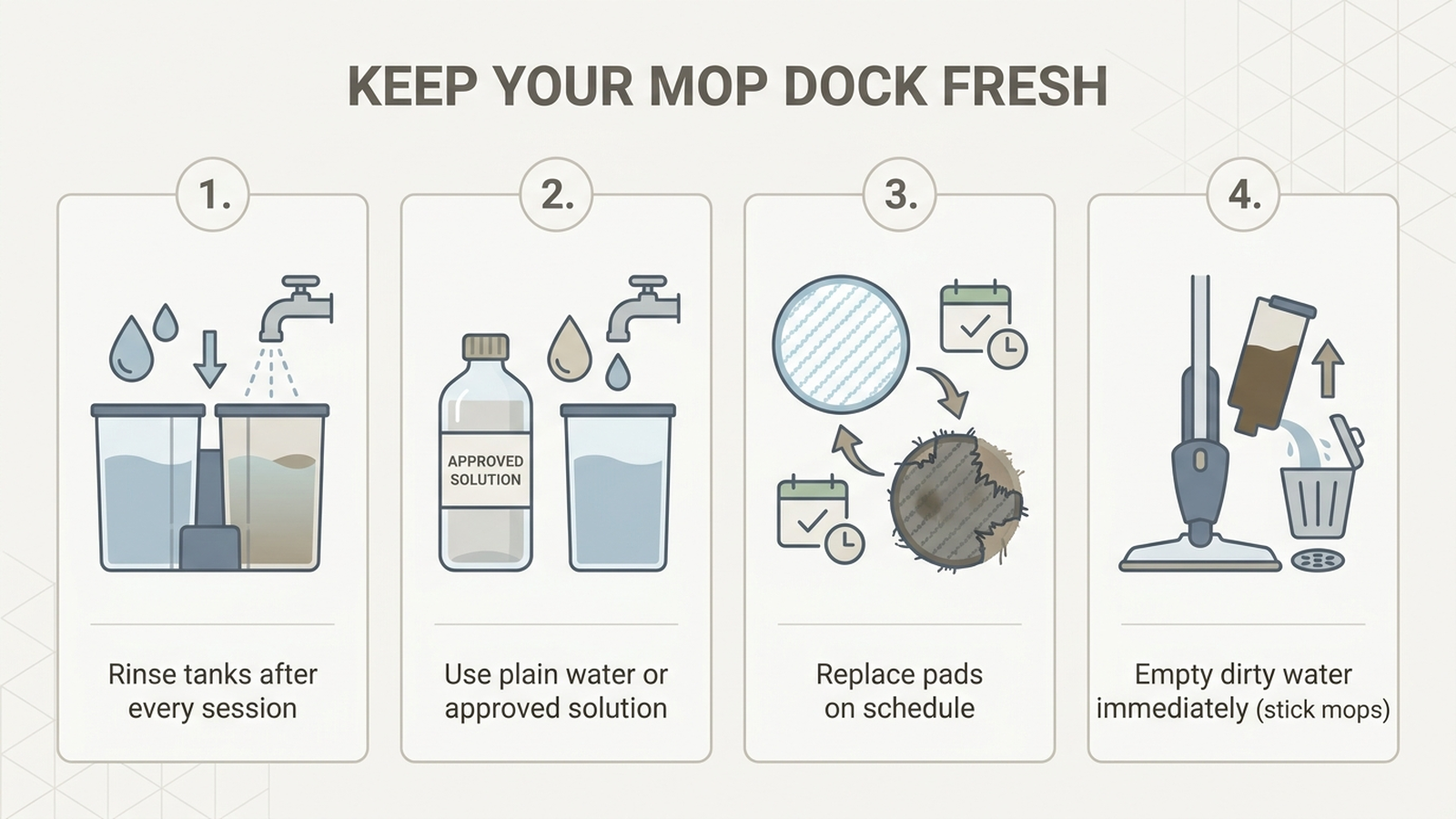
- Empty and rinse the dock’s clean-water and dirty-water tanks after every session, robot or stick — this is the single most common source of odor complaints in both categories.
- Use plain water or the manufacturer’s specified solution. Generic floor cleaners can foam inside a robot’s pump system or a stick mop’s tank and trigger error codes.
- Replace mop pads and brush rollers on the manufacturer’s schedule, not just when they look worn — reduced scrubbing effectiveness happens gradually and is easy to miss.
- For robots, clear floor clutter before the first few runs so the mapping system builds an accurate layout; camera-based systems in particular benefit from good lighting during initial mapping.
- For stick mops, empty the dirty-water tank immediately after use rather than leaving it in the dock — standing dirty water is the top cause of the sour smell that shows up in negative reviews.
9. Decision Flowchart
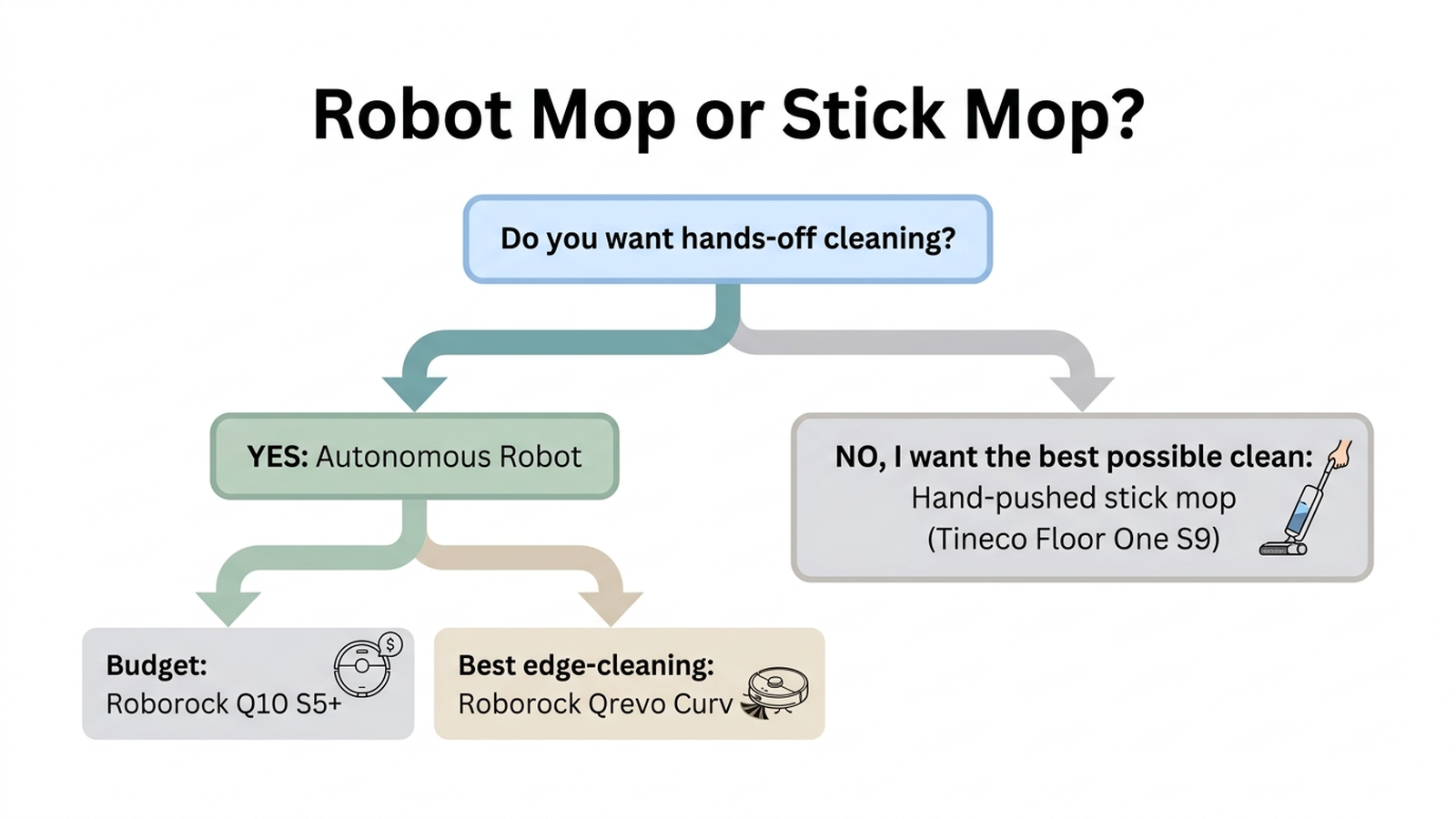
Start with one question: do you want to never think about mopping, or do you want the single cleanest result when you do mop? If it’s the former, you want an autonomous robot — the Roborock Q10 S5+ if budget matters most, the Qrevo Curv if edge-cleaning and top suction matter most, and the iRobot Combo j9+ only if you specifically want the iRobot ecosystem and are comfortable with the brand’s current ownership uncertainty. If it’s the latter, skip robots entirely and get the Tineco Floor One S9 Artist Steam — you’ll spend 15–20 minutes pushing it, but you’ll get a better clean on stubborn spots than any robot mop on this list.
10. Warranty and Support
Roborock and iRobot both typically offer a 1-year limited warranty on the robot and dock (manufacturer terms; confirm at purchase), while Tineco’s Floor One line commonly carries a similar 1-year warranty on the main unit. Because iRobot’s warranty and support infrastructure is now operating under new ownership following its 2026 bankruptcy resolution, it is worth confirming warranty terms directly on the product listing or with iRobot support before purchase rather than assuming continuity with pre-2026 policies. Across all three brands, consumables — mop pads, brush rollers, filters, and self-empty bags — are ongoing costs worth checking before you buy; they are not typically covered under warranty once they show normal wear.
Editorial Recommendation by Use Case
- You want the best all-around autonomous robot mop and budget isn’t the limiting factor: the Roborock Qrevo Curv.
- You want a genuinely hands-off robot mop without flagship pricing: the Roborock Q10 S5+.
- You specifically want the iRobot ecosystem and are comfortable with the brand’s current ownership transition: the iRobot Roomba Combo j9+.
- You want the single cleanest hard-floor result and don’t mind pushing the machine yourself: the Tineco Floor One S9 Artist Steam — and understand going in that it is not a robot.
- Everyone: rinse the dock and tanks after every session — dock hygiene, not suction or navigation, is the top driver of negative reviews across every brand here.
Limitations
This analysis relies on publicly available reviews, third-party reporting, and manufacturer specifications; we did not independently lab-test these units. Suction, mop-pressure, and self-empty capacity figures are manufacturer claims or come from cited third parties, and real-world results vary with floor type, home size, pet shedding, and unit-to-unit variance. iRobot’s bankruptcy and ownership change is a fast-moving situation as of this writing (reports point to the Chapter 11 case closing around February 2026), and terms around support, warranty service, and future product development could change further. Prices and availability were accurate to our research at the time of writing and change frequently — verify current specs, warranty terms, and pricing on the product page before purchasing.
Before you buy any of these, it pays to check that the listing’s reviews are genuine and the price is actually competitive. That is exactly what Arekore does: paste the Amazon URL and our AI analyzes review authenticity, surfaces the most useful low-star feedback, and compares pricing in about five minutes — so you end up with the right floor-cleaning tool for how you actually want to clean, not just the most heavily advertised one.