Best Home Projectors in 2026: Epson vs BenQ vs Anker Nebula
TL;DR / Quick Verdict
- Best for a dedicated dark room: Epson Home Cinema 2350 — a 3-chip 3LCD design that avoids the “rainbow effect” some single-chip DLP projectors can show, with 2,800 lumens of color and white brightness and a long-throw lens built for a fixed, light-controlled setup.
- Best budget entry point: BenQ HT2060 — Tom’s Guide names it the best projector under $1,000, with independently tested out-of-box color accuracy that needs little to no calibration.
- Best for portability and streaming: Anker Nebula Cosmos 4K SE — a hybrid laser/LED portable model with Google TV built in and auto-setup features, though independent testers note its contrast falls short of a dedicated home-theater projector in darker scenes.
Methodology
This analysis synthesizes (a) aggregated Amazon US customer reviews for the Epson Home Cinema 2350, BenQ HT2060, and Anker Nebula Cosmos 4K SE, (b) independent test coverage from RTINGS, Tom’s Guide, TechGearLab, ProjectorCentral, Digital Camera World, and TechRadar, and (c) manufacturer-published brightness, resolution, and warranty specifications. We did not personally test the products covered here. Where we cite a specific claim about image quality or ranking (for example, Tom’s Guide’s “best portable” designation for the Nebula Cosmos 4K SE), it traces back to that outlet’s published testing, not to our own use. Sample sizes for review-based sentiment are labeled per product below where available.
Technical Approach: Three Ways to Build a Projector
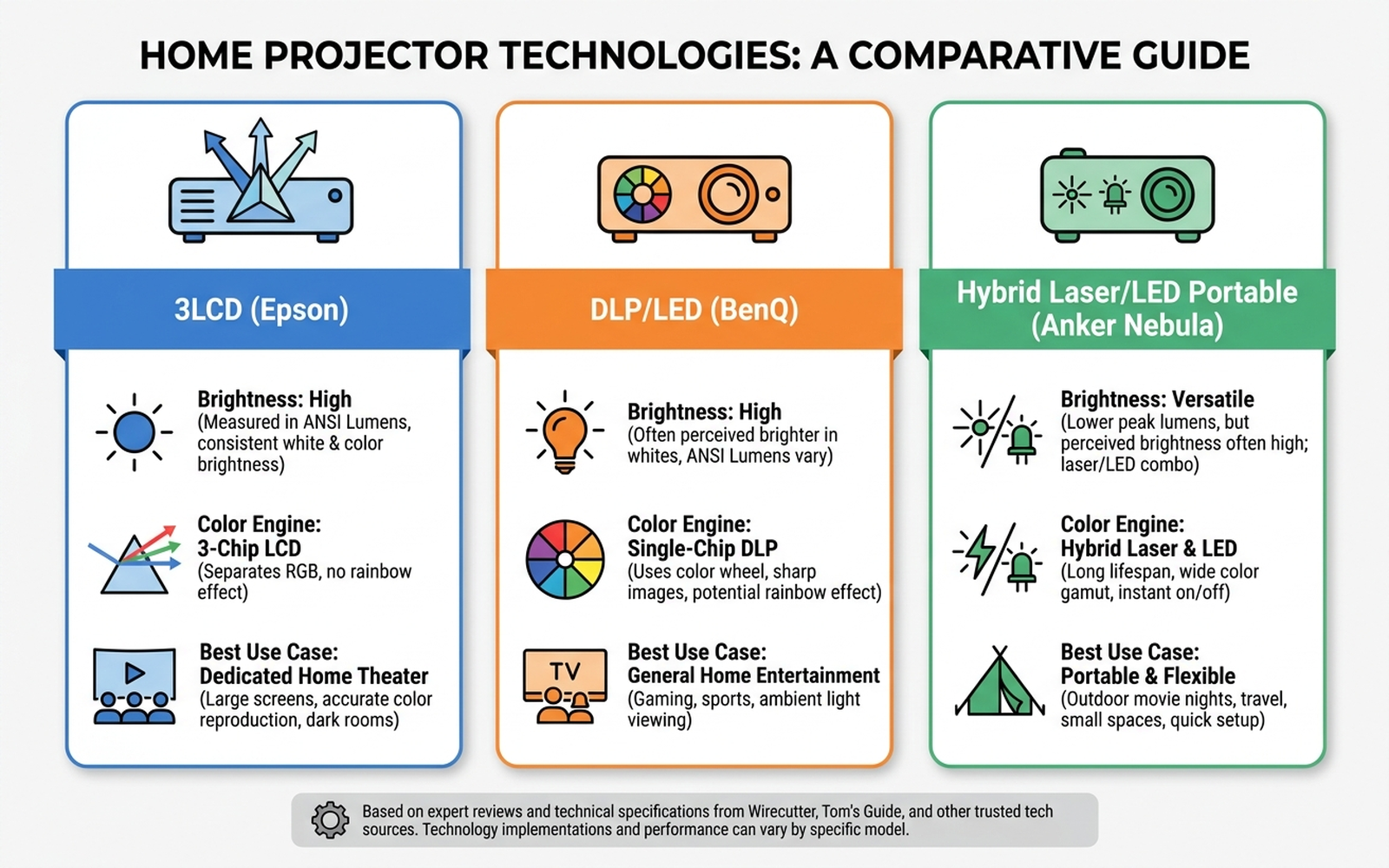
Consumer projectors split into a few core imaging and light-source designs, and the differences explain most of the price, image-quality, and portability gap between the three products compared here:
- 3-chip 3LCD — used in the Epson Home Cinema 2350. Three separate LCD panels (red, green, blue) combine the color image, which avoids the brief color-separation artifact — sometimes called the “rainbow effect” — that some viewers notice on single-chip DLP projectors, particularly in high-contrast scenes. The tradeoff is typically a larger, heavier chassis built for a fixed installation rather than portability.
- Single-chip DLP with an LED light engine — used in the BenQ HT2060. A single DLP chip with millions of micro-mirrors reflects light through a color wheel or LED array. This design tends to produce sharper per-pixel detail and a more compact body than 3LCD at a similar price, and BenQ’s LED light source is rated for tens of thousands of hours, reducing the bulb-replacement costs associated with older lamp-based projectors.
- Hybrid laser/LED (HybridBeam) in a portable smart chassis — used in the Anker Nebula Cosmos 4K SE. Combining a laser and LED light source lets Anker claim higher brightness (1,800 ANSI lumens) in a body small enough to carry between rooms, with Google TV and auto keystone/focus correction built in. Independent reviewers (Digital Camera World, TechRadar) consistently note that the tradeoff for that portability and brightness is weaker black level and contrast in dark scenes compared with a dedicated home-theater projector like the Epson or BenQ.
Manufacturer Deep Dive
Epson Home Cinema 2350
The Home Cinema 2350 is Epson’s entry-level 4K PRO-UHD model in its streaming-focused Home Cinema line, rated at 2,800 lumens of both color and white brightness using 3-chip 3LCD technology, with built-in Android TV, HDR10/HLG support, low-latency gaming mode, and a 1.6x optical zoom with up to 60% vertical lens shift for flexible mounting. Independent test coverage from ProjectorCentral and TechGearLab credits the 3LCD design with consistent color accuracy and an absence of rainbow-effect artifacts, while flagging that even its 2,800-lumen rating isn’t enough to compete with ambient daylight — reviewers are consistent that this model needs a darkened room to look its best. As a long-throw design, it’s built for a fixed mounting position or table setup rather than moving between rooms.
BenQ HT2060
BenQ’s HT2060 is a 1080p (with 4K signal support) LED home theater projector rated at 2,300 ANSI lumens per BenQ’s official US spec sheet, with DCI-P3/Rec.709 wide color gamut coverage, an 8.3ms input-lag figure at 120Hz for gaming, vertical lens shift, and a 1.3x zoom lens. Tom’s Guide names it the top pick under $1,000 and “the smart entry point into home theater,” and RTINGS’ and TechGearLab’s lab testing both credit it with accurate out-of-box color that needs little to no calibration — a notable claim, since most projectors in this price tier ship with a visibly inaccurate default picture mode. The tradeoff independent reviewers consistently flag is dimness in any room with ambient light and the lack of native smart-TV apps, meaning most owners pair it with a separate streaming stick.
Anker Nebula Cosmos 4K SE
The Nebula Cosmos 4K SE is Anker’s portable 4K smart projector, using Anker’s HybridBeam laser/LED light engine rated at 1,800 ANSI lumens, with Google TV built in (including native 4K Netflix support without an external dongle) and an “Intelligent Setup” system that auto-adjusts focus, keystone, obstacle avoidance, and screen fit to the room. Per its Amazon US listing as of 2026-09-11, it carries roughly 4.3 out of 5 stars across approximately 476 ratings. Independent reviews from Digital Camera World and TechRadar are positive on out-of-box image quality, brightness, and built-in audio for a portable form factor, but consistently note that contrast and black-level performance lag behind dedicated home-theater projectors like the Epson or BenQ in darker scenes — the same tradeoff that generally separates all-in-one portable smart projectors from fixed-installation models.
How to Choose: Matching Throw Distance to Your Room
Projector shopping usually starts with a brightness or resolution spec, but the number that determines whether a projector will actually work in your room is throw distance — how far the lens needs to sit from the wall or screen to produce a given image size. A long-throw projector like the Epson needs several more feet of room depth than a short-throw or portable model to hit the same screen size, which rules it out for smaller rooms regardless of how good its image looks on paper.
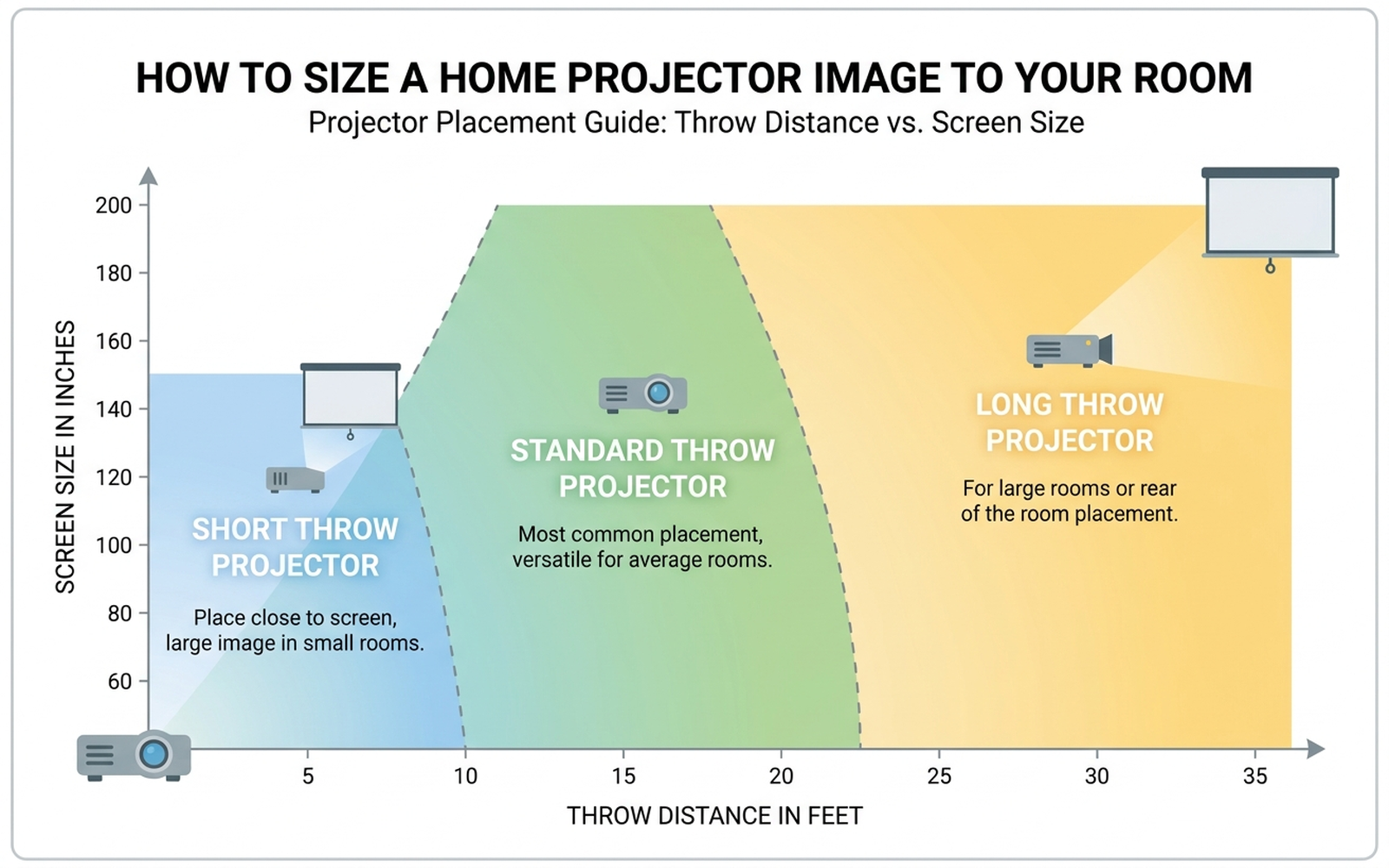
- Long-throw, fixed installation (Epson Home Cinema 2350): needs roughly 10–20+ feet of unobstructed room depth for a 100–120 inch image — best for a dedicated media room or a living room with a long sightline.
- Standard-throw, semi-permanent (BenQ HT2060): similar throw ratio to the Epson but a smaller, lighter chassis that’s easier to reposition between a shelf and a tripod.
- Portable, auto-adjusting (Anker Nebula Cosmos 4K SE): auto keystone and focus correction make it usable on a coffee table, patio, or bedroom shelf with minimal setup, at the cost of the Epson’s and BenQ’s larger maximum image size and contrast in a fixed dark room.
Comparison Table
Prices as of 2026-09-11 — Amazon frequently runs short-term discounts on all three brands; check the live listing before buying.
| Product | Brightness | Imaging Technology | Reviews (Amazon US) | Price |
|---|---|---|---|---|
| Epson Home Cinema 2350 | 2,800 lumens (color/white) | 3-chip 3LCD, 4K PRO-UHD | Established listing, broad review base | ~$1,299.99 |
| BenQ HT2060 | 2,300 ANSI lumens | Single-chip DLP, LED light source | Established listing, broad review base | ~$999.99 |
| Anker Nebula Cosmos 4K SE | 1,800 ANSI lumens | Hybrid laser/LED (HybridBeam) | ~476 ratings, ~4.3/5 avg. (as of 2026-09-11) | ~$899.99–$999.99 |
Decision Flowchart: What Matters Most to You?
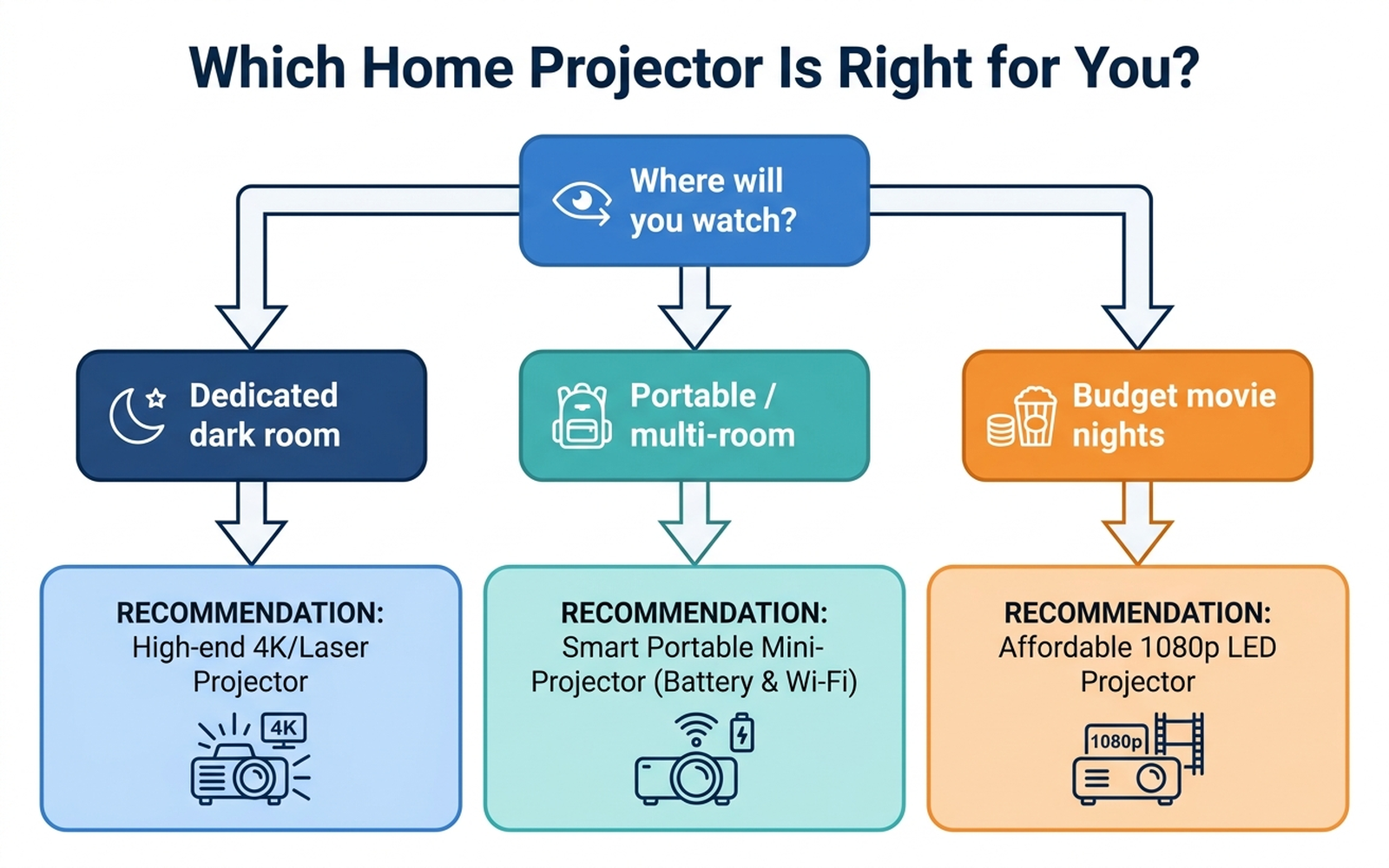
The fastest way through these three options is to start with where and how you’ll actually watch, not the spec sheet. A dedicated, darkened media room favors the Epson’s 3LCD color accuracy and larger max image size; a tighter budget with an otherwise similar fixed setup favors the BenQ; and a need to move the projector between rooms, or to skip buying a separate streaming device, favors the Nebula Cosmos 4K SE.
Warranty and Support
Epson backs the Home Cinema 2350 with a 2-year limited warranty and includes its Road Service program, which offers next-business-day replacement during the warranty period — a notable perk for a projector, where a bulb-and-lens-out-of-alignment issue otherwise means an owner is without a working unit for the repair window. BenQ’s HT2060 carries a standard 3-year limited warranty on the projector and a 1-year warranty on the LED light source. Anker covers the Nebula Cosmos 4K SE with its standard 1-year limited warranty, in line with Anker’s typical consumer-electronics coverage, and shorter than either the Epson’s or BenQ’s terms. None of these warranties typically cover physical damage from drops, which owner discussion threads flag as a meaningful risk specifically for the portable Nebula model given its intended use outside a fixed, protected mounting position.
Editorial Recommendation
- Best for a dedicated dark room: Epson Home Cinema 2350 — 3LCD color accuracy, the largest usable image size of the three, and Epson’s Road Service replacement program, for buyers with a fixed media room.
- Best budget pick: BenQ HT2060 — Tom’s Guide’s top pick under $1,000, with independently tested color accuracy that needs little calibration out of the box.
- Best for portability and all-in-one streaming: Anker Nebula Cosmos 4K SE — built-in Google TV and auto-setup for buyers who move the projector between rooms or want to skip a separate streaming stick, at the cost of contrast in dark scenes and a shorter warranty.
Limitations
This analysis relies on publicly available Amazon customer reviews, independent test coverage from RTINGS, Wirecutter, Tom’s Guide, TechGearLab, Digital Camera World, and TechRadar, and manufacturer-published specifications; we did not independently test brightness, contrast, or color accuracy under controlled conditions. Manufacturer-published figures (lumens ratings, light-source lifespan) are cited as manufacturer claims unless a cited third-party source explicitly verified them. The Anker Nebula Cosmos 4K SE’s review count reflects a smaller sample than the more established Epson and BenQ listings, which may make its aggregated rating less stable over time. Individual experience may vary based on room lighting, screen material, and viewing distance. Prices listed reflect Amazon US at the time of writing and change frequently, including short-term promotional discounts not reflected in the table above.
As an Amazon Associate, Arekore earns from qualifying purchases. The Amazon product links in this article include our affiliate tracking ID and may earn us a commission if you buy through them, at no additional cost to you. See our Links Policy for details on how we select products and how commissions do not influence our recommendations.
- Epson Home Cinema 2350 4K PRO-UHD Smart Streaming Projector
- BenQ HT2060 1080p HDR LED Home Theater Projector
- NEBULA Cosmos 4K SE Portable Projector
Visit Arekore to verify current pricing and availability on any product mentioned here before buying.