Best Portable Chargers in 2026: Anker vs. Mophie vs. Baseus
TL;DR / Quick Verdict
- Best overall for everyday carry: Anker Nano Power Bank (10,000mAh, 30W) — a built-in USB-C cable and PowerIQ 3.0 fast charging that CNN Underscored and Men’s Journal both single out as a top pick for phone-only travel.
- Best for laptops and long trips: Mophie Powerstation Pro AC (27,000mAh) — the only model here with a built-in AC wall outlet, so it charges laptop chargers, CPAP machines, and other plug-in gear, not just USB devices.
- Best value per watt: Baseus Blade 100W (20,000mAh) — a 0.7-inch slim chassis with 100W USB-C output at a price that consistently undercuts Anker and Mophie’s laptop-capable tier.
Methodology
This analysis synthesizes (a) aggregated Amazon US customer reviews for current-generation Anker, Mophie, and Baseus power bank lines, (b) independent test coverage and hands-on reviews from CNN Underscored, Tom’s Guide, and Digital Camera World, and (c) manufacturer-published specifications for capacity, wattage, and charging speed. We did not personally test the products covered here. Amazon does not expose a precise, publicly verifiable review count per listing, so we do not report an exact aggregate sample size; capacity and wattage figures are cited as manufacturer claims unless a named third-party test independently confirmed them.
Technical Approach: Three Different Bets on Portable Power
Portable chargers solve the same core problem — carry battery capacity you can recharge devices from — but the three leading Amazon US brands have converged on different design priorities:
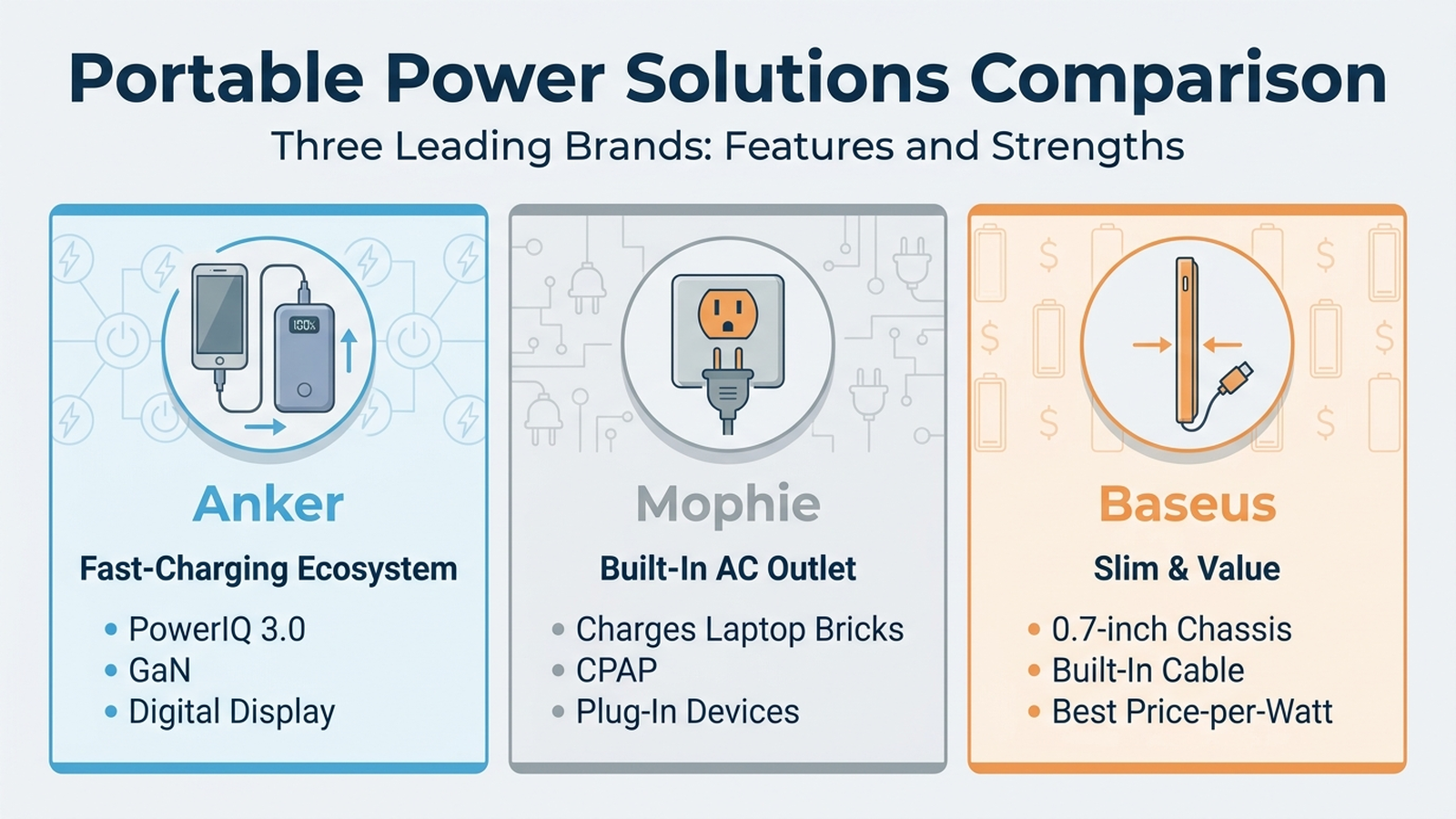
- Anker (ecosystem breadth and proprietary fast-charging silicon): Anker’s PowerIQ 3.0 and GaN-based charging circuitry aim to auto-detect and optimize output for whatever device is plugged in, across the widest span of the lineup — from pocket-sized 5,000mAh models to 200W laptop-capable bricks with a smart digital display showing remaining charge time. Anker’s scale (it is one of the best-selling power bank brands on Amazon US per aggregated sales-tracking data) also means the most third-party review coverage of any brand in this comparison.
- Mophie (Apple-ecosystem trust and a built-in AC outlet): Mophie built its reputation on official Apple-adjacent accessories, and its Powerstation lineup leans into that trust with MFi-relevant compatibility claims and a distinctive move for its top-tier Powerstation Pro AC model — an actual three-prong AC wall outlet built into the unit, not just USB-C and USB-A ports. That lets it recharge a laptop’s own wall charger, a CPAP machine, or any other plug-in device a USB-only power bank cannot touch.
- Baseus (slim form factor and aggressive price-per-watt): Baseus has built a value reputation on Amazon US around ultra-slim chassis design (its Blade line is roughly 0.7 inches thick despite 100W output) and built-in retractable cables that remove the “forgot my cable” failure mode. Baseus power banks consistently price 20–40% below comparable-spec Anker or Mophie models, per pricing trackers like camelcamelcamel — the tradeoff buyers weigh is a shorter brand track record and less independent lab testing than Anker.
Manufacturer Deep Dive
Anker
Anker’s relevant US lineup spans two tiers in this comparison. The Nano Power Bank (10,000mAh, 30W) targets everyday phone-and-earbuds carry: it has a built-in USB-C cable (no separate cable to lose), supports 30W bidirectional charging via USB-C Power Delivery, PPS, and PowerIQ 3.0, and Anker’s own spec claims roughly two full phone charges per cycle. CNN Underscored’s testing found it added over 50% charge to an iPhone 16 in 30 minutes. At the top tier, the Anker Prime Power Bank (20,000mAh, 200W) is built for laptop travel: a smart digital display shows remaining charge time down to the minute, three ports (two USB-C at up to 100W each, one USB-A at 65W) can charge a phone, tablet, and laptop simultaneously, and Anker markets it as TSA-approved for carry-on travel. Anker’s own spec claims the 200W output split can fast-charge a MacBook Pro and a phone at the same time; Digital Camera World’s review confirmed both USB-C ports can each output up to 100W simultaneously when the USB-A port is unused, but did not independently test that exact simultaneous-device scenario.
Mophie
Mophie’s US lineup includes the Powerstation Core (20,000mAh, 18W), positioned as its best-value capacity option — a straightforward multi-device USB-C/USB-A battery pack without the premium-tier extras. The line’s standout, though, is the Powerstation Pro AC (Gen 2, 27,000mAh), which pairs 100W of AC wall-outlet output with 60W USB-C fast charge and an integrated carry strap. Because the AC outlet behaves like a real wall socket, it charges any plug-in device — a MacBook’s own brick, a CPAP machine, a camera battery charger — that a USB-only power bank cannot power directly. Retail trackers like 9to5Toys have repeatedly discounted the Powerstation Pro AC from its roughly $200 list price to the $140–$150 range, which is where most Amazon buyers report purchasing it.
Baseus
Baseus’s relevant US lineup covers a compact tier and a laptop-capable tier. The Picogo (10,000mAh, 45W) is built around a built-in USB-C cable in one of the smallest 10,000mAh chassis on Amazon US per manufacturer dimensions, aimed at buyers who want Anker Nano-level portability at a lower price. The Blade (20,000mAh, 100W) is the laptop-capable option: a 0.7-inch-thick slab with two USB-C ports (up to 100W combined) and two USB-A ports, thin enough to slide into a laptop sleeve alongside the laptop itself. Baseus’s manufacturer claim is a MacBook Pro charged to 50% in 30 minutes via 100W USB-C PD — a figure we cite as a manufacturer specification, not an independently lab-verified result, since we found no third-party lab test isolating that exact claim.
How to Use: Watt-Hours, TSA Rules, and Airline Carry-On Limits
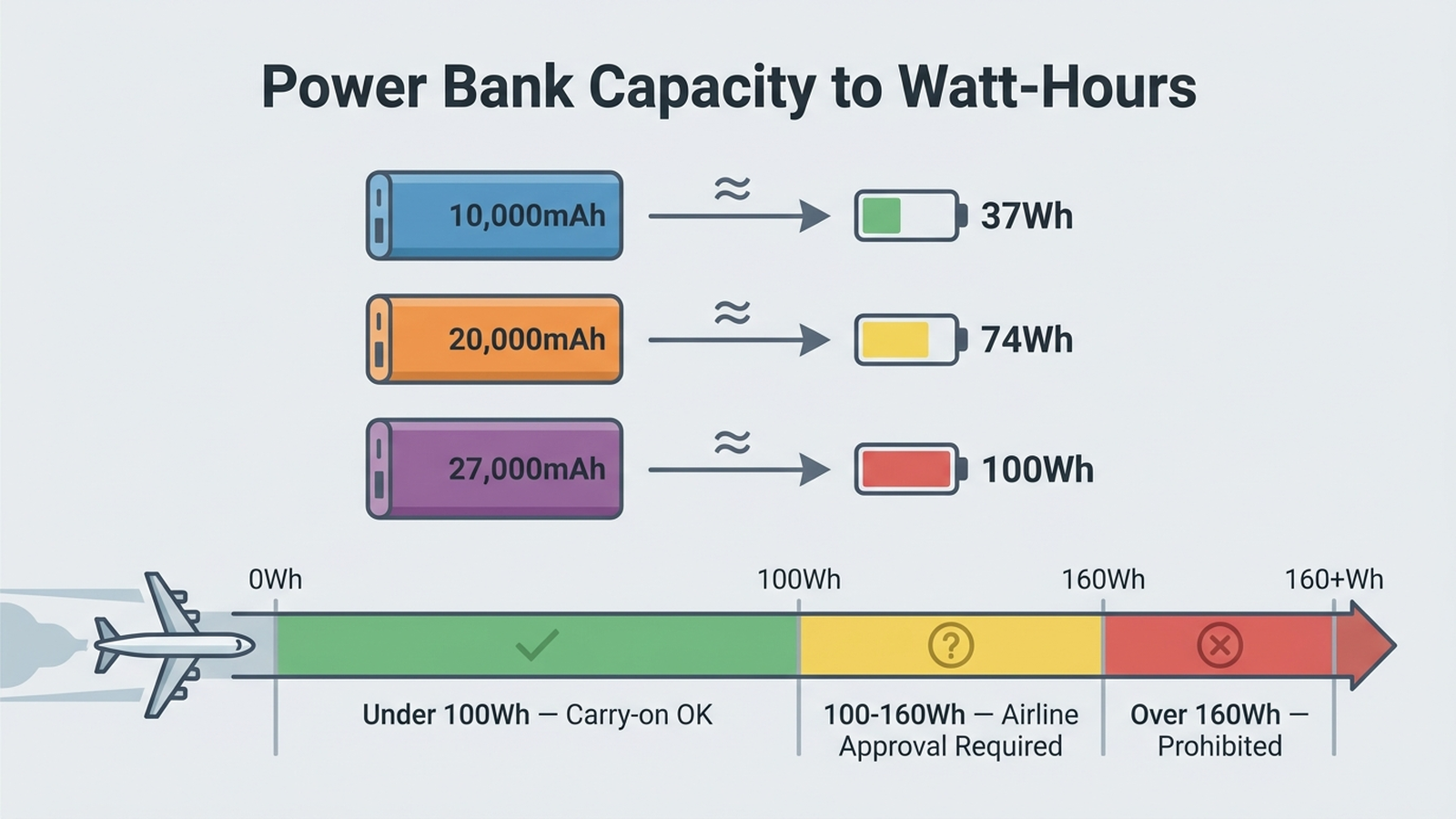
Every power bank on this list is a lithium-ion battery, which the TSA and FAA regulate by watt-hours (Wh), not milliamp-hours (mAh) — the number printed on most retail packaging. To estimate Wh from mAh, multiply capacity by the battery’s nominal voltage (usually 3.7V) and divide by 1,000: a 10,000mAh bank is roughly 37Wh, a 20,000mAh bank is roughly 74Wh, and a 27,000mAh bank is roughly 100Wh — right at the threshold.
- Under 100Wh (covers every model in this comparison up to the Mophie Powerstation Pro AC): allowed in carry-on baggage without airline approval, per current TSA and FAA guidance.
- 100–160Wh: allowed in carry-on only with airline approval — check before flying if you’re considering a higher-capacity model than the ones covered here.
- Over 160Wh: prohibited on passenger aircraft entirely.
- Always carry-on, never checked luggage — this applies to every power bank regardless of capacity.
- As of May 2026, several major US carriers (American, Delta, Southwest) added stricter in-flight rules on top of the TSA baseline: chargers must stay within reach (not in the overhead bin) and, on some airlines, cannot be used to recharge devices during the flight itself. Check your specific airline’s current policy before a trip, since these rules have changed more than once in 2026.
Comparison Table
Prices as of 2026-09-23 — Amazon frequently discounts power banks during sales events; check the live listing before buying.
| Product | Capacity | Max Output | Best For | Price |
|---|---|---|---|---|
| Anker Nano Power Bank | 10,000mAh (~37Wh) | 30W | Everyday phone/earbuds carry | ~$49.99 |
| Anker Prime Power Bank | 20,000mAh (~74Wh) | 200W | Laptop + phone travel, digital display | ~$99.99 |
| Mophie Powerstation Core | 20,000mAh (~74Wh) | 18W | Best-value multi-device capacity | ~$44.95 |
| Mophie Powerstation Pro AC (Gen 2) | 27,000mAh (~100Wh) | 100W (AC) + 60W (USB-C) | Plug-in devices via built-in AC outlet | ~$149.96 |
| Baseus Picogo | 10,000mAh (~37Wh) | 45W | Ultra-compact everyday carry | ~$39.99 |
| Baseus Blade 100W | 20,000mAh (~74Wh) | 100W | Slim laptop-capable, best price-per-watt | ~$49.99 |
Decision Flowchart: Price vs. Purpose
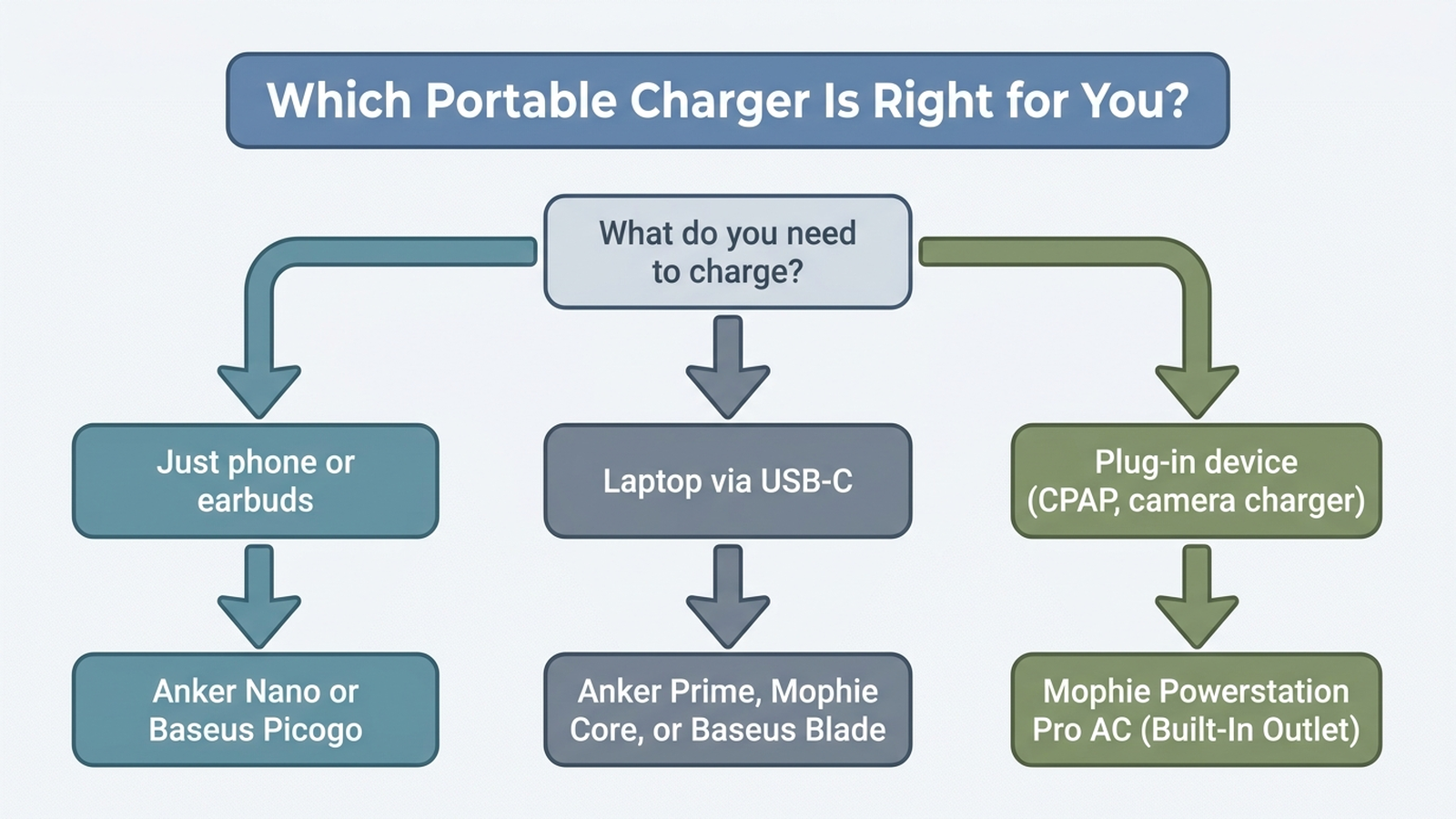
For a quick path through the six models above: start with what you’re charging. If it’s just a phone and earbuds, the Anker Nano or Baseus Picogo cover that at the lowest weight and price. If you need to charge a laptop on the go, the Anker Prime, Mophie Powerstation Core, or Baseus Blade all handle USB-C laptop charging — Baseus wins on price-per-watt, Anker wins on the digital display and charge-time readout. If you need to power something that only accepts a wall plug — a laptop’s own AC brick, a CPAP machine, a camera battery charger — the Mophie Powerstation Pro AC is the only model here that can do it directly, without a separate inverter.
Warranty and Support
Anker publishes an 18-month limited warranty on its power bank lineup (extendable to 24 months with product registration on some models, per manufacturer terms). Mophie publishes a 1-year limited warranty across its Powerstation line. Baseus publishes an 18-month limited warranty on most current US listings, though warranty terms vary by specific model and are worth confirming on the product listing before buying. None of the three brands’ warranties cover normal battery capacity degradation over charge cycles, physical damage, or water damage — all lithium-ion batteries lose capacity over hundreds of charge cycles regardless of brand.
Editorial Recommendation
- Best for most people: Anker Nano Power Bank — a built-in cable, broad device compatibility, and the deepest third-party review coverage of any model here for buyers who just need reliable everyday phone charging.
- Best for laptop travelers: Anker Prime Power Bank — 200W output and a digital charge-time display for buyers who regularly need to top off a laptop and phone at the same time.
- Best for plug-in devices on the go: Mophie Powerstation Pro AC — the only model with a true AC outlet, worth the premium for CPAP users, photographers with plug-in chargers, or anyone who needs to power something that isn’t USB.
- Best value: Baseus Blade 100W — laptop-capable output at a price that typically undercuts comparable Anker or Mophie models by 20–40%.
Limitations
This analysis relies on publicly available reviews, manufacturer specifications, and third-party test coverage from CNN Underscored, Tom’s Guide, and Digital Camera World; we did not independently test charging speed, real-world capacity retention, or cycle-life degradation under controlled conditions. Manufacturer-published figures (wattage, charge-time estimates, “X% in Y minutes” claims) are cited as manufacturer claims, not independently verified facts, unless a cited third-party test explicitly confirmed them. Watt-hour figures in this article are estimated from published mAh capacity using a standard 3.7V nominal lithium-ion voltage; actual Wh printed on a specific unit’s label can differ slightly and is the number airline staff will check, not the mAh figure on the box. Individual experience may vary based on device compatibility, cable quality, ambient temperature, and how many charge cycles a unit has already been through. Prices listed reflect Amazon US at the time of writing and change frequently, including short-term promotional discounts not reflected in the table above.
As an Amazon Associate, Arekore earns from qualifying purchases. The Amazon product links in this article include our affiliate tracking ID and may earn us a commission if you buy through them, at no additional cost to you. See our Links Policy for details on how we select products and how commissions do not influence our recommendations.
- Anker Nano Power Bank (10,000mAh, 30W)
- Anker Prime Power Bank (20,000mAh, 200W)
- Mophie Powerstation Core (20,000mAh, 18W)
- Mophie Powerstation Pro AC, Gen 2 (27,000mAh)
- Baseus Picogo (10,000mAh, 45W)
- Baseus Blade 100W (20,000mAh)
Visit Arekore to verify current pricing and availability on any product mentioned here before buying.