Best Light Therapy Lamps for the Fall Time Change in 2026
TL;DR. Daylight Saving Time ends on November 1, 2026, and the abrupt loss of an hour of evening light is when light-therapy-lamp searches and sales spike every year. All four lamps below claim “10,000 lux,” but that number is only meaningful at a specific distance — the real differentiator between a $70 value pick (Verilux HappyLight Luxe) and a $120-140 flicker-free upgrade (Carex Day-Light Elite, Wirecutter’s current top pick) is how much of your face actually receives 10,000 lux once you sit at a normal desk distance.
A note on links and methodology
As an Amazon Associate, Arekore earns from qualifying purchases. The Amazon product links in this article include our affiliate tracking ID and may earn us a commission if you buy through them, at no additional cost to you. See our Links Policy for details on how we select products and how commissions do not influence our recommendations.
We also did not personally test these products — every claim is an editorial synthesis of public data. The Methodology section below explains exactly which data we used.
Methodology
This article is an editorial analysis based on publicly available data collected in September 2026. We synthesized four categories of source:
- Customer reviews on amazon.com — we read the “Top reviews,” “Most recent reviews,” and the AI “Customers say” summary block on each ASIN’s product page to identify recurring positive and negative themes. We do not report a precise sample size N because Amazon’s review panels do not expose a stable count; reporting a fake precise N would be misleading.
- Independent editorial and lab tests — Wirecutter’s 2026 light-therapy-lamp guide (which names the Carex Day-Light line its top picks after testing multiple lamps), and Reviewed’s (USA Today) hands-on test of the Verilux HappyLight Luxe, which measured brightness levels, dimensions, and timer function directly.
- Manufacturer specifications — official lux-at-distance figures published by Carex, Verilux, and Circadian Optics.
- Clinical and market data — the Mayo Clinic’s light-box guidance for seasonal affective disorder, NIMH’s overview of seasonal affective disorder, and light-therapy-device market-size figures from industry research firms.
We deliberately do not simulate first-person product experience, fabricate reviewer personas, or invent precise data points we cannot verify. Recommendations are editorial opinions formed from the synthesis above. Nothing in this article is medical advice — see a doctor before starting light therapy, especially if you have bipolar disorder, an eye condition, or take a photosensitizing medication (Mayo Clinic’s guidance flags all three as reasons to consult a doctor first).
0. Why this category spikes every year on November 1
Daylight Saving Time ends at 2:00 a.m. on Sunday, November 1, 2026, when clocks fall back an hour. The effect isn’t just an extra hour of sleep once — sunset shifts roughly an hour earlier overnight, and for most of the US it keeps creeping earlier through December, so a 5:30 p.m. sunset becomes a 4:30 p.m. sunset almost overnight. That abrupt shift, not the temperature, is what drives light-therapy-lamp interest into a seasonal spike each fall.
Seasonal affective disorder (SAD) affects about 5% of US adults in a given year, per NIMH, with a much larger share experiencing a milder “subsyndromal” version — a 2021 BMC Psychiatry study of higher-education and vocational students (N=324) found 12.7% met criteria for SAD and another 29% showed subsyndromal symptoms. Prevalence rises with latitude, which is why the category sells disproportionately well in the northern half of the US. Estimates of the SAD-specific light-therapy-device market vary widely by research firm and scope — from roughly USD 300 million to well over USD 1 billion depending on how narrowly “SAD-specific” is defined — so we cite this only as directional evidence of a small but durable category with steady fall demand, not a precise figure.
1. The number that actually matters: lux at your real sitting distance
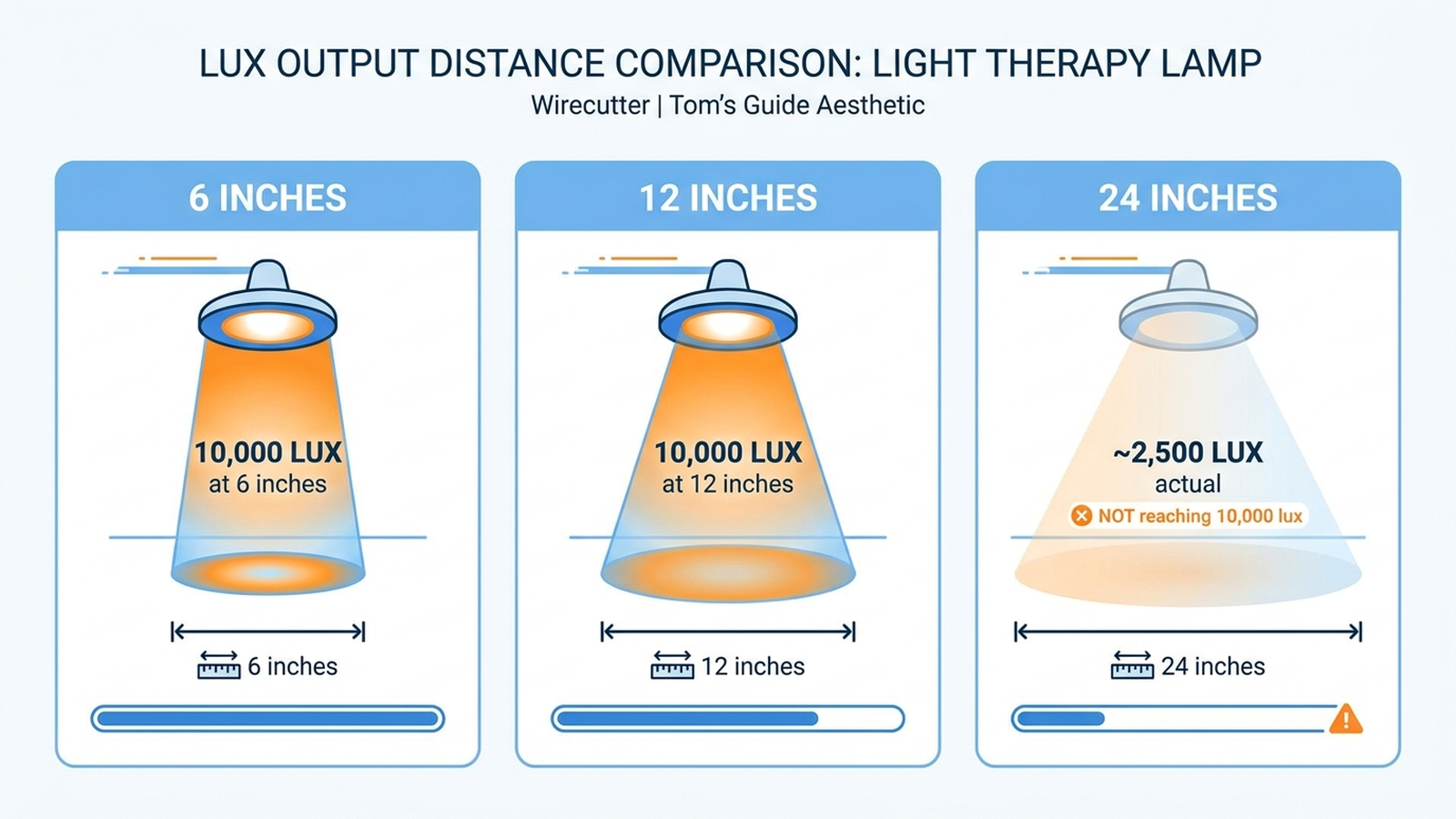
Every lamp in this article advertises “10,000 lux.” That figure is close to meaningless on its own, because lux drops sharply with distance — light intensity follows an inverse-square relationship, so doubling the distance from the lamp cuts effective brightness to roughly a quarter. A lamp that hits 10,000 lux only when your face is 6 inches away is a fundamentally different product from one that hits 10,000 lux at 12 or even 16-24 inches, which is the range the Mayo Clinic actually recommends for comfortable daily use.
| Approach | How it’s measured | What it means for you | Represented by |
|---|---|---|---|
| 10,000 lux at ~12 inches | Manufacturer states the distance at which the panel reaches full rated brightness | The realistic “sit at a desk” distance most people actually use | Carex Day-Light Classic Plus, Carex Day-Light Elite |
| 10,000 lux at ~6 inches, adjustable down | Panel reaches 10,000 lux very close, with lower presets (2,500-7,000 lux) at greater distances | More flexible for people who want lower intensity or shorter close-range sessions | Verilux HappyLight Luxe |
| 10,000 lux, distance not independently verified | Manufacturer states peak lux without publishing a tested distance curve | Treat the headline number as a ceiling, not a guarantee at your actual sitting distance | Circadian Optics Lumos |
Practically: if a lamp only reaches its rated lux within 6 inches of your face, you either sit uncomfortably close for the full 20-30 minute session, or you get meaningfully less than 10,000 lux at a normal desk distance. This is the single most useful thing to check on any lamp’s spec sheet before buying — more useful than the peak lux number itself.
2. Quick comparison table (2026)
Prices as of 2026-09-11. Confirm current pricing on the linked product page before purchase.
| Product | Price (USD) | Rated lux / distance | Design | Best for |
|---|---|---|---|---|
| Carex Day-Light Classic Plus | ~$109.99 | 10,000 lux at 12 in | Large tilting panel, tabletop | The long-running mainstream pick most doctors and pharmacies have stocked for years |
| Carex Day-Light Elite | ~$120-142 | 10,000 lux at 12 in | Downward-angled, flicker-free panel | Wirecutter’s current top pick; best for daily desk use |
| Verilux HappyLight Luxe | ~$69.99 | 2,500-10,000 lux, adjustable | Compact, portable, USB-C | Best budget entry point; Reviewed’s (USA Today) Editors’ Choice |
| Circadian Optics Lumos | ~$45-50 | 10,000 lux (distance not independently published) | Slim, design-forward panel | Shoppers who want a lamp that looks like a desk accessory, not a medical device |
3. Carex Day-Light Classic Plus: the mainstream pick with the longest track record
The Day-Light Classic Plus is Carex’s original workhorse — a large, tiltable panel that’s been recommended by outlets like Good Housekeeping and stocked by pharmacies for years. It’s rated at 10,000 lux at 12 inches, with an angled stand that lets you position it above eye level (the Mayo Clinic notes that most modern light boxes are positioned slightly above eye level, not shone directly into the eyes).
What customer reviews tend to praise:
- Large panel size, which makes it easier to get consistent light exposure even if you shift position slightly during a session
- Long product history — many reviewers mention using a previous-generation Carex lamp for years before buying a replacement
- Simple, no-frills interface (on/off, tilt adjustment) with fewer parts to fail than app-connected competitors
Where reviews push back:
- Size and desk footprint. The large panel takes up more desk space than compact alternatives, a common complaint from small-apartment or shared-desk users.
- No brightness or color adjustment. Unlike the Verilux HappyLight Luxe, the Classic Plus is essentially one brightness level — reviewers who want a dimmer option for sensitive eyes should look elsewhere.
Best for: a dedicated spot on a home desk where the lamp stays in one place, and you want the mainstream, most-tested option rather than the newest design.
4. Carex Day-Light Elite: Wirecutter’s top pick, built around a flicker-free downward angle
The Day-Light Elite is Carex’s newer flagship, and Wirecutter names it their current top pick after testing it against several competitors. Its distinguishing feature is a flicker-free LED panel angled downward, designed to more closely replicate how natural light falls from above rather than shining straight into your eyes from desk height. Carex markets it as reaching 10,000 lux at 12 inches, and an independent lab test by Optimize Your Biology measured it at roughly 12,400 lux at its closest setting — a third-party measurement, not a figure Carex itself publishes.
What customer reviews tend to praise:
- Comfort during extended sessions, which reviewers attribute to the angled, flicker-free design reducing eye strain compared to older flat-panel lamps
- Build quality and stand adjustability
- Effectiveness reported anecdotally for energy and mood during the darkest months
Where reviews push back:
- Price. At roughly $120-142 list, it’s the most expensive lamp in this comparison, and price-sensitive reviewers frequently mention comparing it to the cheaper Classic Plus before deciding whether the flicker-free upgrade is worth it.
- Size. Like the Classic Plus, it’s not a compact travel lamp.
Best for: anyone using a light box daily for the full fall-through-winter season who wants the most comfortable, most-reviewed premium option and is willing to pay for it.
5. Verilux HappyLight Luxe: the budget pick with the most flexibility
The HappyLight Luxe is Verilux’s mid-tier model and the lamp Reviewed (USA Today) gave an Editors’ Choice award after hands-on testing. In that test, Reviewed measured the unit at 11.7 x 7.5 inches, about 2 pounds, with four brightness levels (2,500 / 5,000 / 7,000 / 10,000 lux) and three color temperatures (3,500K warm white, 4,250K medium white, 5,000K daylight), plus a timer adjustable up to 60 minutes in 5-minute increments. Reviewed’s tester wrote that during dark months she was “more than ready to crawl into bed at 5 p.m.” before testing the lamp, and afterward felt “more grounded” and “ready for another portion of the day” — reported here as Reviewed’s own editorial account, not our claim.
What customer reviews tend to praise:
- Adjustable brightness and color temperature, which reviewers with light sensitivity cite as the reason they chose it over a single-brightness lamp
- Portability — small enough to move between a home office and a bedroom nightstand
- Manufacturer’s flicker-free claim, which multiple independent reviewers corroborate (“the light was bright and did not flicker,” per aggregated review sentiment)
Where reviews push back:
- Proprietary USB-C cable concerns. Some reviewers note the charging cable isn’t a universal fit and question brightness levels once you sit farther than about 6 inches away.
- A minority report agitation, even on low settings — a reminder that light-therapy tolerance varies by individual, which is part of why the Mayo Clinic recommends starting with shorter sessions.
Best for: first-time buyers who aren’t sure light therapy will work for them and want the lowest-cost way to try it, plus anyone who wants adjustable color temperature.
6. Circadian Optics Lumos: the design-forward compact pick
The Lumos is Circadian Optics’ original Shark Tank-featured model — a slim, rectangular panel built to look like a modern desk accessory rather than a medical device. It’s rated at 10,000 lux and marketed as UV-free and full-spectrum, but unlike Carex’s lamps, Circadian Optics does not publish an independently tested lux-at-distance curve as prominently, so we treat the 10,000-lux figure as a ceiling rather than a distance-verified guarantee.
What customer reviews tend to praise:
- Compact, low-profile design that fits into small desks and doesn’t look out of place next to a laptop
- Lower price point relative to the Carex lamps
- Simple one-button operation
Where reviews push back:
- Panel size. The smaller panel means less margin for error in positioning — sit slightly off-axis and effective brightness drops more noticeably than with the Carex lamps’ larger panels.
- Less independent lab verification than the Carex or Verilux lines in our source review, which is why we rank it as the pick for design preference rather than the pick for maximum verified brightness.
Best for: shoppers who want the smallest, most aesthetically minimal lamp on a crowded desk and are comfortable with a slightly less independently verified brightness spec.
7. Using a light therapy lamp safely and effectively
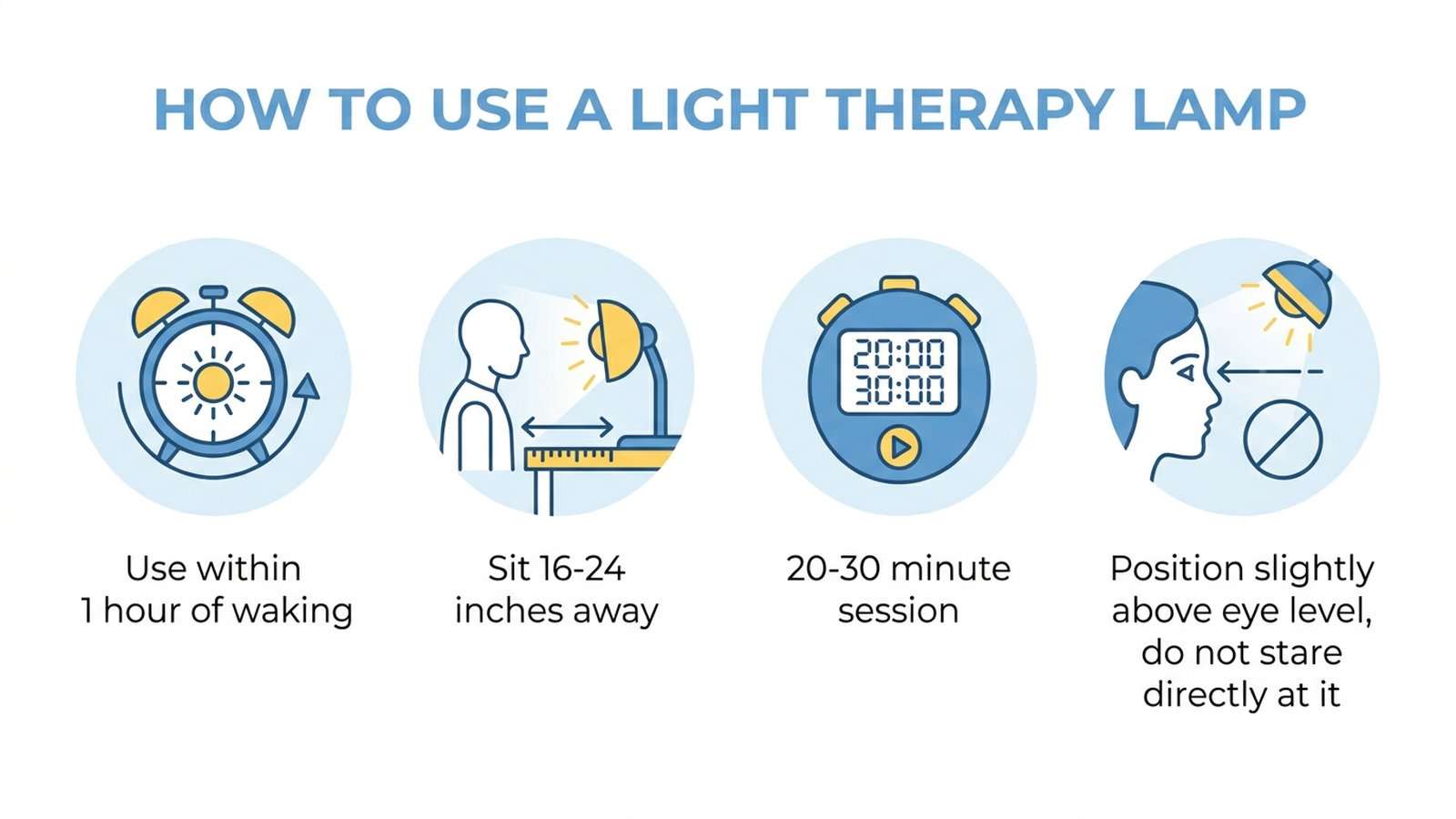
The Mayo Clinic’s guidance applies across all four lamps in this comparison:
- Time it for early morning, ideally within the first hour of waking — light therapy is most effective when it mimics a natural sunrise, and using it in the evening can disrupt sleep.
- Sit roughly 16-24 inches away from a 10,000-lux box for most people, though the exact distance depends on the specific lamp’s tested lux-at-distance curve (see Section 1).
- Use it for about 20-30 minutes per session, positioned slightly above eye level — don’t stare directly into the light; you should be able to read, eat breakfast, or work while it’s on beside you.
- Confirm the lamp is UV-filtered. All four lamps in this comparison market themselves as UV-free LED, which is standard for modern light-therapy panels, but it’s worth confirming on any lamp before buying.
- Talk to a doctor first if you have bipolar disorder, an eye condition, or take a medication that increases light sensitivity — the Mayo Clinic specifically flags these as reasons light therapy needs medical supervision.
8. The “which one for whom” flowchart
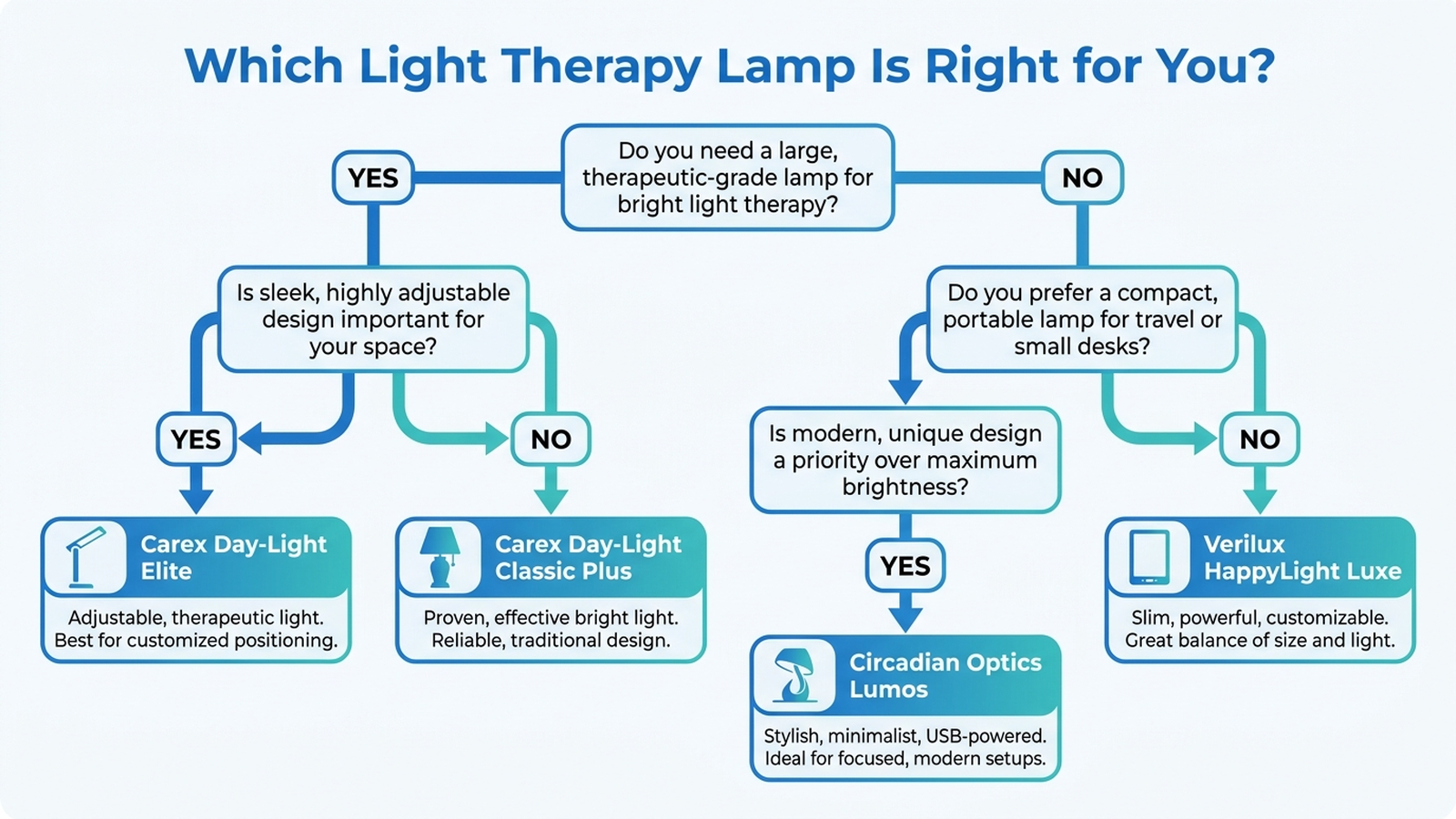
If you’re still deciding, this is the decision tree we’d use:
| Question | Answer | Pick |
|---|---|---|
| Do you want the most-reviewed, longest-track-record mainstream lamp for a dedicated desk spot? | Yes | Carex Day-Light Classic Plus (B00PCN4UVU) |
| Will you use it daily all season and want the most comfortable, flicker-free premium option? | Yes | Carex Day-Light Elite (B0DGH3M35W) |
| Are you trying light therapy for the first time, or need something portable with adjustable brightness/color? | Yes | Verilux HappyLight Luxe (B07TBCFL6B) |
| Do you want the smallest, most design-forward lamp for a crowded desk? | Yes | Circadian Optics Lumos (B01IU9MMPI) |
| Are you looking for a treatment for diagnosed clinical depression rather than seasonal mood dips? | Yes | None of the above — light therapy is a well-studied complementary tool for SAD specifically; talk to a doctor about a full treatment plan |
9. Warranty and after-sales support
| Brand | Manufacturer warranty | Notes |
|---|---|---|
| Carex | 1 year (typical for Carex Health Brands products) | Carex has sold medical and wellness devices in the US for decades; parts and support are handled through Carex directly. |
| Verilux | 1 year | Verilux specializes in light-therapy devices specifically, with a support line focused on that category. |
| Circadian Optics | 1 year (varies by retailer) | A newer brand (Shark Tank-era) with less long-term reliability history in aggregated reviews than Carex or Verilux. |
Warranty length is uniform across this category at a year, so it’s a weaker differentiator here than the lux-at-distance spec covered in Section 1.
10. The bottom line
There is no single “best light therapy lamp” for everyone. The right pick depends on your budget, how often you’ll use it, and whether portability matters:
| Best for | Pick | Approx price | Key data point |
|---|---|---|---|
| Mainstream, most-tested track record | Carex Day-Light Classic Plus | ~$109.99 | 10,000 lux at 12 in, long history with doctors/pharmacies |
| Daily premium use | Carex Day-Light Elite | ~$120-142 | Wirecutter’s current top pick, flicker-free downward-angled panel |
| First-timers and budget | Verilux HappyLight Luxe | ~$69.99 | Reviewed (USA Today) Editors’ Choice, adjustable 2,500-10,000 lux |
| Compact desk aesthetics | Circadian Optics Lumos | ~$45-50 | Slim design-forward panel, Shark Tank origin |
If you’re on the fence between two products, weight the lux-at-distance spec (Section 1) over the headline lux number, and weight how consistently you’ll actually use it over any single feature — light therapy only works with daily use through the season, so the lamp you’ll actually sit in front of every morning beats the lamp with the highest spec sheet.
Limitations of this analysis
To be explicit about what this article does not establish:
- We did not personally test any of these products. Every claim is sourced from publicly available customer reviews, independent third-party publications (Wirecutter, Reviewed/USA Today), manufacturer specifications, and Mayo Clinic/NIMH clinical guidance.
- Sample size. We read top reviews and the AI-summary block on each ASIN’s amazon.com page in September 2026. We do not report a precise N because Amazon does not expose a stable review count for those panels; any specific number we wrote would be misleading.
- Manufacturer lux-at-distance claims are reported as manufacturer specifications, not independently re-measured by us, except where we explicitly cite Reviewed’s own hands-on measurements for the Verilux HappyLight Luxe.
- Market-size figures for the SAD-specific light-therapy-lamp segment vary enormously between third-party industry research firms (from roughly USD 300 million to over USD 1 billion, depending on scope); treat them as directional evidence of a durable category, not a precise number.
- This article is not medical advice. Light therapy is a well-studied complementary approach for seasonal affective disorder, but individual response varies, and anyone with bipolar disorder, an eye condition, or a photosensitizing medication should consult a doctor before starting.
- Pricing fluctuates with promotions and season — light-therapy-lamp prices in particular often shift as fall approaches; confirm current pricing before purchase.
- Long-term durability (3+ years) is harder to assess from public reviews; we relied on aggregated sentiment from older reviews where available, and note that Circadian Optics has a shorter track record than Carex or Verilux.