Best Juicers in 2026: Centrifugal vs Masticating

The juicer aisle splits into two camps that solve the same problem in opposite ways. Centrifugal machines shred produce against a spinning mesh basket at thousands of RPM and finish a glass of juice before the coffee maker does. Masticating (cold-press) machines crush and press produce through a slow-turning auger, taking several times longer but pulling more juice out of leafy greens and leaving less oxidized pulp behind. Neither approach is objectively “better” — they trade speed for yield and quiet for footprint — but the right pick depends heavily on what you’re actually juicing and how much counter time you’re willing to spend.
As an Amazon Associate, Arekore earns from qualifying purchases. The Amazon product links in this article include our affiliate tracking ID and may earn us a commission if you buy through them, at no additional cost to you. See our Links Policy for details on how we select products and how commissions do not influence our recommendations.
TL;DR
- Centrifugal juicers (Breville, Hamilton Beach) juice a pound of carrots in about 40 seconds; masticating juicers (Omega, Ninja NeverClog, Nama) take closer to two minutes but extract more juice from leafy greens and leave the result more stable before it oxidizes.
- Consumer Reports’ most recent juicer testing (updated July 2026) named the Hamilton Beach Big Mouth its top-value centrifugal pick and the Ninja NeverClog its top-value cold-press pick; Wirecutter and Tom’s Guide both named the compact Nama J3 their overall favorite.
- The North America juicer market is on pace for roughly $861.8 million in 2026, according to GM Insights, with masticating and cold-press models driving most of the category’s growth.
- If you mostly juice hard fruit and want juice in under a minute, a centrifugal machine is the simpler buy; if leafy greens, wheatgrass, or next-day storage matter to you, masticating is worth the extra time and counter space.
How We Reached These Conclusions (Methodology)
This is an editorial analysis, not a hands-on test; we did not personally buy or juice with the machines covered here. This guide synthesizes (a) third-party test results and ratings from Consumer Reports, Wirecutter, Tom’s Guide, and America’s Test Kitchen; (b) manufacturer-published specifications (RPM, wattage, feed-chute size, warranty terms), labeled as manufacturer claims where we could not independently verify them; (c) aggregated amazon.com customer-review sentiment on each model’s best-selling listing, sampled in November 2026; and (d) industry market-sizing data from GM Insights and Market Research Future. Prices are amazon.com figures at the time of writing and fluctuate; we note the date next to every price we cite.
Centrifugal vs. Masticating: The Technical Difference
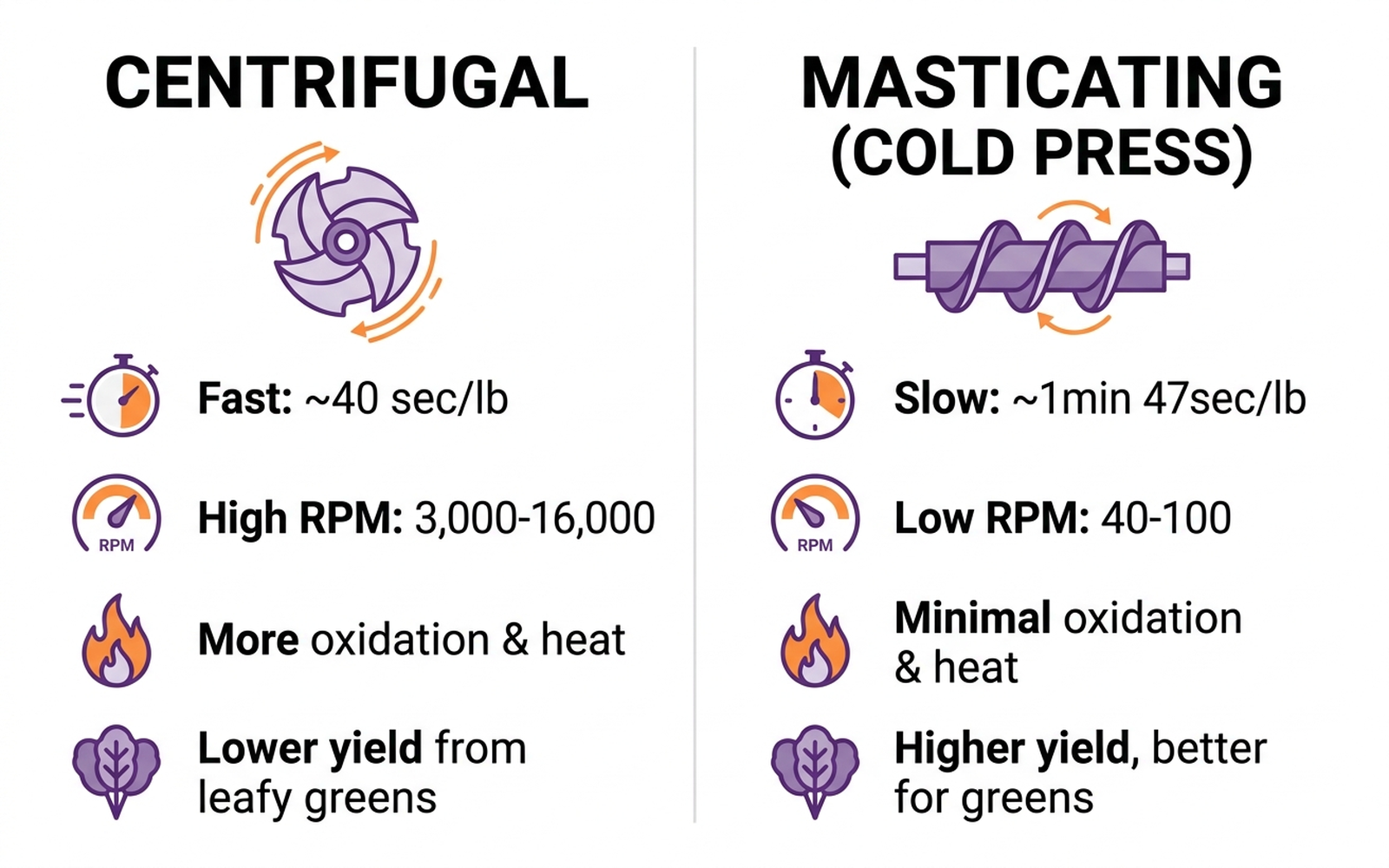
Centrifugal juicers spin a mesh-lined basket at roughly 3,000 to 16,000 RPM, using centrifugal force to fling juice out through the mesh while pulp collects against the basket wall. That speed is the whole appeal — review-outlet testing clocks centrifugal machines juicing a pound of carrots in about 39 seconds — but the same spinning motion whips air into the juice and generates friction heat, both of which speed up oxidation. Reviewers and juicer manufacturers commonly report that centrifugal juice is best consumed within a few hours, and that the machines struggle more with fibrous leafy greens like kale and spinach, leaving noticeably wetter pulp than they do with apples or carrots.
Masticating juicers use a single slow-turning auger (commonly 40 to 100 RPM) to crush and press produce, similar in principle to an old-fashioned press. Review-outlet timing puts a pound of carrots at closer to 1 minute 47 seconds through a masticating machine — more than double the centrifugal time — but the slower, lower-heat process leaves less air in the juice, which manufacturers and reviewers consistently cite as the reason cold-press juice keeps noticeably longer in the refrigerator than centrifugal juice, and why masticating machines handle leafy greens and wheatgrass with less wasted pulp. The trade-off is a narrower feed chute (most produce needs pre-cutting), a bigger footprint, and a higher price at every tier.
The Machines: One Brand at a Time
Breville Juice Fountain Plus JE98XL (Centrifugal)
Breville’s JE98XL has been one of Amazon’s best-selling centrifugal juicers for more than a decade, and Breville’s overall juicer lineup carries the highest combined review volume of any brand in the category on Amazon — a sign of how long it has held a default-pick position for shoppers who want speed over yield. It’s an 850-watt, dual-speed machine with a 3-inch feed chute wide enough for whole apples, and aggregated reviews consistently praise the juice yield and cleanup relative to other centrifugal machines in its price range. The most repeated lower-starred complaint in aggregated reviews is foam volume and pulpiness in the final juice, which is a structural trait of centrifugal extraction rather than a defect specific to this model.
Check the Breville Juice Fountain Plus JE98XL on Amazon
Hamilton Beach Big Mouth 67601A (Centrifugal)
Hamilton Beach’s Big Mouth line is the budget anchor of the centrifugal category, with over 330,000 aggregated reviews on its best-selling listing alone. Consumer Reports’ most recent juicer testing named the Big Mouth its top-value pick among centrifugal models. It’s an 800-watt machine with a 3-inch feed chute, and aggregated reviews describe it as fully assembled out of the box with dishwasher-safe parts — the recurring praise theme is ease of cleanup for a centrifugal machine, which is usually the category’s weak point. Hamilton Beach does not publish an RPM figure for this model, unlike Breville’s dual-speed spec sheet. The most common lower-starred complaint is motor longevity after a year or more of frequent, heavy use, which tracks with its position as a budget rather than a commercial-grade machine.
Check the Hamilton Beach Big Mouth Juicer on Amazon
Omega J8006HDS (Masticating)
Omega’s J8006HDS is a 200-watt, dual-stage masticating juicer that runs at 80 RPM and has held a top-selling position among masticating juicers on Amazon for years. Beyond juice, Omega markets it as a multi-purpose system for nut butter, baby food, and pasta extrusion using swappable attachments — a feature aggregated reviews frequently cite as the reason buyers choose it over single-purpose cold-press machines. The most repeated praise theme in aggregated reviews is yield from leafy greens and wheatgrass; the most common lower-starred complaint is the narrow feed chute, which requires pre-cutting most produce into smaller pieces than a centrifugal machine would need.
Check the Omega J8006HDS on Amazon
Ninja NeverClog JC151 (Cold Press)
Ninja’s NeverClog line is a newer entrant aimed at masticating-juicer shoppers who want less maintenance friction. Consumer Reports named the Ninja NeverClog its top-value pick among cold-press models in its most recent juicer ratings. As the name signals, Ninja’s patented auger design is built to resist the pulp clogs that are the most common complaint about masticating juicers generally, and aggregated reviews back that up — clog-related frustration shows up far less often here than on older masticating designs. The most repeated lower-starred complaint is pulp wetness on fibrous greens compared with higher-end masticating machines like the Omega.
Check the Ninja NeverClog Cold Press Juicer on Amazon
Nama J3 (Compact Cold Press)
Nama’s J3 is the newest machine in this comparison and the one both Wirecutter and Tom’s Guide picked as their overall favorite in recent testing, with Tom’s Guide calling it “the best juicer I’ve tried” for ease of use. It’s a compact, hands-free cold-press machine built for smaller kitchens — about 15.4 inches tall and under 10 pounds — carrying a 15-year warranty, among the longest in this category. Aggregated reviews consistently praise how little hands-on effort it requires compared with other masticating machines, and Nama’s manufacturer pricing lists it at $499, noticeably above the other machines in this comparison; confirm the current Amazon listing price before buying, since third-party marketplace pricing for this model fluctuates more than the brands sold directly by their manufacturers through Amazon.
Check the Nama J3 Cold Press Juicer on Amazon
How to Get the Most Out of Either Type
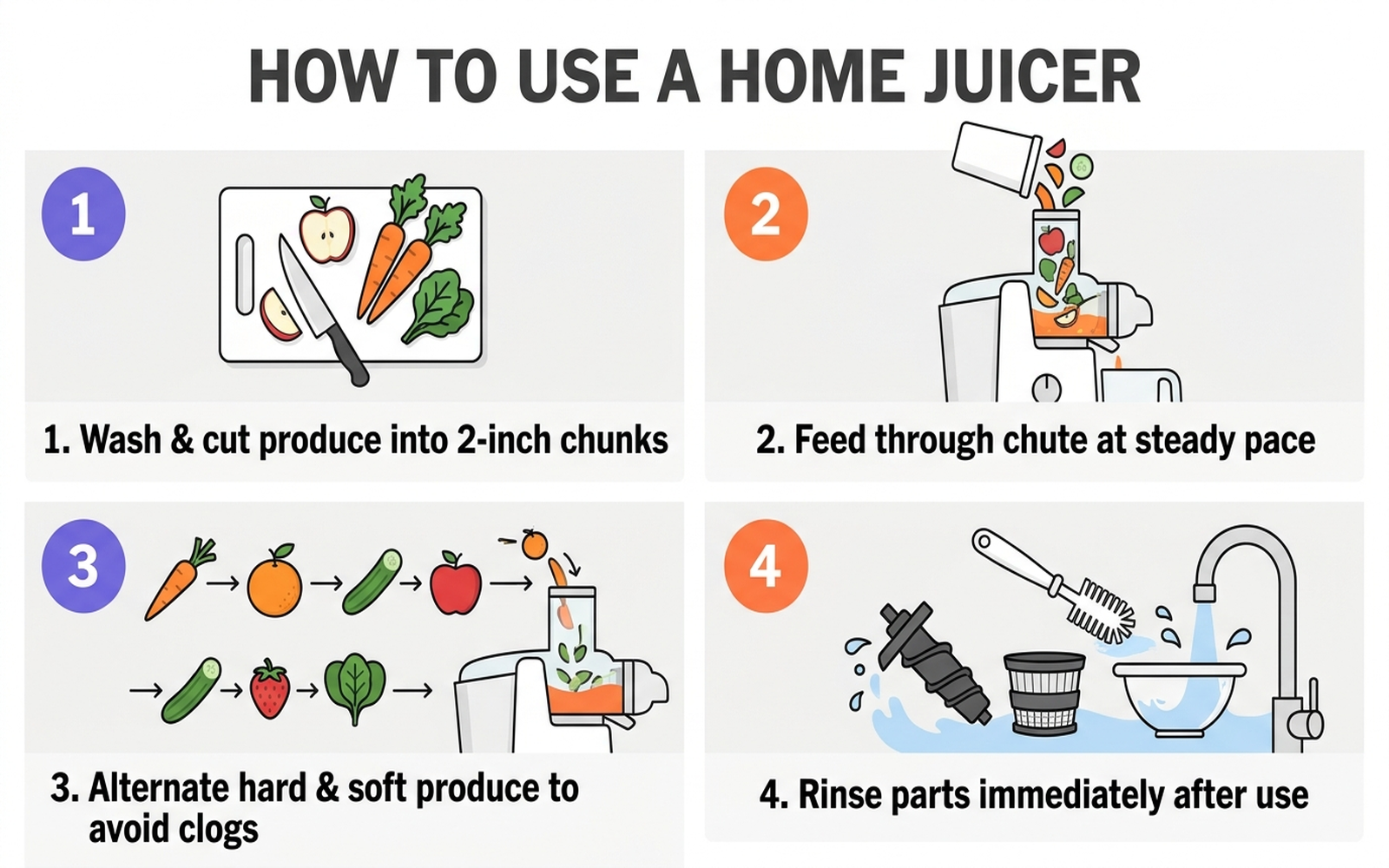
- Cut produce to fit the chute. Masticating machines in particular have narrower chutes than centrifugal ones; pre-cutting into roughly 2-inch pieces is the single biggest factor in avoiding clogs, regardless of brand.
- Alternate hard and soft produce. Feeding a hard item (carrot, apple) between soft or fibrous ones (spinach, celery) is a widely repeated tip in aggregated reviews for keeping masticating augers from clogging.
- Feed at a steady, unhurried pace. Forcing produce through faster than the machine is rated for is the most common cause of motor strain complaints on both juicer types.
- Rinse parts immediately after juicing. Pulp that dries on mesh baskets or auger screens is harder to remove later and is the top complaint driver behind “hard to clean” reviews on centrifugal machines specifically.
What Aggregated Reviews Say
Across the five machines compared here, a consistent pattern emerges in amazon.com customer reviews: centrifugal buyers prioritize speed and easy daily use and are most likely to complain about foam and short juice shelf life, while masticating buyers accept the longer prep and juicing time in exchange for higher yield from greens and juice that holds up better overnight. Cleanup satisfaction correlates more with chute width and part count than with juicer type — Hamilton Beach’s wide-mouth design and Ninja’s clog-resistant auger both draw outsized praise for ease of cleaning relative to their category peers, suggesting that “easy to clean” is now a differentiator brands compete on directly rather than an inherent trait of either juicing method.
Comparison Table
Prices are approximate amazon.com figures as of 2026-11-06 and fluctuate.
| Product | Type | ASIN | Approx. price | RPM | Best for |
|---|---|---|---|---|---|
| Breville Juice Fountain Plus JE98XL | Centrifugal | B003R28HWQ | ~$95–$150 | ~6,500–12,000 | Fastest daily juice, whole-fruit feed chute |
| Hamilton Beach Big Mouth 67601A | Centrifugal | B00E0IBKLQ | ~$65–$75 | Not published | Tightest budget, easiest cleanup for the type |
| Omega J8006HDS | Masticating | B07GWNHDXH | ~$210–$320 | 80 | Leafy greens, wheatgrass, multi-purpose attachments |
| Ninja NeverClog Cold Press JC151 | Cold press (masticating) | B0BR8HZL9V | ~$130–$150 | Low-speed auger | Masticating yield without the clogging hassle |
| Nama J3 | Compact cold press (masticating) | B0DZHTPNXM | ~$449–$499 | Low-speed auger | Small kitchens, hands-free operation, longest warranty |
Which Juicer Is Right for You?
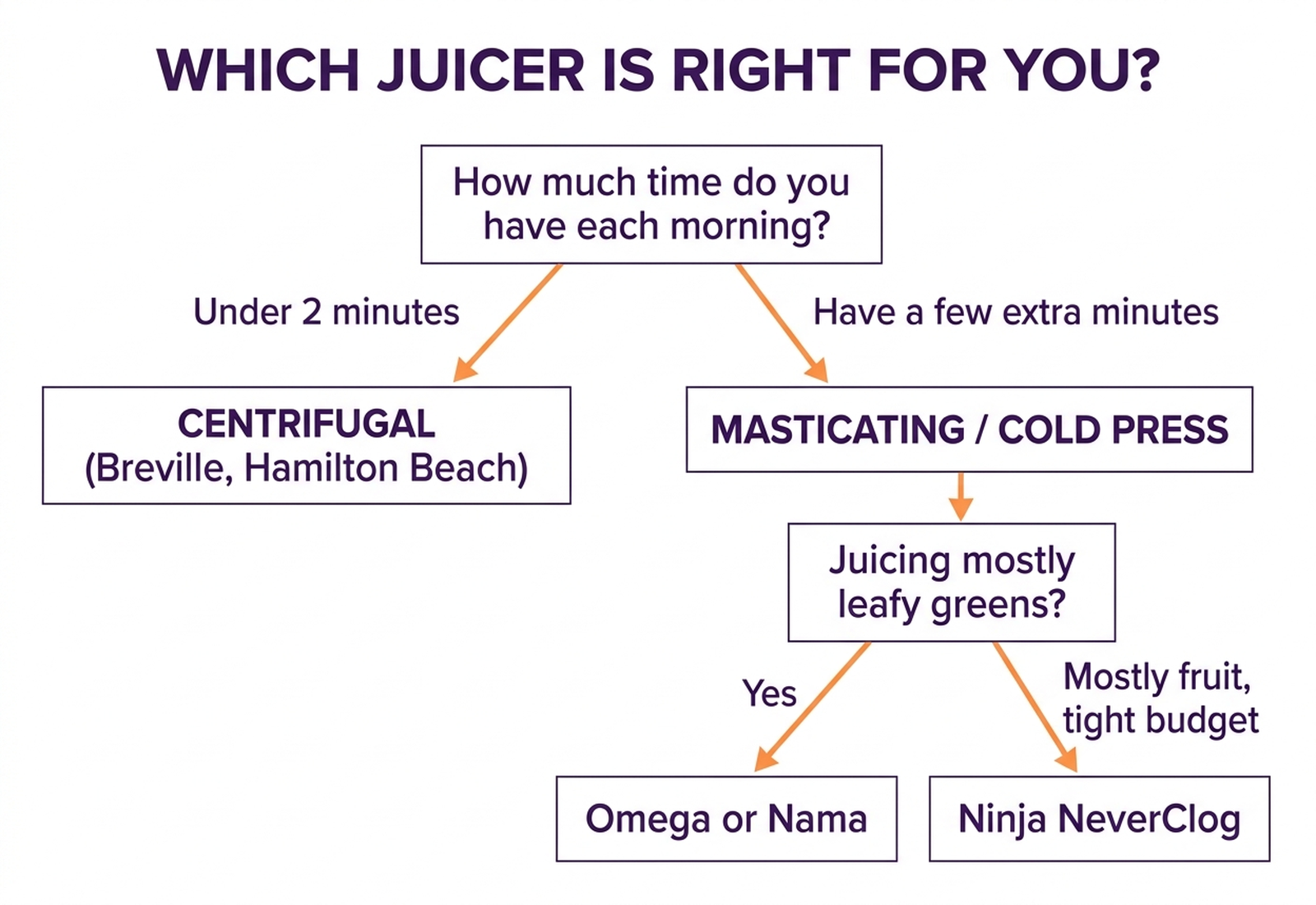
- Juicing mostly apples, oranges, or carrots and want juice in under a minute? A centrifugal machine (Breville or Hamilton Beach) matches your use case without paying for capability you won’t use.
- Juicing a lot of kale, spinach, or wheatgrass? Masticating is worth the extra prep and juicing time — the Omega J8006HDS is the established pick, and the Nama J3 is the easiest to use if counter space or hands-on effort is a concern.
- Want cold-press yield but worry about clogging and maintenance? The Ninja NeverClog is built specifically to reduce that friction at a lower price than Omega or Nama.
- Juicing daily for a household and batch-prepping juice ahead of time? Masticating juice’s slower oxidation makes same-day or next-day batching more practical than it is with a centrifugal machine.
Warranty Notes
- Breville backs the Juice Fountain Plus JE98XL with a standard 1-year limited warranty, typical for its price tier.
- Hamilton Beach publishes a 3-year limited warranty on the Big Mouth line.
- Omega backs the J8006HDS with a 15-year warranty on the motor, among the longest in the category and a common reason aggregated reviews cite for choosing it despite the higher upfront price.
- Ninja covers the NeverClog with a standard 1-year limited warranty.
- Nama backs the J3 with a 15-year warranty, matching Omega’s long-term coverage despite being the newer brand. Confirm current warranty terms on the manufacturer’s site or current Amazon listing before buying, since terms can change between model generations.
Recommendations
- If you want the simplest daily juice with the least cleanup time: the Hamilton Beach Big Mouth is the lowest-friction, lowest-cost entry point into centrifugal juicing.
- If you juice whole fruit often and want a slightly more capable centrifugal machine: the Breville Juice Fountain Plus’s wider chute and dual speed settings are worth the price step up from Hamilton Beach.
- If leafy greens are a regular part of your routine: the Omega J8006HDS has the longest track record and the most attachment flexibility of the masticating machines here.
- If you want cold-press yield without the reputation for clogging: the Ninja NeverClog is the most forgiving masticating machine to live with day to day.
- If kitchen space is tight and you want the least hands-on cold-press experience: the Nama J3 is the newest and most reviewer-praised option, at a real price premium.
Limitations
This analysis relies on third-party test results, manufacturer specifications, aggregated amazon.com review sentiment, and industry market-sizing data; we did not personally test any of the juicers covered here. Timing figures (seconds per pound) and nutrient/oxidation comparisons between juicer types come from review-outlet product testing rather than peer-reviewed food-science research, and individual results vary by produce type, ripeness, and how the machine is maintained. Prices and warranty terms shown are current as of the time of writing and are subject to change; confirm current terms on the product listing or manufacturer site before purchasing.
Bottom Line
Centrifugal and masticating juicers aren’t competing for the same buyer — they’re solving different problems. If your routine is a quick glass of juice before work, the speed of a Breville or Hamilton Beach is the right trade. If you’re juicing leafy greens regularly, batching juice ahead of time, or simply want the higher yield that comes with slower extraction, the Omega, Ninja NeverClog, or Nama J3 will do more with the same produce — you’re just paying for that in time, counter space, and upfront cost.
Before you buy, paste the product link into Arekore — our AI assistant checks review authenticity, surfaces what the one-star reviews actually complain about, and compares prices, free, in about five minutes.