Best Home Security Cameras in 2026: Ring vs. Arlo vs. Wyze
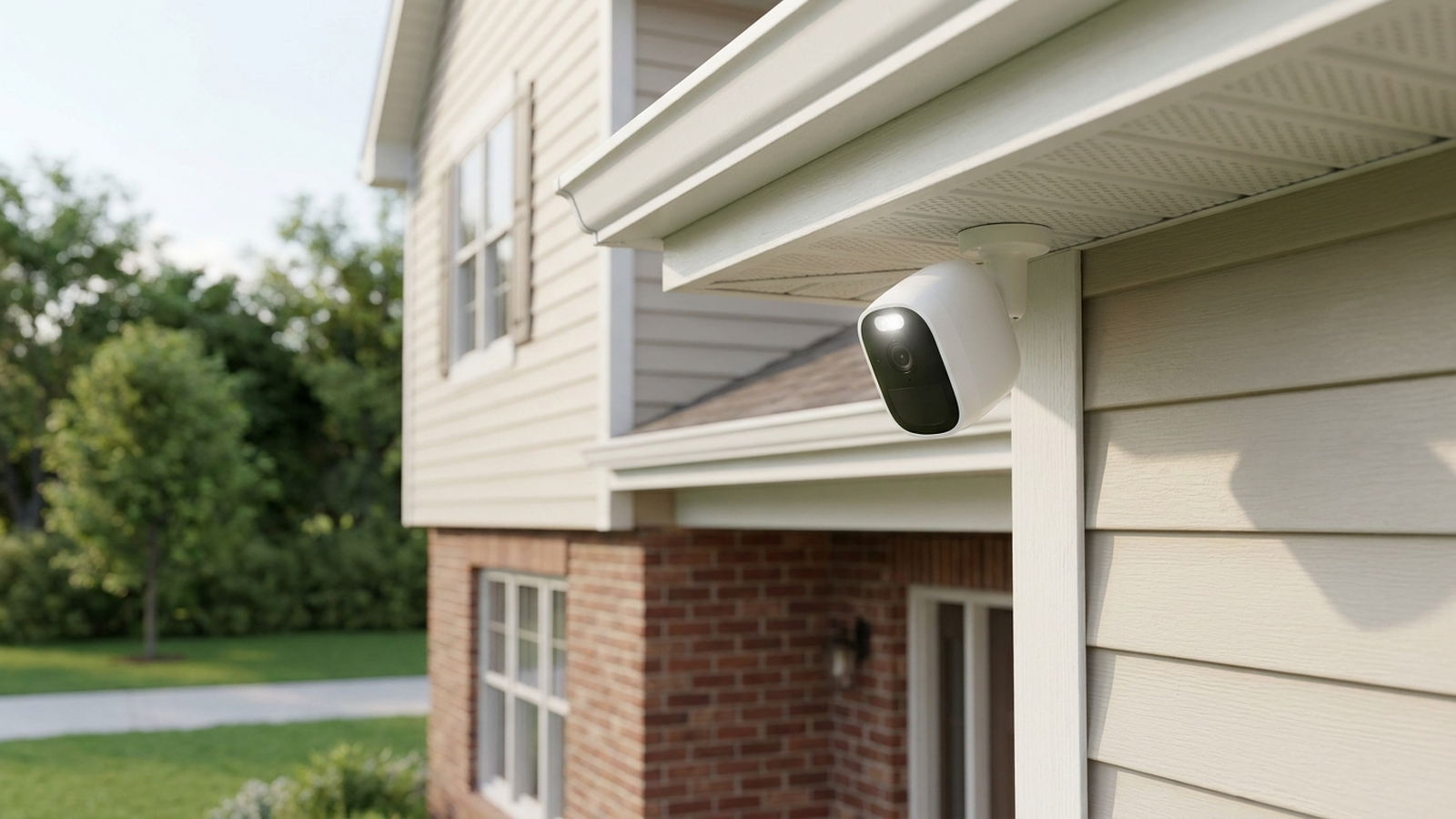
TL;DR / Quick Verdict
- Best overall ecosystem: Ring Stick Up Cam Battery — the widest accessory lineup and Alexa integration, but core features like person detection and video history are gated behind a Ring Protect subscription.
- Best video quality: Arlo Pro 5S — 2K HDR with a 160-degree field of view and color night vision, positioned by reviewers as the premium pick, at a premium subscription price.
- Best budget / lowest total cost: Wyze Battery Cam Pro — 2.5K HDR at roughly half the price of the other two, with a much cheaper optional subscription.
Methodology
This analysis synthesizes (a) aggregated Amazon US customer reviews for current-generation Ring, Arlo, and Wyze security cameras, (b) independent test coverage from Consumer Reports and Tom’s Guide, and (c) manufacturer-published specifications for resolution, field of view, and battery life. We did not personally test the products covered here. Consumer Reports states its camera testing program evaluates models across motion-alert response time, live-feed loading speed, video quality, and roughly 70 data-security and privacy factors; where we cite a lab result, it traces back to that testing program or to Tom’s Guide’s hands-on reviews, not to our own use. Subscription and market-share figures are drawn from Amazon Associates public sourcing (Security.org, SafeHome.org) and industry market reports, cited individually below.
Technical Approach: Three Different Bets on Where Your Footage Lives
Security cameras solve the same basic problem — record and alert on activity around a home — but the three leading brands have converged on different business models built around where video is processed and stored:
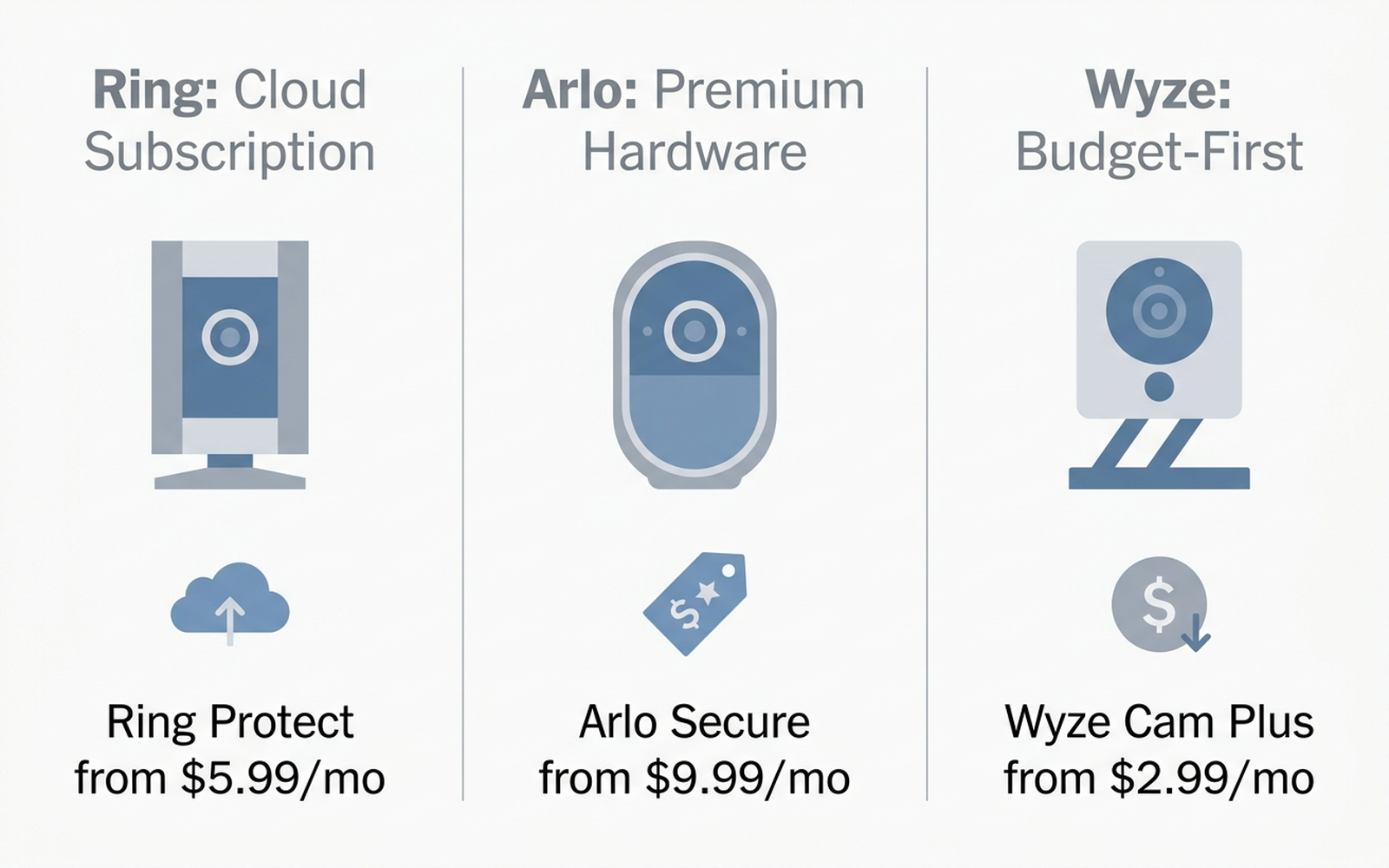
- Ring (cloud-first, subscription-gated features): Ring cameras ship with live view and basic motion alerts for free, but person detection, package alerts, and video history beyond a live look require a Ring Protect plan. Amazon raised Ring Protect pricing 17–20% across tiers effective February 2026: the Basic single-camera tier is now $5.99/month, Plus (whole-home) is $12/month, and the professional-monitoring Pro tier is $24/month, according to pricing trackers at SafeHome.org.
- Arlo (cloud-first, premium tier positioning): Arlo’s cameras similarly need a subscription for smart alerts and cloud video history — a single-camera Arlo Secure plan runs $9.99/month, an unlimited-camera household plan is $19.99/month, and the professional-monitoring Secure Premium tier lists at $29.99/month (or $24.99/month billed annually). Arlo positions itself as the premium hardware tier: its Pro 5S line ships with 2K HDR, a 160-degree field of view, color night vision, and a built-in spotlight, features reviewers consistently rank above Ring’s comparable mid-tier cameras.
- Wyze (budget-first, cheaper optional subscription): Wyze’s original $20 camera undercut the category by 70–80% at launch, and that value positioning persists into 2026. The Wyze Battery Cam Pro captures 2.5K HDR — a higher native resolution than either Ring’s or Arlo’s mid-tier cameras — while its Cam Plus subscription lists at $2.99/month, or $29.99/year on the annual plan after a March 2026 price increase from $19.99/year, per Wyze’s own support documentation. A separate Cam Unlimited tier covers unlimited camera licenses for $9.99/month or $99/year.
Manufacturer Deep Dive
Ring
Ring is the dominant brand in this category by a wide margin: SafeHome.org’s 2026 Home Security Market Report found 43% of US smart-camera owners name Ring as their primary brand, well ahead of Google Nest, Wyze, and Xfinity. That scale comes from Amazon’s push to make Ring a full home-security platform — cameras, video doorbells, sensors, and an alarm panel with cellular backup and emergency dispatch through the Pro subscription tier — rather than a standalone camera line. The Ring Stick Up Cam Battery is the brand’s flagship standalone outdoor/indoor camera: color night vision, two-way talk, and a magnetic mount that doesn’t require drilling into siding. Consumer Reports’ broader camera testing notes that no Ring model currently breaks into the very top of its ratings, a gap the outlet attributes largely to Ring’s data-privacy scoring rather than to raw video quality or response time.
Arlo
Arlo markets itself as the image-quality leader, and independent testing largely backs that positioning. The Arlo Pro 5S shoots 2K HDR with a 160-degree diagonal field of view and integrated spotlight, and Consumer Reports awarded the related Arlo Video Doorbell 2K top marks for data security and response time alongside a strong video-quality score — while flagging data privacy as a comparative weak spot industry-wide, not unique to Arlo. Arlo’s own investor-relations disclosures put annual recurring revenue from subscriptions at roughly $365 million as of Q2 2026, up from $330 million for full-year 2025, reflecting how central the Secure subscription has become to the company’s business model rather than an optional add-on. The tradeoff for buyers: Arlo’s subscription tiers are the most expensive of the three brands compared here at every level.
Wyze
Wyze built its reputation on radically undercutting incumbent pricing while keeping pace on hardware specs, and the Wyze Battery Cam Pro continues that pattern — 2.5K HDR resolution, color night vision, an integrated spotlight and siren, and optional solar-panel charging, at roughly half the retail price of comparable Ring or Arlo models. Consumer Reports’ testing of the related Wyze Duo Cam video doorbell found response time “very quick” (a 5.5-second average alert time) but video quality only “fairly sharp and clear” in daytime and “mediocre” at night, and noted that smart detection beyond basic motion alerts requires the paid Cam Plus subscription — a limitation CR calls meaningful given Wyze’s budget positioning implies fewer paid add-ons are expected. Wyze has also had past data-security incidents that reviewers flag when weighing its lower price against Ring and Arlo’s track records; buyers who prioritize vendor security history over up-front cost should weigh that history alongside the price gap.
How to Choose: Subscription Tolerance, Video Quality Needs, and Ecosystem Lock-In
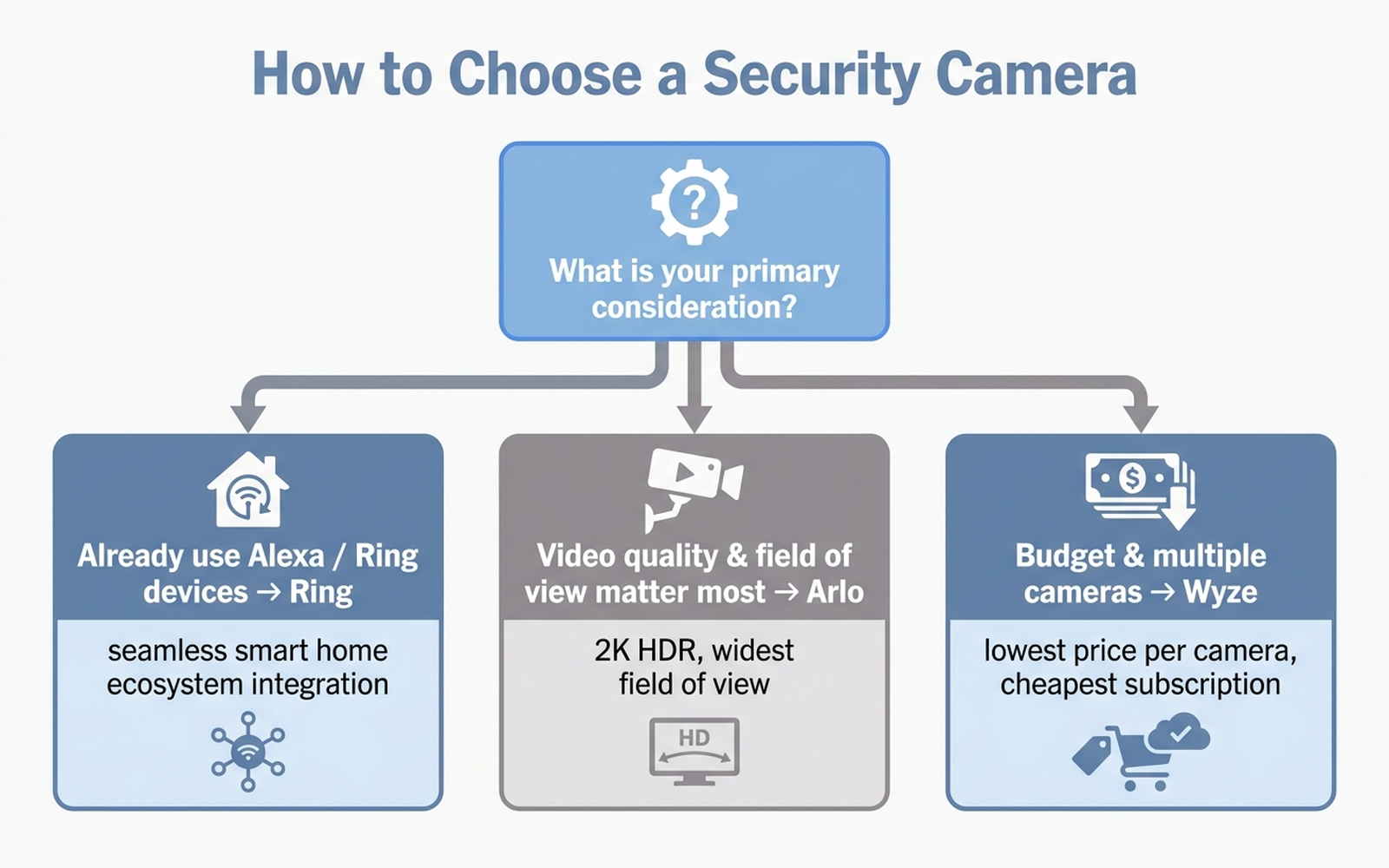
- You already own Ring or Amazon Echo devices: staying in the Ring ecosystem keeps chimes, floodlights, and Alexa routines working together without hub compatibility guesswork — the widest accessory lineup of the three brands compared here.
- Video quality and field of view matter most (large yards, long driveways): Arlo’s 160-degree field of view and 2K HDR outperform Ring and Wyze’s mid-tier resolution, per manufacturer specs and Consumer Reports’ video-quality scoring.
- Budget is the deciding factor, or you’re outfitting multiple entry points: Wyze’s per-camera price and $2.99/month (or $29.99/year) subscription undercut both competitors, especially once you’re buying three or more cameras.
- You want to minimize recurring monthly cost long-term: compare the annual subscription math, not just hardware price — Ring Protect Plus ($12/month = $144/year) and Arlo Secure ($19.99/month = ~$240/year) cost far more over three years than Wyze’s Cam Unlimited ($99/year) for a multi-camera household.
- Data privacy history is a priority: weigh Consumer Reports’ privacy scoring and each brand’s disclosed security incident history, not just the alert-accuracy and video-quality numbers, before deciding.
Comparison Table
Prices as of 2026-09-04 — Amazon frequently runs short-term discounts on all three brands; check the live listing before buying.
| Product | Resolution | Field of View | Subscription (monthly) | Price |
|---|---|---|---|---|
| Ring Stick Up Cam Battery | HD (1080p) | ~130° | Ring Protect Basic $5.99, Plus $12, Pro $24 | ~$99.99 |
| Arlo Pro 5S | 2K HDR | 160° | Arlo Secure single-cam $9.99, unlimited $19.99, Premium $29.99 (or $24.99/mo annual) | ~$149.99 |
| Wyze Battery Cam Pro | 2.5K HDR | ~130° | Cam Plus $2.99/mo or $29.99/yr; Cam Unlimited $9.99/mo or $99/yr | ~$59.99 |
Decision Flowchart: Ecosystem, Video Quality, or Price
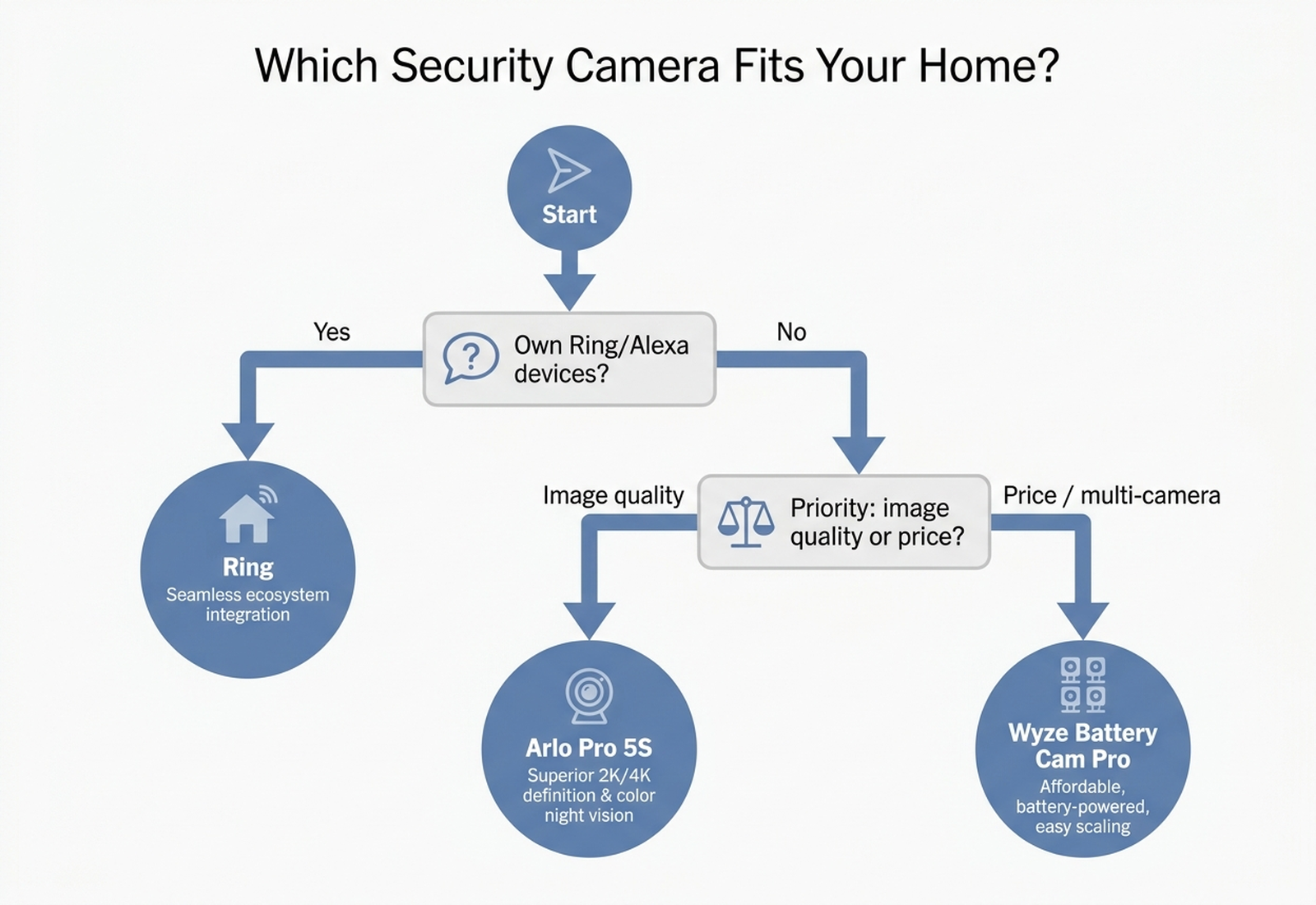
For a quick path through the three brands above: first decide whether you’re already invested in an ecosystem (Alexa/Ring accessories point to Ring). If not, decide whether image quality or price matters more — Arlo wins on field of view and HDR quality, Wyze wins on price per camera and cheapest ongoing subscription. Multi-camera households should run the three-year subscription math before hardware price alone, since Wyze’s Cam Unlimited tier can be far cheaper than paying per-camera fees on Ring or Arlo once you pass two or three cameras. See the flowchart figure below for the full branching logic, including the data-privacy-priority branch.
Warranty and Support
All three brands offer a standard 1-year limited hardware warranty in the US, covering manufacturing defects but not battery degradation from normal use or physical damage from weather exposure beyond the camera’s rated IP rating. None of the three bundles extended hardware coverage into its base subscription tier as of this writing; buyers who want longer coverage need a separate third-party protection plan. Battery-life claims (Ring, Arlo, and Wyze all publish multi-month estimates for their battery-powered models) are manufacturer specifications based on a defined activity profile, not an independently verified real-world average — actual battery life varies with motion-event frequency, temperature, and Wi-Fi signal strength at the mounting location.
Editorial Recommendation
- Best for most people already using Alexa or other Ring devices: Ring Stick Up Cam Battery — the ecosystem advantage outweighs its middling Consumer Reports privacy score for buyers already invested in the platform.
- Best video quality and field of view: Arlo Pro 5S — the 160-degree HDR image is the sharpest of the three per manufacturer specs and third-party scoring, at the highest subscription cost.
- Best budget pick and lowest long-run cost for multi-camera setups: Wyze Battery Cam Pro — 2.5K HDR resolution at roughly half the hardware price, with the cheapest per-camera and unlimited-camera subscription tiers of the three brands compared here.
Limitations
This analysis relies on publicly available reviews, manufacturer specifications, and third-party test coverage from Consumer Reports and industry pricing trackers; we did not independently test detection accuracy, night-vision quality, or battery life under controlled conditions. Manufacturer-published figures (field-of-view degrees, resolution, battery-life estimates) are cited as manufacturer claims, not independently verified facts, unless a cited third-party test explicitly confirmed them. Subscription pricing changes frequently — all figures here reflect publicly reported 2026 pricing as of this writing and should be verified on each brand’s current pricing page before purchase. Individual experience may vary based on mounting height, Wi-Fi signal strength, climate, and how a specific property’s layout interacts with each camera’s field of view.
As an Amazon Associate, Arekore earns from qualifying purchases. The Amazon product links in this article include our affiliate tracking ID and may earn us a commission if you buy through them, at no additional cost to you. See our Links Policy for details on how we select products and how commissions do not influence our recommendations.
Visit Arekore to verify current pricing and availability on any product mentioned here before buying.