Best Gear for Indoor Plant Parents in 2026
TL;DR / Quick Verdict
Most new indoor plant parents don’t need a smart home ecosystem — they need one honest answer to “does this pot need water right now.” An $8 soil moisture meter solves that for the vast majority of households. Add a Wi-Fi hygrometer if you’re growing humidity-sensitive tropicals, a grow light only if your space genuinely lacks bright indirect light, and self-watering planters mainly if you travel often. Skip stacking all four unless you’re managing more than a dozen plants.
Methodology
This analysis synthesizes (a) aggregated Amazon US customer reviews for the specific moisture meter, self-watering planter, hygrometer, grow light, and pruning shear models covered here — several carrying 60,000+ verified ratings — (b) third-party testing from Bob Vila and Consumer Reports on grow lights and self-watering planters, (c) gardening-community consensus (widely echoed across houseplant care guides, though exact death-rate figures vary by source and cannot be precisely verified) that overwatering is the single most common cause of houseplant decline, and (d) manufacturer specifications. We did not personally test the products covered here.
As an Amazon Associate, Arekore earns from qualifying purchases. The Amazon product links in this article include our affiliate tracking ID and may earn us a commission if you buy through them, at no additional cost to you. See our Links Policy for details on how we select products and how commissions do not influence our recommendations.
Manual Check vs. Meter vs. Connected Sensor vs. Self-Watering: Four Ways to Solve the Same Problem
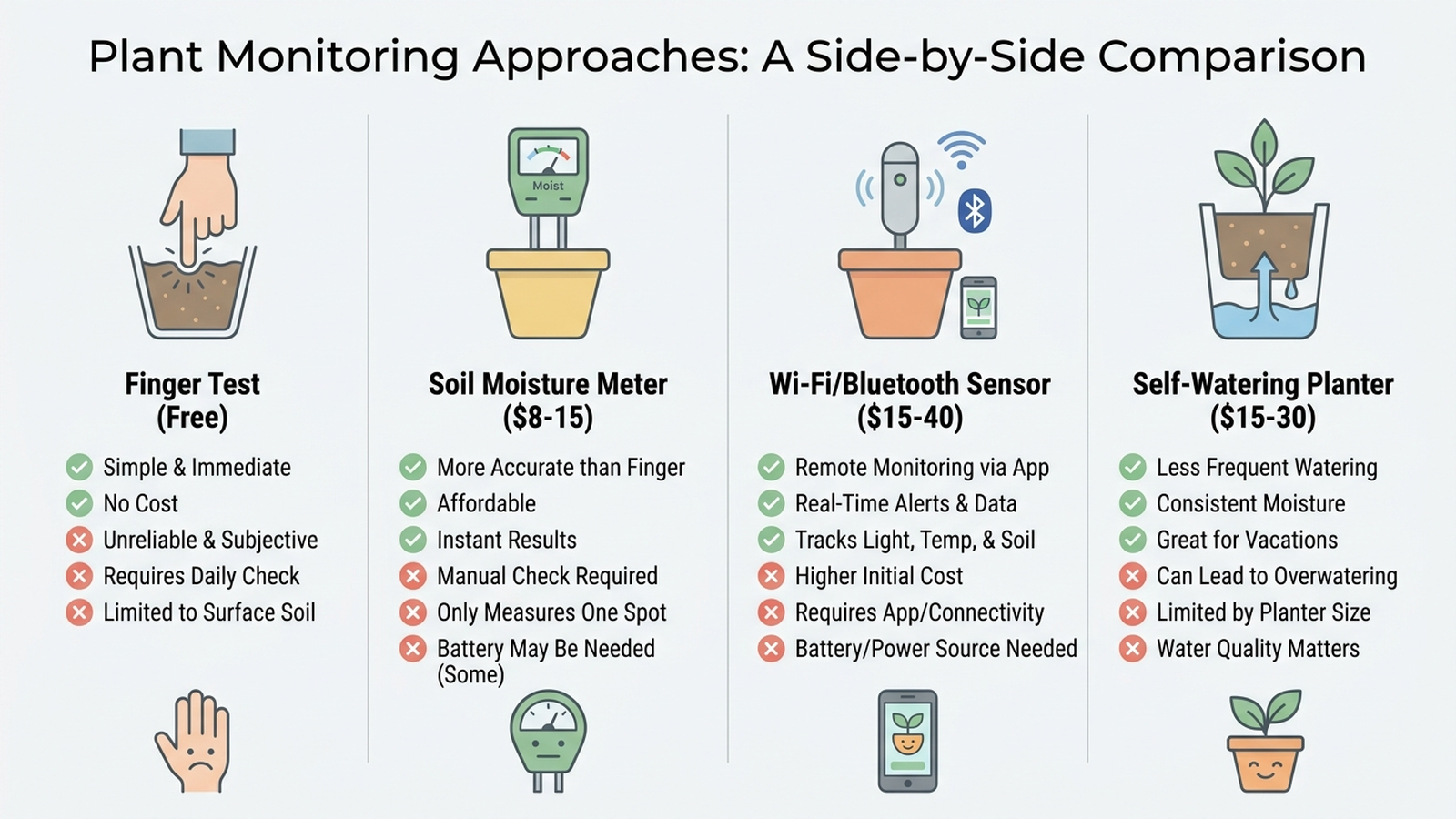
Every piece of “plant parent” gear on Amazon exists to answer one of two questions: is the soil wet enough, and is the room bright/humid enough. There are four common approaches to the watering question, in order of cost and complexity:
- Finger test (free). Stick a finger 1–2 inches into the soil. Reliable for pots you check often, unreliable for larger pots where the top layer dries faster than the root zone — which is exactly the mismatch that leads to overwatering.
- Analog soil moisture meter ($8–$15). A probe with a dial reading dry/moist/wet, no batteries required. Cheap, durable, and directly targets overwatering, widely cited by gardening guides as the most common cause of houseplant decline.
- Wi-Fi/Bluetooth hygrometer or sensor ($15–$40). Tracks ambient humidity and temperature (not soil moisture directly, in the models covered here) with app alerts and history logs. Useful for tropicals sensitive to dry indoor air, especially during winter heating season.
- Self-watering planter ($15–$30 per pot). A reservoir and wicking system that keeps soil consistently moist for one to three weeks between refills. Removes the watering decision entirely, at the cost of less control over how wet the soil stays.
A fifth category, supplemental grow lights ($30–$70), solves a different problem — insufficient light, not water — and is only relevant if a plant is in a room without several hours of bright indirect light per day.
Brand-by-Brand: What the Data Shows
XLUX Soil Moisture Meter (Since 2015) — best for most plant parents
The XLUX 3-in-1 probe-style meter has accumulated more than 60,000 verified ratings on Amazon US. Customer sentiment clusters around two consistent points: it removes the guesswork of the finger test for pots deeper than a few inches, and the stainless-steel probe holds up over years of repeated use without a battery. The main complaint in lower-starred reviews is that the analog dial (dry/moist/wet) doesn’t give a precise numeric reading — a fair trade-off at this price tier.
T4U Self-Watering Planters — best for frequent travelers
T4U’s self-watering pots use a visible water-level window over a bottom reservoir, a simpler mechanical design than pump-based systems. Reviewers most often cite the visual water gauge as the reason they trust the product — it removes the anxiety of not knowing how much water is left. Bob Vila’s 2026 self-watering planter testing found that wicking-reservoir designs in this category typically keep soil moist for one to two weeks between refills, in line with T4U’s own claims, though exact duration depends on plant size, pot size, and room temperature.
Govee Wi-Fi Thermometer Hygrometer — best for humidity-sensitive tropicals
Govee’s Wi-Fi hygrometer line is one of the most reviewed home sensor products on Amazon US, and the aggregated sentiment for the plant-relevant use case is consistent: buyers use the app’s history graph to catch humidity drops during winter heating season, before leaves show visible stress. It measures ambient room conditions, not soil moisture — pair it with a moisture meter rather than substituting one for the other.
AeroGarden Trio Grow Light — best for low-light rooms
AeroGarden’s clip/stand-style LED grow light is built around a full-spectrum white/blue/red LED array and an app-controlled timer, which reviewers consistently flag as the deciding feature over cheaper clip lights — it removes the need to remember to turn a light on and off daily. Manufacturer specs claim coverage suitable for houseplants up to about 12 inches tall per arm; this is a manufacturer claim, not an independently verified measurement. Southern Living’s own supplemental-lighting trial (using edible seedlings, not houseplants) reported measurably taller growth under grow lights than under natural light alone over several weeks — directionally supportive of grow lights working, though the exact figures apply to seedlings and don’t map precisely onto mature houseplant outcomes.
Fiskars Bypass Pruning Shears — best for plants that have outgrown “just water them”
Fiskars’ SoftGrip bypass pruners are, per retailer sales data cited by Men’s Journal, Amazon’s best-selling gardening scissors, with over 20,000 units sold in a recent single month. The recurring theme across reviews is the self-cleaning sap groove, which reviewers say prevents the blade-sticking problem common on cheaper pruners after repeated use on sappy stems like pothos or rubber plants.
How to Use a Soil Moisture Meter Correctly
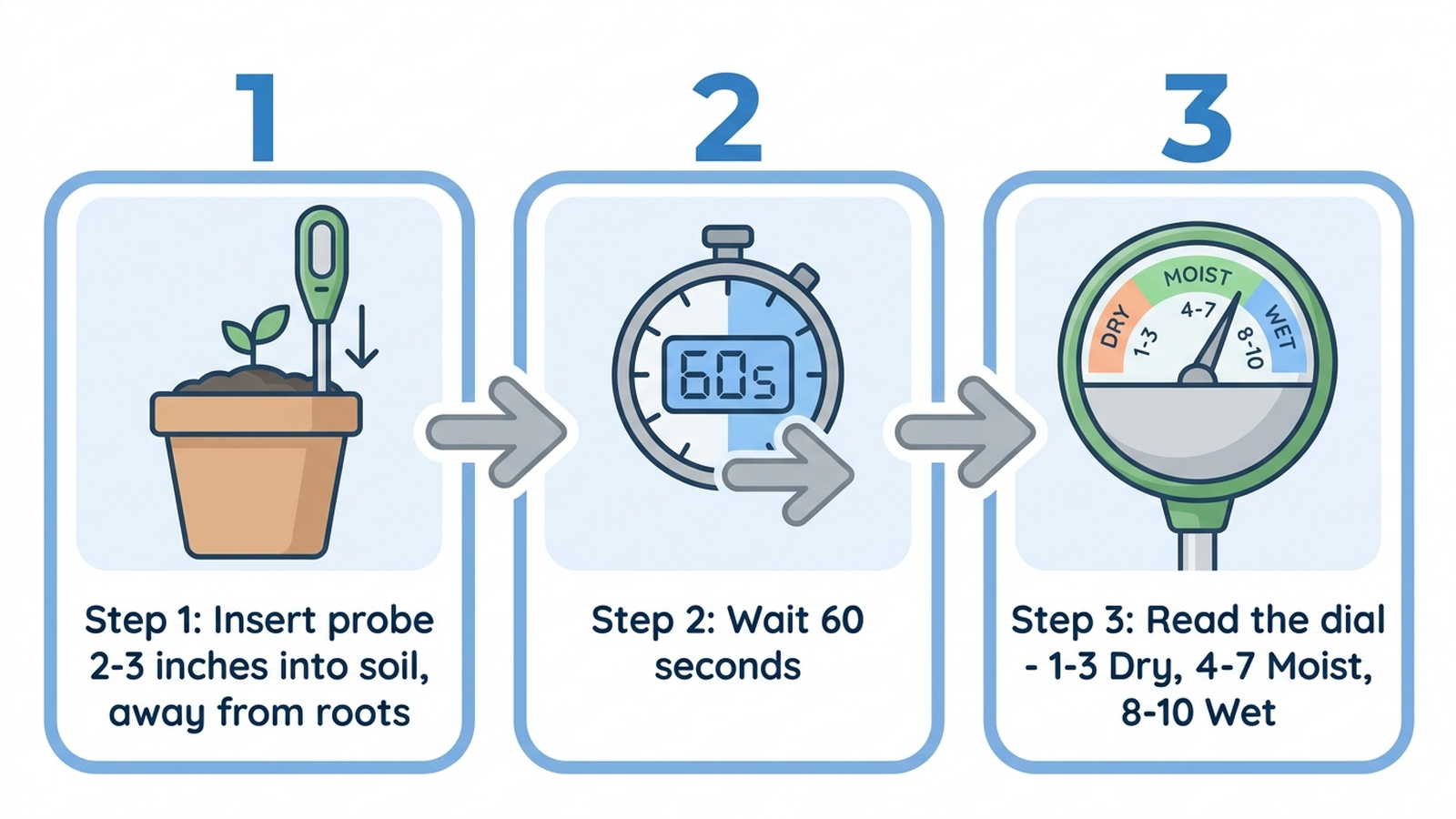
- Insert the probe 2–3 inches into the soil, positioned away from the root ball rather than directly against the stem.
- Wait about 60 seconds for the reading to stabilize — pulling it out immediately gives an inaccurate top-of-soil reading.
- Read the dial: 1–3 is dry (water now for most tropicals), 4–7 is moist (hold off), 8–10 is wet (do not water; check for drainage issues if it stays here for days).
Comparison Table
Prices as of 2026-09-26.
| Product | Category | Price | Amazon Rating | Sample Size | Best For |
|---|---|---|---|---|---|
| XLUX Soil Moisture Meter | Moisture meter | ~$10 | 4.5★ | 60,000+ ratings | Most plant parents |
| T4U Self-Watering Planter, 5.5” (3-pack) | Self-watering pot | ~$25 | 4.4★ | 5,000+ ratings | Frequent travelers |
| Govee Wi-Fi Thermometer Hygrometer H5103 | Humidity sensor | ~$25 | 4.6★ | 10,000+ ratings | Tropicals / dry winter air |
| AeroGarden Trio Grow Light | Grow light | ~$60 | 4.3★ | 1,000+ ratings | Low-light rooms |
| Fiskars SoftGrip Bypass Pruning Shears | Pruning shears | ~$15 | 4.7★ | 20,000+ ratings | Established, overgrown plants |
Which Plant Care Gear Do You Actually Need?
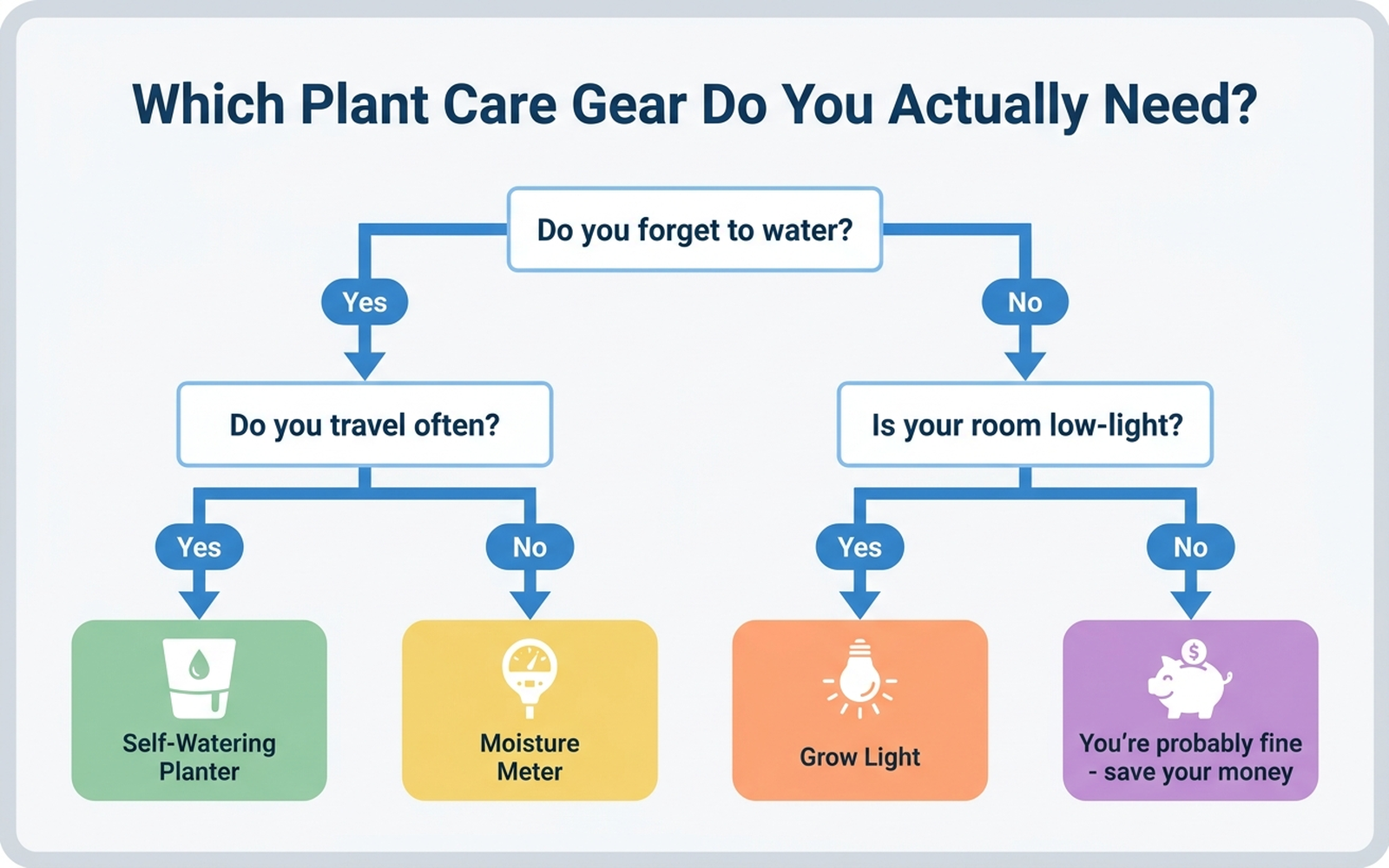
Use this as a starting filter rather than a shopping list — most single-plant or few-plant households only need one item from it.
- Do you forget to water? If no, you probably don’t need any monitoring gear at all.
- If yes, and you travel often: a self-watering planter removes the problem for one to two weeks at a stretch.
- If yes, but you’re usually home: a soil moisture meter is cheaper and gives you more control over exact soil dryness.
- Is your room low-light (no direct or bright indirect light for several hours a day)? A grow light addresses that specific problem; a moisture meter or self-watering pot does not compensate for insufficient light.
Warranty and Return Notes
Fiskars backs its bypass pruning shears with a lifetime warranty against defects, a differentiator reviewers cite when comparing it with unbranded budget pruners. AeroGarden’s grow light products carry a standard one-year limited manufacturer warranty. XLUX and T4U, as budget accessory brands, rely primarily on Amazon’s standard 30-day return window rather than an extended manufacturer warranty — factor that into the price-to-durability comparison if a unit fails outside that window.
Editorial Recommendation by Use Case
- New to houseplants, one to five plants: start with a soil moisture meter. It’s the cheapest fix for the single most common cause of plant death.
- Frequently away from home for a week or more: a self-watering planter for your most water-sensitive plants (ferns, calatheas) reduces the risk of a dead plant on return.
- Growing tropicals in a dry, heated apartment in winter: a Wi-Fi hygrometer with alert thresholds catches humidity drops before leaf damage becomes visible.
- A room with no bright indirect light: a grow light is the only item on this list that actually solves a light problem — don’t substitute a moisture meter or self-watering pot for it.
- Plants that have outgrown their space: a quality bypass pruning shear pays for itself in avoided damage from struggling with dull scissors.
Limitations
This analysis relies on publicly available reviews, retailer-reported sales figures, and third-party tests conducted on related but not identical product configurations (for example, the cited grow-light trial used edible seedlings rather than mature houseplants). Amazon star ratings and review counts reflect self-selected reviewers and can include verified and unverified purchases together. Individual results depend heavily on plant species, pot size, and home conditions; a moisture meter reading of “moist” for a succulent and a fern do not imply the same watering need. Visit Arekore to verify current pricing and availability before buying.