Best Smokers for Beginners 2026: Three Fuel Types Compared
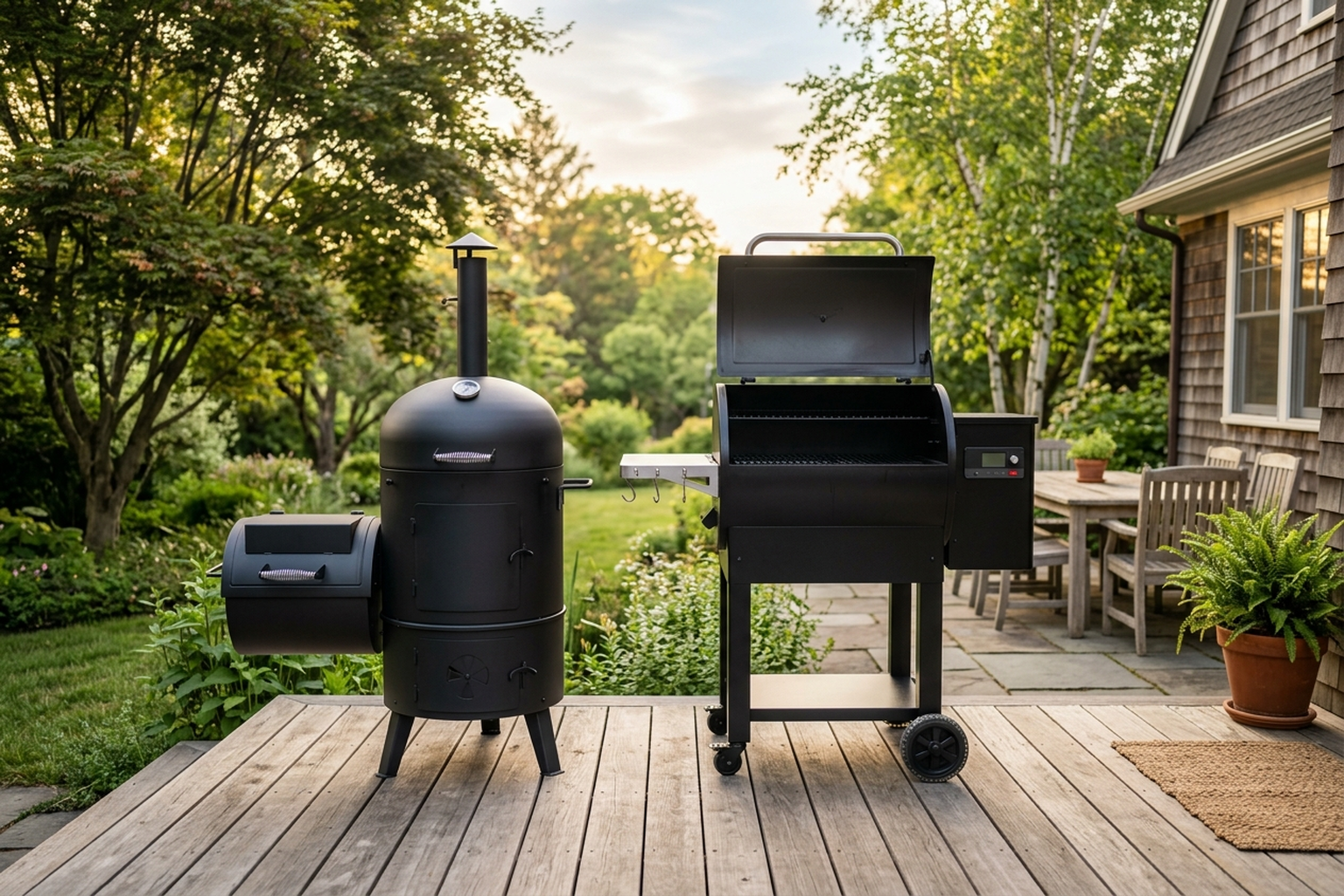
Industry market research on the US barbecue category puts household grill or smoker ownership above 70%, with roughly a third of that market now in the premium segment — which means a first-time smoker buyer is choosing equipment in a far more crowded field than the backyard-BBQ aisle of a decade ago. The real decision isn’t “which brand,” it’s “which fuel type,” because charcoal, electric, and pellet smokers trade off in exactly the three things that matter to a beginner: how much babysitting the fire needs, how forgiving the learning curve is, and how close the result gets to traditional smoke flavor. This guide treats the smoker itself as only half the purchase — the other half is the two accessories that determine whether a first attempt at brisket or pork shoulder turns out edible or inedible, regardless of which smoker it was cooked on.
As an Amazon Associate, Arekore earns from qualifying purchases. The Amazon product links in this article include our affiliate tracking ID and may earn us a commission if you buy through them, at no additional cost to you. See our Links Policy for details on how we select products and how commissions do not influence our recommendations.
TL;DR / Quick Verdict
- The smoker most BBQ sites agree is the best starting point for real smoke flavor: the Weber Smokey Mountain 18-Inch Charcoal Smoker — a vertical charcoal design repeatedly singled out as forgiving enough for a beginner while still delivering the deep, “real BBQ” flavor profile a stick burner or pellet grill can’t fully match.
- The smoker for a beginner who wants to set a temperature and walk away: the Masterbuilt 30-Inch Digital Electric Smoker (MB20071117) — digital keypad control, no fire management, and one of the lowest entry prices in this guide.
- The smoker for a beginner who wants app control and the widest range of cooking modes: the Pit Boss 440 Mahogany Series Wood Pellet Grill & Smoker — an 8-in-1 unit (smoke, bake, roast, braise, grill, sear, char-grill, barbecue) with a digital controller that automates fuel feed.
- The cheap accessory most first-timers skip, and shouldn’t: the ThermoPro TP19 Waterproof Instant-Read Thermometer — none of the three smokers above include a fast, reliable instant-read probe, and guessing doneness is the single most common reason a first smoke turns out dry or undercooked.
- The accessory that turns an 8-hour cook into one you can actually leave the yard for: the ThermoPro TempSync Bluetooth Wireless Meat Thermometer with 2 Probes — monitors both the meat and the smoker’s internal air temperature remotely, so a beginner isn’t standing at the smoker the entire time.
How We Reached These Conclusions (Methodology)
This is an editorial analysis, not a hands-on review. We did not personally test the products covered here. This guide synthesizes (a) aggregated amazon.com customer ratings and the substance of both positive and critical reviews, sampled the week of 2026-10-06; (b) independent third-party testing and buying guidance from Consumer Reports, Wirecutter (NYT), and specialist outlets including Smoked BBQ Source and AmazingRibs.com; (c) manufacturer specifications and published warranty terms; and (d) US market data on grill and smoker ownership and category growth. Where we cite a manufacturer figure — wattage, cooking-surface area, hopper capacity — we label it as a manufacturer claim rather than an independently verified result. Prices as of 2026-10-06 are amazon.com figures and fluctuate.
Why Fuel Type Matters More Than Brand for a First Smoker
A first-time buyer researching smokers quickly runs into dozens of brand-vs-brand comparisons, but the decision that actually determines whether the hobby sticks is fuel type, not brand. Charcoal smokers like the Weber Smokey Mountain produce the deepest, most traditional smoke flavor, because the fire itself is wood and charcoal rather than electricity — but that flavor comes with a learning curve around managing airflow and fuel to hold a steady temperature for 8–12 hours. Electric smokers remove nearly all of that fire management: set a temperature on a digital keypad, add wood chips for flavor, and the unit holds that temperature automatically, which is why they’re consistently recommended as the lowest-friction entry point for someone who isn’t sure they’ll stick with the hobby yet. Pellet grills sit in between — an auger automatically feeds wood pellets to maintain a set temperature, giving beginners most of electric’s convenience with more real wood smoke than an electric unit produces, at a meaningfully higher price than either charcoal or basic electric options.
The honest tradeoff running through all three: smoke flavor and price range move in one direction while fire-management effort moves in the other, and no single smoker optimizes all three at once. A beginner who picks based on “which one looks nicest” without weighing that tradeoff often ends up with a smoker whose convenience or flavor profile doesn’t match why they wanted to start smoking meat in the first place.
The Three Scenarios That Determine Which Smoker to Buy
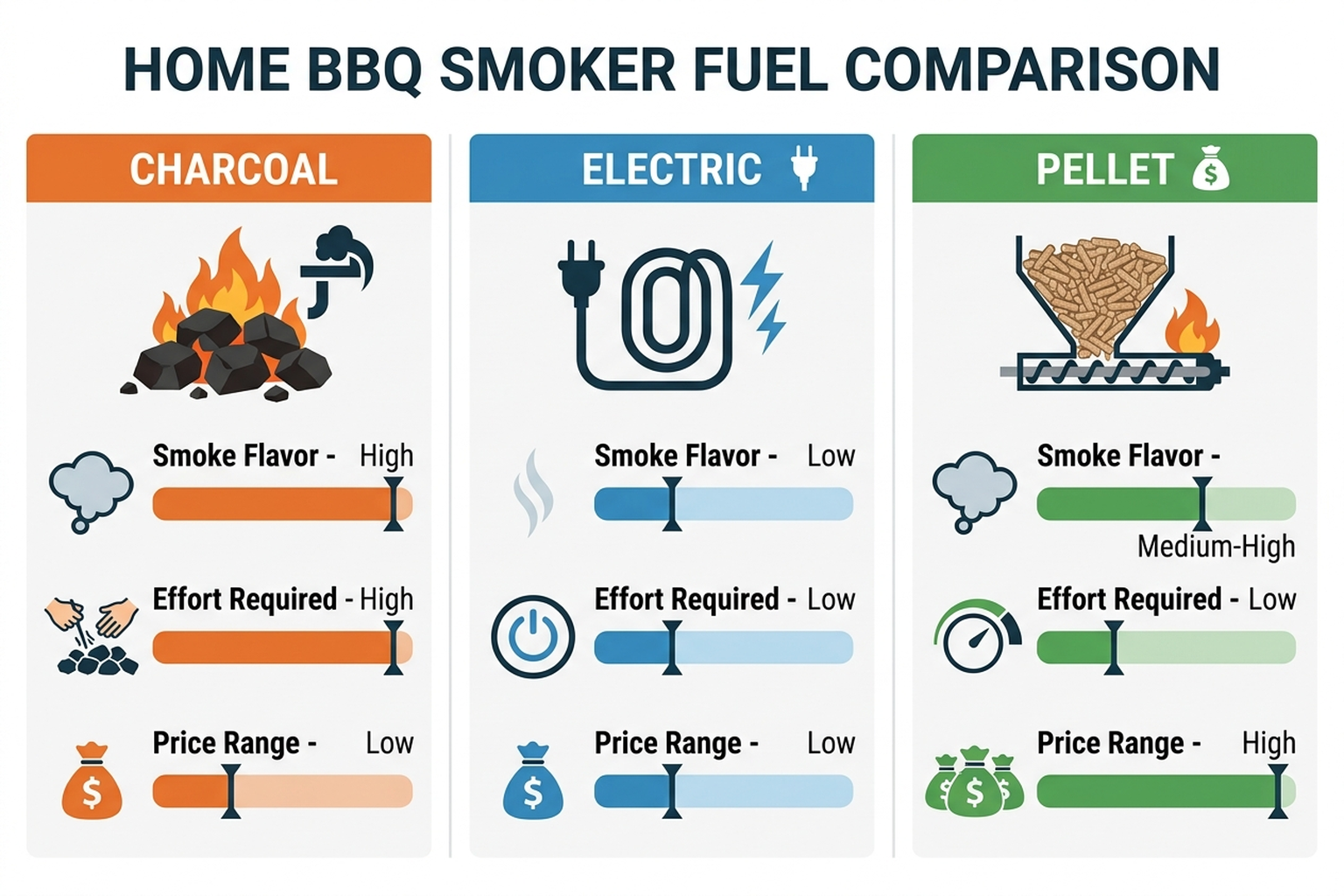
- A beginner who wants the most traditional smoke flavor and doesn’t mind learning fire management. The Weber Smokey Mountain’s vertical charcoal design is widely cited as the most forgiving charcoal smoker to learn on, holding steady temperatures for 8–12 hours once dialed in.
- A beginner who isn’t sure the hobby will stick and wants the lowest-effort, lowest-cost entry point. A digital electric smoker removes fire management almost entirely — set a temperature, add wood chips, and the unit does the rest.
- A beginner who wants more cooking versatility than “just smoking” and is willing to pay more for it. A pellet grill’s 8-in-1 capability (smoke, grill, sear, bake, roast, braise, char-grill, barbecue) means the same unit replaces both a smoker and a backyard grill.
Comparison Table
Prices as of 2026-10-06 are approximate amazon.com figures and fluctuate.
| Item | ASIN | Approx. price | Key spec (manufacturer) | Warranty | Best scenario |
|---|---|---|---|---|---|
| Weber Smokey Mountain 18-Inch Charcoal Smoker | B001I8ZTJ0 | ~$419 | Vertical charcoal design, 2 cooking grates, built-in lid thermometer, porcelain-enameled bowl and lid | 10-year limited | Most traditional smoke flavor, beginner-forgiving charcoal |
| Masterbuilt 30-Inch Digital Electric Smoker (MB20071117) | B07CN38M23 | ~$250 | 800-watt element, digital keypad control, side wood-chip loader, 4 chrome racks, ~710 sq. in. | 1-year limited | Lowest-effort, lowest-cost entry point |
| Pit Boss 440 Mahogany Series Wood Pellet Grill & Smoker | B083STDCGS | ~$300–$400 | 518 sq. in. cooking space, 180°F–500°F range, flame broiler, LED digital controller, 5 lb. pellet hopper | 5-year limited | Most cooking versatility, automated fuel feed |
| ThermoPro TP19 Waterproof Instant-Read Thermometer | B0D2S62XY7 | ~$20–$25 | Thermocouple sensor, 2–3 second read, backlit ambidextrous display, waterproof | 1-year limited | Essential for every smoker type — checking doneness accurately |
| ThermoPro TempSync Bluetooth Wireless Thermometer, 2 Probes | B08K2G5Y78 | ~$50–$65 | Up to 650 ft. range, 2 probes (meat + ambient), rechargeable, smartphone app alerts | 1-year limited | Long cooks where staying by the smoker all day isn’t practical |
1. Weber Smokey Mountain 18-Inch — The Smoker Most Sites Agree Is the Best Starting Point for Real Smoke Flavor
Specialist BBQ outlets and general gear reviewers both converge on the same recommendation for a beginner who wants traditional charcoal flavor: the Weber Smokey Mountain splits the difference between an offset “stick burner” (hard to learn, excellent flavor) and a kettle grill improvised into a smoker (easy, inconsistent results). Its vertical design with a water pan between the fire and the meat moderates temperature swings that trip up first-timers on other charcoal smokers, and reviewers on forums and in buying guides repeatedly describe holding 8–12 hours of steady temperature with minimal adjustment once the initial airflow settings are dialed in.
Aggregated Amazon reviews are strongly positive — 4.7 stars across more than 5,500 ratings — with praise concentrated on how forgiving the unit is for a first attempt at low-and-slow cooking and on the thick-gauge steel holding up over years of use; the most common low-star complaint concerns the stock lid thermometer’s accuracy, with reviewers recommending a separate instant-read or wireless probe (see the accessory picks below) rather than relying on the built-in dial. Weber backs the Smokey Mountain with a 10-year limited warranty on the bowl and lid — longer than either the electric or pellet options in this guide.
Check the Weber Smokey Mountain 18-Inch Charcoal Smoker on Amazon
2. Masterbuilt 30-Inch Digital Electric Smoker — For a Beginner Who Isn’t Sure the Hobby Will Stick
Fire management is the single biggest barrier that keeps first-time smokers from finishing their first cook, and the Masterbuilt MB20071117 removes it almost entirely. A digital keypad sets both temperature and cook time, an 800-watt element holds that temperature automatically, and a side wood-chip loader lets a beginner add smoke flavor without opening the main door and losing heat — a mistake that’s common with simpler electric smokers. At roughly $250, it’s also one of the least expensive ways into smoking that isn’t a toy-grade unit, which matters for someone testing whether the hobby is worth a bigger investment later.
Aggregated Amazon reviews praise the simplicity of the digital controls and the forgiving nature of a “set it and check it occasionally” cook, particularly for pork shoulder and ribs; the most common low-star complaint concerns the stock temperature probe’s accuracy drifting after a year or two of use, which is consistent with the general pattern across budget electric smokers and reinforces why a separate instant-read thermometer is worth buying alongside it. Masterbuilt backs the unit with a 1-year limited warranty, shorter than the Weber Smokey Mountain’s but typical for electric smokers in this price range.
Check the Masterbuilt 30-Inch Digital Electric Smoker on Amazon
3. Pit Boss 440 Mahogany Series — The Smoker That Doubles as a Backyard Grill
A beginner who wants one piece of equipment to cover smoking, grilling, baking, and searing — rather than buying a smoker and keeping a separate grill — is the use case the Pit Boss 440 Mahogany Series is built for. Its flame broiler plate slides open to expose direct flame for searing, while closed it functions as a true indirect-heat smoker across a 180°F to 500°F range, manufacturer-rated for 8-in-1 cooking: smoke, bake, roast, braise, grill, sear, char-grill, and barbecue. The LED digital controller automates the pellet auger feed, giving beginners most of the hands-off convenience of the electric Masterbuilt while burning actual wood pellets for more traditional smoke flavor than an electric element produces.
Aggregated Amazon reviews are positive on the versatility and the real wood-smoke flavor compared to electric alternatives, with several reviewers specifically noting it replaced a separate gas grill entirely; the most common low-star complaint concerns temperature swings in cold weather, since pellet grills generally struggle to maintain their low end in freezing ambient temperatures without an insulating blanket accessory sold separately. Pit Boss backs the Mahogany Series with a 5-year limited warranty, the second-longest coverage in this guide after the Weber.
Check the Pit Boss 440 Mahogany Series Wood Pellet Grill on Amazon
4. ThermoPro TP19 Instant-Read Thermometer — The $20 Accessory That Prevents the Most Common Beginner Mistake
None of the three smokers above ship with a thermometer accurate enough to trust for food safety and doneness on their own — a pattern confirmed by the low-star reviews on all three listings, which repeatedly flag stock dial or probe thermometers running several degrees off. The ThermoPro TP19 uses a thermocouple sensor for a 2–3 second read, fast enough to check a brisket or pork shoulder without opening the smoker door for long enough to lose significant heat, with a backlit, ambidextrous display readable in the low light of an early-morning or overnight cook.
Aggregated Amazon reviews are strongly positive on read speed and the waterproof design surviving repeated use outdoors; the most common low-star complaint concerns battery life on certain batches, with some reviewers reporting the battery indicator reads full shortly before the unit dies unexpectedly — worth keeping a spare battery on hand for a long cook. At roughly $20–$25, it’s the cheapest item in this guide and arguably the one with the highest impact on whether a first smoke turns out well.
Check the ThermoPro TP19 Instant-Read Thermometer on Amazon
5. ThermoPro TempSync Wireless Thermometer — For Cooks Longer Than You Want to Stand Outside
A pork shoulder or brisket cook routinely runs 8 hours or longer, and standing next to the smoker the entire time defeats much of the appeal of “low and slow” cooking. The ThermoPro TempSync solves this with two probes — one for the meat, one for the smoker’s ambient air temperature — transmitting over Bluetooth up to roughly 650 feet to a smartphone app that alerts when the meat hits a target internal temperature, removing the guesswork of relying on the smoker’s own built-in gauge (the same stock-thermometer accuracy problem noted on all three smokers above).
Aggregated Amazon reviews praise the dual-probe setup specifically for long cooks, with reviewers noting they can mow the lawn, run an errand, or go back inside without worrying about the cook; the most common low-star complaint concerns Bluetooth range dropping below the advertised distance through thick walls or in dense neighborhoods, which is a known limitation of Bluetooth-based (rather than WiFi-based) wireless thermometers generally. ThermoPro backs the unit with a 1-year limited warranty.
Check the ThermoPro TempSync Bluetooth Wireless Thermometer on Amazon
Getting a Good First Smoke, Regardless of Which Smoker You Buy
The smoker matters less than a handful of habits that apply across charcoal, electric, and pellet alike — this is where most first-timers either succeed or end up with dry, bitter, or undercooked results.
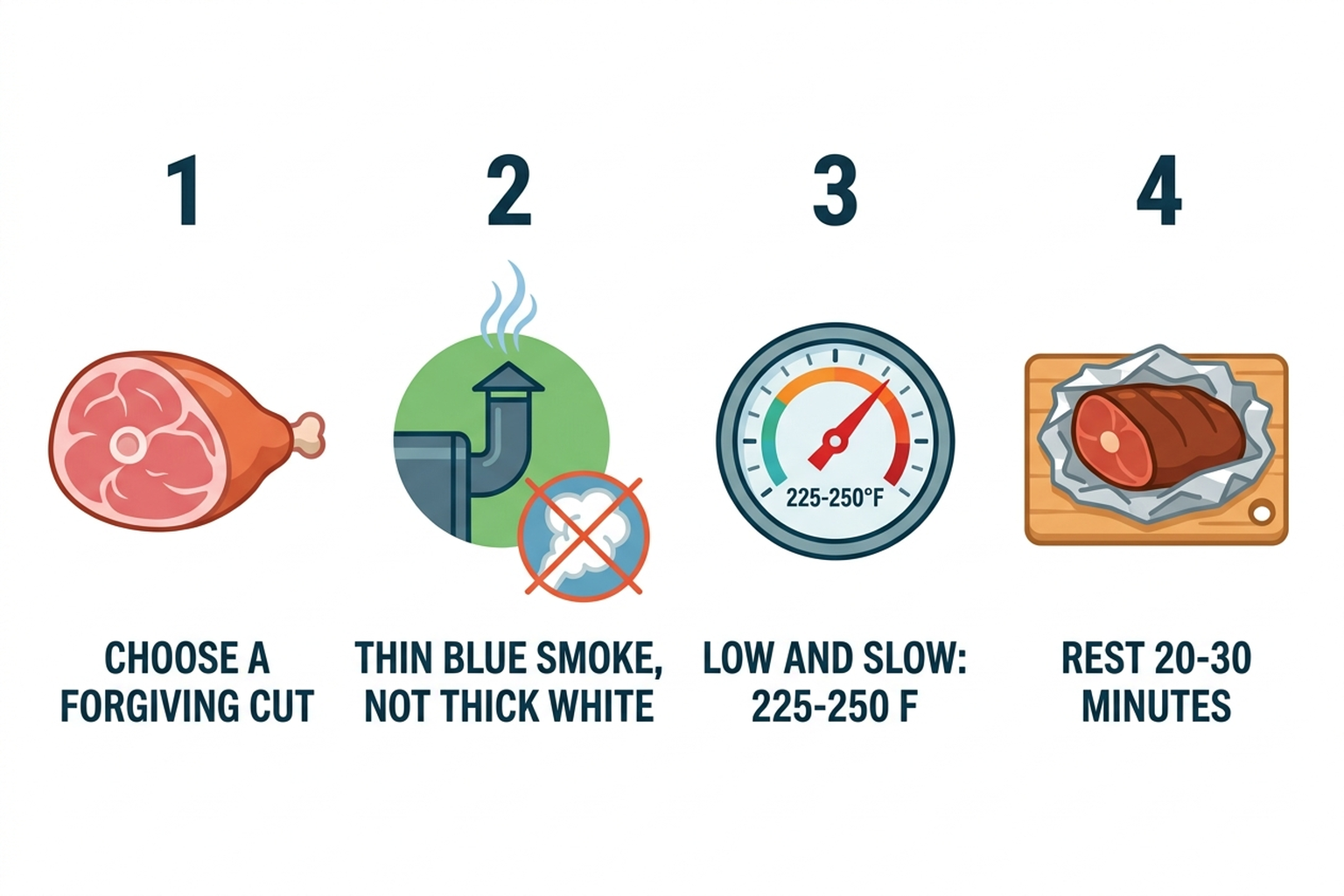
- Start with a forgiving cut, not the hardest one. Pork shoulder and pork belly are repeatedly recommended as beginner cuts because their higher fat content keeps the meat moist even if the cook runs long or the temperature drifts — a brisket’s leaner sections punish small mistakes far more severely.
- Watch for thin, blue smoke rather than thick, white smoke. Thick white smoke is a sign of incomplete combustion and is the primary cause of the acrid, bitter “oversmoked” flavor beginners associate with bad barbecue; thin blue smoke means the fire is burning clean.
- Hold a steady low temperature rather than chasing a high one. Most smoking guidance centers on the 225°F–250°F range for low-and-slow cooking — all three smokers above are built to hold within that band, which is a large part of why fuel type matters more than brand for a first attempt.
- Rest the meat 20–30 minutes before cutting. Wrapping in foil or butcher paper and letting the meat rest redistributes juices that would otherwise run out onto the cutting board — skipping this step on an otherwise well-cooked brisket is one of the most common reasons it turns out drier than expected.
How to Prioritize: A Budget Flowchart
Not every beginner needs the most capable setup on day one. This is the order that matches spend to the scenario that actually applies.
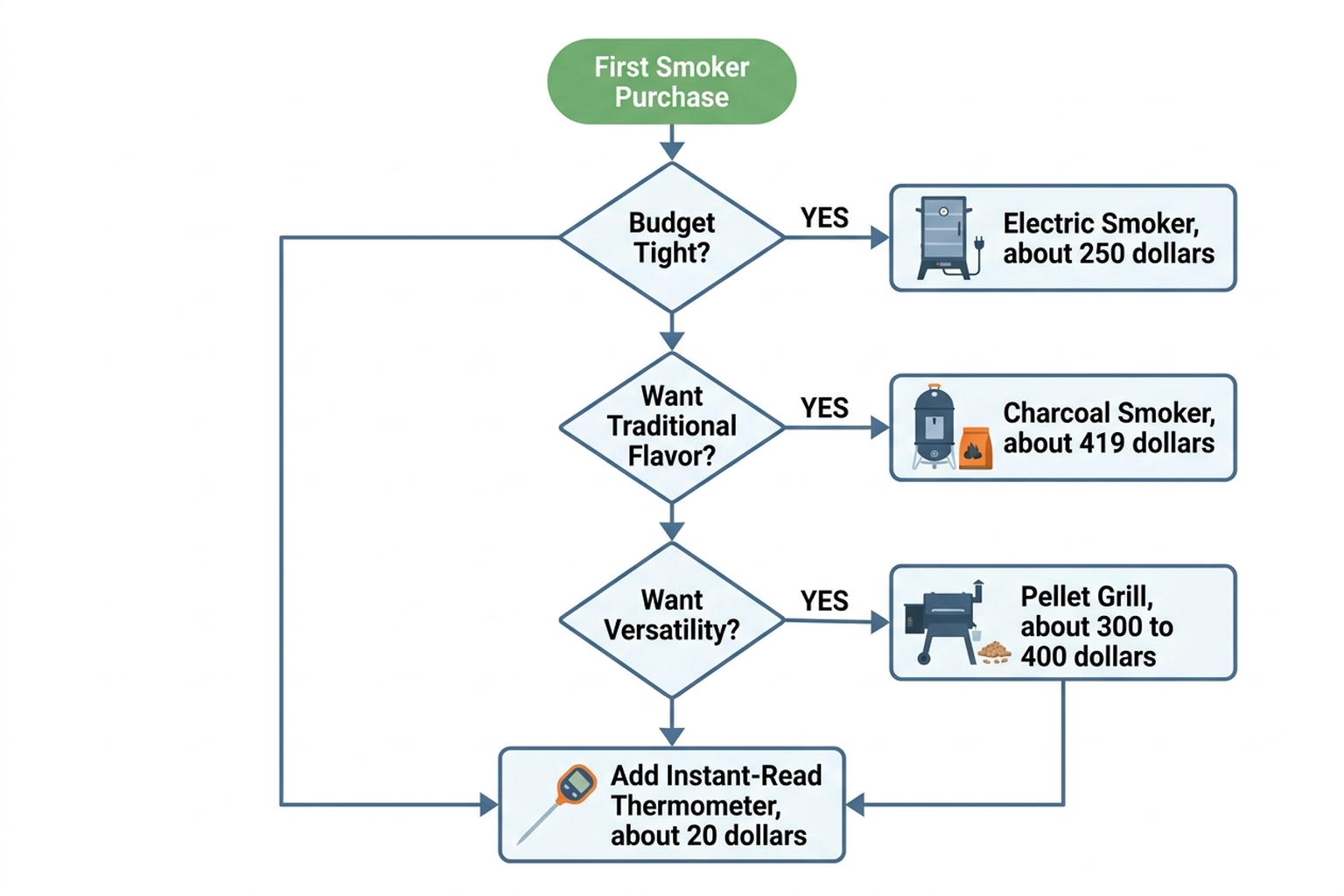
- Buy the ThermoPro TP19 instant-read thermometer first, regardless of which smoker you choose. At roughly $20–$25, it’s the cheapest item here and prevents the single most common beginner mistake — guessing at doneness.
- If budget is the main constraint and you’re not sure the hobby will stick, buy the Masterbuilt Digital Electric Smoker (about $250). The lowest-effort, lowest-cost entry point that still produces real smoked food.
- If traditional charcoal smoke flavor matters more than convenience, buy the Weber Smokey Mountain (about $419) instead. The most forgiving charcoal smoker for a beginner, backed by the longest warranty in this guide.
- If you want one unit that also replaces a backyard grill, upgrade to the Pit Boss 440 Mahogany Series (about $300–$400). The only option here rated for searing and grilling in addition to smoking.
- Add the ThermoPro TempSync wireless thermometer (about $50–$65) once you’re doing cooks longer than 4–5 hours. Monitoring both meat and ambient temperature remotely matters most on the 8+ hour cooks (pork shoulder, brisket) that define the hobby.
Editorial Recommendations by Use Case
- Best overall for traditional smoke flavor: the Weber Smokey Mountain 18-Inch — the charcoal smoker most consistently recommended as forgiving enough for a beginner while delivering real BBQ flavor.
- Best budget pick, lowest effort: the Masterbuilt 30-Inch Digital Electric Smoker — removes fire management almost entirely at the lowest price in this guide.
- Best for versatility beyond smoking: the Pit Boss 440 Mahogany Series — an 8-in-1 unit that doubles as a backyard grill.
- Best first accessory purchase: the ThermoPro TP19 Instant-Read Thermometer — cheap, fast, and addresses the top complaint across all three smoker listings.
- Best for long, unattended cooks: the ThermoPro TempSync Bluetooth Wireless Thermometer — dual-probe monitoring for 8+ hour cooks.
Limitations of This Analysis
This analysis relies on publicly available Amazon reviews, independent third-party buying guides, manufacturer specifications, and general US market data on grill and smoker ownership; we did not personally test these products, and individual experience varies with climate, altitude, the specific cut of meat, and a beginner’s own learning curve on fire and temperature management. Wattage, cooking-surface area, hopper capacity, and temperature range are manufacturer claims rather than independently reproduced lab results in every case. Prices, color variants, and warranty terms change frequently on Amazon listings, and the Pit Boss 440 Mahogany Series in particular has shown inconsistent in-stock availability across retailers — confirm the current price and stock status on the product page before buying.
The Bottom Line
Fuel type, not brand, is the decision that actually shapes a first-time smoker’s experience: charcoal delivers the deepest traditional flavor at the cost of fire-management effort, electric removes nearly all of that effort at the cost of some flavor depth, and pellet splits the difference at a higher price while adding grilling and searing versatility. Whichever smoker fits that tradeoff, the cheap instant-read thermometer matters as much as the smoker itself — the most common reason a first smoke disappoints isn’t the equipment, it’s guessing at doneness instead of checking it. Verify the exact current price, in-stock status, and specific model variant before checkout — and if you want a second opinion on a specific listing, paste the URL into Arekore and let the AI scan the reviews and price history for you in about five minutes.