Best Gear for College Club Athletes in 2026
TL;DR / Quick Verdict
- Club and intramural athletes are a distinct buyer: roughly 30% of college students play club or intramural sports, according to a Michigan State University study, and unlike varsity athletes they buy their own gear on a student budget, store it in a dorm room, and often play more than one sport per year.
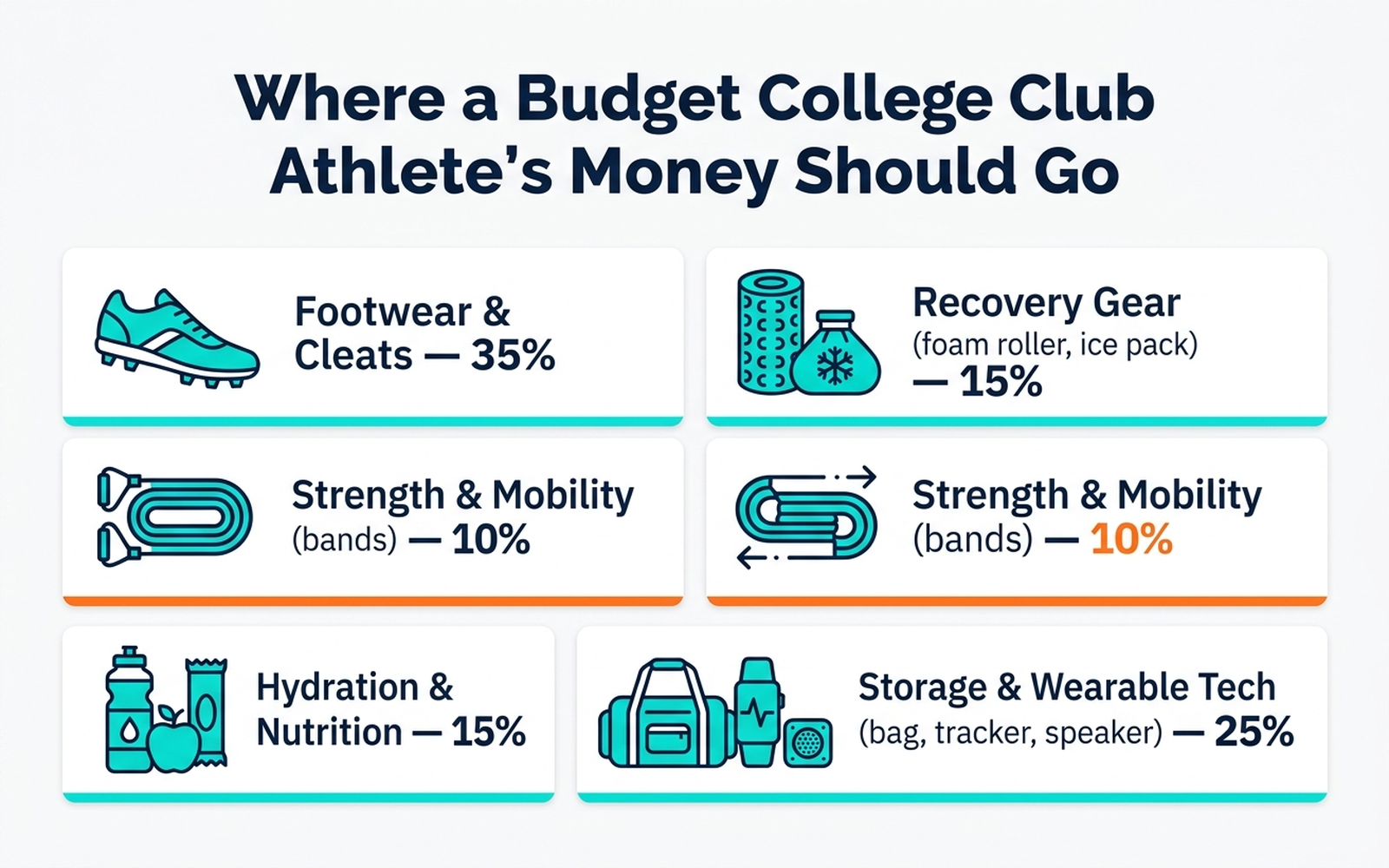
- Footwear is where the budget should concentrate first: turf cleats or indoor court shoes take the most wear and cause the most injury-adjacent complaints in aggregated reviews when bought too cheap.
- Recovery and hydration are the most-skipped category — foam rollers, reusable ice packs, and electrolyte packets are inexpensive relative to the injury and missed-practice risk of skipping them.
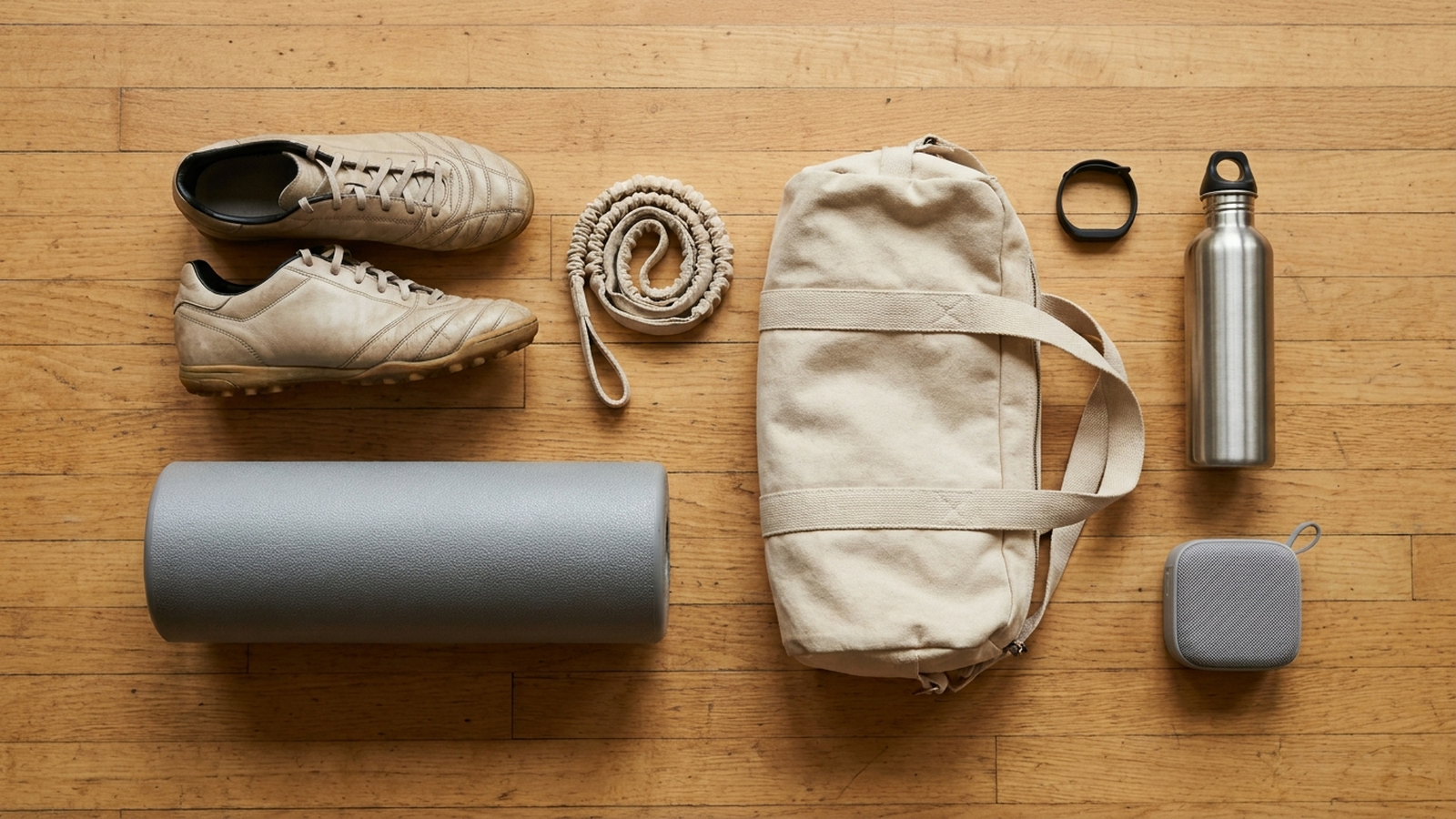
- Multi-sport reuse matters more than sport-specific optimization: a duffel bag, fitness tracker, and portable speaker cross over between soccer, rugby, ultimate frisbee, club volleyball, cycling, and climbing club, so it’s worth buying these once, well, rather than per-sport.
Methodology
This analysis synthesizes (a) aggregated Amazon US customer reviews for the products covered below, sampled in September 2026, (b) buying-guide and lab-test coverage from Wirecutter (NYT), Reviewed (USA Today), Tom’s Guide, and Garage Gym Reviews, (c) manufacturer-published specifications, and (d) publicly reported college-sports participation data (Michigan State University, American College Health Association). We did not personally test the products covered here. Amazon does not expose a precise, publicly verifiable review count per listing at the moment of writing, so figures below are cited as approximate, as-seen counts rather than an audited total.
Who This Guide Is For
Club and intramural sports sit below varsity athletics in funding but above pickup games in commitment. Per Appily’s and CollegeVine’s breakdowns of the US college sports tiers, club teams travel to compete against other schools and often practice several times a week, while intramural leagues stay on-campus — but in both cases, the athlete (not the athletic department) is buying the gear. That means budget constraints, dorm or shared-apartment storage, and gear that has to survive being crammed into a shared closet between practices. This guide is built around that reality: a soccer or rugby club player, an ultimate frisbee regular, a club volleyball player, or a cycling or climbing club member who needs functional gear across a semester, not a single premium purchase built for daily elite training.
Technical Approach: Where Budget Should Actually Go
Aggregated reviews and third-party testing point to a consistent pattern across categories: buyers who go cheapest-possible on footwear and support gear report more discomfort, blister, and early-failure complaints than buyers who spend moderately on footwear and buy genuinely low-cost recovery and storage items. Three sub-categories make up the bulk of a realistic budget for a club athlete:
- Footwear — turf cleats or court shoes are worn for hours several times a week and take direct ground-contact wear, which is why aggregated review data consistently shows footwear complaints (sole separation, stud wear, sizing) outnumbering complaints for any other equipment category.
- Recovery and hydration — foam rollers, reusable ice packs, and electrolyte packets are the cheapest items on this list by unit cost, but Wirecutter’s testing panel of physical therapists found that budget foam rollers perform equivalently to premium ones for general muscle recovery, meaning this is a category where spending more buys little additional benefit.
- Storage and wearable tech — a duffel bag, a fitness tracker, and a portable speaker are shared across every sport a student plays, which is why this analysis treats them as a one-time purchase rather than a per-sport line item.
Manufacturer and Product Deep Dive
As an Amazon Associate, Arekore earns from qualifying purchases. The Amazon product links in this article include our affiliate tracking ID and may earn us a commission if you buy through them, at no additional cost to you. See our Links Policy for details on how we select products and how commissions do not influence our recommendations.
Footwear: Nike Tiempo Legend 10 Club Turf
The Nike Tiempo Legend 10 Club Turf Low-Top Soccer Shoes sit in Nike’s Club tier — a step down from the Pro and Elite versions worn by professional and varsity players, but built on the same synthetic-leather upper and turf-rubber outsole shape. Aggregated Amazon reviews describe the fit as true-to-size with a break-in period of a few wears, and the rubber studs are rated by reviewers as durable across a full season of turf and hard-ground play. This is the category the analysis above flags as worth the higher relative spend: reviewers who bought no-name turf shoes report stud wear and sole separation within weeks, a pattern that shows up far less often on named-brand Club-tier cleats.
Recovery: Amazon Basics Foam Roller and Kinetic Labs Ice Pack Wrap
The Amazon Basics High-Density Round Foam Roller (18-inch) is Wirecutter’s practical general-use recommendation — the outlet’s physical-therapist testing panel found that firm-density EPP foam rollers in this price range are functionally equivalent to premium textured models for standard post-practice muscle recovery, so the cheapest in-stock 18-inch option is a reasonable default rather than a compromise. Paired with it, the Kinetic Labs Reusable Ice Pack Wrap uses an elastic strap design that aggregated reviews describe as easy to secure to a knee, ankle, or shoulder without a second pair of hands — useful for a student icing an injury alone in a dorm room rather than with a team athletic trainer present.
Strength and Mobility: WHATAFIT Stackable Resistance Bands
The WHATAFIT Resistance Bands Set with Handles stacks five color-coded latex tubes up to a manufacturer-rated 100 lbs of combined resistance and packs into a small carry bag — a practical fit for dorm storage where a full weight rack isn’t an option. Aggregated reviews frequently mention using the set for both prehab/rehab work and travel workouts on club road trips, and the set’s door anchor and ankle straps extend it beyond simple arm exercises into the kind of hip and glute activation work that’s commonly prescribed for lower-body injury prevention in field sports.
Hydration and Nutrition: Liquid I.V. Hydration Multiplier
The Liquid I.V. Hydration Multiplier, Lemon Lime, 16-count is a widely reviewed electrolyte product in the sports-nutrition category, marketed by the manufacturer as containing “3x the electrolytes of the leading sports drink,” a claim that should be read as manufacturer messaging rather than an independently verified figure. Each packet supplies roughly 500 mg of sodium and 370 mg of potassium, positioning it as a higher-electrolyte option than typical bottled sports drinks for two-a-day practice schedules or club tournament weekends with multiple matches in a single day.
Storage: Adidas Defender III Medium Duffel Bag
The Adidas Defender III Medium Duffel Bag is a mid-capacity duffel sized for a practice kit plus cleats, without the bulk of a travel-sized bag that’s awkward to store in a dorm closet. Aggregated reviews consistently note the separate bottom shoe compartment as the most-used feature, keeping cleats or turf shoes away from clean clothes and a water bottle in the same bag.
Wearable Tech: Amazfit Band 7
The Amazfit Band 7 is a budget fitness tracker that Tom’s Guide’s review summarized as delivering “Fitbit aesthetics for under $50,” with a manufacturer-rated 18-day battery life and heart-rate and SpO2 monitoring across 120 sport modes. For a club athlete juggling multiple sports and irregular practice schedules, the long battery life matters more in practice than for a daily gym-goer, since a tracker that needs charging every two to three days is easy to leave dead in a drawer during a busy midterms week.
Portable Audio: JBL Clip 4
The JBL Clip 4 Portable Bluetooth Speaker carries an IP67 waterproof and dustproof rating and a built-in carabiner clip, which aggregated reviews describe as genuinely useful for clipping onto a duffel bag or bike frame rather than a marketing gimmick. It shows up often in reviews as a warm-up speaker for team practices and long group rides, where its roughly 10-hour manufacturer-rated battery life outlasts a single outdoor session.
How Gear Care Fits a Dorm-Room Schedule
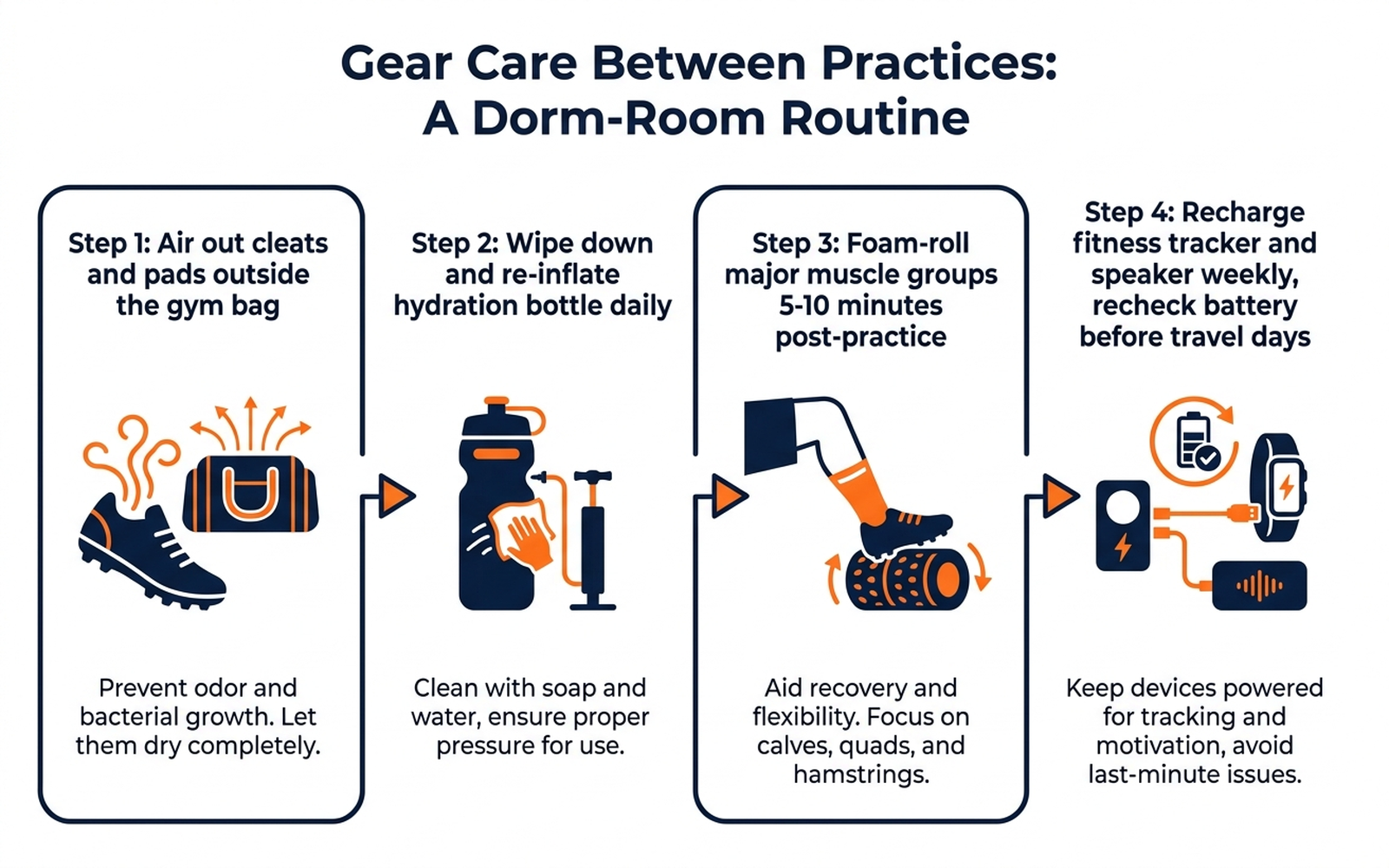
Aggregated reviews and forum complaints across this product set share a common thread: gear that fails early is usually gear that wasn’t given a chance to dry out or recharge between sessions, not gear that was inherently low quality. Airing out cleats outside a sealed gym bag, cleaning and re-pressurizing a hydration bottle, foam-rolling for even five to ten minutes post-practice, and keeping a tracker and speaker charged ahead of travel days are all low-effort habits that show up repeatedly in longer-term reviews as the difference between gear lasting a full season and gear failing within a few months.
Comparison Table
Prices as of 2026-09-25 — check the live listing before buying, as Amazon prices change frequently.
| Product | Category | Key Spec | Price |
|---|---|---|---|
| Nike Tiempo Legend 10 Club Turf | Footwear | Synthetic-leather upper, turf-rubber outsole | ~$64.99 |
| Amazon Basics Foam Roller (18”) | Recovery | High-density EPP foam | ~$14.99 |
| Kinetic Labs Ice Pack Wrap | Recovery | Elastic-strap gel wrap | ~$24.99 |
| WHATAFIT Resistance Bands Set | Strength/Mobility | 5 bands, stacks to 100 lbs (mfr.) | ~$29.99 |
| Liquid I.V. Hydration Multiplier (16-ct) | Hydration/Nutrition | ~500 mg sodium per packet (mfr.) | ~$24.99 |
| Adidas Defender III Medium Duffel | Storage | Bottom shoe compartment | ~$40.00 |
| Amazfit Band 7 | Wearable Tech | 18-day battery (mfr.), SpO2 + HR | ~$49.99 |
| JBL Clip 4 | Portable Audio | IP67, ~10-hr battery (mfr.) | ~$59.95 |
Decision Flowchart: Which Gear by Sport
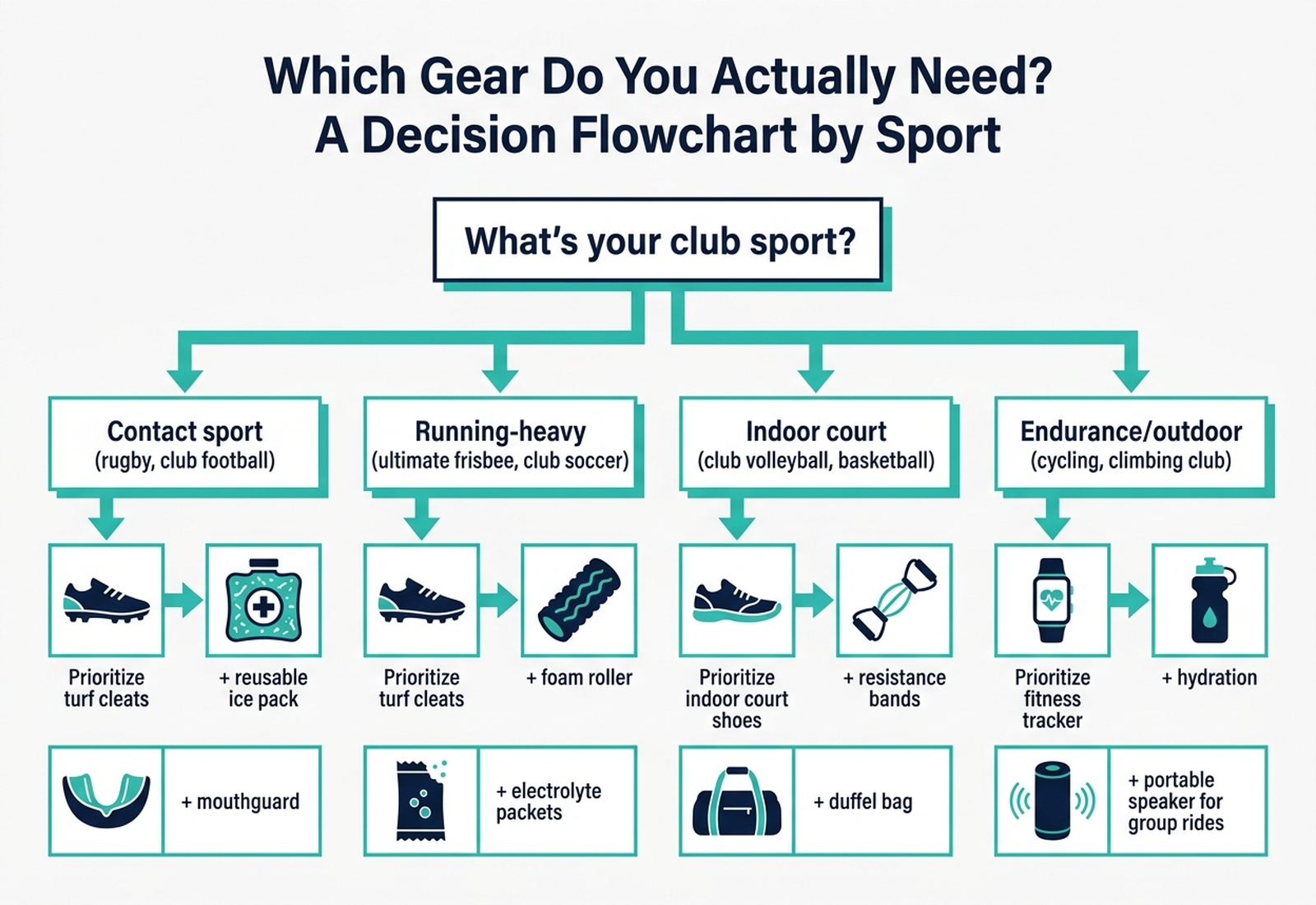
Not every club athlete needs every item on this list. Contact sports like rugby or club football put the most weight on protective and recovery gear — turf cleats plus a reusable ice pack and a mouthguard. Running-heavy sports like ultimate frisbee or club soccer lean on footwear and muscle recovery — turf cleats plus a foam roller and electrolyte packets for two-a-day tournament schedules. Indoor court sports like club volleyball or basketball shift the priority toward indoor court shoes, resistance bands for shoulder and knee prehab, and a duffel bag for gym storage. Endurance and outdoor club sports like cycling or climbing prioritize a fitness tracker for pacing and recovery tracking, hydration, and a portable speaker for group rides or shared training sessions.
Warranty and Support
Per each brand’s published US warranty terms, Nike’s Club-tier cleats carry the standard Nike US limited warranty against manufacturing defects, though normal stud wear from turf and hard-ground play is explicitly excluded, consistent with footwear warranty norms across the industry. Amazon Basics products are covered by Amazon’s own return policy rather than a traditional manufacturer warranty, which aggregated reviews describe as straightforward for defective units within the standard return window. Adidas backs the Defender III duffel with a limited warranty against manufacturing defects in materials and workmanship; normal wear from being crammed into a dorm closet or checked as travel luggage is not covered. Amazfit’s Band 7 carries a standard one-year limited warranty in the US, with the battery pack — the most likely long-term wear component — typically the first part to degrade after repeated daily charge cycles. JBL covers the Clip 4 under a standard one-year limited warranty; the waterproof rating is a design feature, not an insurance policy, and reviewers note that submersion beyond the IP67 rating’s depth and time limits is not a covered failure mode.
Editorial Recommendation
- Best overall starting kit for a first-semester club athlete: Nike Tiempo Legend 10 Club Turf cleats plus the Adidas Defender III duffel — footwear and storage are the two items every club sport shares, and aggregated reviews show both holding up across a full season.
- Best for injury-prone or contact sports: add the Kinetic Labs ice pack wrap and a mouthguard to the base kit — the elastic-strap design makes solo icing realistic in a dorm setting without an athletic trainer present.
- Best value across categories: the Amazon Basics foam roller, WHATAFIT resistance bands, and Liquid I.V. electrolyte packets together cost less than a single pair of premium cleats, and Wirecutter’s own testing found the cheaper foam roller performs equivalently to pricier models.
- Best for multi-sport or endurance club members: the Amazfit Band 7 and JBL Clip 4 cross over cleanly between cycling, climbing, and any sport with a pacing or group-training component.
- Skip regardless of budget: unbranded, unreviewed turf shoes from unfamiliar sellers — aggregated complaint patterns across the footwear category consistently link the cheapest no-name cleats to early sole separation and stud wear, the opposite of where a tight student budget should go first.
Limitations
This analysis relies on publicly available Amazon customer reviews, third-party buying-guide and lab-test coverage from Wirecutter, Reviewed, Tom’s Guide, and Garage Gym Reviews, manufacturer-published specifications, and publicly reported college-sports participation statistics; we did not independently test cleat durability, foam-roller density, or tracker battery life under controlled conditions. Manufacturer-published figures (battery life, sodium content, IP ratings, resistance-band poundage) are cited as manufacturer claims, not independently re-measured facts. Amazon does not expose an exact, audited review count per listing, so review-based observations in this article describe sentiment patterns rather than a precise statistical sample size. Individual experience may vary based on sport, position, body size, storage conditions, and how heavily a given item is used across a season. Prices listed reflect Amazon US at the time of writing and change frequently, including seasonal promotions not captured in the table above.
- Nike Tiempo Legend 10 Club Turf Soccer Shoes
- Amazon Basics High-Density Round Foam Roller (18-inch)
- Kinetic Labs Reusable Ice Pack Wrap
- WHATAFIT Resistance Bands Set with Handles
- Liquid I.V. Hydration Multiplier, Lemon Lime, 16-count
- Adidas Defender III Medium Duffel Bag
- Amazfit Band 7
- JBL Clip 4 Portable Bluetooth Speaker
Visit Arekore to verify current pricing and availability on any product mentioned here before buying.