Best Gas Grills in 2026: Weber vs Traeger vs Char-Broil
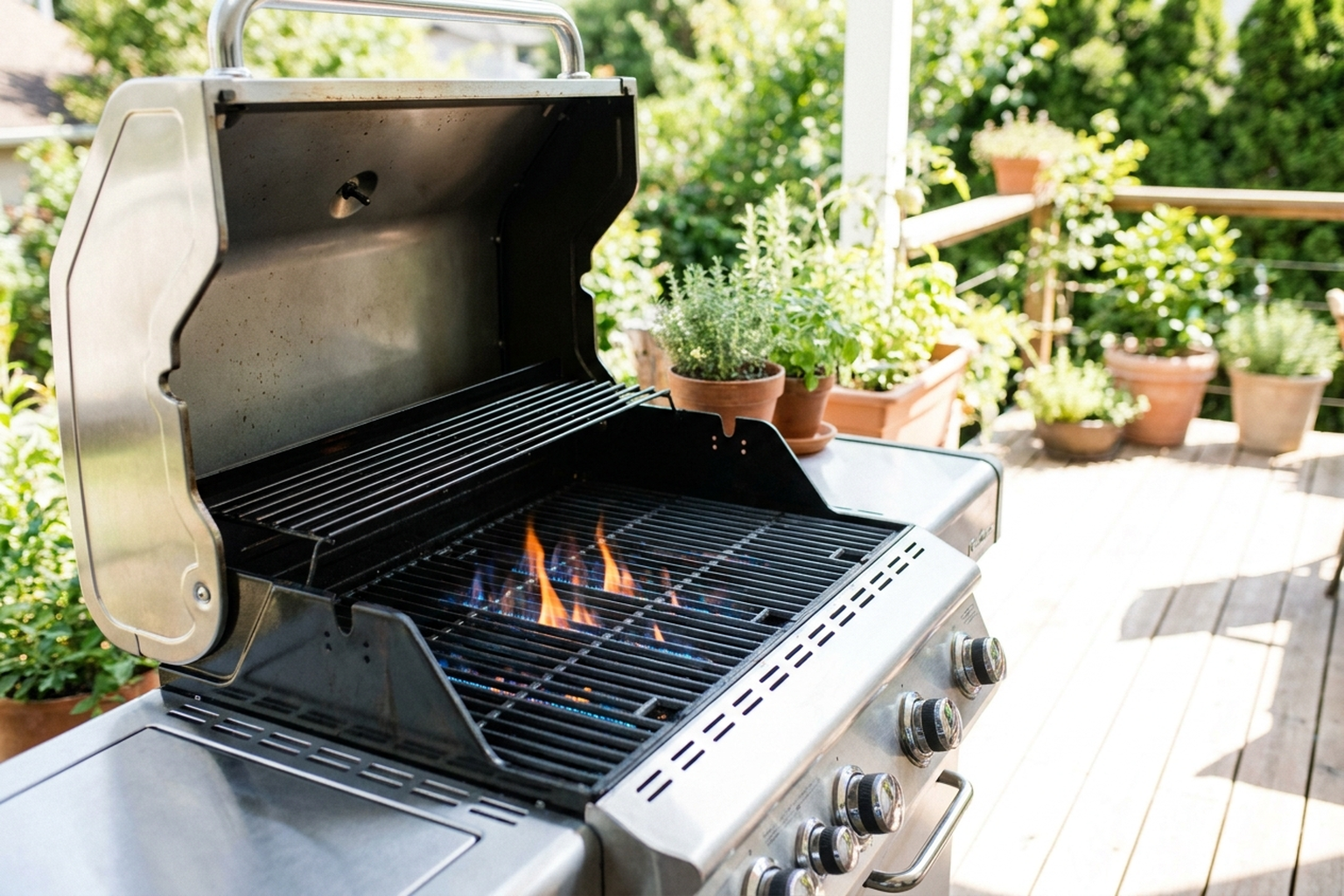
Weber and Char-Broil have been the default gas-grill cross-shop for decades: one is the brand backyard cooks trust to last, the other is the brand that makes a real backyard grill affordable. Traeger complicates that picture — a company built on wood-pellet smokers that, in the last two years, pushed into propane with the Flatrock line, a flat-top griddle rather than a traditional open-grate grill. This guide compares all three head-to-head using Consumer Reports test data, aggregated Amazon customer sentiment, and manufacturer specifications, rather than repeating a generic “best grills” roundup.
As an Amazon Associate, Arekore earns from qualifying purchases. The Amazon product links in this article include our affiliate tracking ID and may earn us a commission if you buy through them, at no additional cost to you. See our Links Policy for details on how we select products and how commissions do not influence our recommendations.
TL;DR / Quick Verdict
- Best overall for most backyard cooks: the Weber Genesis E-325S — Consumer Reports and independent reviewers consistently credit Weber’s porcelain-enameled cast-iron grates and burner design with the most even heat of the three brands, backed by a warranty that runs up to 10 years on major components.
- Best value traditional grill: the Char-Broil Performance Series 4-Burner — TRU-Infrared cooking technology that reduces flare-ups, at roughly half the price of a comparable Weber.
- Best budget entry point: the Char-Broil Classic 360 3-Burner — under $230 with a 4.5-star Amazon average across thousands of ratings, the cheapest capable gas grill in this comparison.
- Best if you actually want a griddle, not a grill: the Traeger Flatrock — a propane flat-top with independently controlled heat zones, built for smash burgers, breakfast, and stir-fry rather than grill-marked steaks. It is not a drop-in replacement for a grates-based grill, and Traeger does not currently sell a traditional open-grate propane grill.
- The factor buyers underweight: material quality at the burner and grate level. Char-Broil’s entry-level steel tends to show rust within a few years in humid climates; Weber’s heavier-gauge stainless and porcelain-enameled grates hold up longer, which is most of what the price difference buys.
How We Reached These Conclusions (Methodology)
This is an editorial analysis, not a hands-on review; we did not personally test the products covered here. This guide synthesizes three kinds of public information: (a) aggregated amazon.com customer ratings and the substance of reviews, sampled in October 2026 — for example, the Char-Broil Classic 360 shows an average rating around 4.5 out of 5 across more than 3,300 ratings; (b) independent third-party testing and reporting, principally Consumer Reports’ annual gas-grill test program, which scores grills on heat evenness, preheat speed, indirect-cooking performance, and convenience; and (c) manufacturer specifications for BTU output, cooking area, and warranty terms. Where we cite a manufacturer figure — BTU rating, cooking-surface square inches — we label it as a manufacturer claim rather than an independently verified result. Prices are amazon.com figures at the time of writing and change frequently.
Technical Approach: Grates, Infrared, and Flat-Top
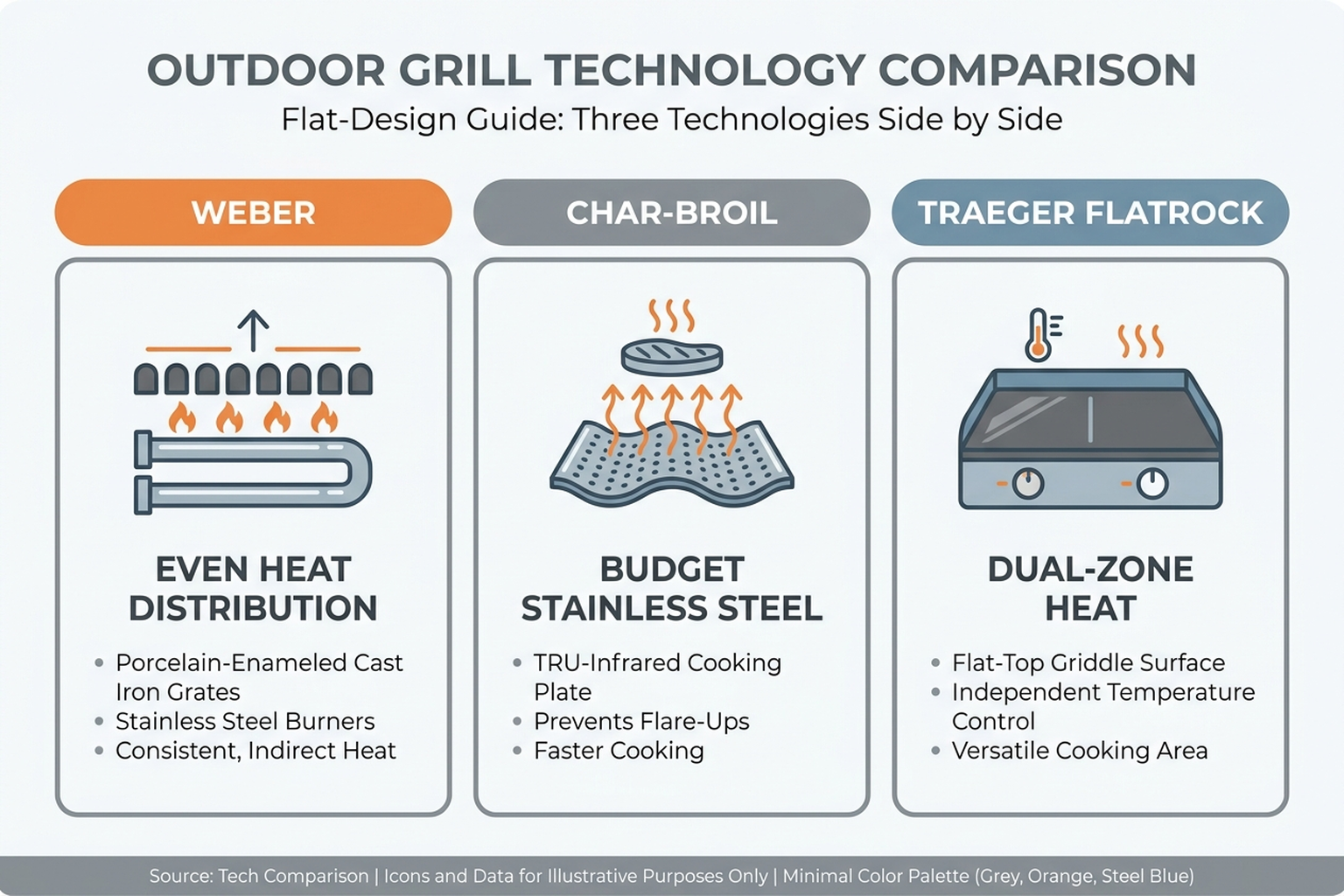
The three brands are not just different price points — they are built around genuinely different cooking technology.
- Weber: heavier-gauge stainless with porcelain-enameled cast-iron grates. Weber’s mid-to-flagship Genesis and Spirit lines pair stainless-steel burner tubes with cast-iron grates finished in porcelain enamel, which resists rust better than bare or painted steel and retains heat well for searing. Weber’s own BTU ratings on these lines run lower than Char-Broil’s (roughly 32,000–39,000 BTU across Genesis models, manufacturer claim) — reviewers consistently note that Weber’s advantage is heat evenness and fuel efficiency, not raw output.
- Char-Broil: TRU-Infrared cooking plate over the burners. Instead of exposing food directly to an open flame, Char-Broil’s TRU-Infrared system places a perforated plate between the burner and the grates, which Char-Broil says spreads heat more evenly and reduces flare-ups from dripping fat (manufacturer claim). Char-Broil’s burners run hotter on paper — the Performance Series is rated around 36,000–48,000 BTU depending on configuration (manufacturer claim) — but most Char-Broil grill bodies use a lighter-gauge steel than Weber’s, which is the main reason Char-Broil costs less and tends to show wear sooner.
- Traeger Flatrock: a propane flat-top griddle, not an open-grate grill. The Flatrock line runs U-shaped burners beneath a solid steel griddle surface rather than grates, with independently controlled “TruZone” heat areas so one side can hold a warm temperature while the other sears (manufacturer claim). This is a fundamentally different cooking format — no grill marks, no direct flame contact — closer to a smash-burger or teppanyaki setup than to a traditional backyard grill. Buyers who specifically want grill-marked steaks or kebabs should not substitute a Flatrock for a Weber or Char-Broil; buyers who cook a lot of breakfast, stir-fry, or smash burgers may prefer it.
- Warranty. Weber backs its Genesis-line stainless steel burner tubes and cast-iron cooking grates with a 10-year warranty, and most other components for 5 years. Char-Broil’s warranties are shorter and vary by part — commonly 1 to 5 years depending on the component — reflecting the lighter materials used. Traeger covers the Flatrock’s main components for 3 years.
Head-to-Head: Flagship Traditional Grill (~$700–$950)
Weber Genesis E-325S is Weber’s mainstream flagship: three stainless-steel burners rated around 39,000 BTU (manufacturer claim), porcelain-enameled cast-iron cooking grates, a side burner, and Weber’s “Grease Management System” that channels drippings into a removable catch pan rather than letting them pool and flare up. Consumer Reports’ testing program has repeatedly placed Weber’s Genesis-class grills among the top performers for heat evenness across the full cooking surface — a trait reviewers single out as the brand’s core strength over cheaper competitors. On Amazon, Genesis-line grills carry ratings in the high 4-star range, with the most common complaints centered on assembly difficulty and occasional shipping damage rather than the grill’s cooking performance itself. It typically lists in the $850–$950 range (as of 2026-10-05).
Check the Weber Genesis E-325S on Amazon
Verdict at this tier: there is no direct Char-Broil or Traeger competitor at this exact format and price — Char-Broil’s comparable 4-burner tops out well below Weber on price and build quality, and Traeger does not sell a traditional open-grate grill at any price. For buyers who specifically want the most durable, most evenly heating traditional gas grill and are willing to pay for it, the Genesis E-325S is the category benchmark.
Head-to-Head: Mid-Tier Traditional Grill (~$170–$530)
Char-Broil Performance Series 4-Burner (with side burner) runs TRU-Infrared cooking technology across four main burners plus a dedicated side burner, with a stainless-steel firebox and lid over a lighter-gauge steel cart and cabinet. It is the clearest “serious backyard grill at half the price” option in this comparison. Aggregated Amazon reviews frequently praise the reduced flare-ups the infrared plate delivers and the value of getting a side burner and four main burners at this price point; the most common criticism is rust developing on the cart and lower-grade steel components within two to three years, especially without a cover. It typically runs $480–$530 on Amazon (as of 2026-10-05).
Check the Char-Broil Performance Series 4-Burner on Amazon
Weber Spirit II E-310 is Weber’s entry into the “real Weber quality, smaller format” category: three burners rated around 30,000 BTU (manufacturer claim), porcelain-enameled grates, and the same Grease Management System as the Genesis line, in a more compact footprint without a side burner. It is the pick for buyers who want Weber’s build quality and warranty without paying flagship prices. It typically lists around $550–$650 on Amazon (as of 2026-10-05), with periodic sales bringing it closer to $450.
Check the Weber Spirit II E-310 on Amazon
Char-Broil Classic 360 3-Burner strips things down further: three burners rated around 30,000 BTU (manufacturer claim), porcelain-coated steel grates (not cast iron), and a simple cart with side shelves, no side burner, no infrared plate. It is one of the most-reviewed gas grills on Amazon at this price, with a 4.5-star average across more than 3,300 ratings — reviewers consistently cite it as “good enough” entry hardware for someone grilling occasionally rather than daily. It typically runs $170–$230 on Amazon (as of 2026-10-05), making it the cheapest capable grill in this entire comparison.
Check the Char-Broil Classic 360 3-Burner on Amazon
Verdict at this tier: the Char-Broil Classic 360 is the value pick for anyone testing whether they’ll actually use a grill regularly. The Char-Broil Performance Series is the step up for buyers who grill often and want infrared’s flare-up control without Weber pricing. The Weber Spirit II E-310 costs more than either Char-Broil but buys Weber’s longer-lasting grates and stronger warranty in a smaller format than the Genesis.
The Flat-Top Alternative: Traeger Flatrock
Traeger’s Flatrock line is propane-powered but cooks nothing like a Weber or Char-Broil. The Flatrock 2-Burner offers a 26-inch flat-top griddle surface (468 square inches of total cooking space, manufacturer claim) with two independently controlled heat zones and typically lists around $699 on Amazon (as of 2026-10-05). The larger Flatrock 3-Burner steps up to a 33-inch, 594-square-inch griddle (manufacturer claim) with three heat zones and a built-in propane level sensor, typically running $799–$899.
Check the Traeger Flatrock 2-Burner on Amazon Check the Traeger Flatrock 3-Burner on Amazon
Independent griddle-focused reviewers have generally concluded the Flatrock’s build quality and even heat justify its premium over cheaper flat-top griddles, crediting the U-shaped burner design with eliminating the hot spots common on budget griddles. It is a genuine option for buyers whose outdoor cooking is mostly breakfast, smash burgers, quesadillas, and stir-fry — not for anyone who wants grill marks or wants to cook directly over an open flame. Because this is a different product category from a traditional gas grill, we have not placed it in the same price-tier comparison as the Weber and Char-Broil models above.
Customer Sentiment Synthesis
- Weber Genesis and Spirit owners most often cite even cooking, reliable ignition, and grates that still look and perform well after years of use — the most common complaint is the time and awkwardness of initial assembly, not the grill’s performance.
- Char-Broil Classic 360 owners overwhelmingly cite value for money given the price, with the most common critical theme being rust on the cart and lower-grade steel parts appearing within a couple of years, especially without a cover.
- Char-Broil Performance Series owners frequently praise the TRU-Infrared system’s reduction in flare-ups and the convenience of the included side burner, with similar durability complaints as the Classic line showing up on the cart and cabinet components over time.
- Traeger Flatrock owners, per aggregated reviews and griddle-focused outlets, consistently note the griddle justifies its price versus cheaper flat-tops on heat evenness, with the main pushback being that buyers expecting a traditional grill experience are disappointed by the lack of grates and open flame.
- Net read: sentiment favors Weber on longevity and consistent heat, Char-Broil on upfront value with a real durability tradeoff in humid or uncovered conditions, and Traeger’s Flatrock as a well-regarded but fundamentally different product that only fits buyers who specifically want a flat-top.
Side-by-Side Comparison
| Model | ASIN | Format | Burners | Output (mfr. claim) | Warranty | Approx. price (as of 2026-10-05) |
|---|---|---|---|---|---|---|
| Char-Broil Classic 360 3-Burner | B01HITNEEE | Open-grate | 3 | ~30,000 BTU | 1–5 yr (varies by part) | $170–$230 |
| Char-Broil Performance Series 4-Burner | B09GXGX7BX | Open-grate, TRU-Infrared | 4 + side | ~36,000–48,000 BTU | 1–5 yr (varies by part) | $480–$530 |
| Weber Spirit II E-310 | B0783GVCFV | Open-grate | 3 | ~30,000 BTU | 10 yr (burners/grates), 5 yr (other) | $550–$650 |
| Weber Genesis E-325S | B09MV1JNGK | Open-grate | 3 + side | ~39,000 BTU | 10 yr (burners/grates), 5 yr (other) | $850–$950 |
| Traeger Flatrock 2-Burner | B0FFF9Y7YY | Flat-top griddle | 2 zones | N/A (griddle) | 3 yr | ~$699 |
| Traeger Flatrock 3-Burner | B0CS4PN33B | Flat-top griddle | 3 zones | N/A (griddle) | 3 yr | $799–$899 |
BTU and cooking-area figures are manufacturer specifications; the Consumer Reports evenness ranking and Amazon review averages cited above are independently sourced. Prices fluctuate — verify the current amazon.com price before buying.
Market Context: Why Gas Still Leads the Grill Market
The US barbeque grill market is valued at roughly $1.4 billion in 2026 and growing at a compound annual rate near 3%, with gas remaining the single largest fuel-type segment at close to 48% share, ahead of charcoal and pellet, according to Mordor Intelligence’s 2026 US barbeque grill market report. That share reflects convenience over flavor purism: gas grills light instantly, hold a set temperature without tending, and don’t require managing charcoal or wood pellets. Within the gas segment, pricing splits cleanly into the tiers this comparison covers — a sub-$300 mass-market band where Char-Broil and similar budget brands dominate, a $300–$700 mid-tier where Char-Broil’s higher configurations and Weber’s smaller models compete directly, and a $700-plus premium tier Weber has built its reputation on. Traeger’s move into propane with the Flatrock line is itself notable market context: a brand built entirely on wood-pellet smoking diversifying into a different cooking format and fuel type signals how much consumer demand has grown for flat-top outdoor griddles specifically, a category that barely existed five years ago.
How to Decide
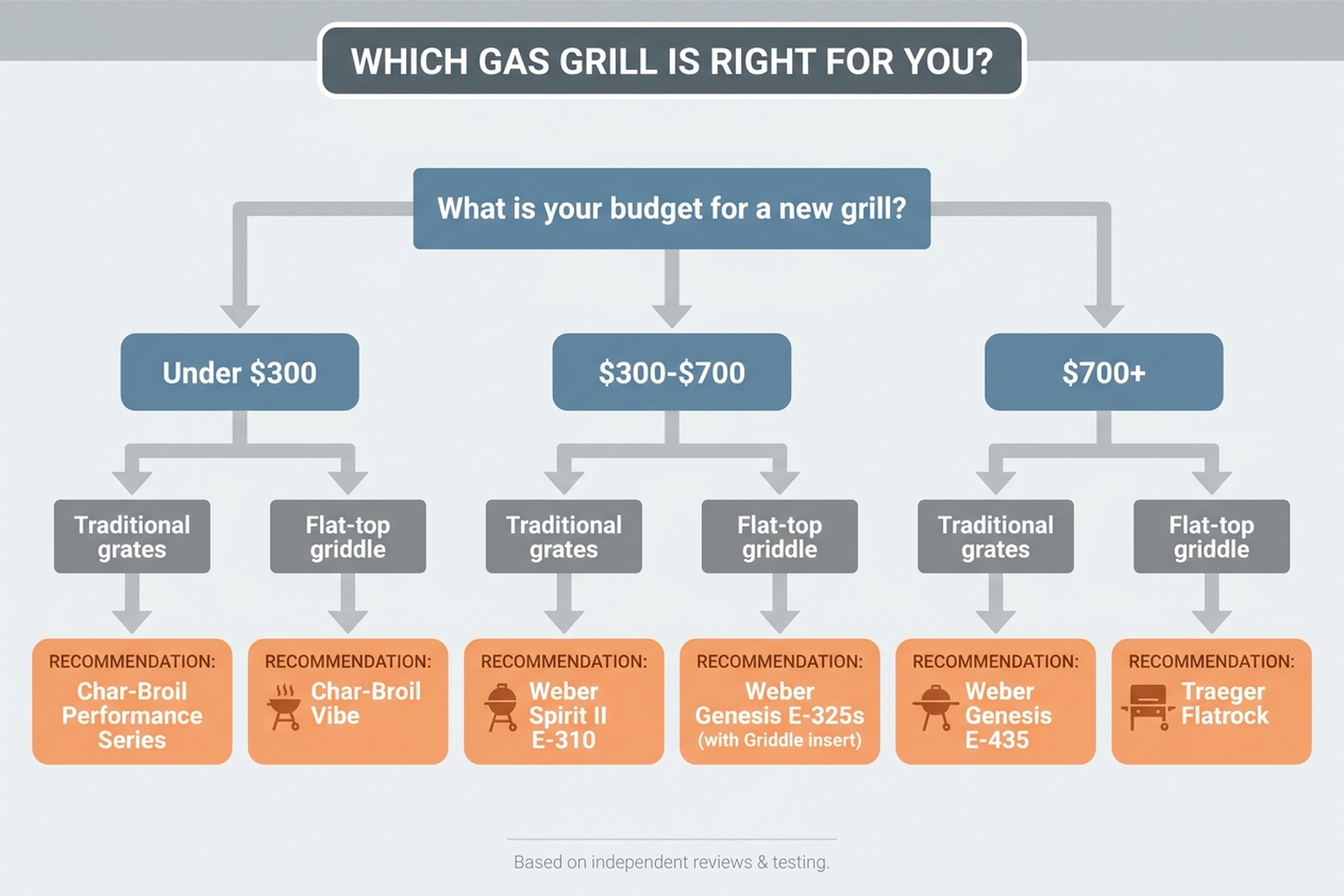
Start with what you actually cook, not the sticker price. If you want grill marks on steaks, burgers, and kebabs over a direct flame, you want a traditional open-grate grill — a Traeger Flatrock will not do that job. From there, the main decision is budget and how long you want the grill to last: a sub-$300 Char-Broil Classic is fine for occasional grilling if you’re willing to replace it or deal with rust in a few years, a $500-ish Char-Broil Performance buys infrared flare-up control and a side burner, and a Weber Spirit or Genesis buys materials that are genuinely built to outlast the others. If your actual cooking is more breakfast, smash burgers, and stir-fry than steaks, skip the grates entirely and look at the Traeger Flatrock instead.
Editorial Recommendation by Use Case
- You want the most durable, most evenly heating traditional grill and can spend accordingly: the Weber Genesis E-325S.
- You want real Weber build quality in a smaller, cheaper package: the Weber Spirit II E-310.
- You grill often and want flare-up control and a side burner without Weber pricing: the Char-Broil Performance Series 4-Burner.
- You grill occasionally and want the cheapest capable option: the Char-Broil Classic 360 3-Burner, with a cover from day one to slow the rust that shows up in reviews.
- Your outdoor cooking is mostly breakfast, smash burgers, or stir-fry, not steaks: the Traeger Flatrock — just understand it’s a griddle, not a grill, before buying.
Limitations
This analysis relies on publicly available reviews, Consumer Reports’ test program, and manufacturer specifications; we did not independently lab-test these units. BTU output is a manufacturer claim and is not a reliable standalone measure of real-world cooking performance, which also depends on burner design, grate material, and lid insulation. Amazon review sentiment reflects aggregated public feedback at the time of writing and can shift as new reviews accumulate. Prices and availability were accurate to our research at the time of writing and change frequently — verify current specs and pricing on the product page before buying.
Before you buy any of these grills, it pays to check that a listing’s reviews are genuine and that a sale price is an actual discount rather than an inflated “was” price. That is exactly what Arekore does: paste the Amazon URL and our AI analyzes review authenticity, surfaces the most useful low-star feedback, and compares pricing in about five minutes — so you end up with the grill that actually fits how you cook, not just the one with the most burners on the spec sheet.