Best Food Processors 2026: Cuisinart vs KitchenAid

TL;DR
For most households, the Cuisinart Custom 14-Cup (DFP-14BCNY) is the safest pick — it has topped Wirecutter’s food processor testing for years on the strength of its 720-watt motor, large bowl, and compact footprint. Households that already own a stand mixer and want tighter kitchen integration, or need finer slicing control, should look at the KitchenAid 13-Cup (KFP1318), whose Exact Slice disc and storage caddy stand out in Consumer Reports’ lab tests. Budget-conscious buyers who mainly need quick chopping and puréeing are well served by the Ninja Professional Plus (BN601), which undercuts both rivals on price but trails them on raw bowl capacity.
Methodology
This analysis synthesizes (a) aggregated Amazon US customer reviews for the three products covered, sampled in October 2026 (exact sample size not precisely reportable, since Amazon does not expose a fixed review count for a point-in-time sample), (b) third-party test data from Wirecutter (NYT), Consumer Reports, and America’s Test Kitchen, and (c) manufacturer specification sheets. We did not personally test the products covered here.
Technical Approach: Motor Design and Bowl Geometry
The three processors differ less in raw wattage than in how that power reaches the blade, which is the main driver of the performance gaps independent testers report.
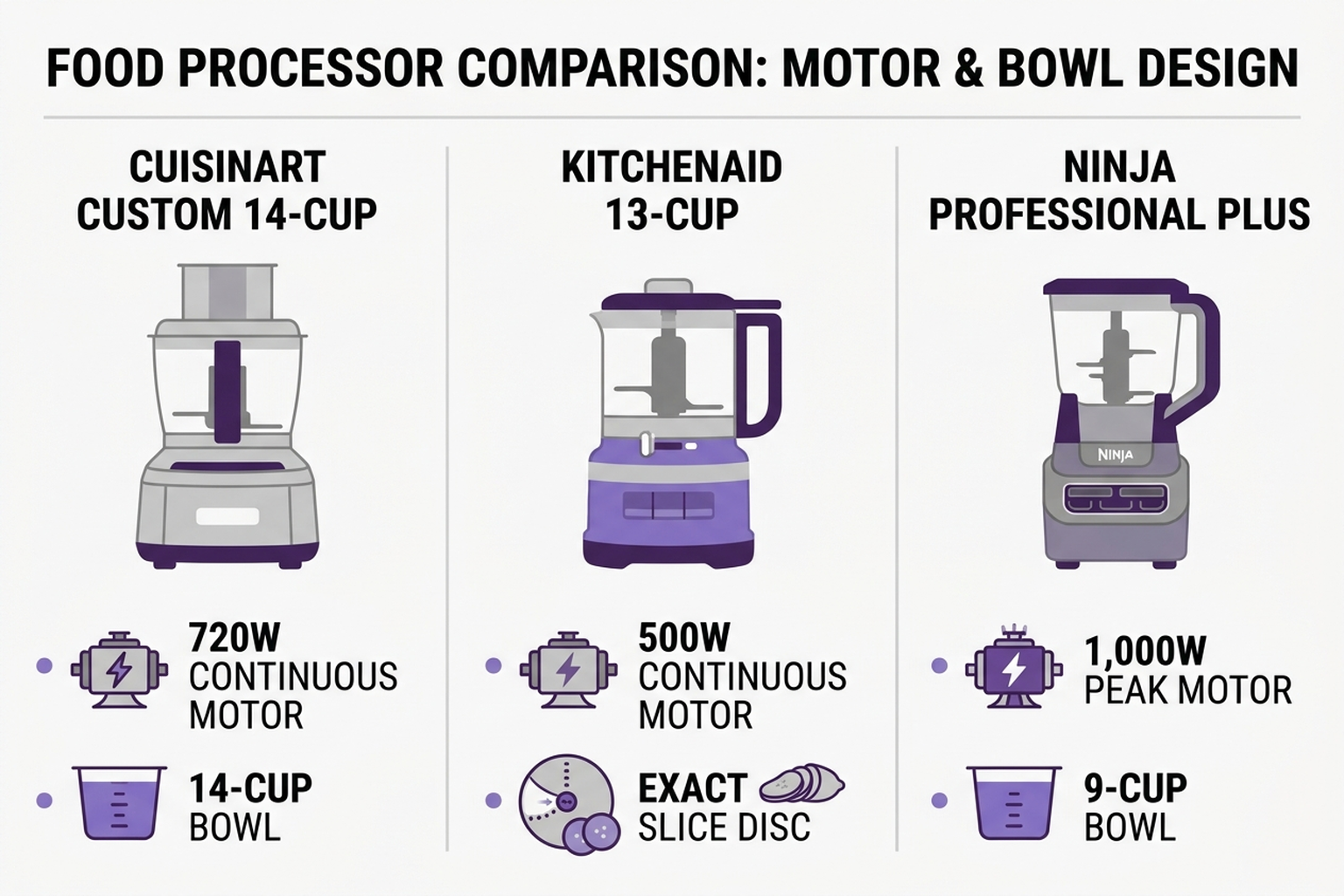
- Cuisinart Custom 14-Cup (720 continuous watts, 14-cup bowl): Uses a direct-drive motor rated for continuous duty rather than a short burst, which Wirecutter’s testing credits for the unit’s ability to knead dense bread dough without stalling. The wide, shallow bowl shape keeps ingredients close to the blade for more uniform chopping.
- KitchenAid 13-Cup (500 continuous watts, 13-cup bowl): Pairs a lower continuous-wattage motor with an externally adjustable Exact Slice disc, letting users change slice thickness without swapping discs mid-task — a feature Consumer Reports highlighted as a meaningful usability edge in slicing tests.
- Ninja Professional Plus (1,000 peak watts, 9-cup bowl): Ninja’s spec sheet lists peak (not continuous) wattage, a manufacturer figure that is not directly comparable to the Cuisinart and KitchenAid continuous-duty ratings. In practice, reviewers and bestreviews.com’s hands-on testing describe it as very capable at quick chopping and purée tasks delivered through Auto-iQ presets, but the smaller bowl caps batch size for large-volume prep.
Manufacturer Details
Cuisinart markets the Custom 14-Cup (DFP-14BCNY) around its 720-watt motor and what the company describes as a “simple, smooth” bowl design that keeps the feed tube out of the way for better visibility during use — a manufacturer framing that Wirecutter’s testers independently corroborated, noting the processor achieved uniform, fast results with low noise across repeated test batches.
KitchenAid, a brand most US shoppers already associate with stand mixers, positions the KFP1318 around its Exact Slice system and an all-in-one storage caddy that nests the blades and discs inside the bowl. KitchenAid’s materials describe the twist-free, one-click bowl assembly as reducing setup friction, a claim Consumer Reports’ lab tests generally supported, though CR rated the KitchenAid models closer to Cuisinart and Breville on overall chopping performance than on any single standout category.
Ninja frames the BN601 Professional Plus around its Auto-iQ one-touch programs — chop, purée, dough, and shred — as a manufacturer claim about convenience rather than raw processing power. Ninja does not publish independent third-party lab validation specifically for the BN601’s chopping uniformity; most of the detailed comparative data on this model comes from retail and buying-guide testing rather than outlets like Consumer Reports or Wirecutter, which have historically focused their food processor coverage on the Cuisinart and KitchenAid lines.
Customer Sentiment Synthesis
Aggregated Amazon customer reviews and cross-referenced retail reviews point to a few consistent patterns:
- Cuisinart Custom 14-Cup: The dominant praise theme is capacity paired with a relatively compact footprint — reviewers frequently note it handles large batches (bread dough, big-batch slaw) without the bowl feeling cramped. The most common complaint cluster involves the disc-storage case, which several reviewers describe as bulky and awkward to store in a standard cabinet.
- KitchenAid 13-Cup: Reviewers’ top praise theme is slicing precision and brand trust carried over from KitchenAid’s stand mixer reputation. The most frequent complaint is price relative to the Cuisinart at a similar capacity, along with occasional reports of the locking lid mechanism feeling stiff when new.
- Ninja Professional Plus: Praise clusters heavily around value and the one-touch Auto-iQ programs, with reviewers frequently calling it an easy first food processor for smaller kitchens. When reviewers specifically discuss large-batch tasks, the sentiment is more mixed — several note the 9-cup bowl fills up faster than expected for recipes written around a 12- to 14-cup capacity.
Comparison Table
| Model | Price (as of 2026-10-25) | Capacity | Motor | Best For | Amazon Rating |
|---|---|---|---|---|---|
| Cuisinart Custom 14-Cup (DFP-14BCNY) | $199.95 | 14 cups | 720W continuous | Overall best, large batches | 4.7★ (sampled listings) |
| KitchenAid 13-Cup (KFP1318CU) | $179.99 | 13 cups | 500W continuous | Precision slicing, stand-mixer households | 4.6★ (sampled listings) |
| Ninja Professional Plus (BN601) | $109.99 | 9 cups | 1,000W peak | Budget, smaller kitchens | 4.7★ (sampled listings) |
Prices are Amazon list prices sampled as of the stated date and change frequently with promotions and lightning deals; check the current listing before buying.
How to Use: Getting Even Results From Any Food Processor
Regardless of which model you buy, a few habits reviewers and manufacturers both point to make the biggest difference in results.
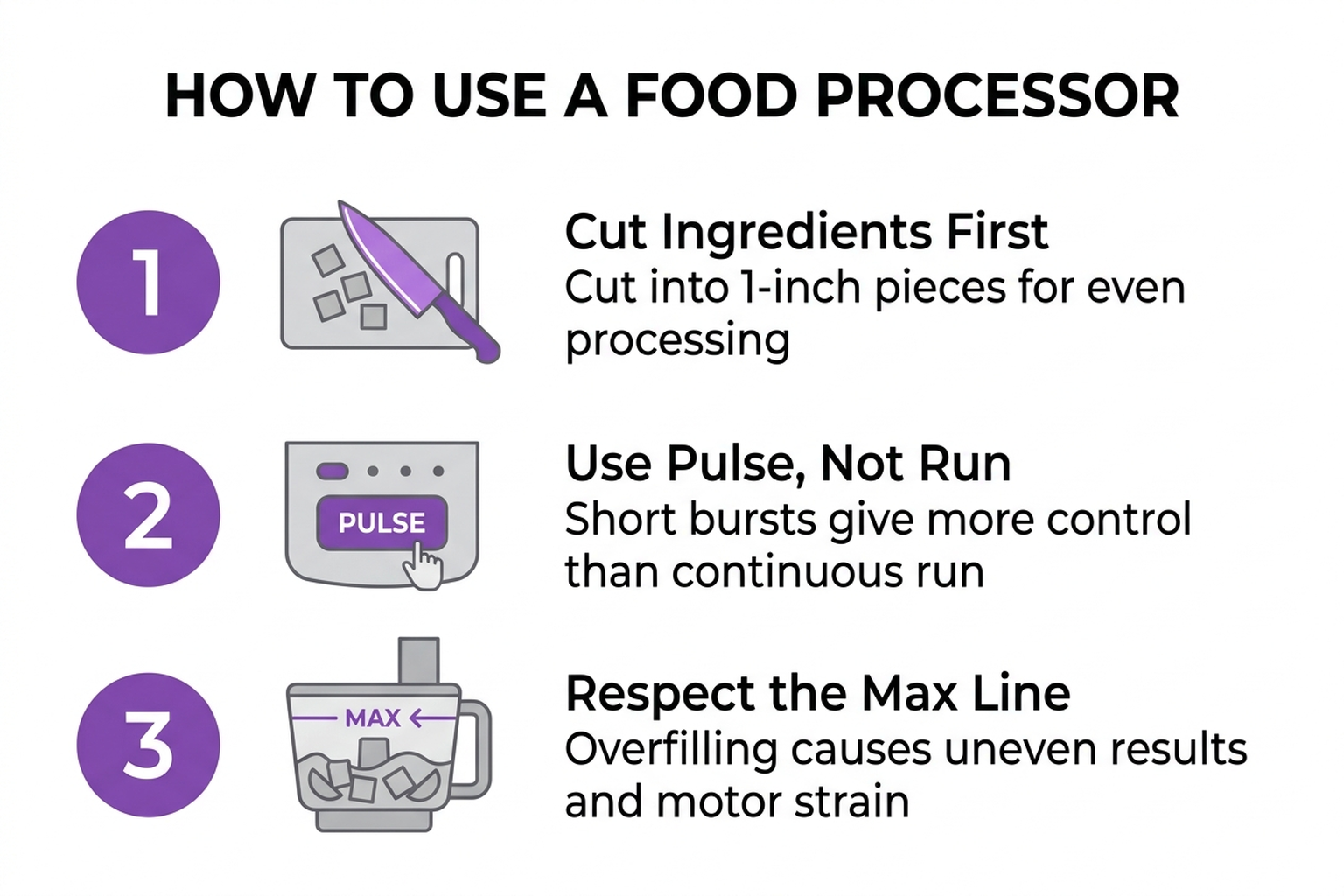
Manufacturer manuals for all three brands recommend cutting ingredients into roughly 1-inch pieces before adding them to the bowl, since oversized chunks chop unevenly regardless of motor power. Independent testers at America’s Test Kitchen consistently favor the pulse setting over continuous run for chopping tasks, noting that a few short pulses give far more control over texture than letting the blade spin continuously — a habit that reduces the risk of turning diced onion into onion purée. All three manufacturers also warn against filling the bowl past its marked maximum line; overfilling is one of the most common causes of uneven chopping and, over time, added motor strain.
Which One Should You Buy?
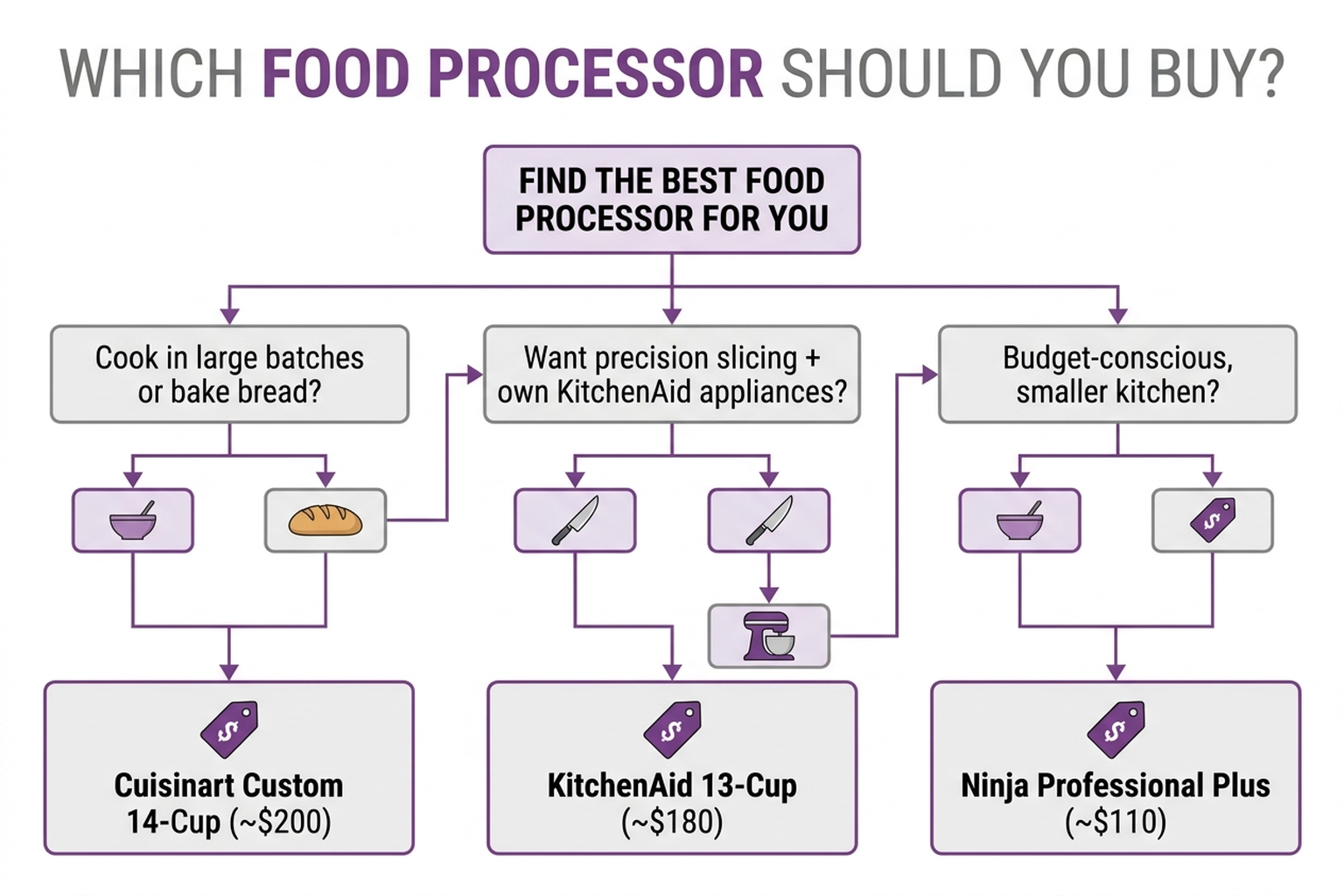
- Best for most people: Cuisinart Custom 14-Cup — the long-running top pick in Wirecutter’s testing, with a continuous-duty motor and bowl capacity that handles both everyday chopping and occasional bread dough.
- Best for precision slicing: KitchenAid 13-Cup — the externally adjustable Exact Slice disc and storage caddy stand out in Consumer Reports’ lab tests, and it fits naturally into kitchens already built around KitchenAid appliances.
- Best on a budget: Ninja Professional Plus — the lowest price of the three by a wide margin, with Auto-iQ presets that cover the most common tasks, at the cost of a smaller 9-cup bowl.
Limitations
This analysis relies on publicly available reviews, manufacturer specifications, and third-party test data from Wirecutter, Consumer Reports, and America’s Test Kitchen. Individual experience may vary based on task type (large-batch prep vs. quick chopping), cooking frequency, and unit-to-unit manufacturing variance. Ninja’s published 1,000-watt figure is a peak-wattage spec and is not directly comparable to the continuous-duty wattage ratings Cuisinart and KitchenAid publish. Prices shown are Amazon list prices as of the stated date and change frequently with promotions; check the current Amazon listing before buying.
As an Amazon Associate, Arekore earns from qualifying purchases. The Amazon product links in this article include our affiliate tracking ID and may earn us a commission if you buy through them, at no additional cost to you. See our Links Policy for details on how we select products and how commissions do not influence our recommendations.
Products Mentioned
- Cuisinart Custom 14-Cup Food Processor (DFP-14BCNY)
- KitchenAid 13-Cup Food Processor (KFP1318CU)
- Ninja Professional Plus Food Processor, 9-Cup (BN601)
Verify current pricing, availability, and specifications on the Amazon product page before purchasing — we do not guarantee prices stay current after publication.