Best Espresso Machines 2026: Breville vs De'Longhi vs Gaggia
TL;DR
For most first-time buyers who want café-quality shots with the least fuss, the Breville Barista Express remains the category benchmark — its built-in conical burr grinder and digital PID temperature control let most owners pull a decent shot within their first hour of ownership. Buyers who want a bean-to-cup workflow with an automated, dishwasher-safe milk system should look at the De’Longhi La Specialista Arte, which trades some grind-setting granularity for a steam wand aggregated reviews consistently praise. Buyers who prioritize long-term repairability and a genuine upgrade path over convenience should choose the Gaggia Classic Pro, a commercial-style semi-automatic that requires a separate grinder but is widely described as serviceable for decades.
Methodology
This analysis synthesizes (a) aggregated Amazon US customer reviews for the three machines covered, sampled in September 2026, (b) independent test data and editorial reviews from Consumer Reports, Reviewed (USA Today), Tom’s Guide, and TechGearLab, (c) manufacturer specification sheets and warranty documentation, and (d) US home-espresso-machine market data from Mordor Intelligence and Cognitive Market Research. We did not personally test the products covered here.
Technical Approach: Three Different Workflows
These three machines are not just different price tiers of the same design — each represents a distinct philosophy for getting espresso from bean to cup, which explains most of what reviewers report.
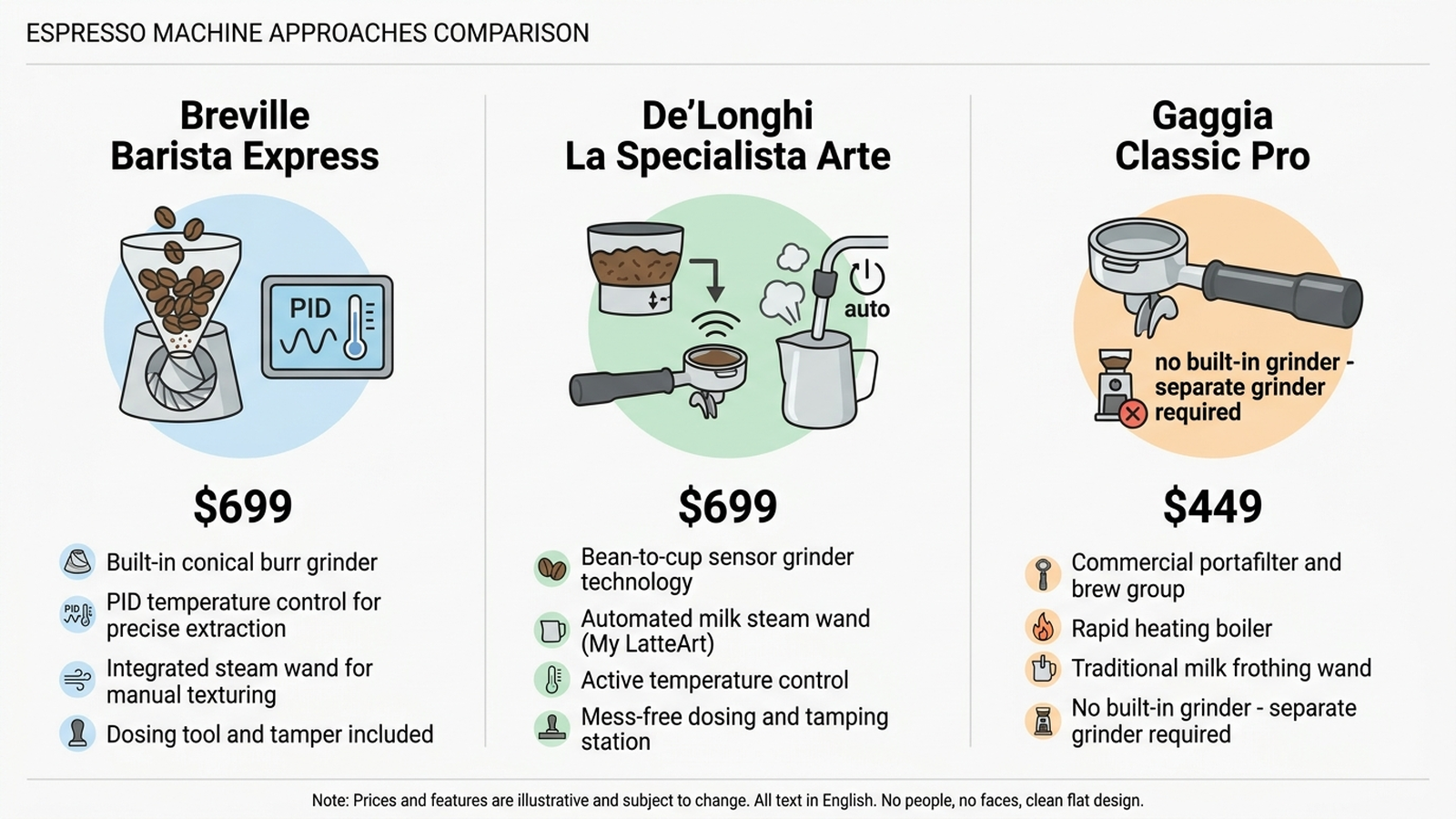
- Breville Barista Express (all-in-one, built-in conical burr grinder, digital PID): The Barista Express integrates grinding, dosing, tamping guidance, and brewing into a single self-contained unit, aimed at buyers who don’t want to shop for a separate grinder. Its digital PID temperature control is a step up from purely mechanical thermostats, which independent reviewers credit for more consistent shot-to-shot temperature.
- De’Longhi La Specialista Arte (bean-to-cup, sensor grinder, automated milk system): The Arte pairs a built-in sensor grinder with De’Longhi’s MyLatte Art steam wand, which automates milk texturing more heavily than the other two machines. Reviewed (USA Today) and Tom’s Guide both single out the automated milk system as the standout feature relative to competitors in this price range.
- Gaggia Classic Pro (semi-automatic, commercial-style portafilter, no built-in grinder): The Classic Pro is a stainless-steel-bodied machine built around a commercial 58mm portafilter, intentionally excluding a built-in grinder so enthusiasts can pair it with a separate burr grinder of their choice. Its stripped-down, largely mechanical design is the basis for its reputation for long-term repairability.
Manufacturer Details
Breville markets the Barista Express’s PID as delivering “optimal water temperature” for extraction — a manufacturer characterization of its digital thermostat system rather than an independently lab-verified temperature-stability figure. The machine ships with a 54mm portafilter, a built-in conical burr grinder, and a manufacturer-stated warranty of up to two years on the machine’s main components (some individual parts carry shorter coverage; check the included documentation for specifics).
De’Longhi describes the La Specialista Arte’s MyLatte Art steam wand as delivering “barista-quality microfoam” through its automated system — again a manufacturer claim about a proprietary steam-wand design, not an independently measured microfoam-quality score. De’Longhi’s standard US warranty runs one year, extendable to two years with product registration.
Gaggia positions the Classic Pro as a commercial-derived design descended from its café equipment line, built around a stainless-steel boiler and a 58mm commercial portafilter standard shared with professional machines — a lineage claim about the platform’s engineering heritage rather than a certification that the home unit itself is commercial-grade equipment. Gaggia backs the Classic Pro with a two-year limited warranty.
Customer Sentiment Synthesis
Aggregated Amazon customer reviews and cross-referenced third-party test coverage point to a few consistent patterns:
- Breville Barista Express: The dominant praise theme is how quickly new owners can pull a passable shot, with many reviewers citing the built-in grinder and guided workflow as removing the biggest barrier to entry. The most common complaint cluster involves the stock grinder’s burrs needing replacement after roughly 1–2 years of daily use, and a learning curve for dialing in grind size that some reviewers found steeper than expected despite the “beginner” positioning.
- De’Longhi La Specialista Arte: Reviewers consistently praise the automated MyLatte Art steam wand, describing milk texturing as close to effortless compared with manual wands on the other two machines. The recurring critique involves minor dripping from the brew head after a shot finishes — cosmetic rather than functional, since the drip tray catches the excess, but noted often enough in reviews to be a real pattern rather than isolated units.
- Gaggia Classic Pro: The dominant praise theme is long-term durability and a large third-party modification community, with reviewers reporting units running reliably for a decade or more with basic maintenance. The most common complaint is the learning curve of “temperature surfing” to stabilize shot temperature on the mechanical thermostat, along with the fact that the box includes no grinder and only basic accessories, so the effective buy-in cost is higher than the sticker price once a separate grinder is added.
Comparison Table
| Model | Amazon Price (as of 2026-09-16) | Warranty | Built-in Grinder | Portafilter Size | Milk System |
|---|---|---|---|---|---|
| Breville Barista Express (BES870XL) | $629.96 | Up to 2 years (manufacturer-stated, varies by part) | Yes, conical burr | 54mm | Manual steam wand |
| De’Longhi La Specialista Arte (EC9155M) | $549.95 | 1 year (2 years with registration) | Yes, sensor grinder | 51mm | Automated MyLatte Art steam wand |
| Gaggia Classic Pro (RI9380/47) | $449.00 | 2 years | No, separate grinder required | 58mm commercial | Manual steam wand |
Prices reflect amazon.com listings as of the stated date and change frequently with promotions and lightning deals — check the current listing before buying.
How to Use: Getting a Consistent Shot on Any of These Machines
Regardless of which machine you buy, reviewers and independent testers converge on the same setup basics — most complaints about sour or bitter shots trace back to grind size and dose, not the machine itself.
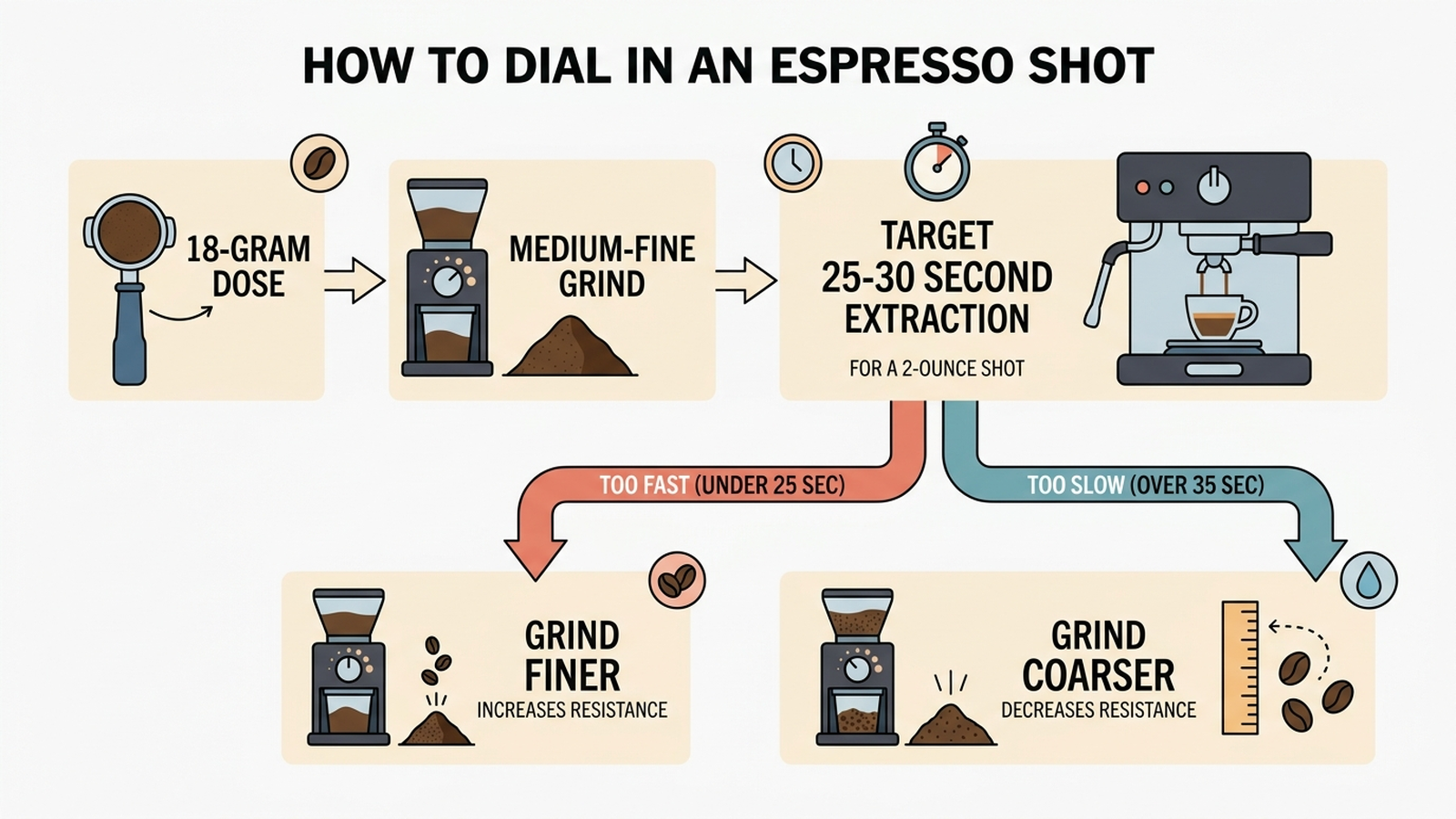
Start with an 18-gram dose of fresh, recently roasted beans and a medium-fine grind, then time the extraction. A shot that finishes in well under 25 seconds is usually running too fast, meaning the grind should go finer; one that drags past 35 seconds is usually too fine, meaning the grind should go coarser. Reviewers across all three machines report that dialing in grind size, not brand differences, accounts for most of the gap between a sour, weak shot and a balanced one.
Which One Should You Buy?
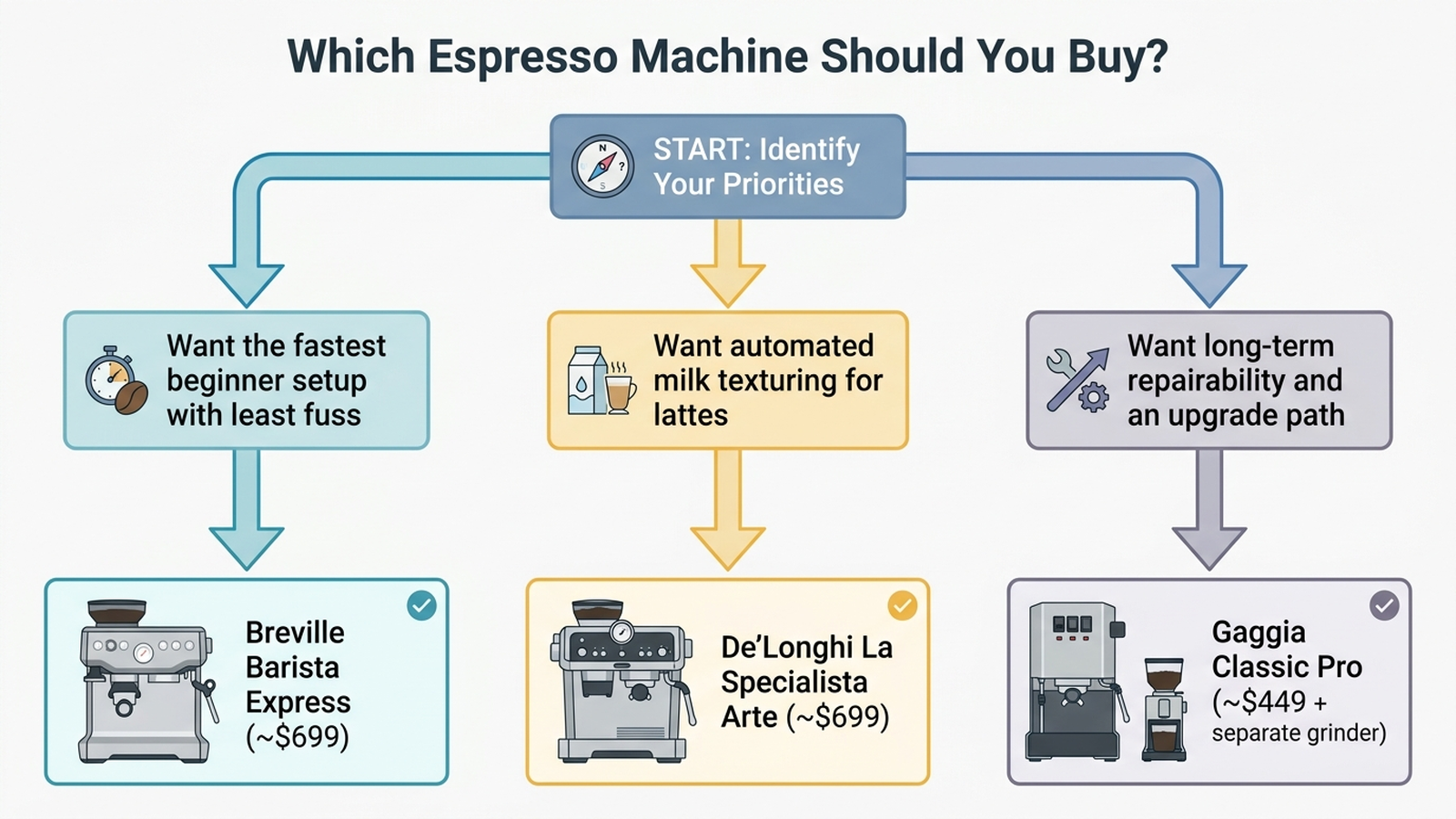
- Best for first-time buyers who want speed to a good shot: Breville Barista Express — the built-in grinder and guided workflow get most owners to a decent shot fastest, with no separate purchases needed.
- Best for milk-drink lovers who want the least manual effort: De’Longhi La Specialista Arte — the automated steam wand is the standout feature reviewers cite most often at this price.
- Best for buyers who want a machine that lasts decades: Gaggia Classic Pro — the lowest sticker price here, but budget for a separate grinder, and expect a steeper temperature-management learning curve in exchange for a widely reported reputation for long-term repairability.
Limitations
This analysis relies on publicly available reviews, manufacturer specifications, and third-party test coverage, including reviews from Consumer Reports, Reviewed (USA Today), Tom’s Guide, and TechGearLab. Individual experience may vary based on water hardness, bean freshness, grinder skill, and unit-to-unit manufacturing variance. Prices shown are list prices as of the stated date and change frequently with promotions; check the current Amazon listing before buying.
As an Amazon Associate, Arekore earns from qualifying purchases. The Amazon product links in this article include our affiliate tracking ID and may earn us a commission if you buy through them, at no additional cost to you. See our Links Policy for details on how we select products and how commissions do not influence our recommendations.
Products Mentioned
- Breville BES870XL Barista Express Espresso Machine, Brushed Stainless Steel
- De’Longhi EC9155M La Specialista Arte Espresso Machine, Stainless Steel
- Gaggia RI9380/47 Classic Pro Espresso Machine, Cherry Red
Verify current pricing, availability, and specifications on the Amazon product page before purchasing — we do not guarantee prices stay current after publication.