Best Electric Kettles in 2026: A Data-Driven Buyer's Guide
The electric kettle looks like a commodity appliance until you start reading the one-star reviews — leaking spouts, dead auto-shutoff switches, and “keep warm” features that barely last 20 minutes. It is also a bigger category than most shoppers assume: on amazon.com it spans a $20 stainless-steel workhorse and a $200 WiFi-connected gooseneck kettle built for pour-over coffee. This guide compares three models that anchor very different price tiers — the budget-standard Hamilton Beach, the mid-tier temperature-control Cosori, and the precision Fellow Stagg EKG Pro — using aggregated Amazon review data, independent lab testing, and manufacturer specifications.
As an Amazon Associate, Arekore earns from qualifying purchases. The Amazon product links in this article may include our affiliate tracking ID and may earn us a commission if you buy through them, at no additional cost to you. See our Links Policy for details on how we select products and how commissions do not influence our recommendations.
TL;DR / Quick Verdict
- Best budget pick: the Hamilton Beach Electric Tea Kettle (40989) — a straightforward 1.7 L stainless-steel kettle with auto-shutoff and boil-dry protection, one of Amazon’s best-selling kettles, usually well under $30.
- Best for tea variety at home: the Cosori Electric Kettle with Temperature Control (6 presets) — a 1.7 L stainless-steel kettle with six temperature presets and a 60-minute keep-warm mode, priced in the $35–45 range.
- Best for pour-over coffee precision: the Fellow Stagg EKG Pro — a 0.9 L gooseneck kettle with to-the-degree PID temperature control, a color LCD, and WiFi scheduling, at roughly $195–200.
- The real choice: decide whether you just need water boiled fast and cheap (Hamilton Beach), want presets for green tea through French press without a gooseneck spout (Cosori), or brew pour-over coffee often enough to justify precision temperature control and pour geometry (Fellow).
How We Reached These Conclusions (Methodology)
This is an editorial analysis, not a hands-on review. We did not personally test the products covered here. Instead, this guide synthesizes three kinds of public information: (a) aggregated amazon.com customer ratings and the substance of low- and high-star reviews, sampled in August 2026; (b) independent third-party testing and reporting from Consumer Reports, Reviewed (USA Today), and Tom’s Guide; and (c) manufacturer specifications. Where we cite a manufacturer figure — a wattage rating, a boil time, or a temperature-hold claim — we label it as a manufacturer claim rather than an independently verified result. Prices are amazon.com figures at the time of writing and change frequently.
The US Electric Kettle Market in 2026
Electric kettles are a larger and more active category than their low price point suggests. Market-research firm MarkWide Research puts the US electric kettle market at roughly $487 million in 2026, projecting growth toward $880 million by the mid-2030s, with industry estimates (compiled across multiple market-research firms, so treat them as directional rather than precise) suggesting annual US unit volume approaching 12–15 million kettles. The same industry data points to a premiumizing category: app-connected and variable-temperature kettles are estimated at 35–40% of unit sales in 2026, up from roughly 20% in 2020, pushing the average selling price from around $35 toward the $55–65 range. E-commerce is estimated to drive 45–50% of category sales, with buyers aged 30–54 cited as the largest cohort — a group analysts tie to home-office coffee and tea habits.
That premiumization is visible in how differentiated the category has become. A basic dome kettle and a $200 gooseneck kettle both “boil water,” but they serve different buyers, which is why this guide compares one from each major tier rather than declaring a single universal winner.
1. First, Decide What Matters Most to You
Before comparing models, settle the question that explains most of the differences here: what are you actually making with the hot water?
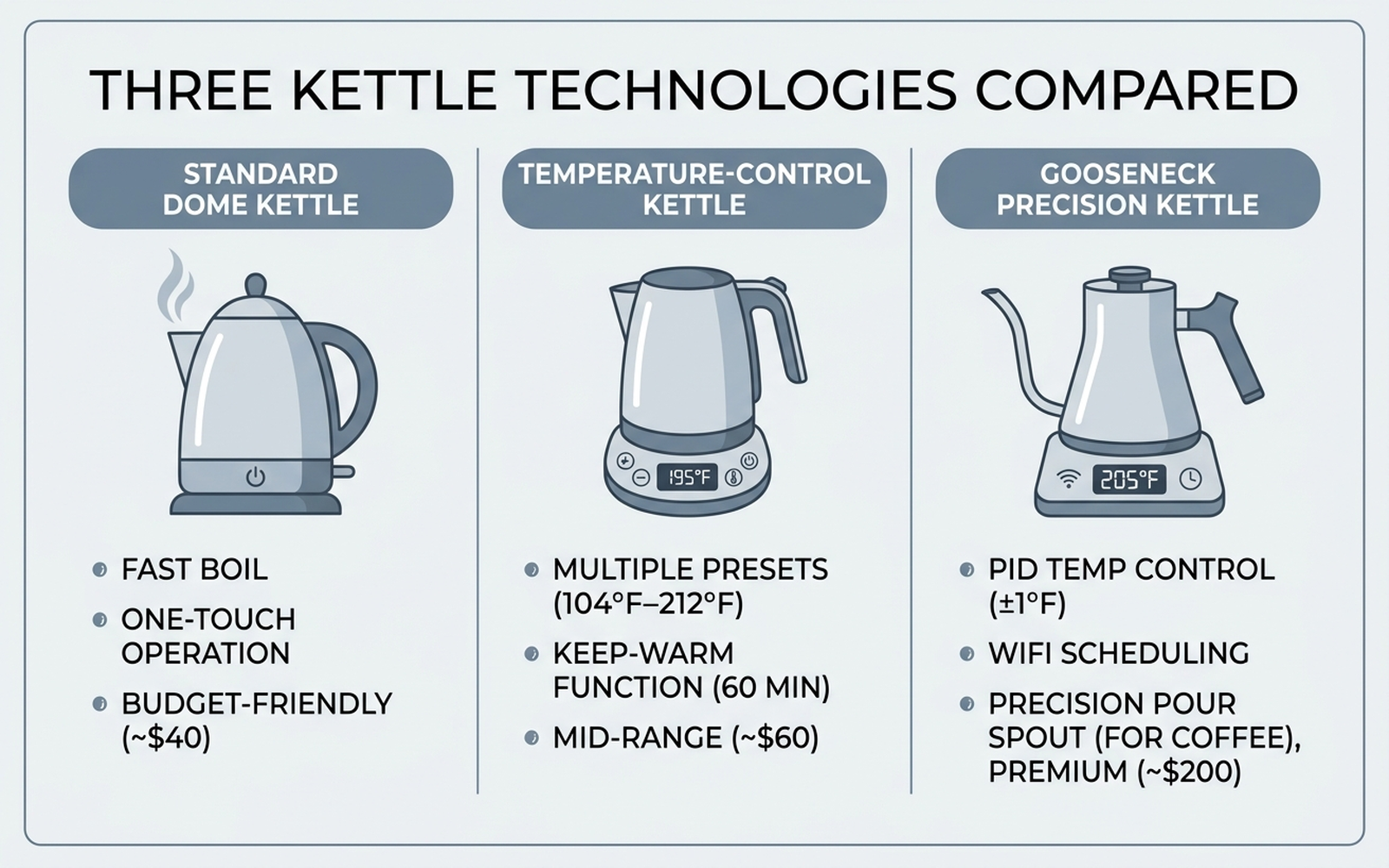
- Just boiling water for instant coffee, oatmeal, or French press at one temperature? A standard dome kettle like the Hamilton Beach does this fast, safely, and cheaply.
- Drinking different types of tea that call for different temperatures (green, oolong, black)? A preset temperature-control kettle like the Cosori removes the guesswork without a big price jump.
- Brewing pour-over coffee or delicate tea where a few degrees and pour control change the result? A gooseneck precision kettle like the Fellow Stagg EKG Pro is built specifically for that.
A useful rule from the aggregated reviews: almost every kettle in this category boils water reliably. Above that baseline, you are mostly paying for temperature precision and hold time (Cosori) or precision plus pour geometry and connectivity (Fellow).
2. The Technology: What Actually Separates These Kettles
Nearly all electric kettles use the same basic mechanism: a concealed heating element in the base, powered by a 1500-watt-class element for household models, that shuts off automatically once water boils or the kettle is lifted. The differences that matter in daily use come down to a handful of specs:
- Temperature control. Basic kettles have one setting: full boil (212°F / 100°C). Preset kettles like the Cosori offer roughly six temperature stops (commonly around 104°F to 212°F) tuned to green tea, white tea, oolong, coffee, and black tea. Precision gooseneck kettles like the Fellow use a PID (proportional-integral-derivative) controller that reviewers and the manufacturer describe as holding temperature within about one degree Fahrenheit — useful for pour-over recipes that specify an exact temperature.
- Keep-warm function. Basic kettles generally lack this. The Cosori’s keep-warm mode runs up to 60 minutes (manufacturer figure). Consumer Reports’ independent testing found top performers among tested budget and mid-tier kettles could hold boiled water warm for 75 minutes or more, so keep-warm duration varies meaningfully even within a similar price band — check the specific model, not just the brand.
- Boil speed. Independent and manufacturer testing across this category generally lands in a 4 to 5.5-minute range for a full kettle, regardless of price tier; a $200 kettle does not necessarily boil water faster than a $25 one.
- Spout geometry. Standard and dome kettles use a wide, functional spout meant for pouring into a mug or pot. Gooseneck kettles use a narrow, curved spout designed to control flow rate precisely — the feature that matters for pour-over coffee extraction and delicate tea steeping, and largely irrelevant if you are not doing either.
- Interior material. Reviewers and manufacturers increasingly highlight “no plastic contact with water” designs (stainless steel or borosilicate glass interiors) as a selling point; both the Cosori and Fellow models reviewed here advertise plastic-free water contact, while some older or budget kettles still use plastic components inside the spout or lid.
- Connectivity. Only the higher tier of the category — including the Fellow Stagg EKG Pro — adds WiFi scheduling, a brew timer, and a companion app; this is a convenience feature for coffee routines, not something that changes how hot the water gets.
Bottom line: temperature precision and hold time are what separate the tiers, not raw boiling speed, which is fairly consistent across the category.
3. Comparison Table
Prices are amazon.com figures at the time of writing (August 2026) and fluctuate.
| Model | ASIN | Approx. price | Capacity | Temperature control | Keep-warm |
|---|---|---|---|---|---|
| Hamilton Beach Electric Tea Kettle (40989) | B00MU51JLW | ~$25–30 | 1.7 L | Single (full boil) | No |
| Cosori Electric Kettle, Temperature Control (6 presets) | B08BFMV68M | ~$35–45 | 1.7 L | 6 presets | 60 min (manufacturer figure) |
| Fellow Stagg EKG Pro (gooseneck) | B0BSVQGR71 | ~$195–200 | 0.9 L | PID, to-the-degree | Temp hold mode |
4. Customer Sentiment Synthesis
What aggregated Amazon reviews and independent testers say about each kettle.
Hamilton Beach Electric Tea Kettle 40989 (ASIN B00MU51JLW)
Hamilton Beach kettles are consistent top sellers in Amazon’s electric kettle category, and this stainless-steel, cordless-serving model is a representative example of the brand’s budget lineup. Aggregated reviews describe it in almost purely functional terms: it boils water reliably, the auto-shutoff and boil-dry protection work as advertised, and the cordless base makes pouring easier than kettles tethered to an outlet. Consumer Reports’ independent lab tests of this budget kettle tier — which included Hamilton Beach alongside brands like Secura, Cuisinart, and Amazon Basics — found boil times in a consistent 4-to-5.5-minute band across price points, with the top-scoring model (the Secura Original) holding warm water for 75 minutes. Basic kettles in this tier, including Hamilton Beach’s, generally trade off no temperature presets and no keep-warm function against a lower price and, in some models, a plastic lid or handle component rather than an all-metal build. The recurring criticism in lower-star reviews is longevity: a subset of buyers report the auto-shutoff switch failing after a year or more of daily use, which is a common failure mode across the budget kettle tier generally, not unique to this model.
Cosori Electric Kettle with Temperature Control (ASIN B08BFMV68M)
Cosori’s temperature-control kettle is the brand’s answer to buyers who want preset flexibility without a gooseneck price tag. Aggregated reviews consistently praise the wide-mouth opening for easy cleaning, the plastic-free stainless-steel interior (marketed as improving water taste versus older plastic-lined kettles), and the six presets covering common tea and coffee temperatures. The 60-minute keep-warm mode is frequently cited as the reason buyers upgrade from a basic kettle. Recurring criticisms in the review base: some buyers find the boil cycle audibly louder than expected, hard water can leave visible mineral buildup on kettles with a glass window, and a handful of reviewers wish the keep-warm window were longer than 60 minutes. None of these issues rise to the level of safety complaints; they are convenience trade-offs typical of the mid-tier price point.
Fellow Stagg EKG Pro (ASIN B0BSVQGR71)
The Fellow Stagg EKG Pro is a specialty-coffee category favorite rather than a mass-market kettle, and third-party reviews treat it accordingly. Reviewed (USA Today) and Tom’s Guide have both reviewed the Stagg EKG Pro positively, with Tom’s Guide describing it as “premium in every way” and Reviewed’s testing highlighting the gooseneck spout’s pour control and the PID controller’s ability to hold temperature within about a degree. Aggregated owner reviews echo the professional reviews: buyers who brew pour-over coffee or delicate teas describe the precise temperature control and slow, controllable pour as a genuine upgrade over a standard kettle, and the roughly five-minute boil time is on par with cheaper models despite the smaller 0.9 L capacity. The recurring criticism is unambiguous: price. At roughly $195–200, it costs six to eight times as much as the Cosori and is explicitly a kettle for people who already care about brew precision, not a general-purpose water boiler. A smaller subset of reviews mention the WiFi/app features as unnecessary for buyers who just want the physical temperature dial.
5. How to Choose the Right Water Temperature
Getting water temperature right affects extraction more than most home cooks expect — too hot and delicate teas turn bitter; too cool and coffee under-extracts and tastes flat or sour.
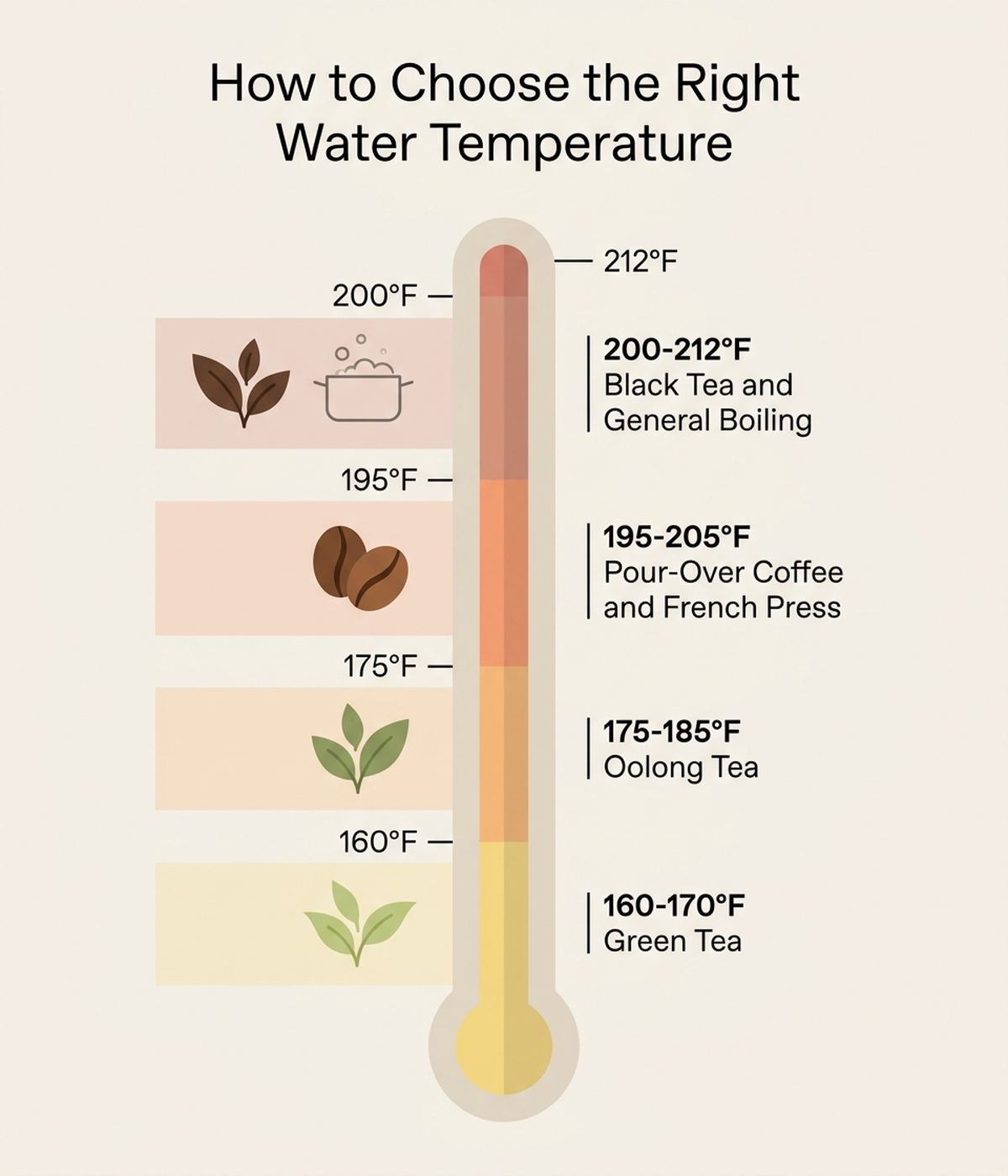
- Green and white tea: roughly 160–175°F. Full-boil water scalds the delicate leaves and produces a bitter, grassy cup.
- Oolong tea: roughly 175–185°F. A middle ground between green and black tea temperatures.
- Pour-over coffee and French press: roughly 195–205°F, just off a full rolling boil. This is the range most specialty-coffee guides and the Fellow’s default presets target.
- Black tea and general boiling: 200–212°F. The only category where a basic full-boil kettle is functionally identical to a temperature-control model.
- If you drink mostly coffee and black tea, a preset or precision kettle offers limited upside over a basic model. If green, white, or oolong tea is a regular part of your routine, a preset kettle pays for itself in cup quality.
6. Which One Should You Buy? A Decision Flow
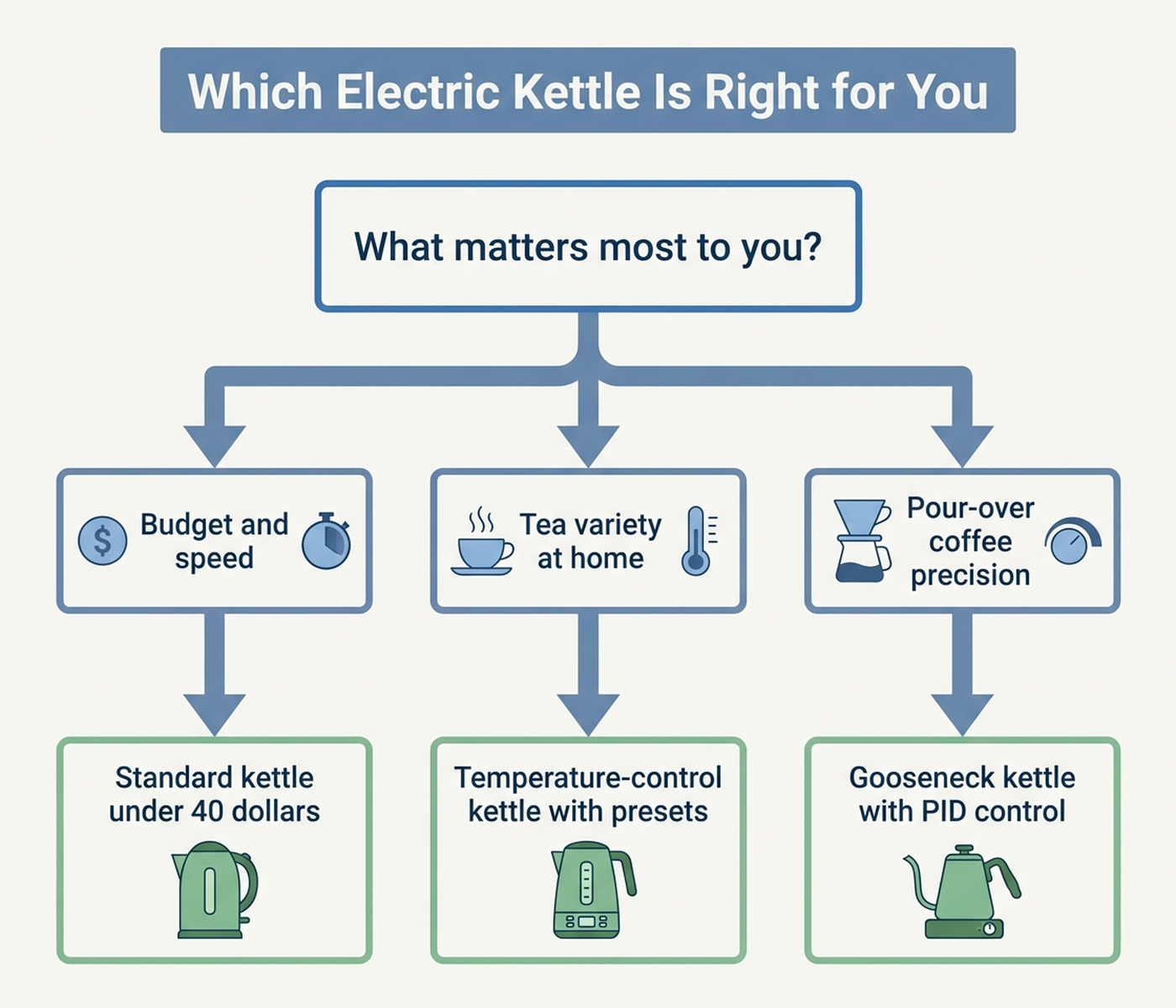
- You just need water boiled fast and cheap → Hamilton Beach 40989. No presets, no keep-warm, lowest price.
- You drink a mix of teas at different temperatures and want a keep-warm function → Cosori Temperature Control. The best balance of features and price for most households.
- You brew pour-over coffee regularly or care about degree-level temperature accuracy → Fellow Stagg EKG Pro. Accept the premium price for the precision and pour control.
- You have hard water and worry about mineral buildup → any of the three, but plan to descale monthly regardless of model; interior material (steel vs. glass) affects how visible buildup is, not how much forms.
- You want the smallest counter footprint → Fellow’s 0.9 L capacity is the smallest of the three, though it also means more frequent refills for multi-cup households.
7. Warranty and Support
Warranty terms in this category are modest compared with larger kitchen appliances, and mostly reflect price tier:
- Hamilton Beach: typically a 1-year limited warranty, standard for the brand’s budget small-appliance lineup — verify current terms on the specific listing.
- Cosori: typically an 18-month to 2-year limited warranty depending on the product line, longer than most budget kettles in its price bracket.
- Fellow: typically a 1-year limited warranty; at this price point, the value proposition is precision and build quality rather than warranty length.
For a $25–45 kettle, a short warranty is a normal trade-off; for a nearly $200 kettle, it is worth confirming the exact terms before buying since the replacement cost is much higher.
8. Editorial Recommendation by Use Case
- Best overall value: Cosori Electric Kettle with Temperature Control — the widest utility per dollar, with presets that cover most tea and coffee needs.
- Best budget pick: Hamilton Beach 40989 — reliable, no-frills boiling for buyers who don’t need presets.
- Best for pour-over coffee enthusiasts: Fellow Stagg EKG Pro — degree-level precision and pour control, verified by independent testing at Reviewed and Tom’s Guide.
- Best for small kitchens or minimal counter space: Fellow Stagg EKG Pro — the smallest footprint of the three, at the cost of lower capacity and higher price.
- Best for large households making multiple cups at once: Hamilton Beach or Cosori — both hold 1.7 L versus the Fellow’s 0.9 L.
9. Limitations of This Analysis
This analysis relies on publicly available reviews, third-party tests, and manufacturer specifications rather than our own hands-on testing. Individual experience may vary based on local water hardness, how often the kettle is descaled, and unit-to-unit variance. Temperature-hold figures (the Cosori’s 60-minute keep-warm claim and the Fellow’s PID precision claim), wattage, and boil-time figures are manufacturer or review-platform claims, not measurements we independently verified. Kettle lineups and pricing change frequently — Hamilton Beach and Cosori in particular sell many similarly named SKUs with different feature sets — so always confirm the exact model, ASIN, and current price on the product page before purchasing.
10. Verify Before You Buy
A star rating and a spec sheet only tell part of the story. Before you buy a kettle you’ll use daily, it pays to read past the five-star reviews into the one- and two-star ones — that’s where auto-shutoff failures, leaking spouts, and keep-warm complaints surface.
That’s exactly what Arekore is built for. Paste a product URL and our AI shopping assistant checks review authenticity, surfaces the substance of low-star feedback, and compares prices across retailers — turning an afternoon of research into about five minutes. Deciding between the Cosori and the Fellow Stagg EKG Pro? Let the aggregated data, not the marketing copy, make the call.
Products mentioned in this article
- Hamilton Beach Electric Tea Kettle (40989) — view on Amazon
- Cosori Electric Kettle with Temperature Control (6 Presets) — view on Amazon
- Fellow Stagg EKG Pro Studio Gooseneck Electric Kettle — view on Amazon
Product links go to amazon.com. Prices and availability were accurate at the time of writing and are subject to change.