Best Dehumidifiers 2026: Frigidaire vs. hOmeLabs
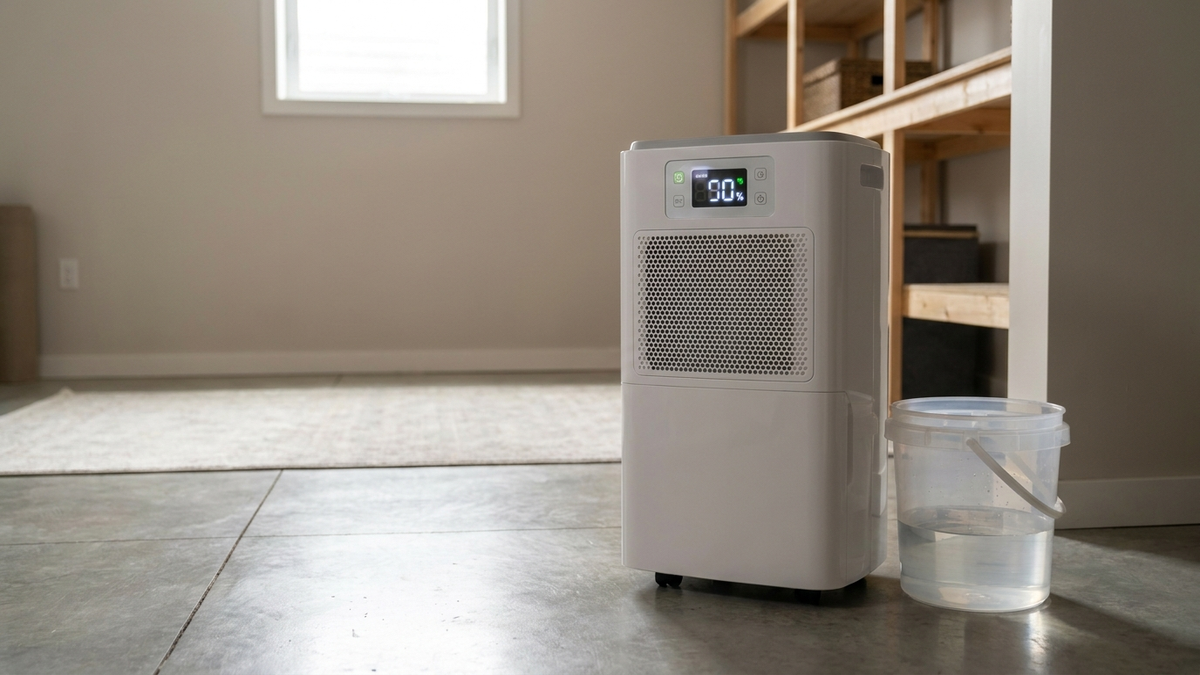
Basements and crawl spaces sit above 60% relative humidity for weeks at a time in many US homes, and the EPA is blunt about what happens next: mold can begin colonizing damp organic material within 24 to 48 hours once conditions cross that line. A 50-pint dehumidifier is the standard fix, and three names dominate that price tier on amazon.com — Frigidaire, hOmeLabs, and Vremi — all covering roughly 4,500 square feet on paper, all priced within about $40 of each other, and all producing meaningfully different results once independent labs and aggregated owner reviews are compared. This guide synthesizes that data so you’re not choosing between three near-identical spec sheets blind.
As an Amazon Associate, Arekore earns from qualifying purchases. The Amazon product links in this article may include our affiliate tracking ID and may earn us a commission if you buy through them, at no additional cost to you. See our Links Policy for details on how we select products and how commissions do not influence our recommendations.
TL;DR / Quick Verdict
- Best overall / fastest moisture removal: the Frigidaire FFAD5034W1 — an Energy Star 50-pint compressor dehumidifier that independent testing measured pulling significantly more water per hour than the hOmeLabs at similar settings, priced around $220–260.
- Best value / quietest at this capacity: the hOmeLabs HME020031N (32-pint, rated for 4,500 sq ft) — a budget-friendly Energy Star unit that testers and owners describe as reliably steady, though slower to remove moisture than the Frigidaire, priced around $180–210.
- Solid mid-tier alternative: the Vremi 50-Pint — an Energy Star–rated unit with a large review base and strong reputation for basement and large-room use, priced around $200–240.
- The real choice: decide whether you want the fastest moisture removal for a genuinely wet basement (Frigidaire), the quietest and cheapest reliable option for a moderately damp space (hOmeLabs), or a middle-ground pick with a long track record (Vremi).
How We Reached These Conclusions (Methodology)
This is an editorial analysis, not a hands-on review. We did not personally test the products covered here. Instead, this guide synthesizes three kinds of public information: (a) aggregated amazon.com customer ratings and the substance of low- and high-star reviews, sampled in August 2026; (b) independent third-party testing and reporting from CNN Underscored, Consumer Reports, and RTINGS; and (c) manufacturer specifications, EPA guidance on mold and moisture, and ENERGY STAR’s dehumidifier capacity and efficiency standards. Where we cite a manufacturer figure — a pint-per-day claim, a coverage-area estimate, or a decibel rating — we label it as a manufacturer claim rather than an independently verified result. Amazon does not publish a precise, verifiable review count per product at a fixed point in time, so we cite approximate review totals rather than an exact N. The CNN Underscored head-to-head lab test cited below was conducted on a Frigidaire Gallery WiFi-enabled unit and a higher-capacity 50-pint/7,000-sq-ft hOmeLabs unit — different specific SKUs from the FFAD5034W1 and 32-pint HME020031N models linked in this article, though built on the same compressor platform and product family as their respective brands’ other 50-pint-class dehumidifiers. We flag this distinction wherever the lab figures are cited. Prices are amazon.com figures as of 2026-08-28 and change frequently.
The US Dehumidifier Market in 2026
Dehumidifiers are a steady, unglamorous appliance category with real staying power. Industry research estimates put the US dehumidifier market at roughly $1.79 billion in 2025, with projections toward $3.29 billion by 2035 at a compound annual growth rate cited around 6.3% — treat these as directional figures, since estimates vary by research firm. North America holds close to half of global dehumidifier demand, driven largely by basement-heavy housing stock in the Midwest and Northeast and by increasingly humid summers in the Southeast. Within that market, Frigidaire, hOmeLabs, and Vremi are three of the highest-volume brands on amazon.com’s dehumidifier bestseller lists, competing primarily on price and moisture-removal speed rather than smart features — a contrast with categories like humidifiers or robot vacuums, where app connectivity increasingly drives purchase decisions.
1. First, Decide What Matters Most to You
Before comparing models, settle the question that explains most of the differences here: how wet is the space you’re actually trying to dry out?
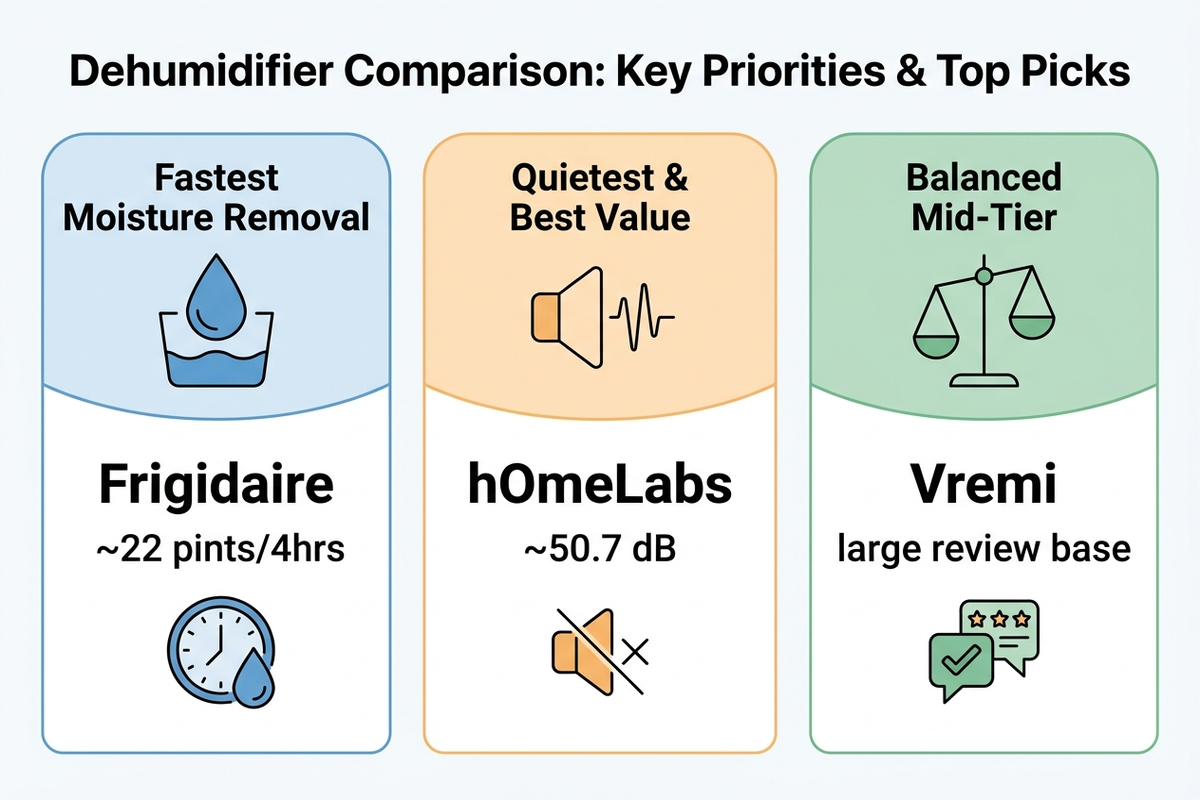
- Actively wet basement, visible condensation, or a musty smell that won’t go away? Prioritize raw moisture-removal speed — this favors the Frigidaire, which independent testing measured extracting water noticeably faster than the hOmeLabs at similar humidity levels.
- Moderately damp space you want to keep in the 40–50% range, not a flood-recovery situation? The hOmeLabs is a steadier, quieter, and cheaper fit for maintenance-level dehumidifying.
- Splitting the difference between speed and long-term reliability? The Vremi has one of the largest and longest-running review bases in this capacity tier, which matters for an appliance most buyers keep running for years.
A theme across all three: dehumidifiers in this class fail less often from the compressor itself and more often from bucket-emptying friction — units without a continuous-drain option or a conveniently placed handle generate a disproportionate share of one- and two-star reviews regardless of brand.
2. The Technology: What Actually Separates These Dehumidifiers
All three units use the same core mechanism — a compressor-driven refrigerant coil pulls air across cold coils, condensing moisture into a bucket — so the differences come down to compressor sizing, fan design, and build quality rather than a fundamentally different approach:
- Compressor size and airflow (Frigidaire). CNN Underscored’s side-by-side testing recorded a Frigidaire Gallery WiFi-enabled unit collecting 22.3 pints in four hours of controlled testing, more than double a 50-pint/7,000-sq-ft hOmeLabs unit’s 9.4 pints under the same conditions — a gap testers attributed to a larger compressor and higher-volume fan rather than a difference in the manufacturer-stated pint rating, since ENERGY STAR pint ratings are measured at standardized lab conditions (65°F, 60% RH) that don’t always predict real-world speed in a genuinely damp basement. Note that the exact units CNN tested are different SKUs from the FFAD5034W1 and HME020031N linked in this article (see Methodology); we treat the result as directional evidence of each brand’s typical compressor performance at this capacity tier, not a guaranteed match to the linked model’s exact output.
- Noise-optimized design (hOmeLabs). The same testing measured the hOmeLabs unit at roughly 50.7 decibels versus the Frigidaire unit’s 52.9 decibels — a modest but noticeable gap for a basement or utility room adjacent to living space, and consistent with owner reviews of the linked hOmeLabs model that describe it as a quieter background presence at the cost of slower moisture removal.
- Continuous-drain compatibility (all three). Every model in this comparison ships with a gravity-drain hose option in addition to the removable bucket, letting buyers route water directly to a floor drain or sump pump — independent reviewers and owners alike describe this as the single feature most worth using if the dehumidifier will run unattended for days at a time.
Bottom line: the Frigidaire trades a few extra decibels for meaningfully faster moisture removal; the hOmeLabs trades removal speed for quieter, cheaper, steady operation; the Vremi sits in between on both axes.
3. Comparison Table
Prices are amazon.com figures as of 2026-08-28 and fluctuate.
| Model | ASIN | Approx. price | Capacity | Coverage (mfr. claim) | Noise (independently tested) | Energy Star |
|---|---|---|---|---|---|---|
| Frigidaire FFAD5034W1 | B0BHCJX7Y1 | ~$220–260 | 50 pint | 4,500 sq ft | ~52.9 dB | Yes |
| hOmeLabs HME020031N | B06X9MFTZZ | ~$180–210 | 32 pint (max 80 pint at 95°F/90% RH) | 4,500 sq ft | ~50.7 dB | Yes |
| Vremi 50-Pint | B07JMZJX4B | ~$200–240 | 50 pint | 4,500 sq ft | Not independently tested in our source set; manufacturer describes it as low-noise | Yes |
4. Customer Sentiment Synthesis
What aggregated Amazon reviews and independent testers say about each dehumidifier.
Frigidaire FFAD5034W1 (ASIN B0BHCJX7Y1)
Frigidaire’s FFAD5034W1 is the brand’s volume leader in this capacity tier. CNN Underscored’s controlled testing of a Frigidaire Gallery WiFi-enabled unit — a different SKU on the same compressor platform, not this exact model — measured 22.3 pints removed in four hours, the fastest of the units it evaluated; we cite this as evidence of Frigidaire’s typical compressor performance at this capacity, not a lab-verified figure for the FFAD5034W1 specifically. Aggregated Amazon reviews of the linked FFAD5034W1 are directionally consistent with that reputation for speed: owners in genuinely damp basements repeatedly describe the bucket filling faster than expected in the first days of operation — read by most reviewers as evidence the unit is working hard, though a minority initially mistake the frequent full-bucket alerts for a malfunction before realizing it reflects how wet their space actually was. The washable antibacterial filter and continuous-drain hose port are both cited positively as low-friction maintenance features. The most consistent criticism in lower-star reviews concerns the auto-defrost cycle in cooler basements (below roughly 65°F), which some owners describe as cutting moisture removal noticeably during winter months — a limitation common to compressor-based dehumidifiers generally, not unique to this model, and one Frigidaire’s own manual acknowledges.
hOmeLabs HME020031N (ASIN B06X9MFTZZ)
The hOmeLabs HME020031N (4,500-square-foot, 32-pint) undercuts the Frigidaire on price while drawing a large and consistently positive Amazon review base, with owners in aggregated reviews frequently describing it as a “sturdy performer at a bargain price” that holds a target humidity level reliably over months of continuous use. CNN Underscored’s independent testing measured a different, higher-capacity 50-pint/7,000-sq-ft hOmeLabs unit at roughly 50.7 decibels — about two decibels quieter than the tested Frigidaire Gallery unit — and removing moisture markedly slower under identical conditions; we treat this as directional evidence of the brand’s typical noise and speed trade-off rather than a lab-verified figure for the smaller HME020031N specifically. Reviewers of the linked model in noise-sensitive settings — a bedroom-adjacent utility closet, a home office near the mechanical room — describe it similarly as a quiet choice, and the most-cited complaint in lower-star reviews is compressor noise or vibration developing after roughly a year of near-continuous operation, which a subset of owners describe as louder than the unit’s stated specifications suggested at purchase. The auto-shutoff at a full bucket and an included wheeled base for repositioning between rooms are both cited as convenience wins relative to the Frigidaire’s simpler handle-based design.
Vremi 50-Pint (ASIN B07JMZJX4B)
Vremi’s 50-pint model has one of the longest sales histories among large-capacity dehumidifiers on amazon.com and a correspondingly large aggregated review base, with owners consistently describing it as reliable for whole-basement humidity control at the 4,500-square-foot tier. Reviewers highlight the digital humidistat’s accuracy — the unit reaching and holding a set target without the overshoot some owners report on cheaper analog-dial competitors — and the auto-restart-after-power-outage feature, useful for a basement unit that may run unattended through storms. The most consistent lower-star criticism centers on the removable bucket’s handle placement, which a recurring subset of reviewers describe as awkward to carry when full without spilling, a design complaint that shows up across multiple Vremi capacity tiers rather than being isolated to this model. Independent lab testing directly comparing Vremi’s noise or moisture-removal speed to the Frigidaire and hOmeLabs was not available in our source set at the time of writing, so its ranking here rests more heavily on aggregated review sentiment and market longevity than on third-party lab measurements.
5. How to Use a Dehumidifier Correctly
Sizing and placement affect real-world performance more than the difference between any two of these three models.
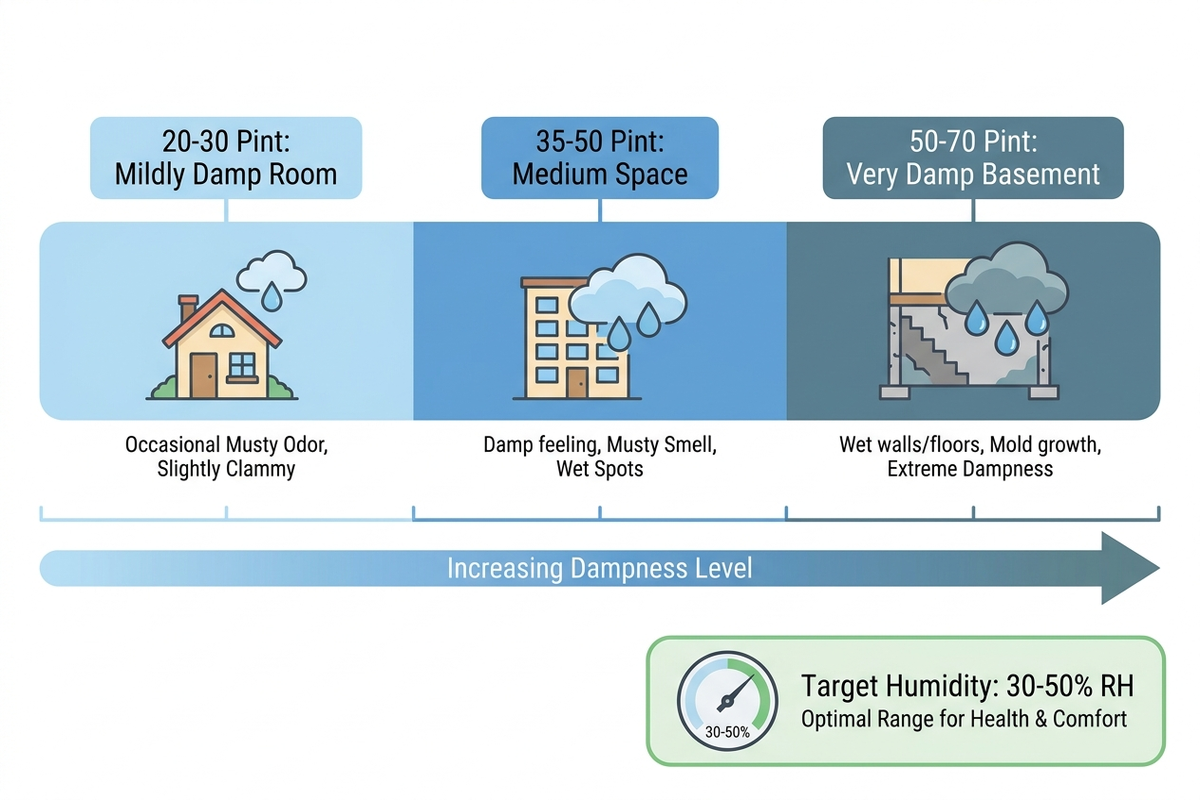
- Target 30–50% relative humidity. The EPA recommends keeping indoor humidity below 60% and ideally in the 30–50% range; above 60% RH, mold-friendly conditions can develop within 24 to 48 hours on damp organic surfaces.
- Size the unit to how damp the space actually is, not just its square footage. ENERGY STAR’s pint ratings are measured at standardized lab conditions and can differ meaningfully from real-world removal speed in a genuinely wet basement versus a mildly damp one — a small room with visible condensation can need more capacity than a larger room that’s merely humid.
- Use continuous drain for unattended operation. All three models support a gravity-drain hose to a floor drain or sump pump; owners in every review set describe this as eliminating the single biggest daily annoyance — emptying a full bucket.
- Keep at least a foot of clearance on all sides. Restricted airflow around the intake and exhaust reduces moisture-removal efficiency regardless of brand.
- Expect reduced output below roughly 65°F. Compressor-based dehumidifiers, including all three covered here, lose efficiency in cold basements; a unit with an auto-defrost cycle is designed for this but will still remove moisture more slowly than in a warmer room.
6. Which One Should You Buy? A Decision Flow
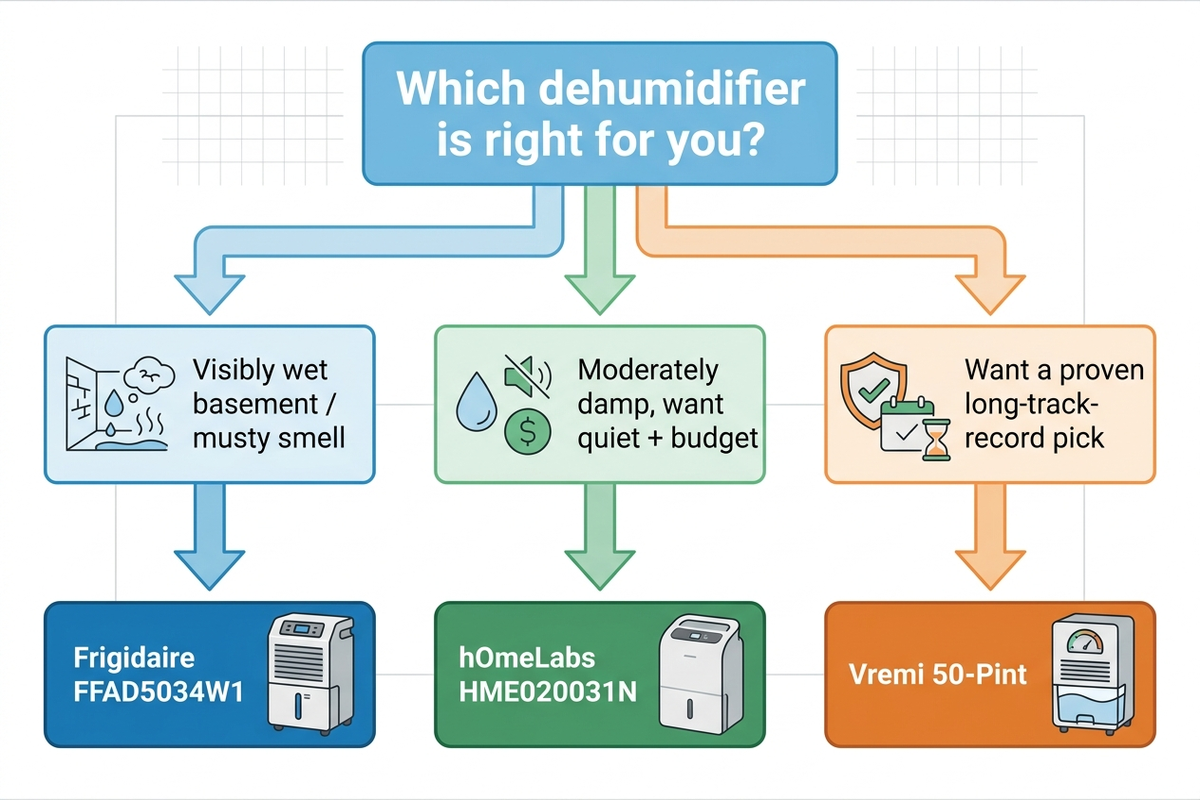
- Your basement has visible dampness, condensation, or a musty smell → Frigidaire FFAD5034W1. The fastest independently tested moisture removal in this comparison.
- You want the quietest and cheapest reliable option for a moderately damp space → hOmeLabs HME020031N. Slower removal, but the lowest tested noise level and the lowest price of the three.
- You want a long track record and a large review base to lean on → Vremi 50-Pint. A dependable mid-tier pick, though without independent lab data confirming its speed or noise relative to the other two.
- The room is cold (unheated basement, garage, crawl space) → any of the three, but check for an auto-defrost cycle, since all compressor dehumidifiers lose efficiency below roughly 65°F.
- You’re not sure how damp your space really is → start with a mid-capacity unit and a $15 hygrometer rather than guessing from square footage alone; ENERGY STAR’s own testing note that pint ratings shift meaningfully between “damp basement” and “very humid” reference conditions.
7. Warranty and Support
Warranty terms in this category are modest and roughly comparable across brands:
- Frigidaire: typically a 1-year limited warranty, standard for the brand’s portable dehumidifier lineup — verify current terms on the specific listing.
- hOmeLabs: typically a 1-year limited warranty with a customer-service program aggregated reviews describe as responsive for units that develop compressor noise or fail within the covered period.
- Vremi: typically a 1-year limited warranty; reviewers describe replacement-unit turnaround as generally straightforward for early failures.
For a $180–260 appliance expected to run for months at a stretch, a 1-year warranty is standard but modest; the bigger long-term consideration is compressor longevity under near-continuous operation, which review data suggests varies by unit more than by brand.
8. Editorial Recommendation by Use Case
- Best overall / fastest results in a wet basement: Frigidaire FFAD5034W1 — the clear leader on independently tested moisture-removal speed.
- Best value: hOmeLabs HME020031N — the lowest price of the three with a large, consistently positive review base.
- Best for noise-sensitive placement: hOmeLabs HME020031N — measured roughly two decibels quieter than the Frigidaire in independent testing.
- Best for buyers who want a long track record over lab data: Vremi 50-Pint — one of the longest-selling, most-reviewed 50-pint units in the category.
- Best for a cold, unheated basement: Frigidaire FFAD5034W1 — its auto-defrost cycle is specifically called out in owner reviews as effective, though all three models lose some efficiency below 65°F.
9. Limitations of This Analysis
This analysis relies on publicly available reviews, third-party tests, manufacturer specifications, and EPA/ENERGY STAR guidance rather than our own hands-on testing. Individual experience may vary based on room temperature, existing humidity level, ventilation, and unit-to-unit variance. The head-to-head moisture-removal and noise figures cited here (22.3 vs. 9.4 pints in four hours; 52.9 vs. 50.7 decibels) come from a single third-party test comparing a Frigidaire Gallery WiFi-enabled unit against a higher-capacity 50-pint/7,000-sq-ft hOmeLabs unit — different specific SKUs from the FFAD5034W1 and HME020031N linked and recommended in this article, though built on the same brands’ comparable compressor platforms. We present these figures as directional evidence of each brand’s typical performance at this capacity tier, not as lab-verified specs for the exact linked models. We were not able to locate an equivalent independent lab comparison including the Vremi at the time of writing, so its placement in this guide relies more heavily on aggregated review sentiment than on lab measurement. Coverage-area figures (4,500 sq ft for all three) are manufacturer claims based on standardized test conditions and will vary in a real basement depending on ceiling height, insulation, and how wet the space actually is. Pricing and specific SKU availability change frequently — always confirm the exact model, ASIN, and current price on the product page before purchasing.
10. Verify Before You Buy
A pint-per-day spec on a listing page doesn’t tell you whether a compressor will still be quiet in year two, or whether the bucket handle will spill on your basement stairs. Before you buy an appliance you’ll run for months at a stretch, it pays to read past the five-star reviews into the one- and two-star ones — that’s where compressor-noise complaints, drain-hose fit issues, and defrost-cycle slowdowns in cold basements surface.
That’s exactly what Arekore is built for. Paste a product URL and our AI shopping assistant checks review authenticity, surfaces the substance of low-star feedback, and compares prices across retailers — turning an afternoon of research into about five minutes. Deciding between the Frigidaire and the hOmeLabs? Let the aggregated data, not the marketing copy, make the call.
Products mentioned in this article
- Frigidaire FFAD5034W1 50-Pint Dehumidifier — view on Amazon
- hOmeLabs 4,500 Sq Ft Energy Star Dehumidifier — view on Amazon
- Vremi 50-Pint 4,500 Sq. Ft. Dehumidifier — view on Amazon
Product links go to amazon.com. Prices and availability were accurate at the time of writing and are subject to change.