Best Cooling Shirts and Base Layers in 2026: A Data-Driven Guide to Beating the Heat (32 Degrees, Uniqlo AIRism, Under Armour, Carhartt)
TL;DR. In 2026, a cooling shirt is less a fashion item and more a piece of heat-safety gear. The US market splits into four engineering approaches — moisture-wicking (Nike Dri-FIT, Hanes Cool DRI), contact-cooling/cool-to-the-touch (Under Armour Iso-Chill, 32 Degrees Cool), breathable mesh (Uniqlo AIRism), and UPF sun-blocking workwear (Carhartt Force Sun Defender). Below: how each technology works, the five things to check before buying, ten specific shirts by use case, a decision flowchart, and care tips that actually preserve the cooling. Prices captured at time of writing.
A note on links and methodology
As an Amazon Associate, Arekore earns from qualifying purchases. The Amazon product links in this article include our affiliate tracking ID and may earn us a commission if you buy through them, at no additional cost to you. See our Links Policy for details on how we select products and how commissions do not influence our recommendations.
We also did not personally test these products. Every claim below is an editorial synthesis of public data, and the Methodology section explains exactly which sources we used.
Methodology
This article is an editorial analysis based on publicly available data collected in June 2026. We synthesized four categories of source:
- Customer reviews on amazon.com — we read the “Top reviews,” “Most recent reviews,” and the AI “Customers say” summary block on each ASIN’s product page to identify recurring positive and negative themes. We do not report a precise sample size N, because Amazon’s review panels do not expose a stable count; printing a fake precise N would be misleading.
- Independent editorial tests — Men’s Journal’s tested undershirt roundup, Treeline Review and CleverHiker base-layer testing, CNN Underscored’s UPF clothing guide, and the German consumer-test landscape (Stiftung Warentest / Falke and Odlo as functional-shirt winners, via outdoor-magazin.com).
- Manufacturer specifications — official material and technology pages from Under Armour (Iso-Chill), Carhartt (Force Sun Defender), Uniqlo (AIRism), and the brands’ Amazon listings.
- Public-health and market data — US heat-mortality data from the CDC / NCHS and HHS Extreme Heat outlook, sun-protection standards from the Skin Cancer Foundation, and cooling-fabric market sizing from IMARC Group and SkyQuest.
We deliberately do not simulate first-person product experience, fabricate reviewer personas, or invent precise data points we cannot verify. Recommendations are editorial opinions formed from the synthesis above.
0. Why “the temperature inside your shirt” is the part you can control
Air conditioning cools a room. It does nothing for the 20-to-40 minutes you spend walking to the train, standing at a bus stop, mowing the lawn, or working a job site. That gap is exactly where a cooling shirt earns its keep.
The stakes are not trivial. Extreme heat is the deadliest weather-related hazard in the United States — deadlier than hurricanes, floods, or tornadoes in an average year. CDC data show that heat-related deaths rose 117% over the 24 years through 2023 (63% after age-adjustment), with the highest annual rate in that span occurring in 2023, and roughly 21,518 heat-related deaths recorded between 1999 and 2023 (CDC / NCHS). Heat-related emergency-department visits in 2024 ran higher than 2023 in 9 of 10 HHS regions for the May–July window (HHS Extreme Heat outlook).
The market has noticed. The global cooling-fabrics category was valued at roughly USD 2.7–2.9 billion in 2025 and is forecast to reach USD 5.1–5.5 billion by 2033, a CAGR in the 7–8% range (IMARC Group, SkyQuest). What used to be a niche for marathoners is now everyday apparel.
The practical takeaway: a good cooling shirt pulls sweat off your skin and either evaporates it or moves heat away from your body before you overheat. The rest of this article is about choosing the right one for your specific situation.
1. Four ways a shirt can keep you cool
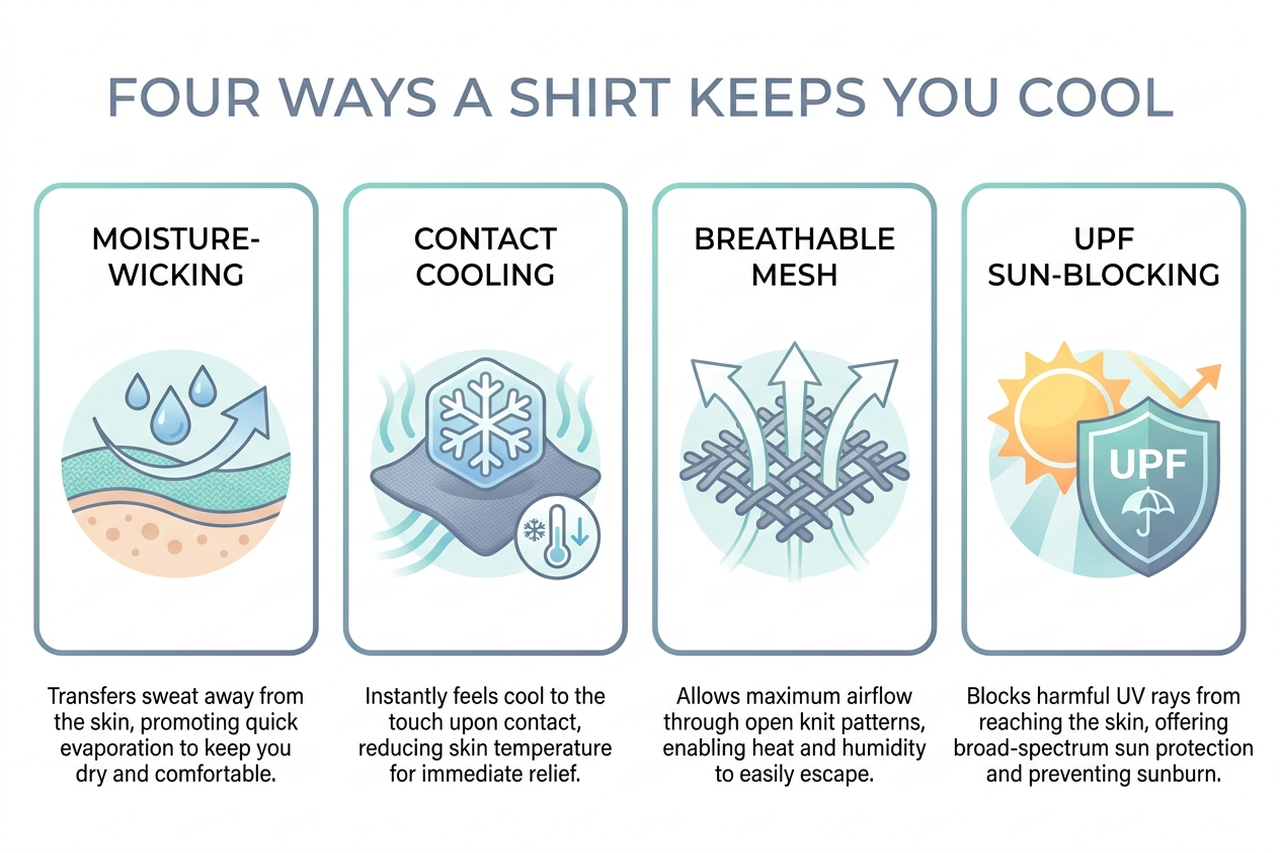
Cooling shirts are not all doing the same thing. There are four distinct mechanisms, and the marketing words (“cool,” “chill,” “dry,” “breathable”) map loosely onto them. Understanding which one a shirt uses is the single most useful filter.
| Mechanism | How it works | Best for | Example tech |
|---|---|---|---|
| Moisture-wicking | Engineered polyester pulls sweat off the skin by capillary action and spreads it across the surface so it evaporates fast | High-sweat activity (gym, running) | Nike Dri-FIT, Hanes Cool DRI |
| Contact cooling (“cool to the touch”) | Flat, dense yarns conduct body heat away quickly, so the fabric feels cold the instant it touches skin | Walking outdoors, the “ahh” feeling on a hot day | Under Armour Iso-Chill, 32 Degrees Cool |
| Breathable mesh / airflow | Open mesh structure lets hot, humid air escape instead of trapping it against the body | Everyday wear, under a regular shirt | Uniqlo AIRism (Micro Mesh) |
| UPF sun-blocking | Tight-weave, UV-treated fabric stops solar radiation from reaching skin; lightweight versions add wicking | Long days in direct sun, work, fishing, golf | Carhartt Force Sun Defender, Hanes Cool DRI UPF 50 |
The key insight: a single shirt rarely maximizes all four. A heavy compression top can wick brilliantly but trap heat; a loose UPF shirt blocks sun but won’t feel “cold.” Match the dominant mechanism to your dominant problem.
A second insight, specific to the US market: contact-cooling fabrics like Under Armour’s Iso-Chill work by using flat yarn to disperse body heat combined with titanium dioxide to absorb UV energy (RevUp Sports’ breakdown of Iso-Chill). A separate, higher-end approach uses phase-change materials (PCM) — microencapsulated waxes that absorb heat as they melt — which Textile World describes as the gold standard for active temperature regulation. PCM is rare in sub-$50 shirts but increasingly common in premium gear.
2. There is no US “cooling number” — so read the fabric, not the adjective
Japan regulates contact-cooling with a published metric (the Q-max value, standardized under JIS L 1927; 0.2+ W/cm² qualifies a fabric as “contact-cool”). The US has no equivalent single, mandatory cooling rating. “Cooling,” “cool-touch,” and “chill” are marketing terms with no enforced threshold behind them.
That has a direct consequence for shoppers: you cannot compare two US shirts by a cooling score, because there isn’t one. Instead, you have to read three things:
- Fabric composition. A high polyester or nylon percentage with a few percent spandex (e.g., “90% polyester, 10% spandex”) signals a synthetic moisture-wicking build. Higher cotton signals comfort-first, slower-drying.
- Named technology. “Iso-Chill,” “Dri-FIT,” “Cool DRI,” “AIRism,” “Force” are proprietary systems with consistent, documented behavior — more reliable than a generic “cooling” label on an unbranded shirt.
- UPF rating, if sun matters. The Skin Cancer Foundation grants its Seal of Recommendation only to fabrics rated UPF 50+, which blocks 98% of UV. UPF 30–49 is still “very good.” A tighter weave and darker color block more UV.
When a sub-$15 shirt says “cooling” with no named technology and a cotton-heavy blend, treat the claim skeptically. Customer reviews bear this out: even a well-known budget line, Hanes Cool DRI, draws mixed feedback — some buyers report it “felt like a normal t-shirt, possibly warmer” (Men’s Journal). The technology is real, but unit and expectation variance is high at the bottom of the price ladder.
3. How to choose: five checkpoints
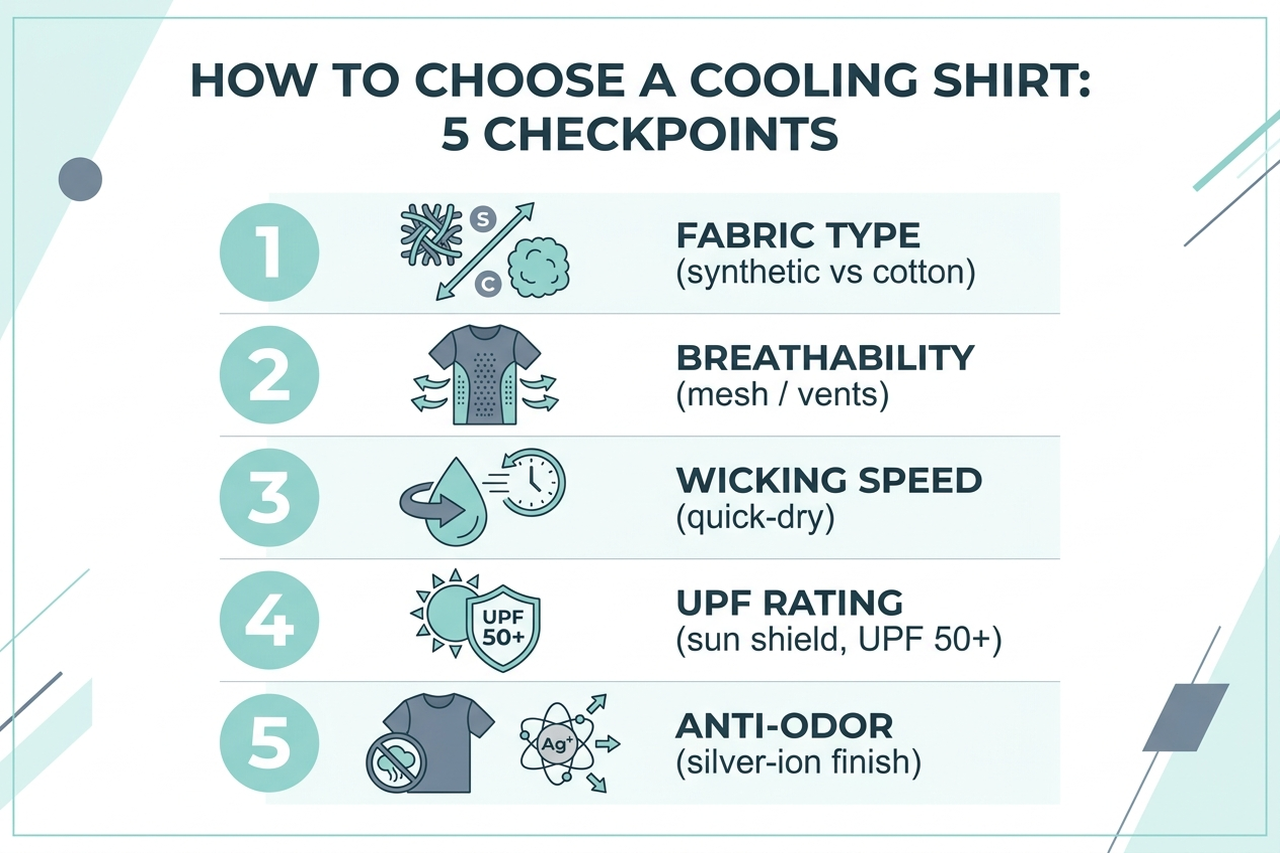
| Checkpoint | What to look for | Common mistake |
|---|---|---|
| Fabric type | Synthetic (poly/nylon + spandex) for max cooling; modal/Supima cotton blends for comfort | Buying 100% cotton expecting it to stay dry — it absorbs sweat and clings |
| Breathability | Mesh panels, micro-mesh knit, underarm venting | A solid heavy jersey that traps heat against the body |
| Wicking speed | ”Quick-dry,” engineered-fiber claims; brands cite “dries 4–5x faster” (Tommy John) | Slow-drying fabric that stays wet and feels heavier as you sweat |
| UPF (if outdoors) | UPF 50+ for all-day sun; UPF 30+ acceptable | No UV protection on a shirt worn for outdoor work or sport — sunburn risk |
| Anti-odor | Silver-ion or proprietary “anti-odor” / odor-shield finishes | No anti-odor finish on a shirt you’ll sweat in all day → smell by afternoon |
One care note that belongs here because it ruins more cooling shirts than anything else: skip the fabric softener. Softener leaves a film on synthetic fibers that blocks wicking, the exact property you paid for. Wash in cool water with regular detergent and, ideally, air dry. We expand on this in the care section below.
4. Quick comparison table (2026)
Prices captured at time of writing, June 2026, and shown as approximate ranges because color, pack size, and promotions all move the number. Confirm current pricing on the linked product page before purchase.
| Product | Approx price (USD) | Primary mechanism | Best for |
|---|---|---|---|
| 32 Degrees Cool Crewneck Tee | $12–16 | Contact cooling + wicking | Everyday cooling, benchmark value |
| 32 Degrees Cool Crewneck, 4-pack | $36–44 | Contact cooling + wicking | Stock-up rotation, lowest cost-per-shirt |
| Uniqlo AIRism Micro Mesh Crew | ~$20 | Breathable mesh | Under a regular shirt, everyday office |
| Tommy John Cool Cotton 2.0 Tee | $40–48 | Cotton-feel wicking | Sensitive skin, “doesn’t feel synthetic” |
| Tommy John Essential Cool Cotton Crew, 3-pack | $70–82 | Cotton-feel wicking | Stay-tucked layer under dress shirts |
| Hanes Cool DRI Performance Tee (UPF 50) | $9–15 | Wicking + UPF | Budget, ubiquitous, sun coverage |
| Nike Dri-FIT Ready Short-Sleeve Tee | $28–35 | Moisture-wicking | Gym, running, training |
| Under Armour Iso-Chill SS Compression | $35–45 | Contact cooling + compression | Cool-to-touch performance, UPF 30+ |
| Under Armour HeatGear Compression LS | $35–45 | Wicking compression base layer | Sport base layer, sun-sleeve coverage |
| Carhartt Force Sun Defender LS | $30–45 | UPF 50+ + wicking | Outdoor work, fishing, all-day sun |
5. Everyday cooling: the value benchmarks
5-1. 32 Degrees Cool Crewneck Tee (B08KSCXGS5)
If there is a US mass-market answer to “the everyday cooling t-shirt,” 32 Degrees is it. The fabric is a 90% polyester / 10% spandex lightweight jersey, lightly brushed both sides, with 4-way stretch, anti-odor, and quick-dry wicking (per the Amazon listing). It’s marketed as cool-to-the-touch and wicking at the same time — a contact-cooling-plus-wicking hybrid.
What customer reviews tend to praise: the price-to-comfort ratio, the soft hand-feel for a synthetic, color retention after repeated washes, and versatility (gym, undershirt, or lounging).
Where reviews push back: as a thin knit, lighter colors can be slightly see-through; and like all synthetics, it benefits from anti-odor washing discipline. It is a value shirt, not a premium one — set expectations at the $12–16 tier.
Best for: the default everyday cooling tee where you want several without overspending.
5-2. 32 Degrees Cool Crewneck, 4-pack (B08D6WJJ6G)
Same fabric platform, sold in a multipack (commonly 2 black / 2 navy). The math is the appeal: at roughly $36–44 for four, the cost-per-shirt drops to single digits. If you’ve already decided 32 Degrees works for you, buying the pack is the rational move.
Best for: stocking up so you can rotate a fresh cooling shirt daily through a heat wave without doing laundry every night.
5-3. Uniqlo AIRism Micro Mesh Crew (official site)
Uniqlo’s AIRism is the global benchmark for breathable-mesh cooling innerwear, and the Micro Mesh version maximizes airflow. Uniqlo describes it as quick-dry, cool-touch, anti-microbial, and odor-controlling, with a breathable mesh knit (Uniqlo US). It is engineered specifically to be worn under a regular shirt and disappear — light, smooth, and cool against the skin.
Note on availability: Uniqlo does not sell AIRism through Amazon in the US; it’s available via Uniqlo’s own stores and site. We link to the official page rather than a third-party reseller, because reseller listings for this item are frequently counterfeit or marked up.
Best for: the office, commuting, and anyone who wants a cooling layer that’s invisible under a button-down or polo.
6. Premium comfort: cotton-feel without the cling
6-1. Tommy John Cool Cotton 2.0 Tee (B0CZQKB7L2)
For people who dislike the feel of synthetics against their skin, Tommy John’s Cool Cotton line is the premium answer. The 2.0 is built from 100% Supima cotton engineered to be breathable and moisture-wicking — the brand claims it keeps you “2–3 times cooler than regular cotton” and dries faster (manufacturer claims, per the Amazon listing). It pairs that with a patented “Stay-Tucked” hem and a flat “Memory Collar.”
What customer reviews tend to praise: the soft, natural-fiber feel; the collar holding its shape; and the stay-tucked design genuinely staying tucked.
Where reviews push back: the price. At $40+ for a single tee, it is a significant step up from a 32 Degrees multipack. The cooling is comfort-grade, not athletic-grade — this is not a gym shirt.
Best for: sensitive skin, people who reject synthetics, and a refined undershirt feel. Note: this is the closest US analog to a premium cotton “stays-dry” innerwear; the cooling is real but gentle.
6-2. Tommy John Essential Cool Cotton Crew, 3-pack — Stay-Tucked (B0FH5K8HV4)
The Essential line brings the Cool Cotton concept to a multipack at a friendlier per-shirt price. These use 95% cotton with moisture-wicking finishing (brand claims sweat “evaporates, drying 4–5x faster” — Amazon listing) and a longer, tapered, stay-tucked cut designed to live under a dress shirt all day.
Best for: professionals who want a cool, sweat-managing layer under a work shirt and prefer cotton’s feel to a slick synthetic. A “Modern Fit” 3-pack (B0FH5LNDGP) exists for those who want a looser midsection.
7. Performance: gym, running, and high-sweat training
7-1. Nike Dri-FIT Ready Short-Sleeve Tee (B0CYRMVG1K)
Dri-FIT is Nike’s moisture-wicking system, and it is the category default for a reason: it pulls sweat to the surface for quick evaporation, keeping you dry and comfortable through a workout (Amazon listing). The “Ready” tee adds raglan sleeves angled for arm movement.
What customer reviews tend to praise: reliable wicking under heavy sweat, lightweight feel, and durability across many washes.
Where reviews push back: as pure wicking (not contact-cooling), it won’t feel “cold to the touch” the way an Iso-Chill or 32 Degrees shirt does — it manages sweat rather than chilling skin. Fit runs athletic.
Best for: the gym, running, and any blood-pumping activity where sweat volume is the main enemy.
7-2. Under Armour Iso-Chill Short-Sleeve Compression (B0C8BDKSJY)
This is the cool-to-the-touch performance pick. Iso-Chill fabric disperses body heat and feels cool against the skin, using flat yarn for heat conduction plus titanium dioxide for UV absorption (UA Iso-Chill explainer; Amazon listing). The compression cut keeps it second-skin tight.
What customer reviews tend to praise: the genuine cooling sensation on contact, the snug supportive fit, and UPF sun protection (UA rates much of this line UPF 30+).
Where reviews push back: compression isn’t for everyone — some buyers describe a tight, “second-skin” feel as restrictive. If you dislike compression, size up or choose a loose-fit shirt instead.
Best for: athletes who want the cooling sensation plus muscular support, in direct sun.
7-3. Under Armour HeatGear Compression Long-Sleeve (B0872NL76Y)
HeatGear is UA’s hot-weather wicking system, designed to wick sweat and stretch (Amazon listing). The long-sleeve compression version adds full-arm coverage — useful as a base layer under a jersey, or for sun coverage on the arms during outdoor sport.
Best for: a base layer under team kit, or arm-coverage sun protection during running, cycling, and field sports. Note this is HeatGear (wicking), not Iso-Chill (contact-cooling) — pick HeatGear for sweat management, Iso-Chill for the cold-touch feel.
8. Outdoor and work: when the sun is the problem
8-1. Carhartt Force Sun Defender Lightweight Long-Sleeve (B0DK28LBC8)
When the threat is hours of direct sun — roofing, landscaping, fishing, golf — the priority flips from “feel cold” to “block UV and dry fast.” Carhartt’s Force Sun Defender is built for exactly this: a UPF 50+, lightweight jersey engineered to block sun, fight sweat, and dry quickly (Carhartt Force Sun Defender; Amazon listing). The long sleeve is a feature here, not a drawback — covering skin beats exposing it in all-day sun, which is why dermatologists favor UPF sleeves over sunscreen alone (Skin Cancer Foundation).
What customer reviews tend to praise: sun coverage without overheating, fast drying, and Carhartt’s durability reputation.
Where reviews push back: it’s a workwear cut (relaxed), not an athletic compression fit; and as a long sleeve it’s a sun-and-work tool, not an indoor everyday tee. A short-sleeve version and a hooded version exist in the same line if you want less coverage.
Best for: outdoor work and recreation in sustained direct sun — the US analog to a heavy-duty job-site cooling shirt.
9. Quick pick by use case
| Situation | First choice | Runner-up |
|---|---|---|
| Everyday tee (visible) | 32 Degrees Cool Crewneck | Tommy John Cool Cotton 2.0 |
| Under a dress shirt | Tommy John Essential Cool Cotton (stay-tucked) | Uniqlo AIRism Micro Mesh |
| Office / commute, invisible layer | Uniqlo AIRism Micro Mesh | 32 Degrees Cool Crewneck |
| Gym / running | Nike Dri-FIT Ready | Under Armour Iso-Chill |
| Outdoor work / all-day sun | Carhartt Force Sun Defender | Hanes Cool DRI UPF 50 |
| Cool-to-the-touch feel | Under Armour Iso-Chill | 32 Degrees Cool |
| Lowest cost per shirt | 32 Degrees Cool 4-pack | Hanes Cool DRI |
| Sensitive skin / no synthetics | Tommy John Cool Cotton 2.0 | Uniqlo AIRism Cotton |
10. Common mistakes (and how to avoid them)
| Mistake | Cause | Fix |
|---|---|---|
| Shirt isn’t cool at all | Bought a generic “cooling” label with cotton-heavy blend and no named tech | Choose a named system (Dri-FIT, Iso-Chill, AIRism, Cool DRI) and read composition |
| Sticks to skin when you sweat | Slow-drying high-cotton fabric | Pick engineered synthetic or a wicking-finished cotton blend |
| Smells by mid-afternoon | No anti-odor finish | Choose silver-ion / “anti-odor” / odor-shield treated shirts |
| Shows through (see-through) | Thin light-colored knit | Choose gray, navy, or black; avoid white for thin synthetics |
| Cooling faded after a few washes | Fabric softener coated the fibers | Wash cool, regular detergent, no softener, air dry |
| Sunburn through the shirt | Loose-weave, non-UPF fabric in direct sun | Use UPF 50+ for all-day sun (Skin Cancer Foundation threshold) |
11. Care: how to keep the cooling alive
A cooling shirt is a piece of engineering, and laundry habits decide how long the engineering lasts.
- No fabric softener. This is the single biggest mistake. Softener deposits a film that clogs the capillary structure of wicking fabric, killing the exact property you bought. Skip it entirely on synthetics.
- Wash cool, not hot. Hot water can degrade the elastane (spandex) that gives 4-way stretch its recovery, and high heat is hard on technical finishes.
- Air dry when you can. High dryer heat is the second-biggest enemy of stretch and anti-odor finishes. If you must use a dryer, low heat.
- Wash anti-odor shirts promptly. Silver-ion and similar treatments resist odor, but letting sweat-soaked fabric sit still allows bacteria to establish; a prompt cool wash keeps the finish effective longer.
These habits are the difference between a cooling shirt that performs for two seasons and one that’s a plain tee by August.
12. The “which one for whom” flowchart
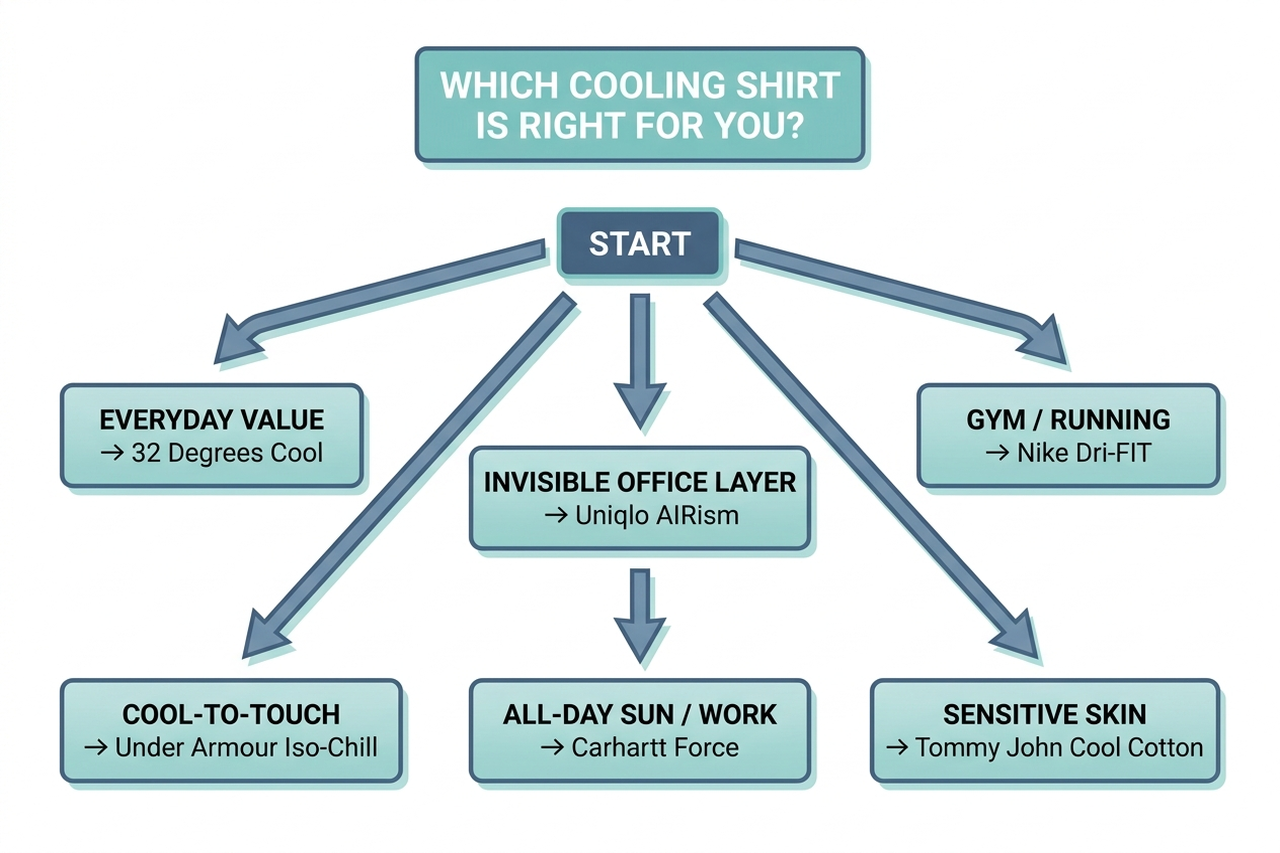
| Question | Answer | Pick |
|---|---|---|
| Want an everyday cooling tee at the best value, several at once? | Yes | 32 Degrees Cool 4-pack (B08D6WJJ6G) |
| Need an invisible cooling layer under a button-down? | Yes | Uniqlo AIRism Micro Mesh (official site) or Tommy John Essential (B0FH5K8HV4) |
| Dislike the feel of synthetics on your skin? | Yes | Tommy John Cool Cotton 2.0 (B0CZQKB7L2) |
| Sweating hard at the gym or on a run? | Yes | Nike Dri-FIT Ready (B0CYRMVG1K) |
| Want the genuine “cold to the touch” sensation? | Yes | Under Armour Iso-Chill (B0C8BDKSJY) |
| Working or playing in direct sun for hours? | Yes | Carhartt Force Sun Defender (B0DK28LBC8) UPF 50+ |
| Just want the cheapest thing that wicks and adds UPF? | Yes | Hanes Cool DRI (B074LH1DV2) |
13. The bottom line
There is no single “best cooling shirt in 2026.” There are four technologies and several use cases, and the right answer is the intersection of your activity and your budget:
| Best for | Pick | Approx price | Key data point |
|---|---|---|---|
| Everyday value | 32 Degrees Cool (4-pack) | $36–44 | 90% poly / 10% spandex, anti-odor, ~$10/shirt |
| Invisible office layer | Uniqlo AIRism Micro Mesh | ~$20 | Breathable micro-mesh, cool-touch + anti-microbial |
| Premium, cotton-feel | Tommy John Cool Cotton 2.0 | $40–48 | 100% Supima, brand-claimed “2–3x cooler than cotton” |
| Gym / running | Nike Dri-FIT Ready | $28–35 | Dri-FIT wicking, raglan sleeves |
| Cool-to-the-touch | Under Armour Iso-Chill | $35–45 | Flat-yarn heat dispersion + titanium dioxide UV, UPF 30+ |
| All-day sun / work | Carhartt Force Sun Defender | $30–45 | UPF 50+ (Skin Cancer Foundation threshold), fast-dry |
If you’re choosing between two shirts in the same tier, weight the dominant mechanism against your dominant problem: contact-cooling for the walk-outside “ahh,” wicking for high-sweat exertion, mesh for invisible everyday wear, and UPF 50+ for sustained sun. And whatever you buy — no fabric softener.
Limitations of this analysis
To be explicit about what this article does not establish:
- We did not personally test any of these products. Every claim is sourced from publicly available customer reviews, independent editorial tests, manufacturer specifications, and public-health and market-research data.
- Sample size. We read top reviews and the AI-summary block on each ASIN’s amazon.com page in June 2026. We do not report a precise N because Amazon does not expose a stable review count for those panels; any specific number would be misleading.
- Manufacturer claims (“2–3x cooler than cotton,” “dries 4–5x faster,” “cool to the touch,” specific UPF ratings) are reported as marketing claims, not independently verified by us. Unlike Japan’s JIS L 1927 Q-max standard, the US has no mandatory contact-cooling metric, so cross-brand cooling comparisons are inherently qualitative.
- Market-size figures (USD 2.7–2.9B in 2025 → 5.1–5.5B by 2033) are from third-party research firms and vary by source; treat them as directional.
- Pricing fluctuates with color, size, pack, and promotions; the ranges shown are approximate at time of writing — confirm on the product page.
- Availability — apparel SKUs (especially color and pack variants) come and go. A linked ASIN may be out of stock; check the brand’s site for the current equivalent. Uniqlo AIRism is sold through Uniqlo, not Amazon US.
- Individual fit and skin sensitivity vary. Compression fit, in particular, is polarizing; what feels supportive to one person feels restrictive to another.