Best Pour-Over Coffee Grinders 2026: Baratza vs Fellow
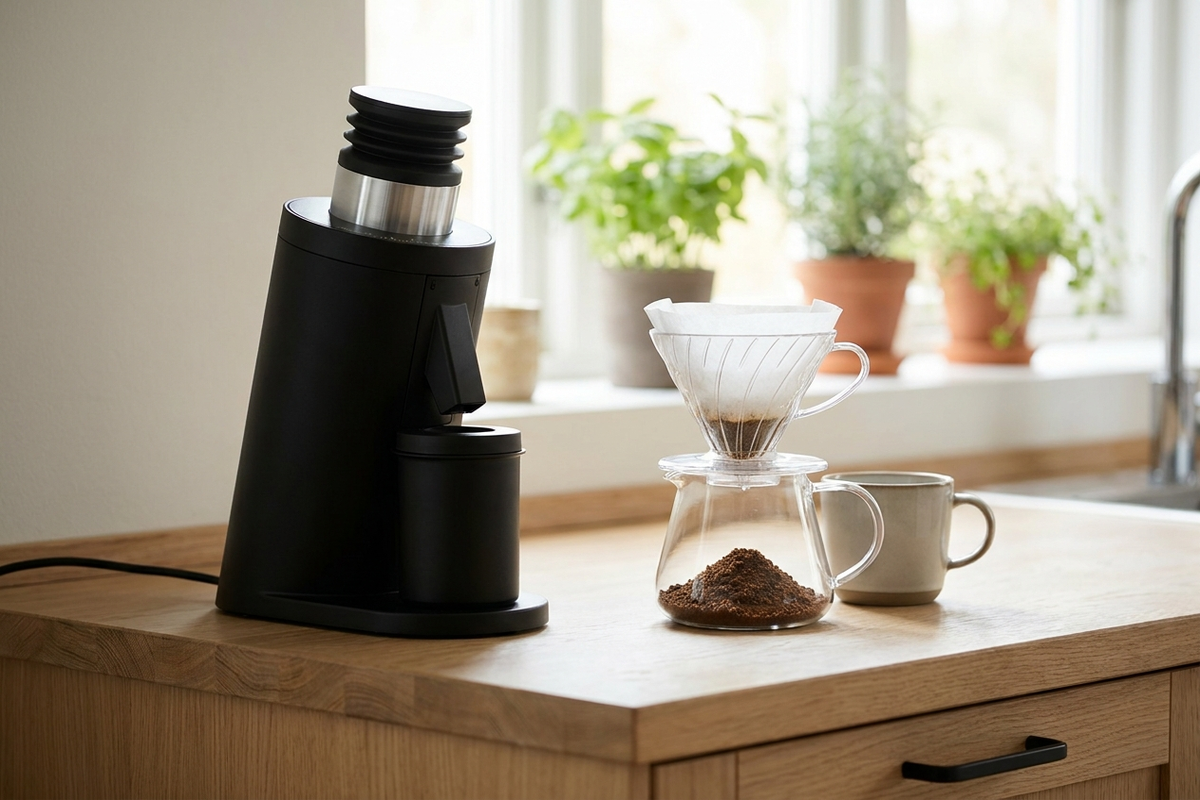
For pour-over coffee, the grinder matters more than the brewer. A $40 dripper paired with evenly ground coffee will beat a $400 setup fed by a cheap blade grinder every time, because pour-over rewards uniform particle size above almost anything else. As more Americans built serious home coffee routines, three burr grinders kept surfacing at the top of the “first real grinder” conversation: the long-running value benchmark Baratza Encore, the sleek, all-purpose Fellow Opus, and the budget-friendly OXO Brew Conical Burr. This guide breaks down which one wins for which kind of buyer, using aggregated Amazon review data, independent testing, and manufacturer specifications.
As an Amazon Associate, Arekore earns from qualifying purchases. The Amazon product links in this article may include our affiliate tracking ID and may earn us a commission if you buy through them, at no additional cost to you. See our Links Policy for details on how we select products and how commissions do not influence our recommendations.
TL;DR / Quick Verdict
- Best all-rounder and the safe default: the Baratza Encore — a conical burr grinder with 40 settings, a decade-plus track record, fully repairable parts, and grind quality that punches above its price for pour-over and drip. The easiest grinder to recommend to a first-time buyer.
- Best design and most versatile: the Fellow Opus — a quieter, better-looking grinder with 41 stepped settings plus a micro-adjust ring, single-dose friendly, and capable of reaching espresso-fine. The pick if it lives on an open counter or you want one grinder for many brew methods.
- Best budget entry point: the OXO Brew Conical Burr — the cheapest way into real burr grinding, with a built-in timer and 15 settings plus micro-adjustments. Loud, and coarser at the extremes, but a genuine upgrade over any blade grinder.
- The real choice: decide whether you value a proven, repairable workhorse (Encore), a quiet, good-looking all-rounder (Opus), or the lowest price of entry (OXO).
How We Reached These Conclusions (Methodology)
This is an editorial analysis, not a hands-on review. We did not personally test the products covered here. Instead, this guide synthesizes three kinds of public information: (a) aggregated amazon.com customer ratings and the substance of low-star reviews, sampled in June 2026; (b) independent third-party testing and reporting from Wirecutter (NYT), CoffeeGeek, Coffee Review, Seattle Coffee Gear, Prima Coffee, and Coffeeness; and (c) manufacturer specifications. Where we cite a manufacturer figure — a burr diameter, a motor torque rating, or a settings count — we label it as a manufacturer claim rather than an independently verified result. We deliberately avoid quoting precise review counts or “percent of reviewers” figures we cannot verify; the sentiment summaries below are directional. Prices are amazon.com figures at the time of writing and change frequently, especially around Prime Day and the holidays.
The US Coffee-Grinder Market in 2026
Home brewing is no longer a fallback — it is the main event. A widely reported consumer survey found that roughly 35% of US consumers say they are making coffee at home more often in the face of rising café prices, and the Specialty Coffee Association’s 2026 National Coffee Data Trends report again found specialty coffee consumption at a record high. As home setups have grown more serious, the grinder has become the upgrade enthusiasts buy first.
Pour-over has ridden that same wave. By one widely cited estimate, the pour-over method is now used by about 14.4% of US coffee drinkers, up from 6.4% in 2014 — more than double in a decade. That growth maps directly onto demand for better grinders, because pour-over is the brew method most sensitive to grind quality.
The category itself is expanding steadily. Market researchers at 360iResearch value the coffee grinder market at roughly $458 million in 2026, growing toward $731 million by 2032 at about a 7.8% annual rate (a third-party estimate; other firms publish different figures, so treat it as directional). The practical takeaway for a buyer: at every price point from $99 to $200, the entry-level burr grinder is now a mature, competitive product — and the differences between the three here are about consistency, noise, and how the grinder fits your kitchen, not about whether any of them works.
1. First, Decide What Matters Most to You
Before comparing models, settle the questions that explain most of the differences here:
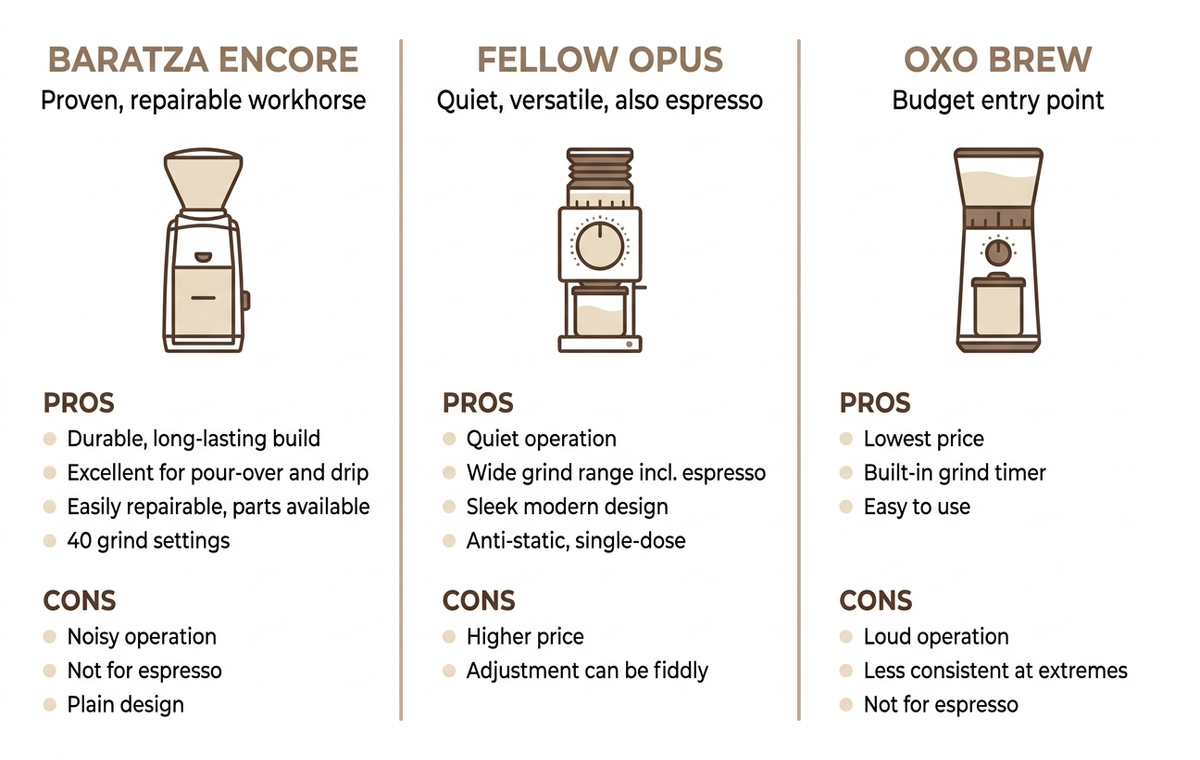
- Do you want a proven workhorse you can repair, not replace? The Baratza Encore has been sold and serviced for over a decade, with replacement burrs and parts readily available.
- Do you care about how it looks and sounds on the counter? The Fellow Opus is the quietest and most design-forward of the trio, and it single-doses cleanly.
- Is the lowest possible entry price the priority? The OXO Brew Conical Burr is typically the cheapest of the three and adds a built-in grind timer.
- Will you ever pull espresso? Only the Fellow Opus (and the espresso-capable Encore ESP sibling) reaches a true espresso-fine grind. The classic Encore and the OXO are built for filter, pour-over, drip, and French press.
A useful rule of thumb from the aggregated reviews: any of these three is a dramatic upgrade over a blade grinder for pour-over. Above that baseline, you are mostly paying for repairability and a proven record (Encore), quiet operation and design (Opus), or the lowest price (OXO).
2. The Technology: Why Burrs Beat Blades
The single most important fact in this whole category is that burr grinders crush beans to a consistent size, while blade grinders chop them randomly. Pour-over depends on that consistency: uniform particles extract at the same rate, so the cup tastes balanced instead of simultaneously sour and bitter.
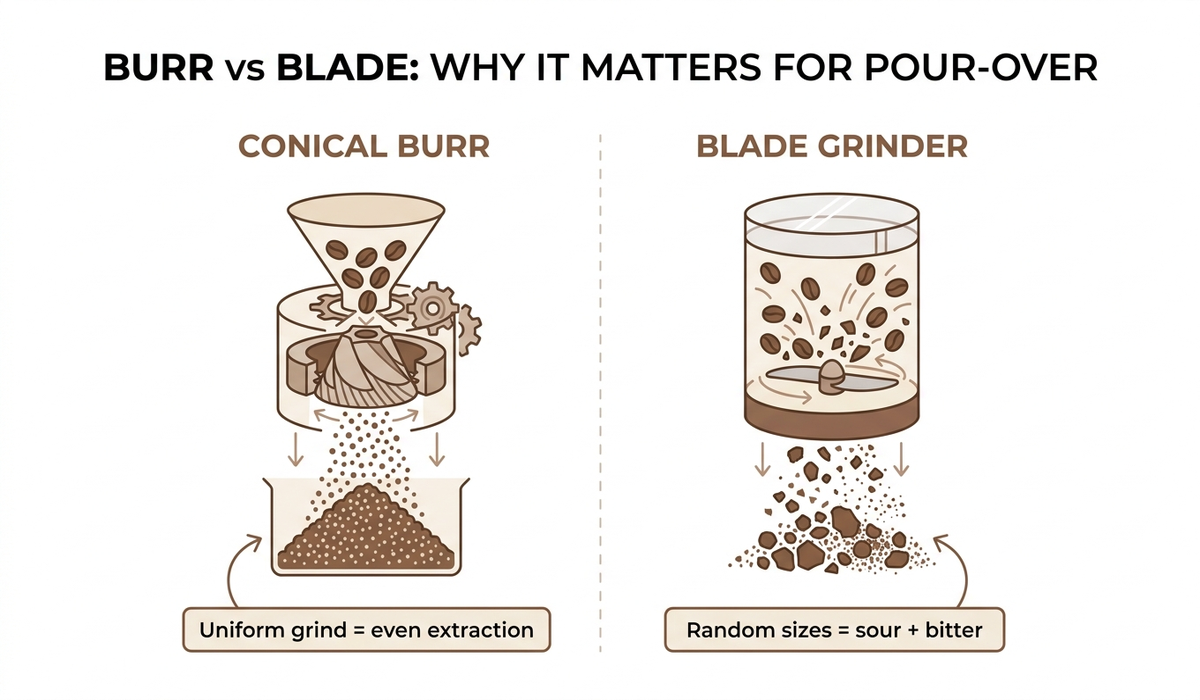
- Conical burrs. All three grinders here use conical burrs — a cone-shaped inner burr spinning inside a ringed outer burr. Beans fall into the gap and are crushed to a size set by how far apart the burrs sit. Conical burrs are forgiving, run cooler at lower speeds, and are the standard at this price.
- Burr material and size. The Baratza Encore and Fellow Opus both use 40mm stainless steel conical burrs (manufacturer figures). Larger, sharper burrs generally produce fewer “fines” — the dust-like particles that can muddy a pour-over. Reviewers consistently rate the Encore’s burr set as a step above typical budget grinders.
- Stepped settings. Each grinder uses stepped adjustment, meaning the grind size clicks between fixed positions rather than sliding continuously. The Encore offers 40 steps, the Opus 41 steps plus a micro-adjust ring for fine-tuning, and the OXO 15 steps with additional micro-settings (manufacturer figures).
- Fines and uniformity. No sub-$200 grinder is perfectly uniform. The goal is “few enough fines that the cup is clean.” Independent reviews place the Encore and Opus ahead of the OXO on this measure, with the OXO still well clear of any blade grinder.
- Retention and static. Cheaper grinders hold onto stale grounds and fling static-charged coffee around. The Opus addresses this with an anti-static design; the Encore and OXO retain a little more and benefit from a quick tap or brush.
Bottom line: pick the grinder whose settings range and consistency match your brewing, then weigh noise, looks, and price.
3. Comparison Table
Prices are amazon.com figures at the time of writing (June 2026) and fluctuate. Burr size, settings count, and capacity are manufacturer or review-platform figures.
| Model | ASIN | Approx. price | Burrs | Settings | Best for | Espresso? |
|---|---|---|---|---|---|---|
| Baratza Encore | B007F183LK | ~$169.99 | 40mm stainless steel conical | 40 stepped | Pour-over, drip, French press | No (ESP sibling does) |
| Fellow Opus | B0BV96VPSR | ~$195 | 40mm stainless steel conical | 41 stepped + micro ring | All methods incl. espresso | Yes |
| OXO Brew Conical Burr | B07CSKGLMM | ~$99 | Stainless conical | 15 stepped + micro | Pour-over, drip on a budget | No |
4. Baratza Encore — The Proven Workhorse
The Baratza Encore is, for many buyers, the default answer to “what’s a good first coffee grinder?” It has been the go-to entry-level electric burr grinder for well over a decade, and that longevity is the point: Baratza built its reputation on repairability and US-based service, selling replacement burrs, motors, and parts so a worn grinder can be fixed rather than thrown away. For pour-over, its 40mm stainless steel conical burrs and 40 grind settings (manufacturer figures) deliver the even, fines-light grind that filter brewing rewards.
Independent reviewers have long treated the Encore as the value benchmark in this space. Wirecutter (NYT) keeps the Encore family in rotation as its entry-level recommendation, and CoffeeGeek has praised the platform for grind quality that outclasses its price. Long-term owner reviews — including write-ups documenting years of daily use — repeatedly highlight how serviceable the grinder is.
The trade-offs are real but minor. The classic Encore is a filter grinder: its coarser-spaced settings are tuned for pour-over, drip, and French press, not espresso. If you want one grinder that also pulls shots, Baratza sells the espresso-capable Encore ESP as a sibling at a higher price. The Encore is also loud — a common trait among entry-level electric grinders — and the design is functional rather than stylish.
Aggregated sentiment: the Encore carries a high average rating across thousands of ratings (in the mid-4-star range at time of writing). Praise clusters around grind consistency, durability, and repairability; the most common complaints involve noise and a plastic-feeling build.
Check the Baratza Encore on Amazon
5. Fellow Opus — The Quiet, Versatile All-Rounder
The Fellow Opus is the grinder for people who care how their kitchen looks and sounds. It belongs to Fellow’s design-forward lineup, and it shows: a sleek, compact, commercial-inspired body, a noticeably quieter motor than the Encore, and a single-dose-friendly workflow. Where it really separates from the classic Encore is range — the Opus pairs 41 stepped settings with a micro-adjust ring and 40mm stainless steel conical burrs (manufacturer figures) that reach all the way from cold-brew coarse to espresso fine.
Reviewers consistently call the Opus a true all-rounder. Coffeeness rates it as one of the more versatile grinders at its price, and head-to-head comparisons from Seattle Coffee Gear and Prima Coffee note that the Opus is the quieter of the popular sub-$200 grinders and the better-looking on a counter. For a household that wants one grinder for pour-over today and the option to dabble in espresso later, that flexibility is the selling point.
The catches: the Opus’s inner-and-outer-ring adjustment is less intuitive than the Encore’s single dial, and several reviews note that while it grinds espresso, dedicated espresso grinders still pull cleaner shots with fewer fines. It also sits at the top of this price bracket (around $195 at the time of writing), and Fellow’s newer Opus 2 revision has appeared alongside the original, so confirm exactly which version a listing shows before buying.
Aggregated sentiment: consistently high ratings, with reviewers highlighting the quiet operation, the design, and the wide grind range. Recurring criticisms are the fiddly adjustment mechanism and the price.
Check the Fellow Opus on Amazon
6. OXO Brew Conical Burr — The Budget Entry Point
If the Baratza is about a proven record and the Fellow is about design, the OXO Brew Conical Burr is about getting into real burr grinding for the least money. It is typically the cheapest of the three, and it adds a feature the others lack: a built-in grind timer that lets you dial in a duration and grind hands-free at the push of a button. Its stainless conical burrs and 15 settings plus micro-adjustments (manufacturer figures) cover pour-over, drip, and French press comfortably, with a UV-blocking hopper that holds up to roughly 12 ounces of beans.
Independent reviews position it clearly. Coffee Review and Coffeeness both frame the OXO as the best of the true entry-level cohort around $100 — a meaningful upgrade over any blade grinder and a sensible first burr grinder. Home Grounds reaches a similar conclusion on value, while noting its limits.
Those limits are worth stating plainly. The OXO is especially loud, even by budget-grinder standards — reviewers warn it can wake the house during an early-morning grind. Its 15 stepped settings give less granular control than the Encore’s 40 or the Opus’s 41-plus-micro, and at the extremes (very fine, very coarse) it produces more fines and less uniformity than the pricier two. It is not an espresso grinder. For a buyer whose priority is the lowest price of entry for daily pour-over and drip, none of that is disqualifying.
Aggregated sentiment: strong ratings for the price, with reviewers praising value, the timer, and ease of use. The most common complaints are noise and inconsistency at the coarsest and finest settings.
Check the OXO Brew Conical Burr on Amazon
7. How to Grind for Pour-Over
A great grinder still needs the right setting. For pour-over, the target is a medium-fine grind, roughly the texture of table salt — finer than drip, coarser than espresso. Here is how that maps onto these grinders.
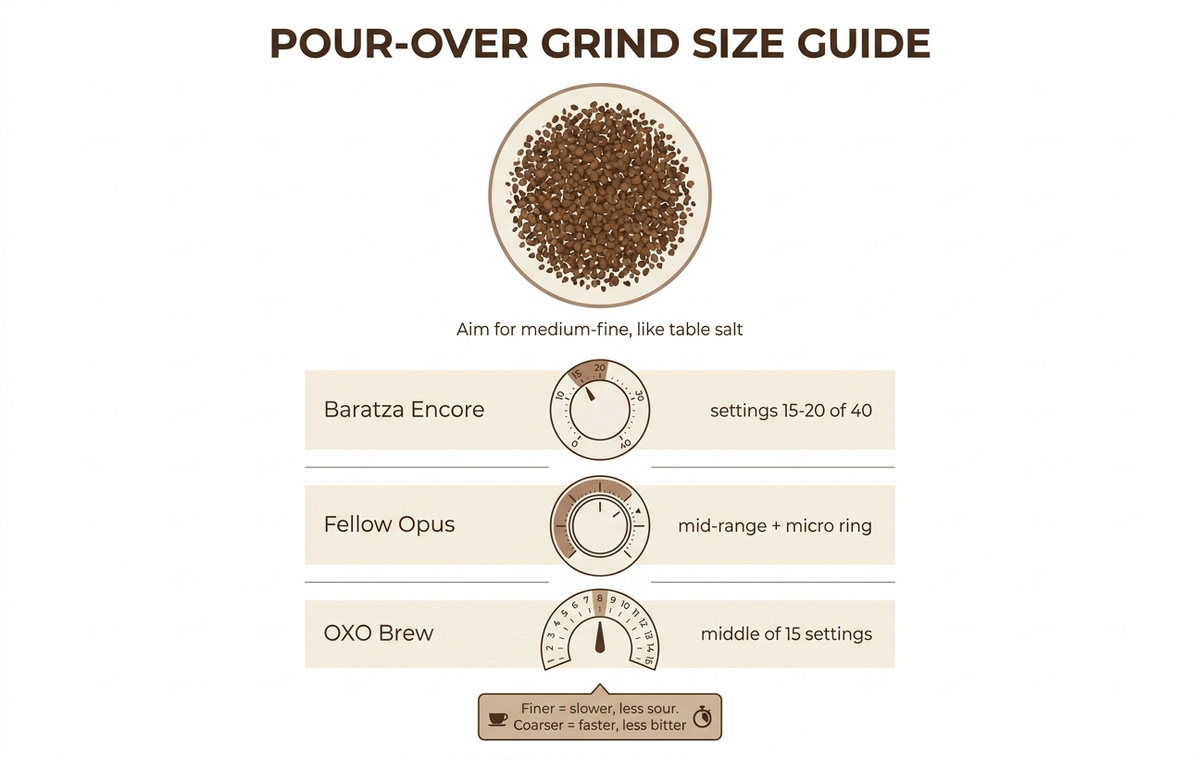
- Baratza Encore: start around settings 15–20 of its 40 for a standard pour-over (lower numbers are finer). Adjust finer if the cup tastes thin and sour, coarser if it tastes harsh and bitter.
- Fellow Opus: start in the mid-range of its 41 steps for pour-over, then use the micro-adjust ring to fine-tune. The Opus can go much finer for espresso, so you have plenty of headroom in both directions.
- OXO Brew: use a middle setting of its 15, then nudge by feel. With fewer steps, each click changes the grind more, so adjust in single steps.
- The dial-in rule: change one variable at a time. If the brew runs too fast and tastes weak, go one step finer; if it stalls and tastes bitter, go one step coarser. Keep your coffee dose and water amount fixed while you tune.
Two universal tips: grind immediately before brewing (ground coffee goes stale within minutes), and weigh your beans and water with a scale for repeatable results.
8. How to Choose: A Decision Flowchart
The three grinders barely compete head-to-head; each is the clear answer to a different question.
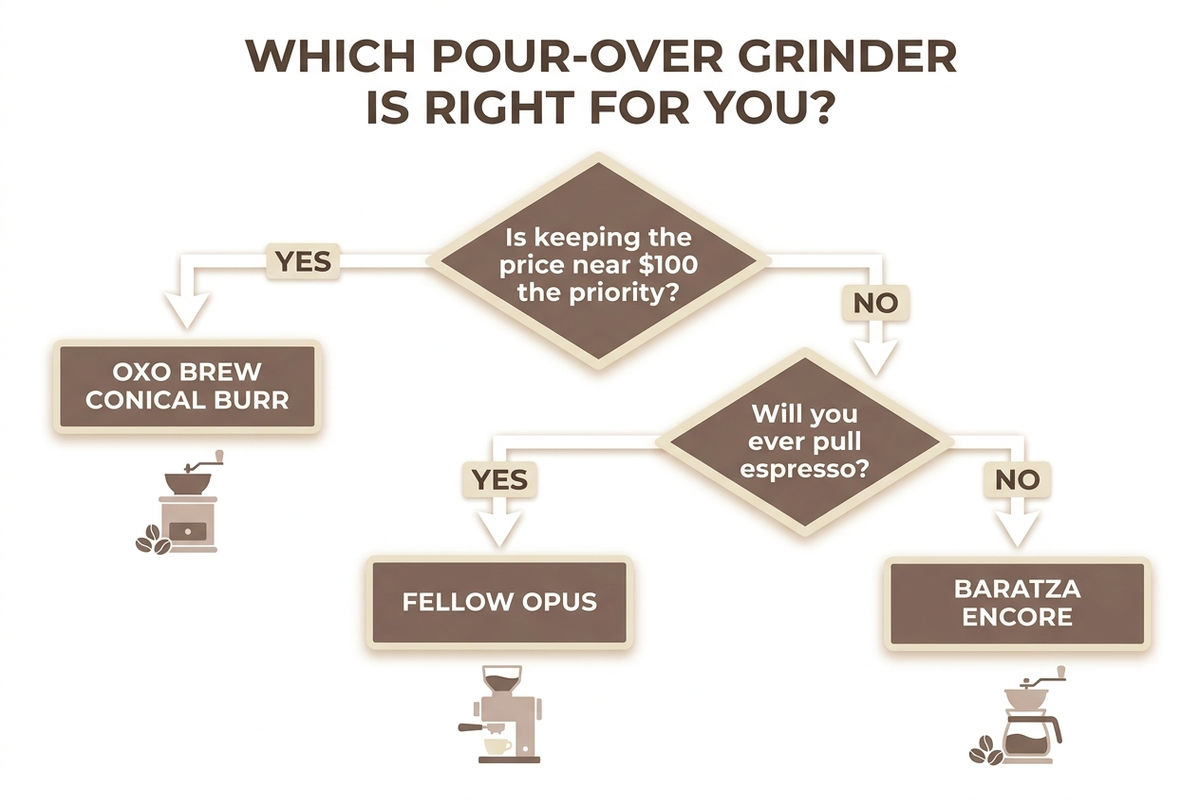
- Start with budget. If keeping the price near $100 matters most, the OXO Brew Conical Burr is the entry point. If you can spend more for better consistency and longevity, look at the Encore and Opus.
- Then weigh espresso. Will you ever pull shots? Only the Fellow Opus (or the Encore ESP sibling) reaches espresso-fine. If you only brew pour-over, drip, and French press, the classic Baratza Encore is purpose-built for it.
- Finally, weigh kitchen fit. Care about a quiet, good-looking grinder on an open counter? The Fellow Opus wins. Want a proven, repairable workhorse you can service for years? The Baratza Encore is the safe long-term bet.
9. Editorial Recommendations by Use Case
- Best for most people: Baratza Encore. The combination of proven grind quality, repairability, US service, and 40 filter-focused settings makes it the easiest grinder to recommend to a first-time pour-over buyer.
- Best for design and versatility: Fellow Opus. If it lives on an open counter, you want quiet operation, or you might pull espresso someday, the Opus is the most flexible pick — at the highest price here.
- Best on a budget: OXO Brew Conical Burr. The cheapest real burr grinder of the three, with a handy timer. Accept the noise and the coarser extremes and it is a huge step up from a blade grinder.
- Best if you also want espresso: the Fellow Opus, or step up to the Baratza Encore ESP sibling if you want Baratza’s repairable platform with espresso capability.
10. Warranty, Support, and Longevity
Warranty terms differ across the three (confirm the current terms on each product page, as they occasionally change):
- Baratza is the standout on longevity. Beyond its limited warranty, the brand is built around repairability — replacement burrs, motors, and parts are sold directly, and US-based service is a core part of its reputation. An Encore can realistically last a decade or more with maintenance.
- Fellow offers a limited warranty on the Opus and sells some replacement parts; its grinders are newer to market, so the long-term service record is shorter than Baratza’s.
- OXO backs the Brew Conical Burr with its consumer-products satisfaction guarantee, but it is the least repairable of the three — treat it more as a replace-than-repair appliance.
The grinder most likely to still be on your counter in ten years is the one you can service, which tilts the longevity argument toward the Baratza Encore.
11. Limitations of This Analysis
This analysis relies on publicly available reviews, independent third-party tests, and manufacturer specifications; we did not personally test these grinders, and individual experience varies with bean type, roast level, brew recipe, and unit-to-unit variance. Grind “consistency” and “noise” are partly subjective and depend on your beans and kitchen; recommended grind settings are starting points, not exact values, and every grinder needs dialing in. Market-size and pour-over-adoption statistics come from third-party research firms and surveys whose methodologies differ, so we present them as directional. Prices, ASIN availability, model revisions (such as the Fellow Opus 2), and warranty terms change frequently; always confirm the current price, version, and specifications on the product page before buying. Manufacturer claims (burr size, settings count, capacity) are labeled as such and are not independently verified here.
The Bottom Line
For pour-over, spend on the grinder before anything else. Choose the Baratza Encore if you want a proven, repairable workhorse tuned for filter coffee, the Fellow Opus if you want a quiet, good-looking grinder that also reaches espresso, and the OXO Brew Conical Burr if you want the lowest price of entry without dropping to a blade grinder. Whichever you lean toward, verify the exact model, version, and current price before you check out — and if you want a second opinion on a specific listing, paste the URL into Arekore and let the AI scan the reviews and price history for you in about five minutes.