Best Budget Laptops in 2026: Under $600 Buyer's Guide

TL;DR / Quick Verdict
- Best overall value: Acer Aspire 16 AI (Snapdragon X, 16GB RAM) — a 16-inch 120Hz display and a Copilot+ NPU at a price other brands can’t match for the screen size, though some Windows desktop apps still run through ARM emulation.
- Best for Apple ecosystem buyers: Apple MacBook Neo 13” (A18 Pro chip) — Apple’s first sub-$600 Mac, built around an iPhone-grade chip rather than M-series silicon, with 8GB of unified memory as the only configuration under $600.
- Best true budget pick: Acer Chromebook Plus 514 — ChromeOS’s lighter memory footprint means it dodged most of the 2026 RAM-crisis price hikes that pushed budget Windows laptops higher this year.
Methodology
This analysis synthesizes (a) aggregated Amazon US customer listings and review patterns for current-generation Acer, Apple, and Lenovo budget laptop lines, (b) independent test coverage from Consumer Reports, Tom’s Guide, PCWorld, and TechRadar, and (c) manufacturer-published specifications for processors, memory, and battery life. We did not personally test the products covered here. Amazon does not expose a precise, publicly verifiable review count per listing, so we do not report an exact aggregate sample size; manufacturer battery-life and performance claims are labeled as such unless a named third-party test independently confirmed them.
Technical Approach: Four Different Bets on “Budget” in 2026
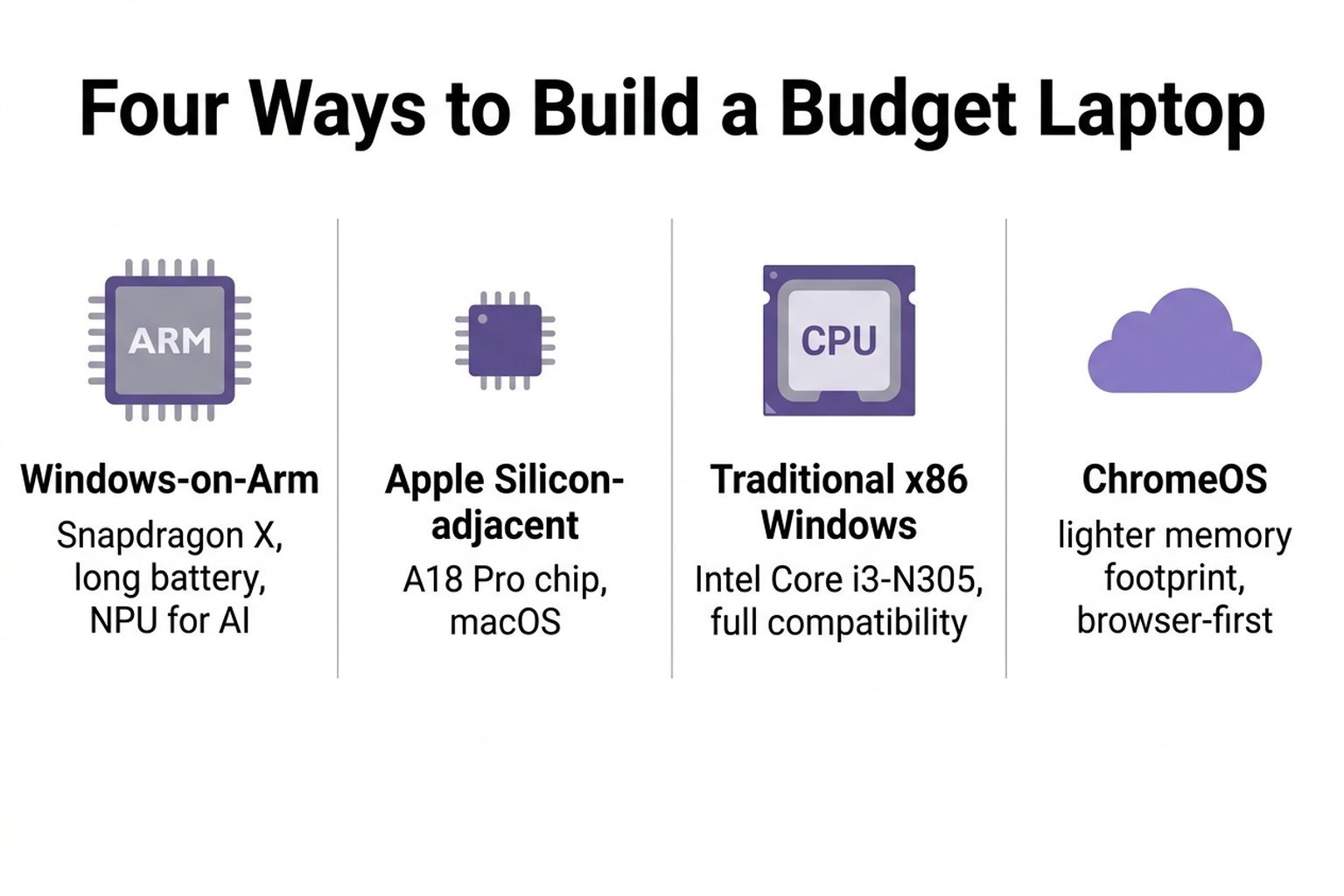
Under $600 no longer means one kind of laptop. The ongoing 2026 DRAM shortage — IDC forecasts full-year 2026 PC shipments down 11.3% alongside average selling prices up 18.3%, and manufacturers including Lenovo, Dell, HP, Acer, and ASUS have warned of 15–20% PC price increases in 2026 due to DRAM and NAND shortages — has pushed manufacturers toward different strategies for keeping a model under the $600 line:
- Windows-on-Arm Copilot+ PCs (Acer Aspire 16 AI): Qualcomm’s Snapdragon X chips sidestep the worst of the DRAM crunch by using efficient LPDDR5X memory and power draw low enough to hit genuinely long battery claims, plus a dedicated NPU for on-device AI features. The tradeoff: some legacy x86 Windows software still runs through emulation rather than natively, which can cost performance on older or niche applications.
- Budget Apple Silicon-adjacent (MacBook Neo): Apple’s answer wasn’t a cut-down M-series Mac — it’s a MacBook built around the A18 Pro, the same chip family that powers iPhones, marking the first time an iPhone-grade chip has shipped in a Mac rather than M-series silicon. That lets Apple hit $599 while keeping macOS, but the only configuration under $600 ships with 8GB of unified memory and no RAM upgrade path after purchase.
- Traditional x86 Windows (Lenovo IdeaPad Slim 3i): The cheapest route to a conventional, fully compatible Windows laptop is also the one hit hardest by the RAM crisis — manufacturers are reportedly holding mid-range and budget PCs at 8GB of RAM as a bare minimum specification to protect the price point, rather than offering 16GB as the entry configuration like they did in 2024–2025.
- ChromeOS (Acer Chromebook Plus 514): Chrome OS’s smaller memory footprint and heavier reliance on web apps over locally installed software gives manufacturers more pricing headroom during a memory shortage — one of the reasons Chromebooks in the $200–$400 range have been comparatively insulated from the price increases hitting budget Windows laptops in 2026.
Manufacturer Deep Dive
Acer
Acer covers two different budget approaches in this comparison. The Aspire 16 AI (Snapdragon X X1-26-100 configuration) pairs a 16-inch WUXGA (1920x1200) IPS display — with some configurations offering a 120Hz refresh rate and touch support — with 16GB of LPDDR5X memory and a 45 TOPS NPU for Copilot+ AI features, at prices Amazon lists from roughly $599 to $699 depending on configuration. PCWorld’s review called it “seriously good value,” while noting battery life, though strong, fell short of Acer’s advertised up-to-23-hour claim in lab testing. The Chromebook Plus 514 takes the opposite approach: a 14-inch FHD IPS touchscreen, an Intel Core i3-N305 8-core processor, 8GB of LPDDR5 memory, and a 128GB SSD on the lowest-priced listing (256GB and 512GB configurations are also sold under the same model name at a higher price), aimed at buyers who live mostly in a browser and want a lighter, cheaper machine that sidesteps most of the RAM-crisis price pressure hitting Windows laptops.
Apple
The MacBook Neo is Apple’s first dedicated budget Mac in more than a decade, announced in March 2026 and positioned to compete directly with Chromebooks and entry-level Windows machines rather than with the MacBook Air. It uses the A18 Pro chip (6-core CPU, 5-core GPU) — the same silicon family found in recent iPhones — rather than M-series chips used in every other current Mac. The base $599 configuration ships with 8GB of unified memory and 256GB of storage; a 512GB configuration is also available under $600 in some listings. It includes a 13-inch Liquid Retina display rated up to 500 nits, a 1080p FaceTime HD camera, and Apple’s own claim of up to 16 hours of battery life. Consumer Reports described it as “a genuinely compelling option” for everyday workloads like browsing, email, and light productivity, while noting it trades the performance headroom of M-series Macs for the lower price.
Lenovo
The IdeaPad Slim 3i (15.6-inch, Intel Core i3-N305) is Lenovo’s entry-level pick in the traditional x86 Windows category, typically listed on Amazon in the $390–$430 range depending on storage configuration (128GB or 256GB SSD, 8GB of LPDDR5 RAM). It’s an 8-core, low-power Intel processor aimed at web browsing, office work, and streaming rather than heavier multitasking or gaming. Some listings ship in “Windows 11 Home in S Mode,” a restricted mode limited to Microsoft Store apps unless switched out of S Mode — worth checking on the specific listing before buying if you plan to install software outside the Store.
How to Decide: RAM, Storage, and the 2026 Shortage
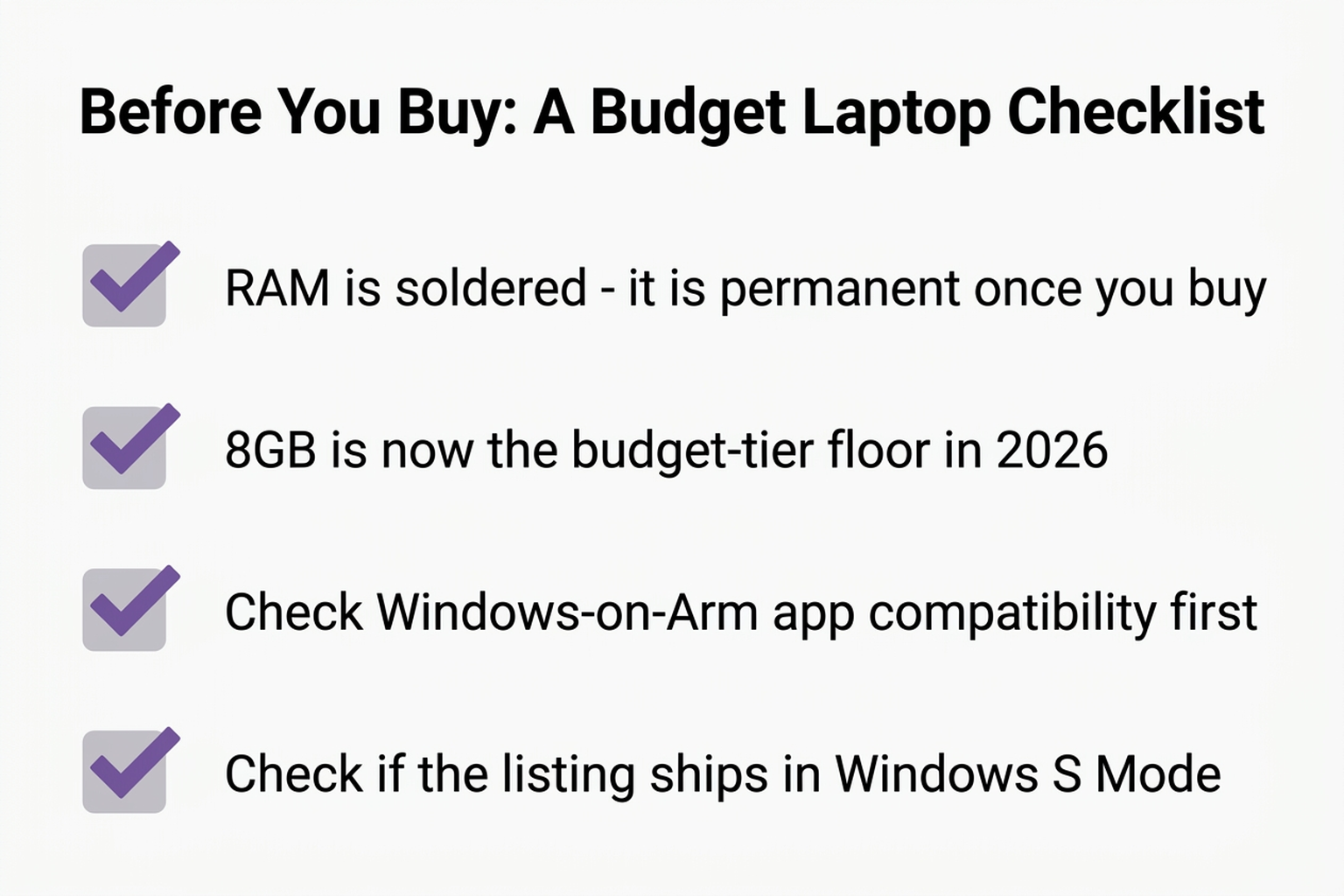
Three things matter more in 2026 than in a typical year, because of the ongoing memory shortage:
- RAM is likely soldered and non-upgradeable on every laptop in this price range, across all four technical approaches above. Whatever RAM configuration you buy is very likely permanent — there is no “add more RAM later” option on these models.
- 8GB is now a common budget-tier floor, not a stopgap. Industry reporting indicates manufacturers are holding mid-range and budget laptops at 8GB as a bare minimum to protect price points during the shortage, where 16GB was more commonly available at this price tier before 2026. If your workload is more than browser tabs and office documents, the Acer Aspire 16 AI’s 16GB configuration is the only model in this comparison that clears that bar.
- Check Windows-on-Arm software compatibility before buying if you rely on specific legacy Windows software — the Snapdragon-based Aspire 16 AI runs most mainstream apps natively or through Microsoft’s emulation layer without issue, but some older or specialized x86 applications may run slower or not at all.
- Check S Mode and app-store restrictions on budget Windows listings — some Lenovo IdeaPad Slim 3i listings ship in Windows 11 Home S Mode, which can be switched off for free but is worth confirming before you buy if you plan to install software from outside the Microsoft Store.
Comparison Table
Prices as of 2026-10-12 — Amazon frequently adjusts laptop pricing amid the ongoing 2026 memory shortage; check the live listing before buying.
| Product | Chip/Processor | RAM | Storage | OS | Price |
|---|---|---|---|---|---|
| Acer Aspire 16 AI | Snapdragon X X1-26-100 (Windows-on-Arm) | 16GB LPDDR5X | 512GB SSD | Windows 11 Home | ~$599–$699 |
| Apple MacBook Neo 13” | Apple A18 Pro | 8GB unified | 256GB SSD | macOS | ~$599 |
| Lenovo IdeaPad Slim 3i 15.6” | Intel Core i3-N305 | 8GB LPDDR5 | 256GB SSD | Windows 11 Home | ~$390–$430 |
| Acer Chromebook Plus 514 | Intel Core i3-N305 | 8GB LPDDR5 | 128GB SSD | ChromeOS | ~$390–$430 |
Decision Flowchart: Price vs. Purpose
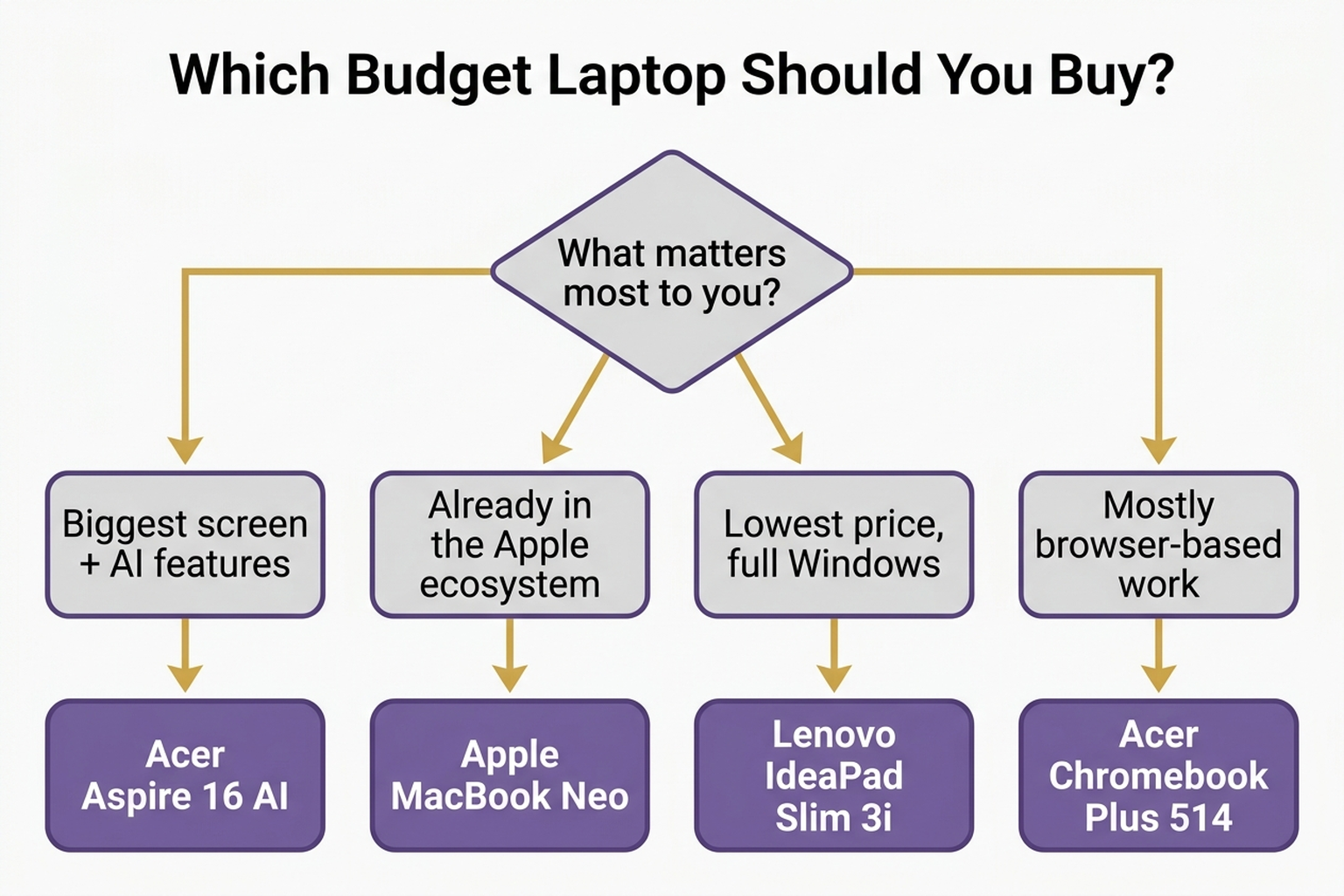
Start with your ceiling budget and what software you need. If you’re set on spending close to $600 and want the biggest, highest-refresh-rate display plus on-device AI features, the Acer Aspire 16 AI’s 16GB configuration is the strongest spec package here. If you’re already inside Apple’s ecosystem (iPhone, iCloud, Apple apps) and mainly do browsing, email, and documents, the MacBook Neo gets you into macOS at a price Apple has never offered before — but its memory ceiling is fixed at purchase. If you need a conventional, fully compatible Windows machine and want to spend well under $450, the Lenovo IdeaPad Slim 3i covers basic productivity. If your work genuinely lives in a browser — web apps, Google Workspace, streaming — the Acer Chromebook Plus 514 is the cheapest, and its ChromeOS footprint has been comparatively shielded from the 2026 RAM price spikes.
Warranty and Support
Acer publishes a 1-year limited warranty on its Aspire and Chromebook lines, extendable through optional paid plans on some listings. Apple covers the MacBook Neo with its standard 1-year limited warranty and 90 days of complimentary phone support, with AppleCare+ available as a paid extension for accidental damage coverage. Lenovo publishes a 1-year limited warranty (sometimes “depot” repair, meaning you ship the unit in rather than on-site service) on the IdeaPad Slim 3i, with paid warranty upgrades available at checkout on some listings. None of these warranties cover battery capacity degradation from normal charge cycles, which affects every lithium-ion laptop battery regardless of brand.
Editorial Recommendation
- Best overall value: Acer Aspire 16 AI — the only model here with 16GB of RAM and a large, high-refresh display, for buyers willing to spend closer to $600–$699.
- Best for Apple ecosystem buyers: Apple MacBook Neo 13” — macOS at a price point Apple has never previously offered, best suited to light workloads given the fixed 8GB memory.
- Best true budget pick: Acer Chromebook Plus 514 — the cheapest path to a usable daily laptop for browser-centric work, and comparatively insulated from 2026 RAM-driven price hikes.
- Best conventional Windows value: Lenovo IdeaPad Slim 3i — a fully compatible Windows machine for basic productivity at the lowest price of the four, with the caveat of 8GB RAM and some listings shipping in S Mode.
Limitations
This analysis relies on publicly available product listings, manufacturer specifications, and third-party test coverage from Consumer Reports, Tom’s Guide, PCWorld, and TechRadar; we did not independently test battery life, emulation performance, or real-world multitasking under controlled conditions. Manufacturer-published figures (battery-life claims, NPU TOPS figures, display brightness) are cited as manufacturer claims, not independently verified facts, unless a cited third-party test explicitly confirmed them. Individual experience may vary based on specific configuration, software workload, and unit-to-unit variance. Prices and specific configurations (RAM, storage, S Mode status) vary by individual Amazon listing and change frequently amid the ongoing 2026 memory shortage — confirm the exact configuration on the live listing before buying.
As an Amazon Associate, Arekore earns from qualifying purchases. The Amazon product links in this article include our affiliate tracking ID and may earn us a commission if you buy through them, at no additional cost to you. See our Links Policy for details on how we select products and how commissions do not influence our recommendations.
- Acer Aspire 16 AI Copilot+ PC (Snapdragon X, 16GB RAM)
- Apple MacBook Neo 13” (A18 Pro, 256GB)
- Lenovo IdeaPad Slim 3i 15.6” (Intel Core i3-N305)
- Acer Chromebook Plus 514 (Intel Core i3-N305)
Visit Arekore to verify current pricing and availability on any product mentioned here before buying.