Best Baby Monitors 2026: Nanit vs Owlet Compared

TL;DR. Baby monitors in 2026 split into three genuinely different products, not just three brands. Nanit Pro is a Wi-Fi smart camera built around computer-vision sleep analytics — it watches and scores how your baby sleeps, but tracks no vital signs. Owlet Dream Duo 3 pairs a camera with an FDA-cleared wearable sock that measures heart rate and blood oxygen — the only one of the three that monitors a physiological signal. Infant Optics DXR-8 Pro skips Wi-Fi entirely, talking directly to its own handheld screen over a closed radio link — no app, no account, nothing for a stranger to hack. Below: how each technology actually works, what independent testers and aggregated owner feedback say, a comparison table, and a flowchart to match the right monitor to your actual worry (sleep quality, a medical concern, or network security).
A note on links and methodology
As an Amazon Associate, Arekore earns from qualifying purchases. The Amazon product links in this article include our affiliate tracking ID and may earn us a commission if you buy through them, at no additional cost to you. See our Links Policy for details on how we select products and how commissions do not influence our recommendations.
We did not personally test these products. Every claim below is an editorial synthesis of publicly available data, and the Methodology section explains exactly which sources we used.
Methodology
This article is an editorial analysis based on publicly available data collected in November 2026. We synthesized four categories of source:
- Customer reviews on amazon.com — we read the “Top reviews,” “Most recent reviews,” and the AI “Customers say” summary block on each product’s listing to identify recurring positive and negative themes. We do not report a precise sample size N, because Amazon’s review panels do not expose a stable, independently auditable count; quoting a fake precise N would be misleading.
- Independent lab and editorial testing — Consumer Reports’ baby monitor test program, which tests monitors using a security protocol adapted from its wireless-camera testing, and Reviewed (USA Today), which hands-on tested the Infant Optics DXR-8 Pro. We also drew on BabyGearLab’s independent comparison testing methodology for video-monitor category context.
- Manufacturer specifications and regulatory filings — official Nanit and Owlet product pages, and the FDA clearance status of Owlet’s pulse-oximetry sensor. Manufacturer performance claims are labeled as such, not treated as independently verified facts.
- Regulatory and advertising-review findings — the September 2026 National Advertising Division (NAD) decision on Nanit’s advertising claims, and US baby-monitor market data synthesized from multiple 2026 market-research publishers (Precedence Research and others).
We deliberately do not simulate first-person product experience, fabricate reviewer personas, or invent precise data points we cannot verify. Recommendations are editorial opinions formed from the synthesis above.
0. Market context: a growing category with a trust problem
The US baby monitor market is estimated at roughly $360 million in 2026, with analysts projecting growth to $660 million by 2035 at a compound annual growth rate of about 6.25% (Precedence Research, 2026). Nearly 12 million American households use some form of baby monitor, and an estimated 84% now prefer a video or hybrid model over a basic audio-only unit. Wi-Fi-connected monitors that add temperature or vital-sign tracking have grown especially fast — one estimate puts year-over-year growth for that connected-sensor segment at roughly 41%.
That growth has come with scrutiny. In September 2026, the National Advertising Division (NAD), following a challenge from competitor Owlet, recommended that Nanit discontinue or modify several advertising claims — including the claim that Nanit parents get “36 nights of extra sleep per year,” general “smartest baby monitor” superiority language, and implied messaging connecting the product to SIDS risk reduction. Nanit agreed to comply. We mention this not to single out one company unfairly — competitor-initiated NAD challenges are common across the baby-gear industry — but because it’s a useful reminder to read marketing claims about sleep and safety outcomes skeptically, regardless of brand.
1. Three different technical approaches, not three versions of the same product
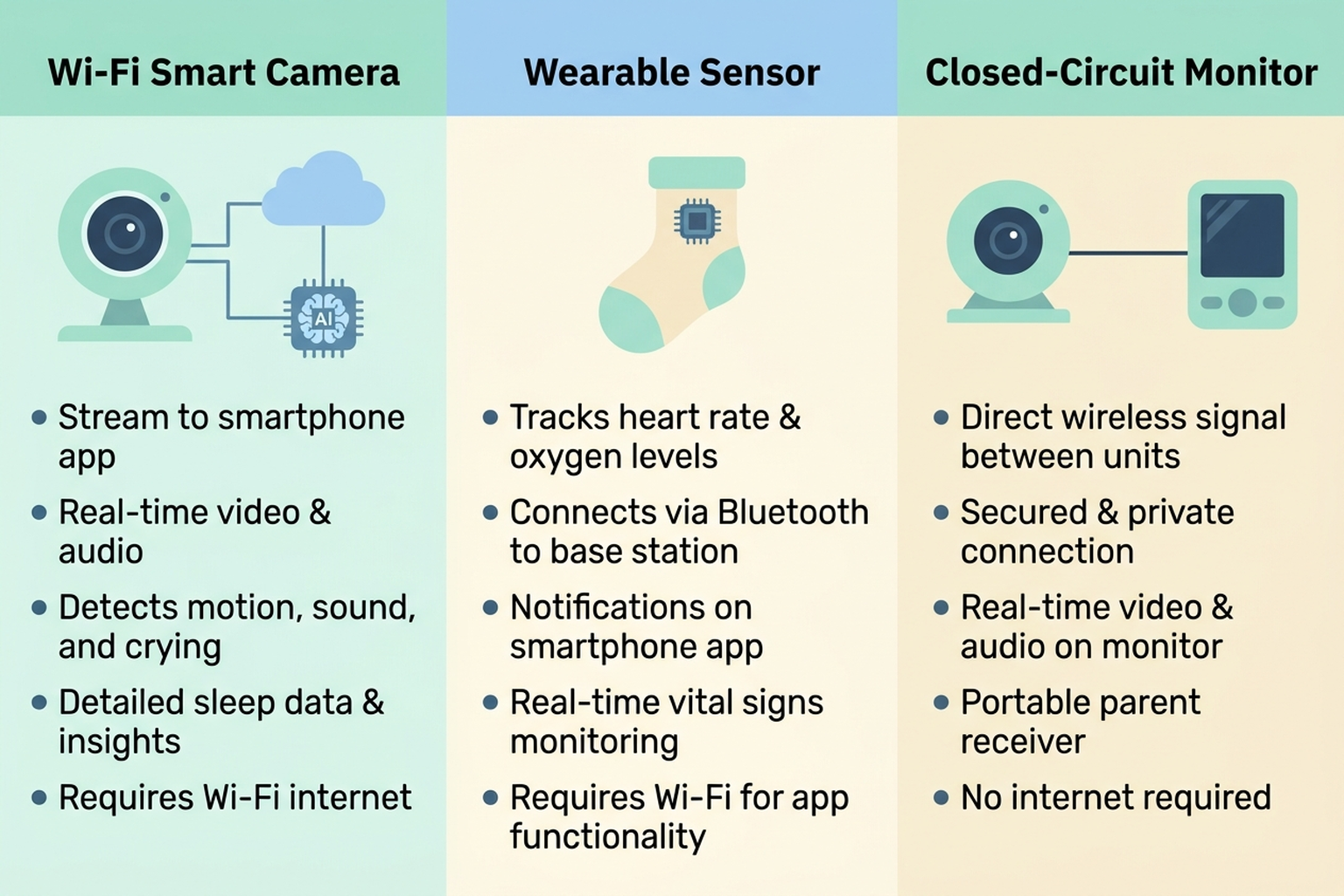
Wi-Fi smart camera with computer-vision sleep analytics (Nanit). The camera streams video to Nanit’s app and cloud service, where computer-vision software tracks sleep and wake patterns, motion, and sound, then generates a nightly sleep score and trend charts. No physical contact with the baby is required — the entire system is passive video and audio analysis. The core video and motion/sound alerts work without a paid plan; multi-night sleep trend history and some advanced insights require a Nanit subscription.
Wearable pulse oximetry plus camera (Owlet). The Owlet Dream Sock is a fabric sock containing a pulse-oximetry sensor, the same underlying technology hospitals use on a finger or foot, cleared by the FDA for home use in this product. It measures heart rate and blood-oxygen saturation continuously and triggers an alert if either falls outside a preset range, while a companion 2K camera provides the video feed. This is the only approach of the three that monitors an actual physiological signal rather than inferring wellbeing from video and sound alone.
Closed-circuit, non-Wi-Fi video monitor (Infant Optics). The DXR-8 Pro’s camera talks directly and only to its own dedicated 5-inch handheld screen over a proprietary encrypted radio link (frequency-hopping spread spectrum, the same general class of technology used in cordless phones). There is no app, no cloud account, no home Wi-Fi dependency, and therefore nothing exposed to the public internet for an attacker to find. The trade-off is also structural: no remote viewing away from home, no sleep analytics, and no vital-sign tracking.
2. Quick comparison table (prices as of 2026-11-06)
| Monitor | Price | Core Technology | Vital-Sign Tracking | Remote Viewing / App |
|---|---|---|---|---|
| Nanit Pro Camera & Floor Stand V2 | ~$299.99 | Wi-Fi camera, computer-vision sleep AI | No | Yes (subscription adds trend history) |
| Owlet Dream Duo 3 | ~$379.99 (frequently discounted to $299–$349) | Wearable FDA-cleared pulse oximetry sock + 2K camera | Yes (heart rate, blood oxygen) | Yes |
| Infant Optics DXR-8 Pro | ~$199.99 | Closed-circuit non-Wi-Fi camera, dedicated screen | No | No (local only, no app or account) |
3. Nanit Pro: the sleep-data specialist
Nanit Pro Camera & Floor Stand V2 — view on Amazon
Nanit’s current Pro generation records at 1080p with improved night vision over the earlier Nanit Plus, adds a soft nightlight built into the camera housing, and includes sound, motion, and cry detection that push alerts to a phone without requiring a subscription. The subscription layer (Nanit Insights) adds multi-night sleep trend graphs, nap and bedtime pattern analysis, and a “sleep score,” which is the feature the product is built around and marketed most heavily. Consumer Reports has tested multiple Nanit Pro configurations as part of its ongoing baby-monitor program, evaluating both monitoring features and connected-device security using a protocol adapted from its wireless security-camera testing. As the NAD finding above indicates, prospective buyers should read Nanit’s specific sleep-benefit and safety-outcome marketing claims (rather than its core video/audio functionality, which is not in dispute) with some skepticism until the company’s post-NAD advertising updates are fully reflected on its current marketing pages.
4. Owlet Dream Duo 3: the only one that measures a vital sign
Owlet Dream Duo 3 — view on Amazon
The Dream Duo 3 bundles Owlet’s Dream Sock — an FDA-cleared pulse oximetry sensor worn on the baby’s foot — with a 2K HD camera. Unlike Nanit’s inferred sleep-quality scoring, the Dream Sock reads an actual physiological signal (blood oxygen saturation and heart rate) and is designed to alert parents if either reading drops outside a preset normal range. This is a meaningfully different value proposition from a video-only monitor: it’s aimed at parents with a specific medical concern (a history of apnea, a NICU graduate, a sibling with a prior health scare) rather than general sleep-quality curiosity. Owlet markets the product at a premium accordingly — list price is $379.99, though it is frequently discounted to the $299–$349 range around sales events. Prospective buyers should note that FDA clearance applies to the pulse-oximetry sensor function specifically, not to the product’s sleep-coaching or camera features, which are standard consumer software.
5. Infant Optics DXR-8 Pro: the privacy-first non-Wi-Fi pick
Infant Optics DXR-8 Pro — view on Amazon
The DXR-8 Pro is built on the opposite philosophy from the other two: it has no Wi-Fi radio, no app, and no cloud account, so there is structurally nothing for a remote attacker to access over the internet. Reviewed (USA Today) hands-on tested the DXR-8 Pro and found it impressive overall, flagging one notable gap consistent with the entire non-Wi-Fi category: there’s no way to check on your baby remotely when you’re not at home, since the signal only reaches the paired handheld screen. It includes patented active noise reduction to filter background hiss, interchangeable standard and zoom lenses, and remote pan/tilt/zoom control from the parent unit. Owners most commonly report battery life on the handheld screen as the weakest point of an otherwise strong package — a tradeoff of running a live video receiver continuously rather than the much lower-power standby mode a phone app affords.
6. What aggregated customer sentiment says
Across the independent test sources and amazon.com review patterns we reviewed, a few themes recur consistently:
- Nanit owners who value the sleep-score feature tend to be its most vocal advocates, while owners who bought it primarily as “just a camera” more often question whether the subscription cost is worth it for features they don’t use.
- Owlet Dream Duo owners overwhelmingly frame the product around peace of mind for a specific concern (prematurity, a prior health scare, parental anxiety) rather than as a general-purpose nursery camera — consistent with its premium price and medical-sensor focus.
- False alarms are the most common complaint across all wearable vital-sign monitors, Owlet included; a sock that shifts position or loses skin contact can trigger an oxygen-drop alert that reflects a sensor read failure, not an actual medical event. This is a known limitation of consumer pulse-oximetry wearables generally, not unique to one brand.
- Infant Optics owners consistently cite reliability and simplicity as the main draw — a closed system with fewer points of failure than an app-and-cloud product — with battery life on the handheld unit as the most repeated complaint.
7. Which one is right for you?
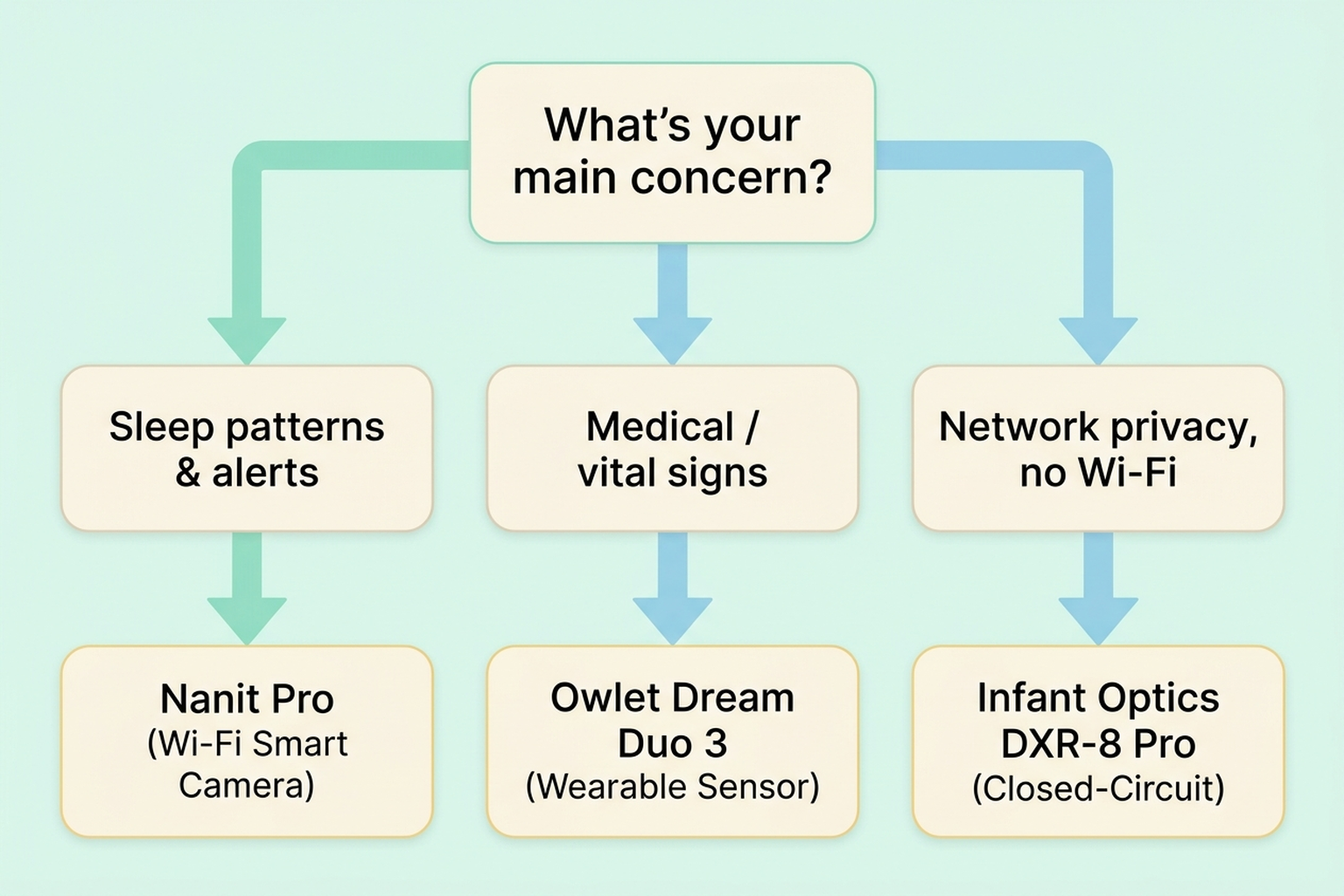
- Your main interest is understanding sleep patterns and getting alerted to motion or crying: Nanit Pro.
- You have a specific medical concern (prematurity, a prior apnea scare, a pediatrician’s recommendation to track oxygen): Owlet Dream Duo 3 — and talk to your pediatrician about what the readings do and don’t tell you.
- Home network security or avoiding an internet-connected camera in the nursery is your top priority: Infant Optics DXR-8 Pro.
- Budget is the deciding factor and you mainly want to see and hear your baby: the non-Wi-Fi DXR-8 Pro is also the least expensive of the three, with no ongoing subscription cost.
8. How to position and set up a baby monitor correctly
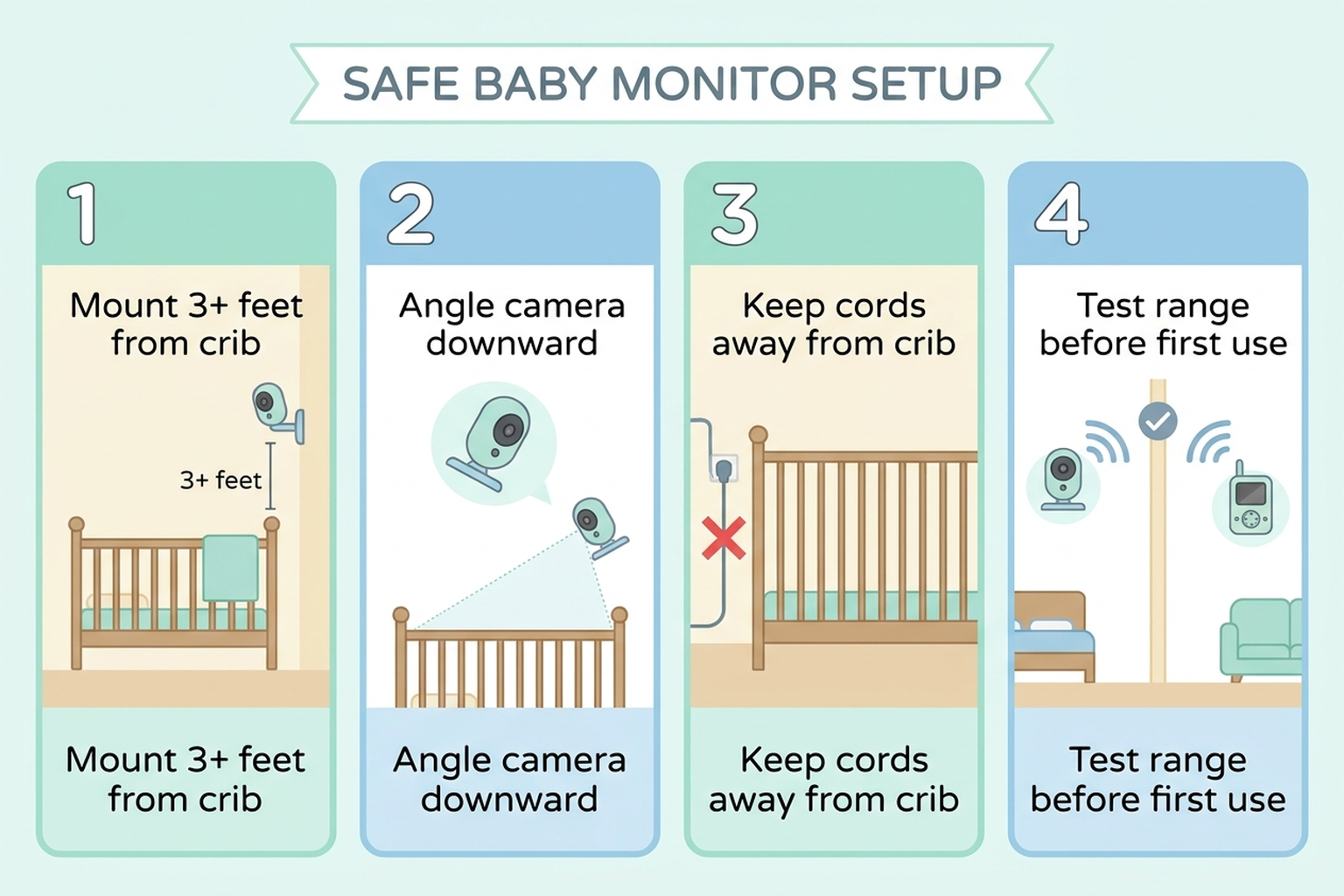
- Mount the camera at least 3 feet from the crib and out of the baby’s reach, following the Consumer Product Safety Commission’s standing guidance on strangulation risk from monitor cords and cables near cribs — never drape a cord across or near the crib rail.
- Angle the camera downward from a shelf, wall mount, or the included floor/flex stand rather than clipping it to the crib itself, for both the safety reason above and a more stable, consistent view.
- For wearable sensors like the Owlet Dream Sock, check fit every few weeks — infant feet grow quickly, and a loose sock is the leading cause of false low-oxygen alerts.
- Test audio and video range in the actual home before relying on it overnight, especially for non-Wi-Fi closed-circuit monitors, where thick walls or long distances between rooms can reduce range in ways a product spec sheet won’t fully predict.
9. Warranty and support
Nanit backs the Pro camera with a standard 1-year limited warranty against manufacturing defects, consistent with most connected consumer electronics. Owlet covers the Dream Duo 3 with a 1-year limited warranty, and because the Dream Sock is the FDA-cleared component, Owlet also provides sizing-fit support and replacement-sock guidance through its customer support channel as babies grow between sock sizes. Infant Optics offers a 1-year limited warranty on the DXR-8 Pro, and because the camera and monitor are sold as a closed, non-updatable hardware pair, Infant Optics also sells standalone replacement cameras and monitor units compatible with the same model generation — useful if only one half of the pair fails rather than needing to replace the entire system. Across all three brands, verify current warranty terms on the manufacturer’s own site before purchase, since terms are updated periodically and are not guaranteed by the Amazon listing itself.
10. Verify any product in about five minutes with Arekore
Baby-monitor pricing moves frequently around sales events, and manufacturers periodically release new hardware generations under similar product names (Nanit Plus vs. Pro, Owlet Dream Duo vs. Dream Duo 3, multiple Infant Optics DXR-8 variants). Before buying, confirm you’re looking at the current generation and current price on the live amazon.com listing, and read a handful of the most recent reviews — not only the oldest, highest-voted ones — since hardware and software revisions can change the ownership experience over a product’s lifespan.
Summary: match the technology to your actual concern, not the marketing
These three monitors aren’t really competing for the same buyer. Nanit Pro is for parents who want data and insight into sleep patterns. Owlet Dream Duo 3 is for parents with a specific physiological concern who want an FDA-cleared sensor, not just a camera. Infant Optics DXR-8 Pro is for parents who want to see and hear their baby without adding another internet-connected device to the home. Once you’re honest with yourself about which of those three needs is actually driving the purchase, the choice mostly makes itself — and it’s worth being skeptical of marketing claims, from any brand, that promise more than a camera or a sensor can actually deliver.
Limitations
This analysis relies on publicly available reviews, manufacturer specifications, regulatory filings, and third-party test coverage rather than side-by-side lab testing performed by Arekore. Pulse-oximetry and sleep-tracking accuracy can vary with fit, skin tone, motion, and individual physiology in ways that aggregated owner reviews and manufacturer specifications do not fully capture; none of the three products discussed here is a substitute for pediatric medical advice or a dedicated medical monitoring device when a genuine health concern exists. Prices, hardware generations, and specific model numbers change frequently; verify the current listing before purchase.