Best At-Home Beauty Devices in 2026: NuFACE vs FOREO vs Shark, a Data-Driven Buyer's Guide
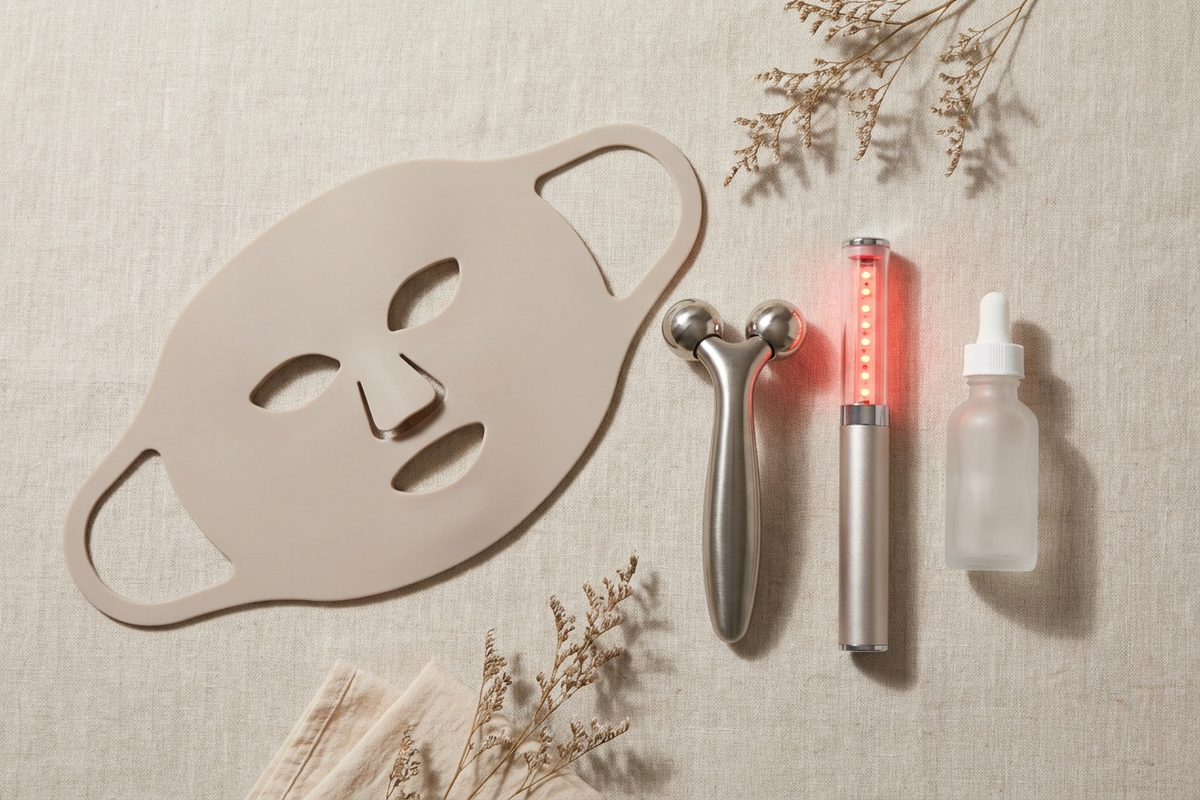
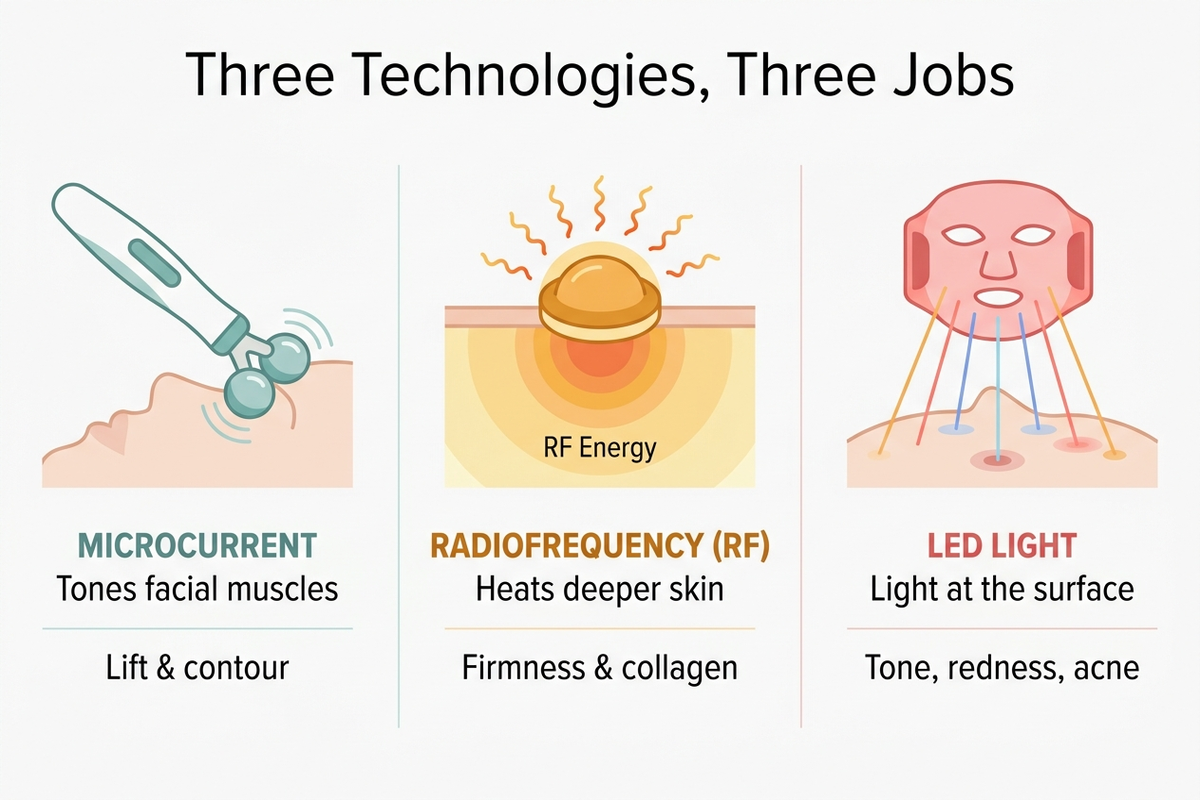
You spent a few hundred dollars on a sleek facial device, used it twice, and now it lives in a drawer. If that sounds familiar, you are not alone. The most common reason people regret an at-home beauty device is not the brand or the price. It is a mismatch between the technology inside the device and the skin goal the buyer actually had. At-home tools generally fall into three technical camps: microcurrent, which tones facial muscles; radiofrequency (RF), which heats deeper layers to encourage firmness; and LED light therapy, which works at the skin’s surface on tone, redness, and acne. Pick by looks or price alone and you can end up with a muscle-toning gadget when what you wanted was wrinkle smoothing. This guide breaks down those three technologies, then compares the brands US shoppers cross-shop most, NuFACE, FOREO, and Shark, plus standout LED and RF specialists, so you can match a device to your real goal.
This article is provided by Arekore, an AI shopping assistant. Paste a product URL and our AI checks review authenticity, digs into low-star feedback, and compares prices in about five minutes.
TL;DR / Quick Verdict
- Best for lift and jawline definition: microcurrent. NuFACE Trinity+ is the most established, FDA-cleared pick; FOREO BEAR 2 is the higher-intensity, design-forward rival.
- Best for firmness and collagen: at-home RF. TriPollar STOP Vx 2 is the strongest mainstream option, but it asks for confidence and consistency.
- Best for wrinkles, redness, and acne: an LED mask. Shark CryoGlow adds under-eye cooling; Dr. Dennis Gross and Omnilux are the dermatologist-favorite alternatives.
- Best easy, lower-cost all-rounder: a red-light wand like Solawave for daily, low-commitment use.
- The honest truth: these are supportive tools, not substitutes for in-office treatment. Results build over 4 to 12 weeks of consistent use.
How We Reached These Conclusions (Methodology)
This is an editorial analysis, not a hands-on review. We did not personally test the products covered here. Instead, this guide synthesizes three kinds of public information: (a) aggregated amazon.com customer ratings and the substance of low-star reviews, reviewed in June 2026; (b) independent third-party coverage and testing from outlets such as Wirecutter (NYT), Tom’s Guide, Who What Wear, Refinery29, and TechRadar, alongside peer-reviewed dermatology literature; and (c) manufacturer specifications and FDA-clearance status. Where we cite a manufacturer figure, such as a clinical-trial percentage published by the brand, we label it as a manufacturer claim rather than an independently verified result. Prices are approximate amazon.com figures at the time of writing and will change.
The US At-Home Beauty Device Market in 2026
At-home beauty tech has moved from novelty to mainstream. The US beauty devices market was valued at roughly $20.45 billion in 2025 and is projected to reach about $24.53 billion in 2026 (MarketDataForecast), with home-use devices specifically estimated near $14.4 billion in 2026 (industry market reports). Adoption is broad: by some industry estimates, around 65% of US consumers now use at least one electronic skincare or haircare device on a regular basis.
Two device categories lead the surge. LED therapy masks account for roughly 23.7% of the facial beauty device market, and LED usage has grown about 27.6% year over year as shoppers seek clinically framed solutions for aging and acne. Microcurrent devices, which stimulate facial muscles for a firmer look, have seen global unit sales rise about 22.4% (Facial Beauty Devices Market report, Business Research Insights). The clinical literature has kept pace: a 2025 systematic review of 15 studies covering 1,230 participants reported that RF treatments improved skin firmness in 52.9% to 100% of patients, depending on protocol (published in Aesthetic Surgery Journal Open Forum). Against that backdrop, this guide compares NuFACE, FOREO, and Shark, the names US buyers most often weigh against one another, plus the LED and RF specialists worth knowing.
1. First, Understand the Three Technologies
The biggest driver of whether a device suits you is the technology inside it. Three approaches dominate at-home skincare, and they do genuinely different jobs.
| Technology | What it does | What to expect | Best for these goals |
|---|---|---|---|
| Microcurrent | Sends low-level current to facial muscles | A toned, lifted, contoured look | Sagging jawline, loss of definition, puffiness |
| Radiofrequency (RF) | Heats deeper skin layers | Gradual firmness, smoother fine lines | Mild laxity, crepey skin, collagen support |
| LED light therapy | Delivers specific light wavelengths to the surface | Better tone, calmer redness, fewer breakouts | Dullness, uneven tone, acne, maintenance |
| Galvanic / red-light wands | Combine red light, gentle current, warmth, massage | Subtle radiance and product absorption | Daily upkeep, beginners, depuffing |
In plain terms: microcurrent is a workout for your facial muscles. It targets the look of lift and contour along the jawline and cheekbones, and dermatologists describe it as primarily a muscle toner rather than a collagen builder. RF is the collagen play. It warms the deeper dermis to encourage firmness over weeks, which is why reviewers and clinicians most associate it with skin tightening. LED works at the surface, using red and near-infrared light for tone and fine lines, and blue light for acne. Many shoppers eventually combine technologies, but the smartest first move is to name your single biggest goal and start with the technology built for it.
One reality check worth stating early: at-home devices deliver energy at roughly 10 to 20 percent of professional, in-office power. Independent reviewers and dermatologists consistently frame the results as subtle and cumulative, not dramatic or instant. These tools are best seen as maintenance between professional treatments, not replacements for them.
2. The Three Brands at a Glance (2026)
“What actually separates NuFACE, FOREO, and Shark?” Here is the quick read.
| Comparison | NuFACE | FOREO | Shark (Beauty by Shark) |
|---|---|---|---|
| Origin | USA | Sweden | USA |
| Signature strength | Microcurrent precision, clinical pedigree | Design, ease of use, gentle ramp | Appliance-maker engineering and value |
| Core technology | Microcurrent (plus optional red-light attachment) | Microcurrent with T-Sonic pulsations; also LED and sonic cleansing | LED light therapy with under-eye cooling |
| Learning curve | Moderate (gel required, technique matters) | Low (beginner-friendly, app-guided) | Very low (place mask, press start) |
| Price range | ~$209–$395 | ~$150–$349 | ~$350 |
| Best for | Lift and contour purists who want the established standard | Beginners and design-led daily users | Set-and-forget LED users who want cooling extras |
In a sentence each: NuFACE is the microcurrent specialist that US reviewers most often treat as the category benchmark, with 20-plus years and FDA clearances behind it. FOREO is the Swedish design house whose BEAR devices add an Anti-Shock System and a gentler on-ramp, making microcurrent approachable for beginners, alongside its well-known LUNA cleansing line. Shark, the home-appliance giant, entered beauty with the CryoGlow LED mask, betting that its engineering and pricing can undercut boutique LED brands. The next section helps you map those personalities onto your own face and routine.
3. How to Choose Without Regret: 4 Checkpoints
Before picking a brand, sort your own needs along four axes.
- 1. Name your single biggest skin goal first. Loss of jaw and cheek definition points to microcurrent. Mild sagging or crepey texture points to RF. Dullness, uneven tone, or acne points to LED. Trying to fix everything at once is the fastest route to an unused drawer device. Rank one goal and choose the matching technology.
- 2. Be honest about consistency. Every technology here rewards routine and punishes neglect. Microcurrent and RF generally call for several sessions a week for 6 to 12 weeks, then maintenance. LED masks ask for 3 to 5 sessions a week. If a hands-free LED mask or a quick daily wand is the only thing you will actually keep up, that beats a powerful device you abandon.
- 3. Factor in the conductive gel and consumables. Microcurrent and RF devices require a conductive gel to work safely and effectively, and you will rebuy it over time. Budget for that ongoing cost. LED masks, by contrast, need no gel. Wands fall in between.
- 4. Budget for the whole system, not just the device. Sticker prices here run from about $150 for an entry wand to roughly $455 for a premium LED mask. Add gel, replacement parts, and the time commitment. A device that fits your life and your budget will beat a pricier one that does not.
A higher price does not guarantee the right fit. Matching goal, consistency, consumables, and total cost to your life is what drives satisfaction.
4. NuFACE: The Microcurrent Standard
NuFACE built its reputation on microcurrent, and US reviewers repeatedly treat it as the category’s reference point. The brand is aesthetician-developed, FDA-cleared, and has refined its technology over two decades. Its flagship Trinity+ offers three adjustable frequencies and pairs with an app and interchangeable attachments, including a separate red-light wrinkle-reducer head for those who want to layer in LED. The trade-off NuFACE asks for is technique: results depend on using the conductive gel, working in the right strokes, and showing up several times a week. The brand’s own clinical claims are bullish; NuFACE states that after 60 days, 85% of Trinity+ users saw improved facial contour (a manufacturer claim, not independently verified here).
5. FOREO: Design, Ease, and a Gentler On-Ramp
FOREO is the Swedish brand that made microcurrent feel approachable. Its BEAR line pairs microcurrent with patented T-Sonic pulsations and an Anti-Shock System that ramps intensity gradually, which reviewers cite as friendlier for first-timers than diving straight into a stronger device. FOREO leans hard into design and app guidance, and the brand markets the BEAR 2 as offering very high microcurrent output among at-home devices (a manufacturer claim). Like all microcurrent tools, BEAR devices require a conductive serum to work safely. Beyond microcurrent, FOREO is also widely known in the US for its LUNA sonic cleansing devices, making it the most “ecosystem” of the three brands here.
6. Shark and the LED Mask Specialists
LED masks are the fastest-growing corner of this market, and they are the easiest to stick with because they are largely hands-free: cleanse, put on the mask, press start. Shark brought home-appliance scale to the category with the CryoGlow, whose signature trick is built-in under-eye cooling plates alongside red, blue, and infrared LEDs. Tom’s Guide, Who What Wear, Refinery29, and TechRadar reviewers have generally praised the CryoGlow’s cooling feature and value relative to boutique masks, while noting it imposes shorter session limits and, per some reviewers, lacks the near-infrared depth of certain rivals. For shoppers who want the dermatologist-favorite pedigree, Dr. Dennis Gross and Omnilux are the alternatives reviewers most often crown for pure light therapy.
7. The RF Option and the Easy All-Rounder
Two more devices round out the picture for specific buyers. If your goal is firmness and collagen rather than muscle lift, at-home RF is the technology built for it, and the TriPollar STOP Vx 2 is the strongest mainstream choice. The clinical case for RF is the most developed of the three technologies here. A brand-associated clinical study of the TriPollar STOP, published in the Journal of Cosmetic and Laser Therapy, reported a statistically significant reduction of wrinkles in 90% (perioral) and 95% (periorbital) of 23 participants after six weeks of home use, with an average periorbital wrinkle reduction of 41% (a manufacturer-linked study, not an independent trial). At-home RF demands consistency, typically 2 to 3 sessions a week for 6 to 8 weeks, plus a conductive gel.
At the other end of the commitment spectrum is the red-light wand, the easiest and lowest-cost way in. The Solawave 4-in-1 combines red light, a gentle galvanic current, therapeutic warmth, and massage in a single handheld tool for daily, low-pressure use. It works at the surface for radiance and depuffing rather than deep structural change, but for beginners and budget-conscious shoppers it is the friendliest entry point.
8. How to Use These Devices (and How Often)
Technique matters more with beauty devices than with most gadgets, because the wrong routine quietly wastes the investment. The general pattern below reflects manufacturer instructions and common dermatologist guidance; always follow your specific device’s manual.
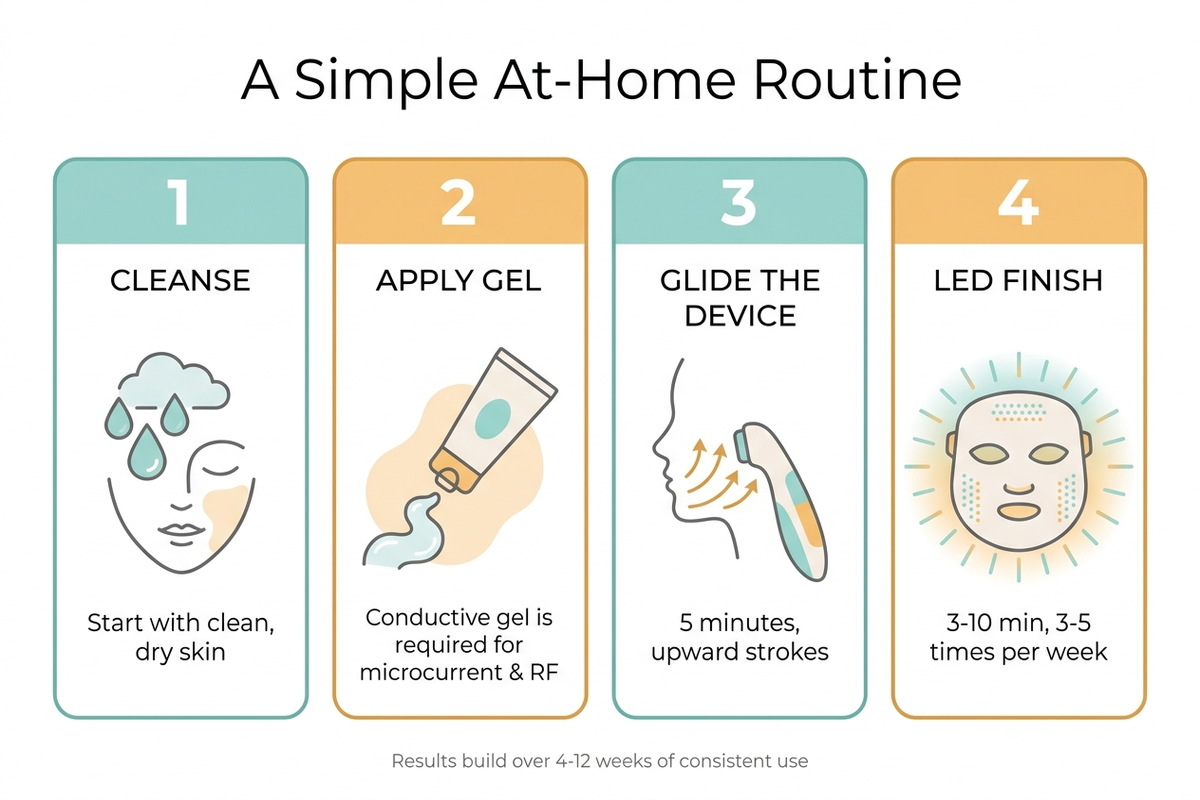
- Start clean and dry. Remove makeup and cleanse first. Residue blocks both current and light.
- Apply conductive gel for microcurrent and RF. These technologies need a gel layer to carry the current safely and evenly. LED masks and most wands do not.
- Glide, do not press. For microcurrent and RF, move the device slowly in upward strokes, usually around 5 minutes, following your device’s mapped zones.
- Finish with LED, on a schedule. LED sessions typically run 3 to 10 minutes, 3 to 5 times a week. Consistency beats intensity.
- Give it 4 to 12 weeks. Across every technology, reviewers and studies describe results as gradual. Skipping sessions resets your progress more than it does with skincare products.
9. What the Aggregated Reviews and Tests Say
Reading across thousands of amazon.com ratings and independent coverage, a few consistent themes emerge. The patterns below reflect aggregated sentiment and third-party reporting, not our own hands-on testing.
- NuFACE draws the most consistent praise for visible lift and contour with regular use, and earns trust for its FDA clearances and long track record. The recurring criticisms are price, the ongoing gel cost, and that results fade if you stop.
- FOREO BEAR wins on ease, design, and a gentle ramp that beginners appreciate; some reviewers feel its results are subtler than they expected and dislike being tied to the brand’s serum.
- Shark CryoGlow is widely praised by Tom’s Guide, Who What Wear, and Refinery29 reviewers for its under-eye cooling and value among LED masks; common gripes are the fixed session limits and a heavier feel.
- Dr. Dennis Gross and Omnilux are the LED masks reviewers most often recommend for pure light therapy, with Omnilux’s flexible fit and Dr. Dennis Gross’s 3-minute speed as their respective draws; price is the main barrier for both.
- TriPollar and Solawave sit at opposite ends: TriPollar is respected for genuine RF power but asks for commitment, while Solawave is liked as an affordable, easy daily wand with appropriately modest expectations.
10. Editorial Recommendation by Use Case
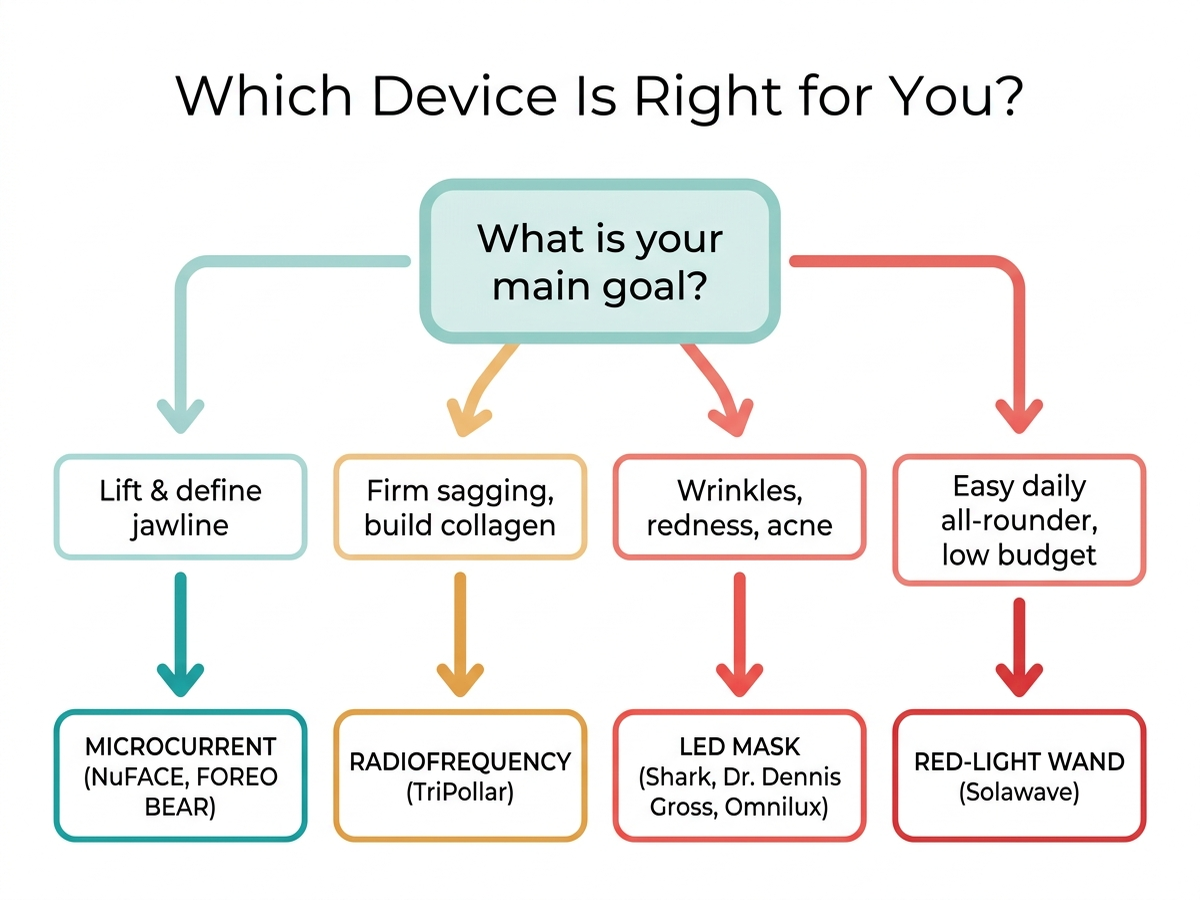
Mapping the analysis above onto common situations:
| If your main goal is… | Consider | Why |
|---|---|---|
| Lift and jawline definition | NuFACE Trinity+ or Mini+ | The established microcurrent standard for toning and contour |
| Beginner-friendly microcurrent | FOREO BEAR 2 or BEAR Mini | Anti-Shock ramp and app guidance make it approachable |
| Firmness and collagen support | TriPollar STOP Vx 2 | Strongest mainstream at-home RF; best clinical case for tightening |
| Wrinkles, redness, and easy upkeep | Shark CryoGlow | Hands-free LED plus under-eye cooling at LED-mask value |
| Fast, dermatologist-founded LED | Dr. Dennis Gross FaceWare Pro | Red and blue light in quick 3-minute sessions |
| Comfortable full-coverage red light | Omnilux Contour Face | Flexible silicone fit, deep peer-reviewed light-therapy pedigree |
| Easy daily routine on a budget | Solawave 4-in-1 Wand | Low-cost, low-commitment radiance and depuffing |
Warranty, Upkeep, and the Bottom Line
Before you buy, two practical notes. Warranty: most of these brands back their devices with a limited warranty (commonly one to two years; FOREO is known for a longer warranty on registration). Register your purchase and keep the receipt, since coverage usually requires proof of purchase, and buy from authorized sellers so the warranty is honored. Upkeep: wipe metal microcurrent and RF heads after each use, keep buying conductive gel for those technologies, and clean LED masks per the manual. Factor the consumables into your real cost of ownership.
The bottom line is the principle that opened this guide: a higher price tag does not automatically mean the right device for you. Match your single biggest goal, your consistency, the consumables, and your total budget to the technology, and the choice becomes clear. Want lift and contour? Microcurrent (NuFACE or FOREO). Want firmness and collagen? RF (TriPollar). Want tone, redness, and acne handled hands-free? An LED mask (Shark, Dr. Dennis Gross, or Omnilux). Want an easy daily habit on a budget? A red-light wand (Solawave).
Of course, checking every spec, price, and review for each device is a lot of work, and beauty-device review pages are not always trustworthy. That is where the Arekore AI shopping assistant helps: paste the URL of any device you are considering, and the AI checks review authenticity, summarizes what low-star reviewers actually complain about, and weighs whether the current price is reasonable, in about five minutes.
Found a device you like? Verify it with Arekore.
Limitations
This analysis relies on publicly available customer reviews, third-party coverage, peer-reviewed dermatology literature, and manufacturer specifications. We did not personally test the products covered here. At-home beauty devices deliver energy well below in-office levels, and individual results vary widely with skin type, age, consistency, and technique; they are supportive tools, not medical treatments. Aggregated review sentiment can be skewed by review manipulation. Manufacturer figures (clinical-trial percentages, microcurrent output, wavelength counts) are claims by the maker, not independently verified by us. Anyone with a pacemaker, implanted electronic device, active skin condition, or who is pregnant should consult a clinician before using microcurrent or RF devices. Prices and ratings are approximate amazon.com figures at the time of writing (June 2026) and will change; confirm current details on each product page before buying.
Prices in this article are approximate amazon.com figures at the time of writing (June 2026). Prices, availability, and ratings change frequently, so confirm the latest details on each retailer’s page before purchasing. Follow each product’s manual and safety instructions in use.
References:
- MarketDataForecast — United States Beauty Devices Market
- Business Research Insights — Facial Beauty Devices Market
- Journal of Cosmetic and Laser Therapy — Home-use TriPollar RF device for facial skin tightening: clinical study results (PubMed)
- Tom’s Guide — Shark CryoGlow LED face mask review
- Who What Wear — I Tested Shark’s CryoGlow Mask for 67 Days
- PureWow — NuFACE Mini vs Solawave Radiant Renewal Wand
- PMC — Evaluating the Effectiveness and Safety of Home Facial Antiaging Beauty Devices
- Mohs-MD — A Dermatology Expert’s Guide to Safe At-Home LED Masks & Microcurrent Tools