Beach Tech That Survives 2026: Sand, Salt & Sunscreen Guide
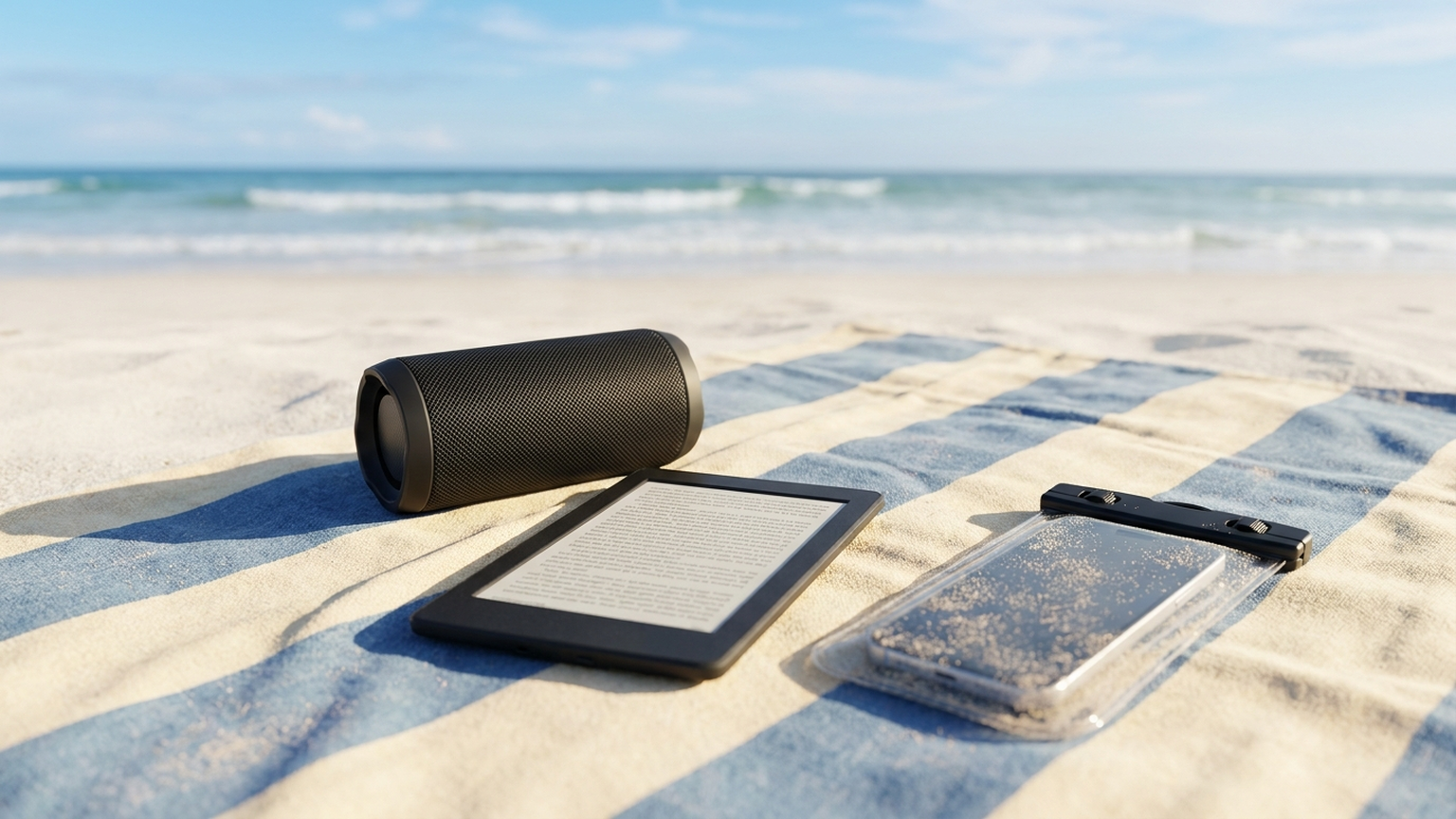
Americans make more than 400 million beach visits every year, according to the United States Lifesaving Association — and a remarkable amount of consumer electronics does not survive the trip. Sand grinds into charging ports, saltwater corrodes seals that were only ever tested in fresh water, and the sunscreen on your hands quietly strips the coating off your phone screen. The gear that dies at the beach usually dies for predictable reasons, and the gear that survives shares a short list of verifiable traits. This guide separates the two: four beach-proven picks available on US Amazon, the specifications that actually matter, and the popular devices that data says you should leave in the car — or at home.
As an Amazon Associate, Arekore earns from qualifying purchases. The Amazon product links in this article may include our affiliate tracking ID and may earn us a commission if you buy through them, at no additional cost to you. See our Links Policy for details on how we select products and how commissions do not influence our recommendations.
TL;DR / Quick Verdict
- The speaker to bring: the JBL Flip 6 (
$100–$130 at the time of writing) or the Ultimate Ears Wonderboom 4 ($80–$100). Both are rated IP67 — dust-tight and submersible — which is the spec that matters where there is sand, not just water. The Wonderboom 4 also floats; the Flip 6 sinks. - The $12 item with the best return on investment on this list: a JOTO IPX8 waterproof phone pouch. It solves sand, salt spray, and sunscreen for the most expensive device you own, for roughly the price of two beach sodas.
- The reading device: a Kindle Paperwhite (IPX8) — with a major caveat buried in Amazon’s own specs: it is rated for 60 minutes in 2 meters of fresh water, but only about 3 minutes in shallow seawater. Waterproof is not saltproof.
- Leave at home: AirPods and most true wireless earbuds (splash-resistant IP54 at best, and Apple explicitly warns against sunscreen exposure), laptops and tablets, and any device left in direct sun — lithium-ion batteries take permanent damage above 95°F.
How We Reached These Conclusions (Methodology)
This is an editorial analysis, not a hands-on review. We did not personally test the products covered here. This guide synthesizes three kinds of public information: (a) aggregated amazon.com customer ratings and the substance of low-star reviews for each product, sampled in July 2026; (b) independent third-party testing and reporting from RTINGS, SoundGuys, Forbes, and technology publications covering manufacturer documentation; and (c) manufacturer specifications, IP certification claims under IEC standard 60529, and official care guidance from Apple, Amazon, JBL, and Ultimate Ears. Where we cite a figure such as battery life, submersion depth, or an IP rating, it is a manufacturer claim under laboratory conditions unless attributed to an independent test. Prices are amazon.com figures at the time of writing and fluctuate through the summer promotional season.
Why Beach Days Kill Gadgets: The Three Failure Modes
The beach combines three separate attack vectors, and most “water-resistant” electronics are only engineered against one of them.
Sand is an abrasive and an intruder. It scratches screens and lenses, jams buttons, and packs into USB-C and Lightning ports where it blocks charging and can short contacts. Water resistance ratings say nothing about grit unless the first digit of the IP code covers it — more on that below.
Salt is corrosive. IP ratings under IEC 60529 are certified in fresh water in a lab; ocean water is a different chemical environment. Amazon’s own documentation for the Kindle Paperwhite illustrates the gap: IPX8-rated for 60 minutes in 2 meters (about 6.6 feet) of fresh water, but only 0.25 meters (about 10 inches) for roughly 3 minutes in seawater, with an explicit instruction to rinse the device in tap water and dry it after any saltwater exposure. Salt residue keeps corroding seals and contacts long after the device looks dry — which is why “it worked fine on vacation” is often followed by a dead speaker in September.
Heat and sunscreen attack devices you never put in the water. Apple and Samsung both specify a maximum operating temperature of 95°F (35°C) for phones; above that threshold, lithium-ion batteries suffer cumulative, permanent capacity loss, and a phone lying on a towel in direct summer sun passes 95°F in minutes. Sunscreen and lotions are on Apple’s official list of substances to keep away from iPhones and AirPods, because their oils and solvents degrade the oleophobic screen coating and the acoustic membranes and water seals on earbuds.
The market has noticed the problem. The US waterproof speaker segment alone was estimated at $2.36 billion in 2024 and is projected to reach $4.25 billion by 2032, and Bluetooth models accounted for 67.8% of the waterproof speaker market in 2024 (both figures: SNS Insider) — beach-proof audio is now a mainstream category, not a niche.
IP Ratings, Decoded: The Two Digits That Decide Everything
Every recommendation in this guide follows from reading the IP code correctly, so here is the 60-second version.
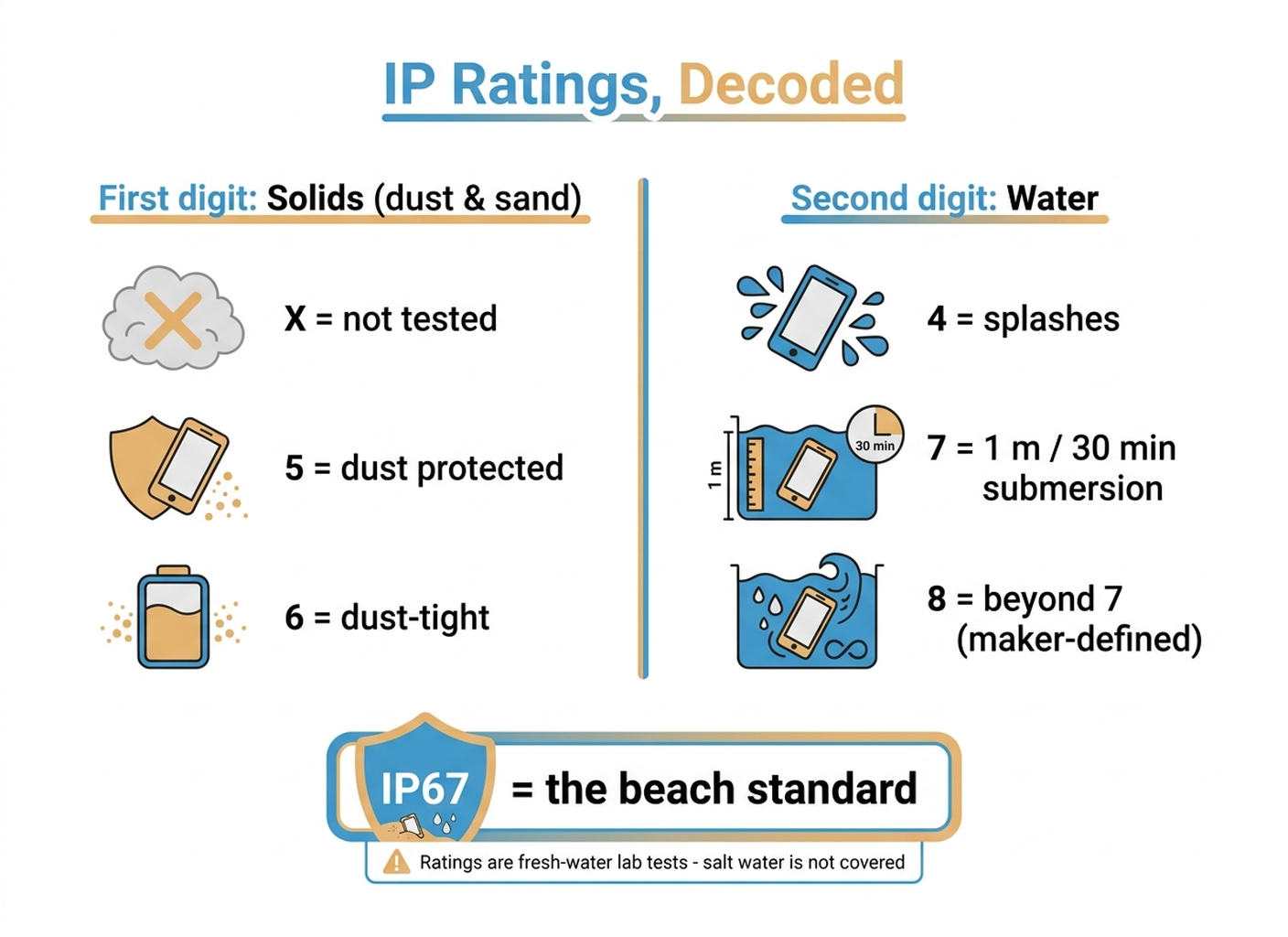
- First digit = solids (sand and dust). A 6 means dust-tight — the enclosure was tested against fine particulate. An X does not mean zero protection; it means the manufacturer did not have it tested. For the beach, that distinction is everything: an IPX7 speaker and an IP67 speaker may survive the same dunk, but only the IP67 unit is certified against the sand that gets into everything.
- Second digit = water. A 4 survives splashes from any direction. A 7 survives 30 minutes submerged at 1 meter (about 3.3 feet). An 8 exceeds level 7 under conditions the manufacturer defines — for the Kindle Paperwhite, that is 2 meters (about 6.6 feet) for 60 minutes.
- The fine print: every one of those numbers comes from still, fresh water in a laboratory. No IP rating certifies performance in saltwater, chlorine, or moving surf, and manufacturers including JBL and Amazon explicitly direct users to rinse devices with fresh water after ocean exposure.
The practical takeaway: IP67 is the beach benchmark. Dust-tight against sand, submersible past any realistic splash or drop into the shallows, and available under $100 in the speaker category.
Comparison Table
Prices are approximate amazon.com figures at the time of writing (July 2026) and fluctuate. Ratings and battery figures are manufacturer claims.
| Item | ASIN | Approx. price | Rating | Floats? | Battery (mfr. claim) | Beach role |
|---|---|---|---|---|---|---|
| JBL Flip 6 | B09GJVTRNZ | ~$100–$130 | IP67 | No — sinks | 12 hours | Best-sounding beach speaker |
| Ultimate Ears Wonderboom 4 | B0BRXJ9WTD | ~$80–$100 | IP67 | Yes — grille-up | 14 hours | Pool, boat, and surf-adjacent audio |
| Kindle Paperwhite (16 GB, 2024) | B0CFPJYX7P | ~$140–$160 | IPX8 (fresh water) | No | Weeks (per charge) | Reading in sun and splash range |
| JOTO Waterproof Phone Pouch | B00LBK7OSY | ~$10–$15 | IPX8 (mfr. claim) | Variant-dependent | — | Sand/salt/sunscreen barrier for the phone |
1. JBL Flip 6 — The IP67 Default for a Reason
The Flip 6 is the speaker that made IP67 the expectation in the category rather than a premium feature. JBL’s official spec sheet rates it IP67 — dust-tight and submersible to 1 meter (about 3.3 feet) for 30 minutes — with 12 hours of playtime (manufacturer claims); note that some Amazon listing titles abbreviate this as “IPX7,” but the manufacturer certification includes the dust rating. It has been tested by the independent lab RTINGS, whose measurements back its reputation for punchy, room-filling output in a bottle-sized package. SoundGuys’ review reaches a similar verdict: a well-rounded portable that tolerates real outdoor abuse.
Aggregated customer sentiment across its enormous amazon.com review base is strongly positive on bass output and build quality. The recurring critiques are consistent and worth knowing: it sinks in water rather than floating, and like all speakers in this class it should be rinsed in fresh water and dried after contact with saltwater or sunscreen — JBL’s IP certification, like everyone’s, is a fresh-water lab test.
Who it is for: the person who wants the best sound per dollar that can also be dropped in wet sand without a second thought.
Check the JBL Flip 6 on Amazon
2. Ultimate Ears Wonderboom 4 — The One That Floats
The Wonderboom 4 trades a little low-end punch for two beach-specific advantages. First, the same IP67 certification as the Flip 6 — dust-tight, 1 meter (3.3 feet) for 30 minutes. Second, it floats, resting grille-up at the waterline, which converts “dropped it off the paddleboard” from a loss into a retrieval. Ultimate Ears claims 14 hours of battery and a 131-foot Bluetooth range, and the design’s 360-degree output suits a group sitting around it rather than in front of it (manufacturer claims). Forbes’ tech editors include the Wonderboom line among their tested waterproof picks, and the model is a fixture of independent best-waterproof-speaker roundups in 2026.
Aggregated review sentiment praises exactly what the spec sheet promises — survivability and loudness for the size — while the consistent criticisms are the lack of an aux input and bass that thins out at maximum volume. Reviewers who use it around pools specifically cite the flotation as the deciding feature over the Flip 6.
Who it is for: pools, boats, and anyone whose speaker genuinely might end up in the water rather than just near it.
Check the Ultimate Ears Wonderboom 4 on Amazon
3. Kindle Paperwhite — Waterproof, Not Saltproof
An e-ink reader is arguably the single best-suited electronic device for a beach: the glare-free screen gets more readable in direct sun, and a charge lasts weeks (manufacturer claim). The current Kindle Paperwhite (2024, 7-inch) carries an IPX8 rating — the highest water rating on this list on paper.
The paper is where nuance lives, though, and it is the reason this section exists. Amazon’s own specification, widely covered by outlets including Pocket-lint and XDA, rates the Paperwhite for 60 minutes in 2 meters (6.6 feet) of fresh water — but only about 3 minutes in 0.25 meters (10 inches) of seawater, and Amazon explicitly advises against intentionally exposing the device to seawater or pool water at all, with instructions to rinse it in tap water and air-dry it if it happens. Note also the X in IPX8: the Kindle carries no dust rating, and reviewers report sand finding its way into the USB-C port and speaker-less crevices. A $2 zip-top bag — through which the touchscreen still works — closes both gaps.
Aggregated customer sentiment on the 2024 Paperwhite is strongly positive on the larger display and faster page turns; complaints center on price creep and lockscreen ads on the base configuration, not on durability.
Who it is for: anyone who actually reads at the beach. Just treat the IPX8 rating as pool-drop insurance, not an invitation to read in the surf.
Check the Kindle Paperwhite (16 GB) on Amazon
4. JOTO Waterproof Phone Pouch — $12 of Insurance for a $1,000 Phone
The most vulnerable device at the beach is the most expensive one: your phone. Modern flagships carry IP68 ratings, but the practical beach threats — sand in the port, salt on the seals, sunscreen on the screen, resale-value-killing scratches — are exactly the ones an IP rating does not address. A transparent dry pouch addresses all of them at once.
The JOTO universal pouch is the category’s perennial best-seller on amazon.com, with one of the largest review bases of any phone accessory on the platform. JOTO claims IPX8 protection to 100 feet, and the clear TPU window keeps the touchscreen and cameras usable inside the pouch (manufacturer claims; camera photos shoot through the plastic). Independent hands-on reviews — including cruise-travel outlet Cruzely’s dunk testing — consistently find the seal holds when the snap-lock closure is properly engaged, and it fits phones up to 7 inches, covering every current iPhone and Galaxy.
Aggregated sentiment is heavily positive on watertightness for the price; the recurring criticisms are a flimsy included lanyard and reduced touchscreen sensitivity underwater (a physics limitation of every pouch, not a JOTO defect). Two habits fix most reported failures: test the empty pouch in a sink first, and close the locking clips fully every time.
Who it is for: literally everyone who brings a phone to a beach. This is the cheapest meaningful risk reduction in consumer electronics.
Check the JOTO Waterproof Phone Pouch on Amazon
What to Leave at Home
The other half of a good beach kit is what stays behind.
- AirPods and most true wireless earbuds. AirPods Pro 2 (USB-C model) are rated IP54 — dust-protected and splash-resistant, not submersible — and Apple’s support documentation explicitly warns against exposing them to sunscreen, lotions, and oils, which degrade the acoustic membranes and water seals. A single wave, a sweaty sunscreen-coated ear, or a drop into dry sand can be a $250 mistake. If you want in-ear audio at the beach, buy a cheap IP67-rated sport model and consider the AirPods a commuting device.
- Laptops and tablets. No mainstream laptop carries any IP rating. Sand in a keyboard is effectively permanent, screens are a magnet for abrasion, and a dark slab in direct sun exceeds safe battery temperatures quickly. E-ink or paper wins here on every axis.
- Your phone, unprotected, in direct sun. Apple and Samsung specify 95°F as the maximum operating temperature; a parked car in summer regularly exceeds 130°F, and a phone face-up on a towel is not far behind. Heat damage to a lithium-ion battery is cumulative and permanent — the phone does not need to shut down for the damage to count. Keep it in the shade, in a bag, ideally in the pouch above.
- Anything with exposed fabric speakers or open ports you cannot rinse. Salt spray travels; devices well above the waterline still come home coated in it.
Beach-Day Care Habits That Actually Extend Gear Life
Surviving one beach day is a spec; surviving the whole summer is maintenance. Manufacturer care guidance across JBL, Ultimate Ears, Amazon, and Apple converges on the same short list.
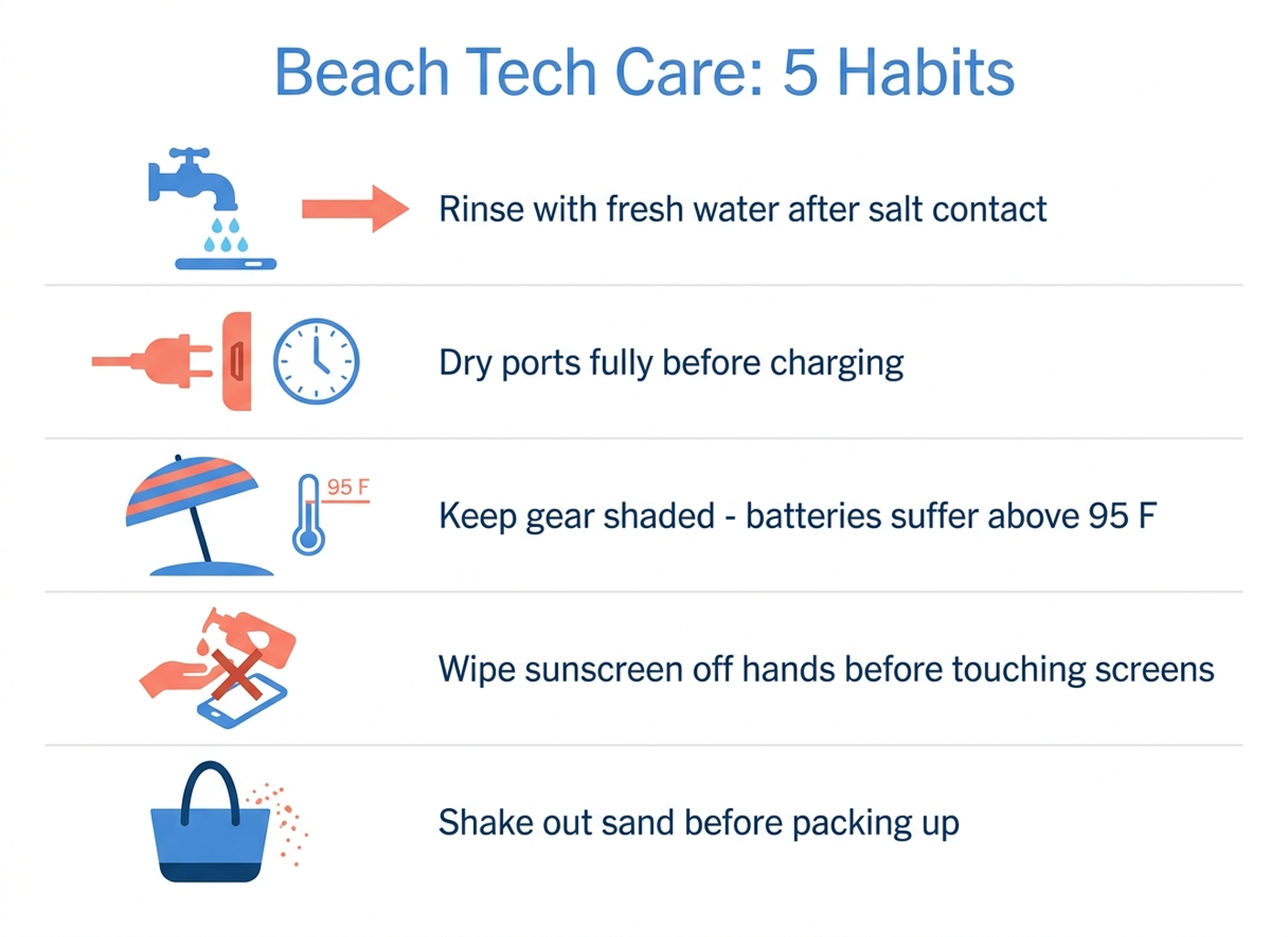
- Rinse after salt, every time. A brief fresh-water rinse and air-dry after any saltwater or pool contact is official guidance from both Amazon (Kindle) and speaker manufacturers. Salt left in place keeps corroding seals for weeks.
- Bone-dry before charging. Water plus a live USB connection is how “waterproof” devices actually die. Shake out the port, let it air-dry completely — modern phones will warn you, but speakers and e-readers will not.
- Shade is a spec. Keep everything under a towel, in a cooler bag pocket, or in a light-colored bag. The 95°F battery ceiling arrives faster than intuition suggests.
- Sunscreen hands, then screens — never. Wipe hands before handling devices, and clean screens with a damp lint-free cloth at day’s end, per Apple’s handling guidance.
- Sand exits before the bag. Brush and shake everything at the beach; sand that rides home in the bag grinds against lenses and screens the whole way.
Which Beach Tech Should You Bring? A Decision Flowchart
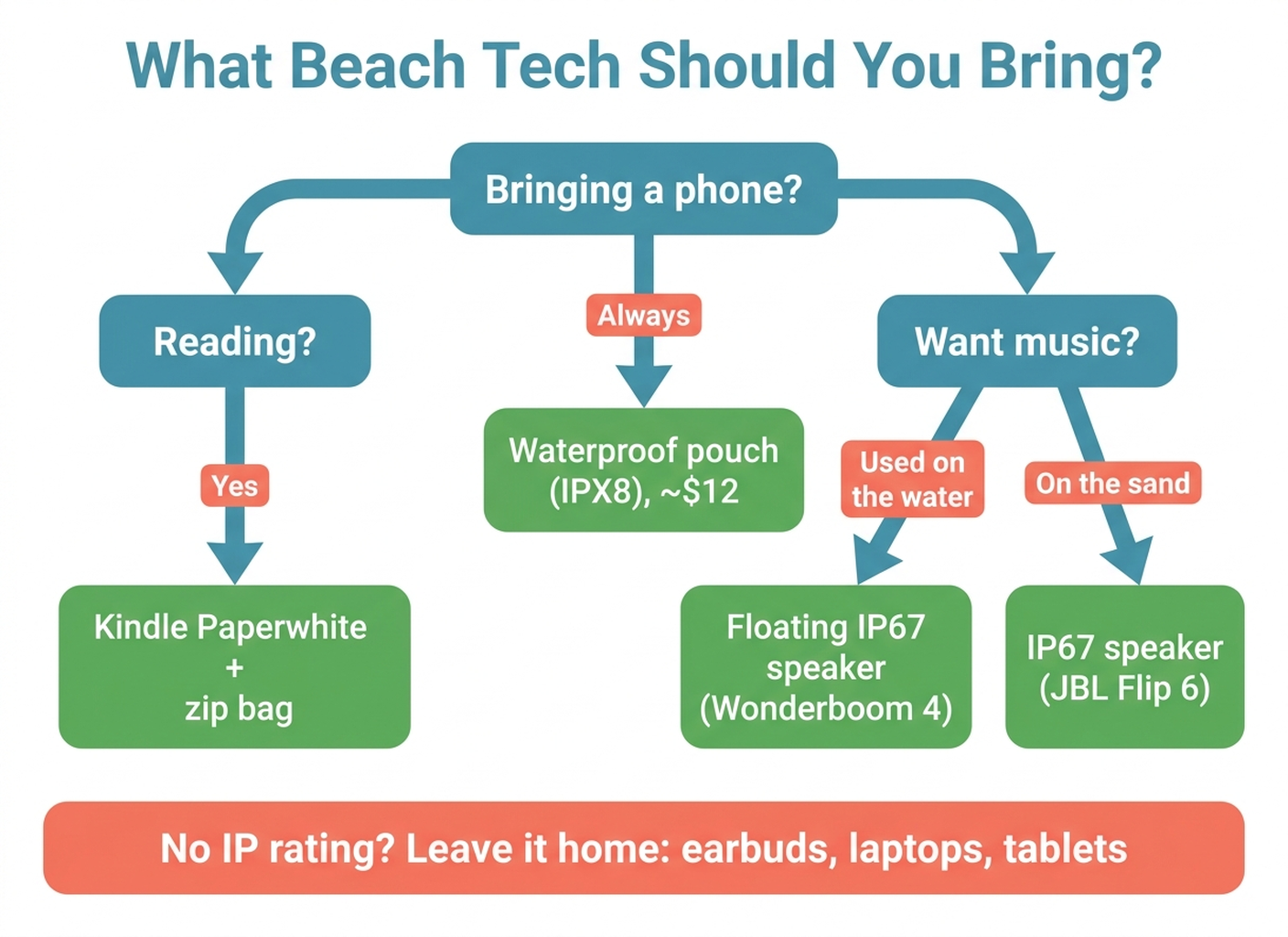
- Everyone, first dollar (~$12): the JOTO pouch. It protects the most valuable and least replaceable item on the towel.
- If the group wants music (~$80–$130): an IP67 speaker. Choose the Wonderboom 4 if the speaker will be used on or in the water — flotation is the tiebreaker — and the Flip 6 if sound quality on the sand is the priority.
- If you read more than you scroll (~$150): the Kindle Paperwhite, kept out of the surf and ideally inside a zip-top bag.
- If it has no IP rating: it stays home. That rule alone filters out laptops, tablets, over-ear headphones, and nearly every earbud people actually bring.
Editorial Recommendations by Use Case
- Best overall beach kit under $150: the JOTO pouch + Ultimate Ears Wonderboom 4. Full sand, salt, and sunscreen coverage for phone and audio, with flotation as the safety margin.
- Best sound on the sand: the JBL Flip 6 — the independent-lab-tested pick (RTINGS) with the strongest low end in this size class. Keep it on the towel; it sinks.
- Best for readers: the Kindle Paperwhite — the rare screen that improves in sunlight, with pool-grade (fresh-water) submersion protection as a backstop.
- Best money you’ll ever spend on a $1,000 device: the JOTO pouch, again. The asymmetry between its price and the value it protects is the entire argument.
- Most defensible thing to leave behind: AirPods. IP54 plus Apple’s own sunscreen warning makes the beach close to a worst-case environment for them.
Limitations of This Analysis
This analysis relies on publicly available reviews, independent third-party tests, and manufacturer specifications; we did not personally test these products, and individual experience varies with conditions and unit-to-unit variance. IP ratings cited are manufacturer certifications under IEC 60529 laboratory conditions — still, fresh water — and no rating on this page guarantees survival in saltwater, surf, or chlorinated pools; manufacturer care guidance (rinsing, drying) is the operative protection there. Market statistics come from the research firm SNS Insider and the United States Lifesaving Association, whose methodologies differ; treat them as directional. Prices, ASIN availability, and model revisions change frequently — Amazon listings rotate color and bundle variants under different ASINs — so confirm the current price, version, and rating on the product page before buying.
The Bottom Line
Beach-proof tech is not about buying rugged versions of everything — it is about reading two digits correctly and respecting three enemies. An IP67 speaker (dust-tight and submersible), an IPX8 pouch around the phone, and an e-reader kept out of the surf cover an entire summer for under $250 combined, while the most expensive failures — dead earbuds, sand-jammed ports, heat-cooked batteries — come from gear that should never have left the house. Whichever direction you go, verify the exact variant and current price before checkout — and if you want a second opinion on a specific listing, paste the URL into Arekore and let the AI scan the reviews and price history for you in about five minutes.