Best Time-Saving Kitchen Gear for Working Parents 2026
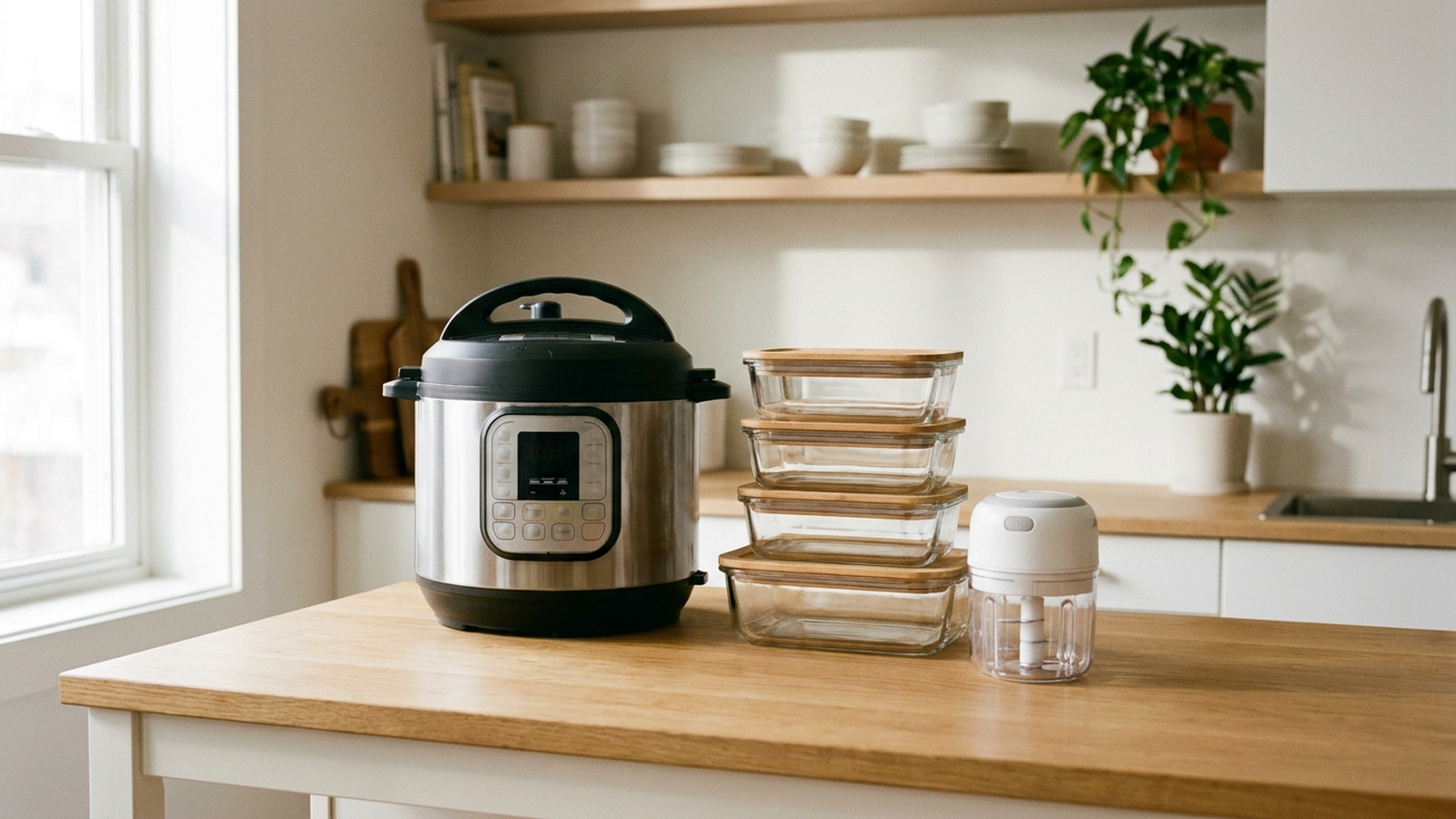
The first Monday back from parental leave is rarely the hard part. The hard part is the Wednesday six weeks later, when the adrenaline of “new routine” has worn off and there is still a baby to feed, a lunch to pack, and a dinner to get on the table in a kitchen that measures, on average, well under 200 square feet if you live in a US apartment. This guide skips the aspirational sourdough-starter gear and focuses on a short list of items that credibly buy back time and counter space for parents navigating that specific season — going back to work with less sleep, less slack in the schedule, and no more square footage than before. Every pick is available on US Amazon, and every recommendation is grounded in aggregated review data, independent third-party testing, and manufacturer specifications.
As an Amazon Associate, Arekore earns from qualifying purchases. The Amazon product links in this article may include our affiliate tracking ID and may earn us a commission if you buy through them, at no additional cost to you. See our Links Policy for details on how we select products and how commissions do not influence our recommendations.
TL;DR / Quick Verdict
- The single biggest time-saver: the Instant Pot Duo Plus 9-in-1 multicooker. Independent standardized testing found it saves roughly 3.4 hours per week versus stovetop cooking, and it replaces a rice cooker, steamer, and slow cooker on a counter that has room for none of those separately.
- The “ready when you walk in” pick: the Crock-Pot 6-Quart Programmable Slow Cooker with MyTime, which times a cook to finish exactly when you get home rather than hours early or late.
- The tiny-cabinet meal-prep solve: the Rubbermaid Brilliance Glass Storage Set of 9, whose uniform lids and nesting shapes fit small apartment cabinets far better than mismatched plastic tubs.
- The freezer-space saver: Stasher silicone reusable bags, which lie flat in a freezer door shelf instead of stacking as rigid tubs do.
- The principle: in a tiny kitchen, the gear that actually saves time is the gear that does more than one job, cleans up fast, and does not need its own dedicated cabinet — not the gadget with the most buttons.
How We Reached These Conclusions (Methodology)
This is an editorial analysis, not a hands-on review. We did not personally test the products covered here. Instead, this guide synthesizes three kinds of public information: (a) aggregated amazon.com customer ratings and the substance of both positive and low-star reviews, sampled in July 2026; (b) independent third-party testing and reporting from Consumer Reports, CNET, Tom’s Guide, and The Kitchn; and (c) manufacturer specifications and published warranty terms. Where we cite a manufacturer figure — a capacity, a wattage, a cycle time — we label it as a manufacturer claim rather than an independently verified result. Statistics on parental leave, household mental load, and kitchen size come from the Minneapolis Fed’s Opportunity & Inclusive Growth Institute, Motherly’s State of Motherhood survey, a University of Bath analysis of US parents, KPMG, and the National Kitchen and Bath Association (NKBA); we cite these directionally rather than as a single unified dataset. Prices are amazon.com figures at the time of writing and fluctuate.
The Season This Guide Is Actually For
US parental leave is short by international standards, and the return to work is often abrupt. US mothers take an average of about 7.2 weeks of maternity leave, well short of a full school semester, and only about 27% of US employees have access to any paid family leave at all — most rely on unpaid leave under the Family and Medical Leave Act. Bipartisan Policy Center research estimates the average family’s household income drops by roughly $1,400 a month during unpaid or partial-pay leave, so many parents return to work budgeting both time and a smaller paycheck at once. None of that leaves room for an elaborate kitchen renovation or a cabinet full of single-purpose gadgets.
The mental-math problem compounds the space problem. A University of Bath analysis of roughly 3,000 US parents found mothers handle about 71% of household tasks that require ongoing mental effort — 60% more than fathers — and Motherly’s State of Motherhood survey puts primary responsibility for meal planning specifically at 55% of mothers. KPMG survey data names time management as the single biggest challenge for working parents, cited by 57% of respondents. Meanwhile the kitchen where all of this has to happen is small by design: the National Kitchen and Bath Association classifies anything under 100 square feet as a small kitchen, and industry sources place typical US apartment kitchens in the 70-to-200-square-foot range — well below the roughly 161-to-169-square-foot US average across all home types. The gear below is chosen for that specific, unglamorous intersection: less time, less mental bandwidth, and less counter.
1. What Actually Saves Time in a Small Kitchen
Not every appliance marketed as a “time-saver” earns the label once you account for the extra washing, storage, and decision-making it adds. Across aggregated long-term reviews and independent lab testing, four traits reliably separate gear that saves real time from gear that just saves stovetop attention:
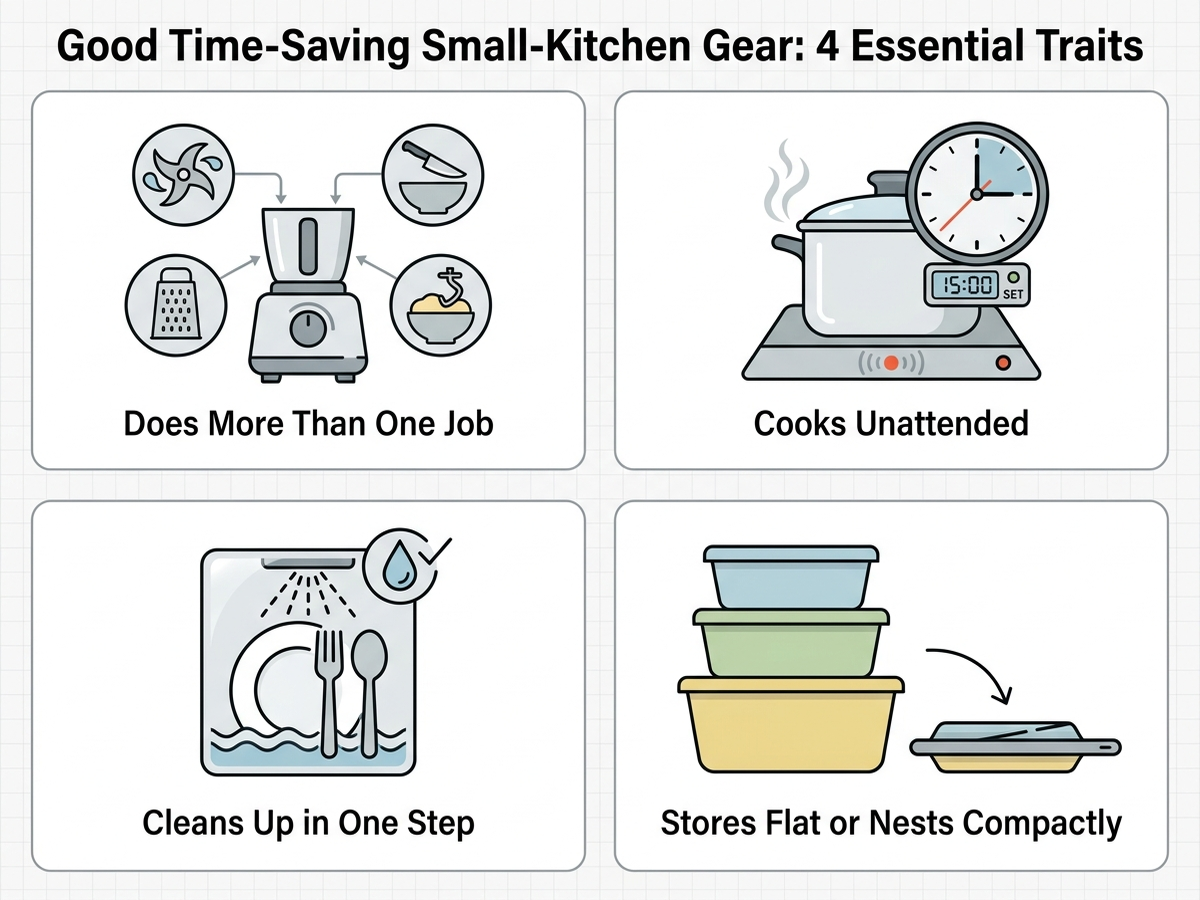
- Does more than one job. A multicooker that pressure-cooks, slow-cooks, and steams removes three single-purpose appliances from a counter that cannot fit any of them individually.
- Cooks unattended. Anything that requires standing at a stove during the exact hour you are also doing bath-and-bedtime is not actually a time-saver for this specific season, regardless of how fast it cooks.
- Cleans up in one step. Dishwasher-safe parts and few crevices matter more when hand-washing at 9 p.m. is the realistic alternative, not a choice.
- Stores flat or nests compactly. Small kitchens lose more usable time to “where does this even go” than to slow cook times; gear that stacks or lies flat earns its cabinet space.
The six picks below apply those criteria to the categories that matter most for this specific stretch: hands-off cooking, meal-prep storage, quick daily prep, and dish cleanup.
2. Comparison Table
Prices are approximate amazon.com figures at the time of writing (July 2026) and fluctuate.
| Item | ASIN | Approx. price | Key spec | Warranty (manufacturer) | Saves time because |
|---|---|---|---|---|---|
| Instant Pot Duo Plus 9-in-1, 6 Qt | B01NBKTPTS | ~$100–$140 | Pressure cook, slow cook, rice, steam, sauté, yogurt | 1 year | Replaces 3–4 single-use appliances on one small footprint |
| Crock-Pot 6-Qt Programmable w/ MyTime | B0D9Z1TN3J | ~$50–$70 | Timed cook-to-finish, auto warm | 1 year | Meal is ready exactly at pickup/arrival time, not early or late |
| Rubbermaid Brilliance Glass Set of 9 | B08BR9HBZ3 | ~$40–$55 | Assorted sizes, airtight, oven-safe to 450°F | Limited | Uniform lids and nesting shapes fit small cabinets |
| Stasher Silicone Reusable Bags, 4-Pack | B087XBR564 | ~$50–$60 | Freezer/microwave/dishwasher/oven safe to 425°F | Lifetime | Lies flat in freezer door instead of stacking as rigid tubs |
| KitchenAid 3.5 Cup Food Chopper | B01LX8I3R3 | ~$45–$60 | One-touch, dishwasher-safe bowl and blade | 1 year | Cuts prep chopping to seconds without a full food processor’s footprint |
| COMFEE’ Countertop Dishwasher | B09ST4M8VF | ~$280–$330 | 6 place settings, 8 cycles, Energy Star | 1 year | No hookup needed; handles meal-prep container backlog without hand-washing |
3. Instant Pot Duo Plus 9-in-1 — The One Appliance That Replaces Four
If a tiny kitchen can only justify one large appliance, this is the category to spend it on. The Instant Pot Duo Plus combines pressure cooking, slow cooking, rice/grain cooking, steaming, sautéing, and yogurt-making in a single 6-quart footprint (manufacturer figures), which matters as much for cabinet space as for cook time. Consumer Reports’ aggregated testing analysis of the broader multi-cooker category and CNET’s standardized cooking comparisons found the format saves roughly 3.4 hours per week versus stovetop cooking — a number that compounds specifically for a parent short on both time and sleep.
Aggregated Amazon sentiment is strongly favorable: the Duo Plus line maintains ratings in the high 4-star range across a very large review volume, with recurring praise for one-touch programs on rice, beans, and stews. Low-star reviews cluster around two predictable issues: the learning curve on pressure-release timing for first-time users, and the ceramic-coated inner pot variant wearing faster than the stainless version over years of dishwasher use — worth checking the specific listing’s pot material before buying.
The honest trade-off: it is not fast for everything. Pressure cooking still needs time to build and release pressure, so a 20-minute recipe can take 40 minutes door-to-door; the time saved is hands-off time, not clock time.
Check the Instant Pot Duo Plus 9-in-1, 6 Qt on Amazon
4. Crock-Pot 6-Qt Programmable with MyTime — Dinner That Lands When You Do
Standard slow cookers assume a fixed cook window, which is a bad assumption for a parent whose daycare pickup time, commute, and nap schedule shift daily. The Crock-Pot Programmable 6-Quart with MyTime technology solves the specific problem: it lets you set a target finish time rather than a start time, then works backward to time the cook so the meal is ready exactly when you want to eat rather than hours early on warm mode or still cooking when you walk in (manufacturer feature description).
This distinction matters more than it sounds. Not every “programmable” slow cooker on the market has genuine delay-start or finish-time logic — some Crock-Pot models intentionally omit delayed start for food-safety reasons, since letting raw meat sit at room temperature before a cooker switches on is a real hazard. The MyTime approach avoids that problem by keeping the cook running and adjusting timing internally rather than delaying the start. Aggregated reviews are positive on the core promise — dinner ready on arrival — with the most common low-star complaints centered on the digital display being hard to read in dim kitchen lighting and on the stated 1-year manufacturer warranty feeling short for a $60 appliance.
Check the Crock-Pot 6-Qt Programmable Slow Cooker on Amazon
5. Rubbermaid Brilliance Glass Storage Set of 9 — Meal Prep That Fits a Small Cabinet
Meal-prep advice universally assumes batch-cooking on the weekend, and batch-cooking universally assumes somewhere to put the batches. The Rubbermaid Brilliance Glass Food Storage Set of 9 is built around uniform, interchangeable lids across its assorted container sizes, so a small cabinet holds nine containers without the “which lid fits which base” search that consumes mismatched plastic tubs. The Kitchn’s review of the line and Consumer Reports’ testing both note the containers stack and nest cleanly, are leak-proof with vented lids for splatter-resistant microwaving, and go from freezer to microwave to a 450°F oven without a container swap (manufacturer specifications).
Aggregated Amazon sentiment consistently distinguishes this line from cheaper glass sets on exactly the point that matters for a tiny kitchen: the lids do not warp or stain the way stain-prone plastic does, and the uniform-lid design is repeatedly cited as the reason people replace an entire mismatched cabinet with one set. The recurring low-star complaint is weight — glass is heavier to carry in a lunch bag than plastic — and the price premium over basic plastic containers, which buyers weigh against not re-buying warped containers every year or two.
Check the Rubbermaid Brilliance Glass Storage Set of 9 on Amazon
6. Stasher Silicone Reusable Bags — Freezer Space That Lies Flat
Freezer meal-prep is one of the most-recommended strategies for returning parents, and it is also the strategy most likely to fail in a tiny apartment freezer, because rigid containers stack into unusable towers. Stasher silicone reusable bags solve the geometry problem: they are dishwasher-, microwave-, freezer-, and oven-safe to 425°F (manufacturer specifications), and — unlike rigid tubs — they lie flat against a freezer door shelf or stack thin, so a week of pre-portioned soups or purées takes a fraction of the space rigid containers would.
CNN Underscored’s hands-on testing over repeated dishwasher cycles found the bags held up without degrading, and Stasher backs the product with a lifetime warranty against damage from normal use — a meaningfully stronger guarantee than most reusable-bag competitors offer. Aggregated review sentiment is positive on durability and leak resistance via the Pinch-Loc seal; the most common criticism is that the bags are bulkier and heavier than disposable plastic bags for on-the-go use, and that overfilling can pop the seal open, so they suit batch storage better than a diaper-bag snack bag.
Check Stasher Silicone Reusable Bags, 4-Pack on Amazon
7. KitchenAid 3.5 Cup Food Chopper — Prep in Seconds, Not a Full Processor’s Footprint
A full-size food processor is genuinely useful and genuinely too large for many apartment kitchens, both on the counter and in storage. The KitchenAid 3.5 Cup Food Chopper covers the actual daily task — chopping an onion, mincing garlic, puréeing a small batch of baby food — with a one-touch pulse design and a dishwasher-safe bowl and blade (manufacturer specifications), in a footprint closer to a large mug than a countertop appliance.
Tom’s Guide’s hands-on week-long test found it handled routine chopping tasks quickly and was notably quiet compared to full-size processors, while noting its single fixed blade means it is not a food-processor replacement for slicing, shredding, or dough work. Aggregated Amazon reviews are strongly positive for its stated use case, with the most frequent praise being “used weekly” and the most frequent complaint being the single-blade limitation the reviewers themselves flag as expected at this size and price.
Check the KitchenAid 3.5 Cup Food Chopper on Amazon
8. COMFEE’ Countertop Dishwasher — For the Meal-Prep Backlog, Not the Whole Kitchen
Meal prep and multicooking both generate more dishes, and many apartment kitchens simply have no dishwasher hookup. The COMFEE’ Countertop Dishwasher is an Energy Star-certified, no-installation option: it fills from a built-in water tank, needs no faucet connection, handles up to 70 pieces across 6 place settings, and runs 8 cycles including a Baby-Care setting relevant to parents sterilizing bottles and pump parts (manufacturer specifications). Aggregated Amazon reviews put it around a 4.4-star average, with the large majority of reviewers saying they would recommend it.
This is the one pick on this list that is a genuine trade-off rather than a clear win: it is the most expensive item here, it takes real counter space in a kitchen that has little to spare, and low-star reviews commonly mention that it does not fully dry dishes and can under-dissolve detergent tablets on some cycles. It earns its place specifically for parents whose apartment has no built-in dishwasher and whose realistic alternative is hand-washing a growing pile of bottles and meal-prep containers at the end of an already short evening — for anyone with a built-in dishwasher already, skip this one.
Check the COMFEE’ Countertop Dishwasher on Amazon
9. Making a Tiny Kitchen Actually Work for This Season
Buying the gear is half of it; the daily habits below are what turn an appliance purchase into actual saved time rather than one more thing to manage.
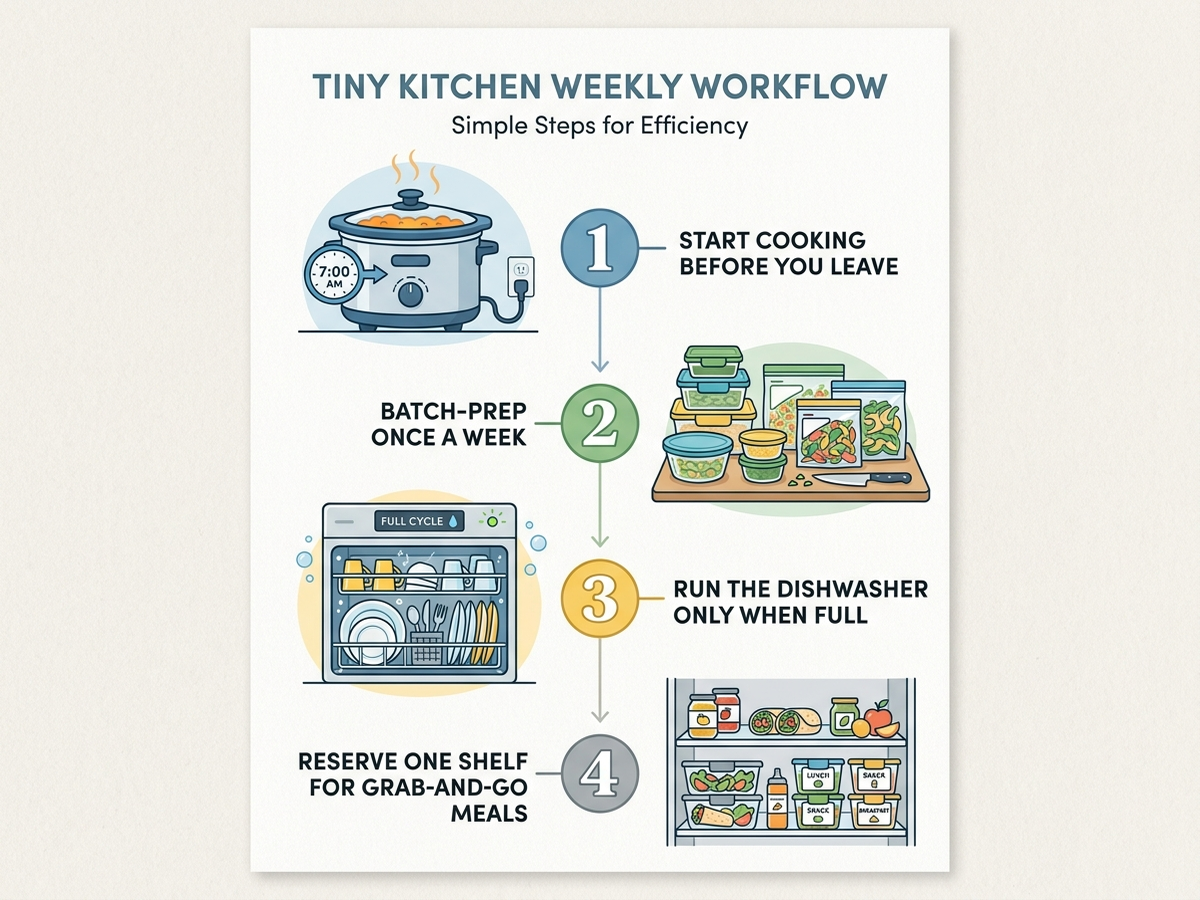
- Start hands-off cooking before you leave, not when you get home. A slow cooker or a multicooker’s slow-cook setting run during a commute converts otherwise-dead time into a finished dinner.
- Batch on one day, not every night. Fill the glass containers and flat silicone bags in a single weekend session; the nesting and flat-storage design only pays off if you are stocking several meals at once, not portioning nightly.
- Run the dishwasher (or the multicooker’s dishwasher-safe parts) only when full. A 6-place-setting countertop unit is efficient at capacity and wasteful run half-empty.
- Reserve one visible shelf for “grab tonight” meals. The mental-load research above is specifically about decision fatigue; removing the “what’s for dinner” decision by pre-labeling a shelf addresses the planning burden, not just the cooking time.
- Wipe down small appliances immediately after use. In under-100-square-foot kitchens, a chopper or multicooker left dirty on the one available counter strip blocks the next meal’s prep entirely.
10. How to Choose: A Priority Flowchart
Few parents can buy all six at once on a leave-reduced income. This is the order that returns the most time saved per dollar for the specific season of returning to work.
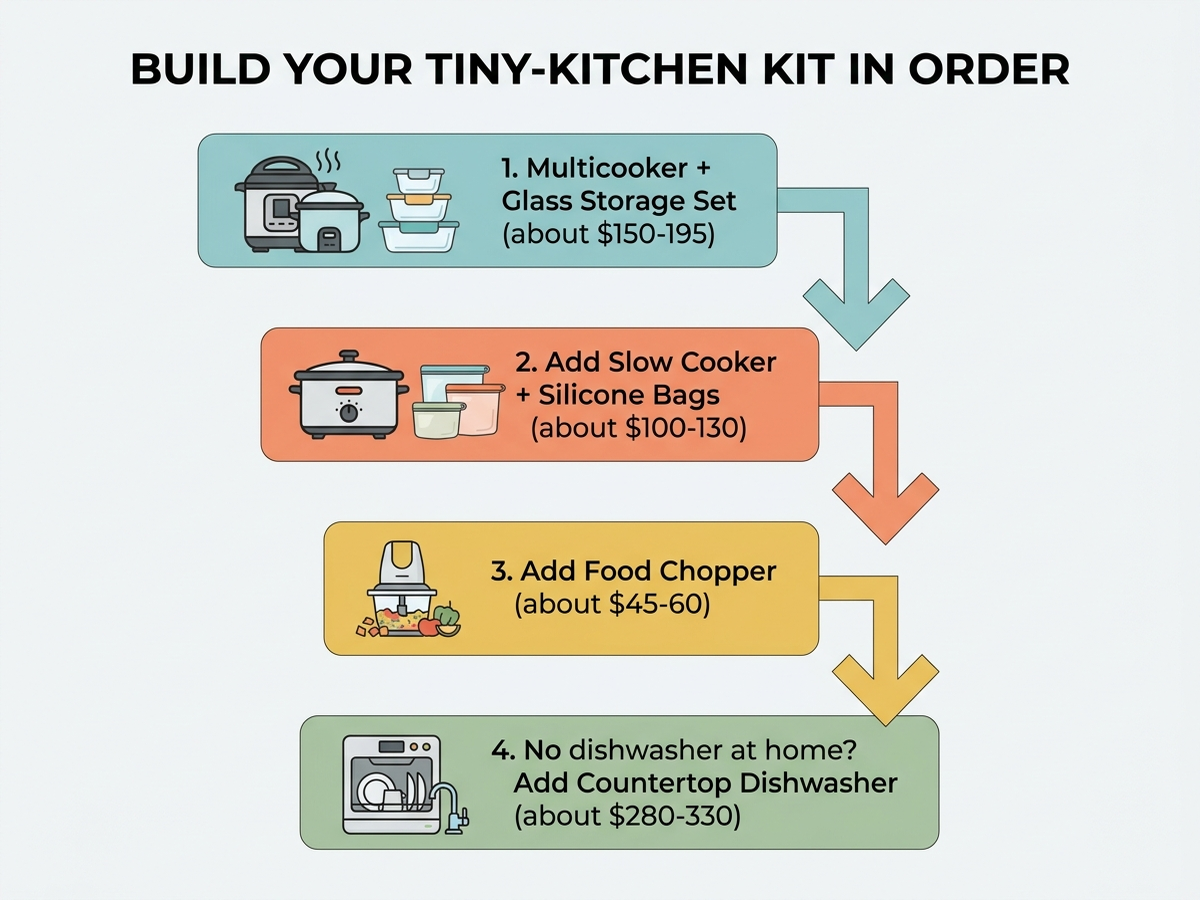
- Start with the multicooker and the glass storage set (about $150–$195). These two alone address both cooking time and the “where does this go” storage problem, and the multicooker replaces several appliances a tiny kitchen cannot otherwise fit.
- Add the slow cooker and silicone bags for freezer batch-cooking (about $100–$130). Once weekend batch-cooking becomes routine, timed finishing and flat freezer storage compound the time saved.
- Add the food chopper for daily prep (about $45–$60). This is the smallest purchase and the one used most often day to day.
- Add the countertop dishwasher only if you have no built-in dishwasher (about $280–$330). For anyone with an existing dishwasher, skip this and put the budget toward the first four items instead.
Editorial Recommendations by Use Case
- Best single purchase if you buy only one thing: the Instant Pot Duo Plus. It has the strongest independent time-savings data on this list and replaces the most separate appliances.
- Best for unpredictable pickup and commute times: the Crock-Pot with MyTime, built specifically around a finish time rather than a fixed start.
- Best for a genuinely tiny cabinet: the Rubbermaid Brilliance Set of 9, whose uniform lids solve the storage problem more than any individual container spec.
- Best for freezer batch-cooking: Stasher silicone bags, for the flat-storage geometry rigid containers cannot match.
- Best “boring but used daily” pick: the KitchenAid 3.5 Cup Food Chopper — the cheapest item here and the one aggregated reviews describe as used weekly.
- Best for a kitchen with no dishwasher hookup: the COMFEE’ Countertop Dishwasher, with the caveat that it is a real trade-off in both cost and counter space.
Warranty and Durability, Compared
Warranty terms below are manufacturer figures at the time of writing; confirm current terms on each product page, as they change.
- Lifetime-class: Stasher covers its silicone bags against damage from normal use for the life of the product — a stronger guarantee than most reusable-bag or plastic-container competitors offer.
- Limited/standard: Instant Pot, Crock-Pot, KitchenAid, and COMFEE’ each carry roughly a 1-year manufacturer warranty typical of small kitchen appliances; Rubbermaid’s Brilliance line carries a limited warranty against manufacturing defects rather than a lifetime term.
- Worth knowing about the category: glass and silicone items in this list (the Rubbermaid set and the Stasher bags) have no motor or electronics to fail, so their realistic service life is generally longer than their warranty term implies, provided lids and seals are inspected periodically for wear.
Limitations of This Analysis
This analysis relies on publicly available reviews, independent third-party tests, and manufacturer specifications; we did not personally test these products, and individual experience varies with household size, cooking habits, and unit-to-unit variance. Parental-leave, mental-load, and kitchen-size statistics are drawn from several distinct surveys and research bodies with different methodologies and years, so treat them as directional context rather than a single unified figure. Prices, ASIN availability, color variants, and warranty terms change frequently — Amazon listings in particular rotate bundle and color variants under different ASINs — so always confirm the current price, version, and warranty on the product page before buying. Cooking and drying performance for the multicooker, slow cooker, and countertop dishwasher can vary with local water hardness, recipe, and load size.
The Bottom Line
Returning to work with a new baby and a small kitchen is a specific, temporary, and genuinely hard season — not a permanent lifestyle to over-equip for. Six pieces of gear that do more than one job, clean up fast, and store flat or nest compactly — an Instant Pot multicooker, a timed slow cooker, a uniform-lid glass storage set, flat silicone freezer bags, a compact food chopper, and, if you lack a built-in dishwasher, a countertop model — cost roughly $500 total at typical prices and are chosen specifically to give back time and counter space rather than add a new thing to manage. Whichever items you prioritize, verify the exact version and current price before checkout — and if you want a second opinion on a specific listing, paste the URL into Arekore and let the AI scan the reviews and price history for you in about five minutes.