Anker vs Baseus: Which Portable Charger Wins in 2026?
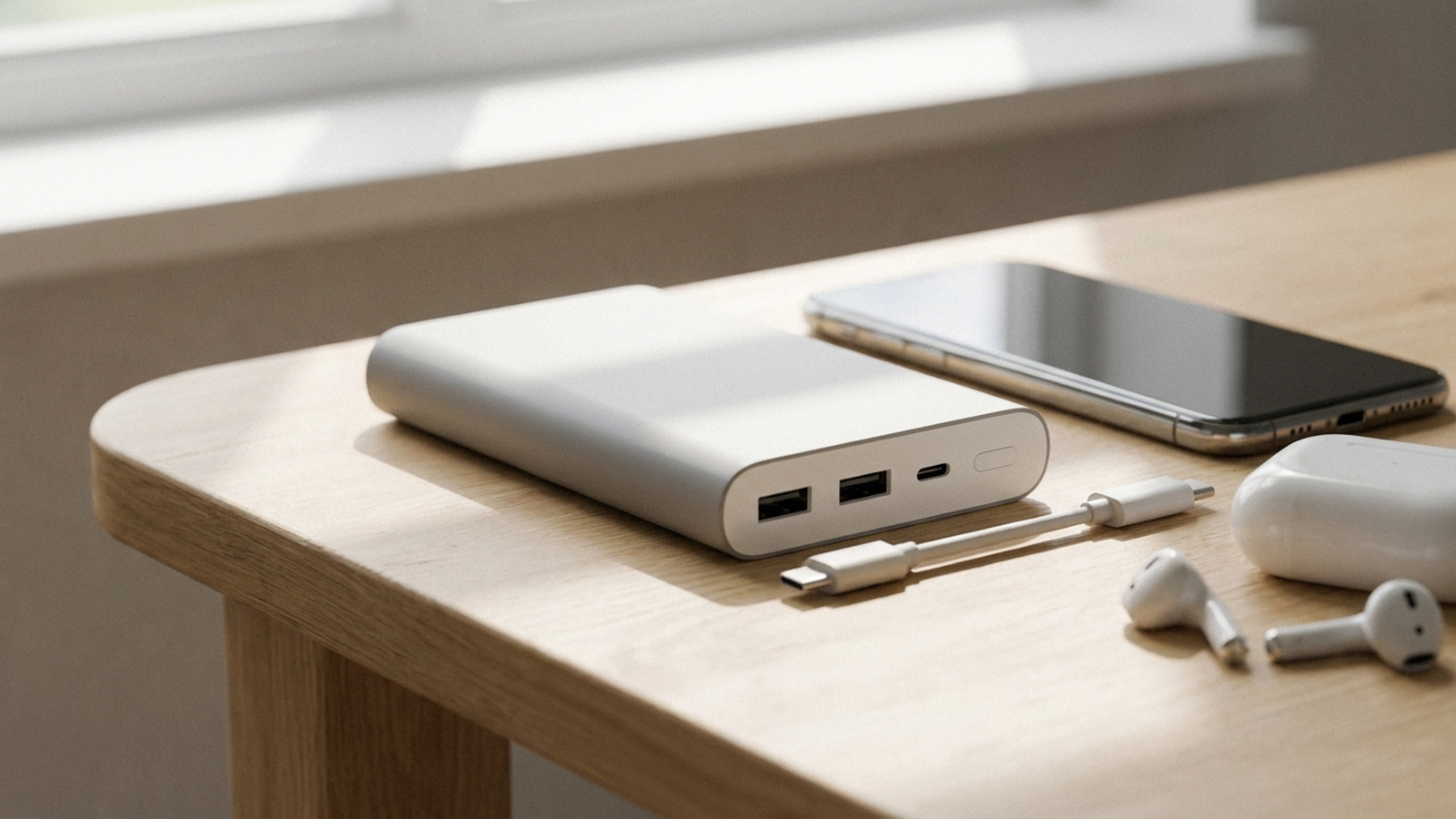
Anker has been the default answer to “which power bank should I buy” on amazon.com for years. Baseus has spent the last two years closing that gap with faster charging speeds at lower prices and a design language that increasingly looks and feels like Anker’s. Both brands also share something less flattering: each has had a U.S. Consumer Product Safety Commission recall tied to lithium-ion battery overheating since 2024. This guide compares what each brand actually sells across three price tiers, what independent testing and regulatory records say, and what aggregated owner reviews report.
As an Amazon Associate, Arekore earns from qualifying purchases. The Amazon product links in this article include our affiliate tracking ID and may earn us a commission if you buy through them, at no additional cost to you. See our Links Policy for details on how we select products and how commissions do not influence our recommendations.
TL;DR / Quick Verdict
- Compare within a price tier, not brand-to-brand. A $20 Baseus and a $180 Anker both charge phones, but they are not substitutes for each other — match the product to your capacity and charging-speed needs first.
- Best all-around pick: the Anker Nano Power Bank (10,000mAh, 30W) — a compact, built-in-cable design from the brand Tom’s Guide has repeatedly named its favorite mid-size pick, typically $25–$35.
- Best value for laptop-level charging: the Baseus Blade (100W, 20,000mAh) — four ports and a built-in display at roughly two-thirds the price of Anker’s equivalent-capacity model.
- Best for frequent flyers: the Anker Prime (27,650mAh, 250W) — TSA-compliant at 99.54Wh, with a 4.7-star Amazon rating across 211 reviews and the highest sustained output in this comparison.
- The factor buyers underweight: both brands have an active CPSC recall on record — Anker for 481,000 units (33 fire/explosion reports) and Baseus for 132,000 units (39 fires, 13 burn injuries) — tied to specific older model numbers, not the current lineups covered here. Checking your model number against the recall list takes two minutes and matters more than any spec on this page.
How We Reached These Conclusions (Methodology)
This is an editorial analysis, not a hands-on review; we did not personally test the products covered here. This guide synthesizes three kinds of public information: (a) aggregated amazon.com customer reviews sampled in September and October 2026; (b) independent reporting from Tom’s Guide and CPSC recall records; and (c) manufacturer specifications for capacity, wattage, and charging speed. Where we cite a manufacturer figure — wattage, charge time, or certification claim — we label it as a manufacturer claim rather than an independently verified result. Prices are amazon.com figures at the time of writing and fluctuate, sometimes significantly, with frequent lightning deals on both brands.
Technical Approach: Anker’s Ecosystem vs. Baseus’s Spec Sheet
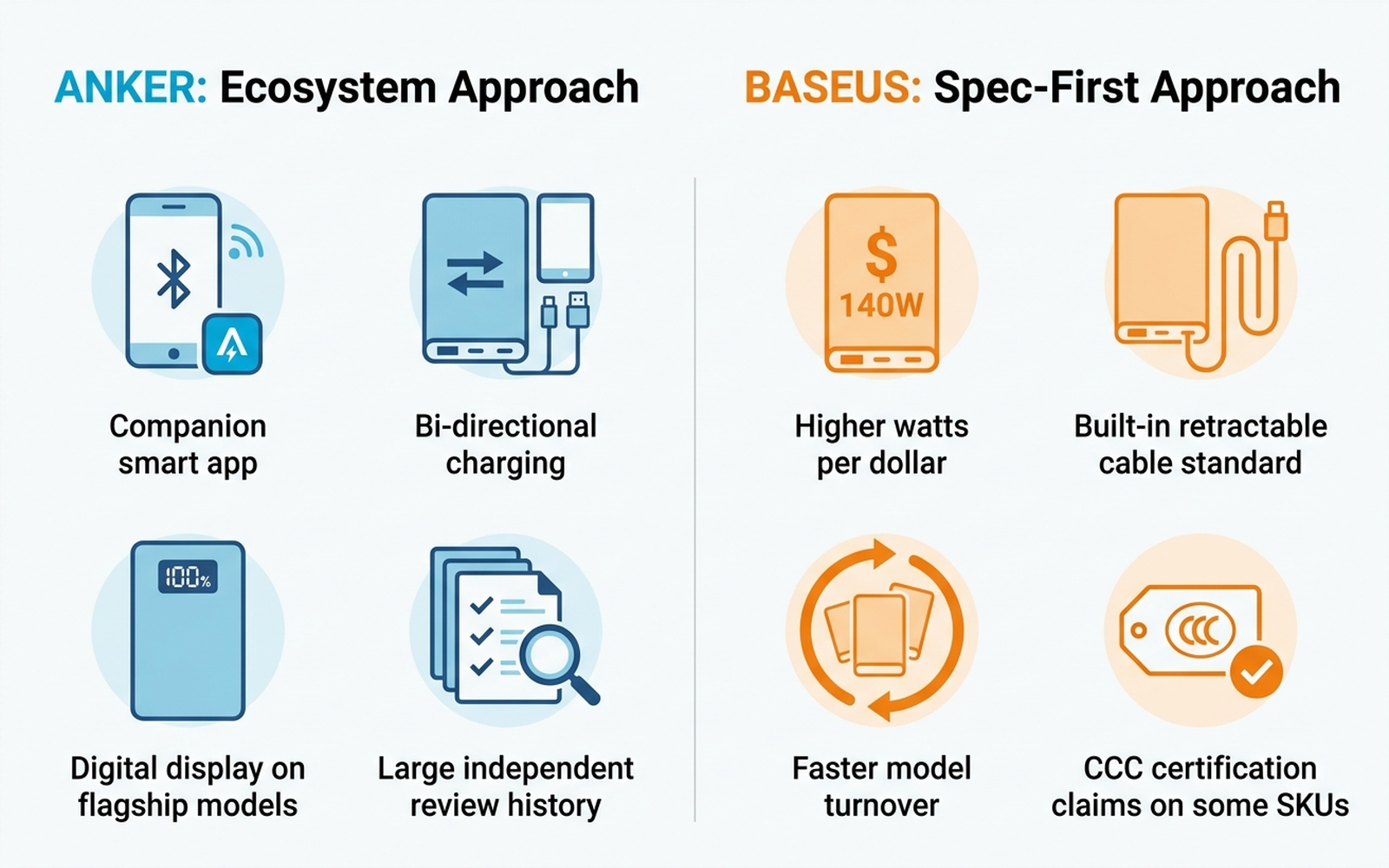
The two brands are competing on different axes, and that shapes which one makes sense for a given buyer.
- Anker’s approach leans on ecosystem polish: a companion smart app on higher-end models like the Prime series, bi-directional charging that lets a bank recharge your laptop or your laptop recharge the bank, and a reputation — reinforced by years of independent reviews — for consistent quality control across a large product line. Anker’s flagship Prime models add a digital display and magnetic charging-base compatibility that Baseus’s comparable tier does not match feature-for-feature.
- Baseus’s approach competes primarily on watts and dollars per mAh. Its Blade and 25,000mAh laptop-charging lines consistently ship with higher advertised wattage (100W–145W) than Anker products at a similar capacity and price, and nearly every Baseus model in this comparison includes a built-in retractable USB-C cable as standard — a feature Anker reserves for select SKUs.
- Certification claims. Baseus markets CCC certification (China Compulsory Certification, a safety mark required for products sold in China, not a U.S. standard) on some higher-wattage models; one widely cited Amazon review thread reported that two units purchased under that claim arrived without the physical CCC certification mark on the device, which the reviewer flagged as a discrepancy between the listing and the product received. We note this as a documented buyer report, not a confirmed pattern across all units — if certification matters to your purchase, verify it against the physical device, not just the listing copy.
- Build quality track record. Anker’s longer U.S. retail history gives it a larger base of independent long-term reviews; Baseus’s faster model turnover means fewer third parties have tracked a single SKU for years the way outlets have with, for example, Anker’s original PowerCore line.
Head-to-Head: Everyday Tier (~$18–$35)
Anker Nano Power Bank (10,000mAh, 30W) is Anker’s compact daily-carry pick: a built-in USB-C cable, a slim form factor, and 30W output enough to fast-charge most phones and some tablets. Tom’s Guide has named the Anker PowerCore line — the Nano’s predecessor family — its favorite mid-size portable charger in ongoing coverage of the category, citing consistent real-world charging speed as the deciding factor over flashier competitors. It typically lists between $25 and $35 on Amazon.
Check the Anker Nano Power Bank (10,000mAh) on Amazon
Baseus Picogo (10,000mAh, 45W) undercuts the Nano on both price and advertised wattage: a built-in retractable USB-C cable, three output ports, and a small digital charge-level display, with Amazon customer ratings around 4.5 out of 5 stars across roughly 320 reviews (76% five-star, per the review breakdown) as of this writing. Pricing swings widely with frequent promotions, from roughly $18 during sales up to $40 at list price. The most common critical review flags the built-in cable’s connector wearing out after roughly 10 months of regular use — a failure mode specific to built-in-cable designs on either brand, not unique to Baseus.
Check the Baseus Picogo (10,000mAh, 45W) on Amazon
Verdict at this tier: the Baseus Picogo advertises higher wattage and a lower typical price; the Anker Nano carries the longer independent-review track record from outlets like Tom’s Guide. If built-in-cable durability is your top concern on either model, a model with separate USB-A/USB-C ports and your own cable avoids that specific failure point entirely.
Head-to-Head: Laptop-Capable Tier (~$50–$70)
Anker Power Bank (20,000mAh, 87W, Model A1383) is Anker’s built-in-cable answer at laptop-adjacent wattage: 87W max output, enough to meaningfully charge (though not always fully fast-charge) many USB-C laptops, plus phone and tablet support. It typically lists in the $50–$70 range, with Anker’s frequent lightning deals bringing it closer to $50.
Check the Anker Power Bank (20,000mAh, 87W) on Amazon
Baseus Blade (100W, 20,000mAh) matches the Anker on capacity and beats it on advertised peak wattage — 100W across two USB-C and two USB-A ports, plus a built-in digital display showing real-time wattage draw. It carries a 4.3 out of 5 Amazon rating, and reviewer coverage (including hands-on pieces from Android Central and AppleInsider) consistently calls out the slim form factor relative to its 100W output as the standout feature. Pricing has ranged from around $51 during sales to roughly $70 at list price.
Check the Baseus Blade (100W, 20,000mAh) on Amazon
Verdict at this tier: the Baseus Blade’s extra 13W of advertised peak output and built-in display make it the better spec-for-dollar pick on paper; Anker’s model draws on a longer history of independent reliability reporting if brand consistency matters more to you than the wattage number on the box.
Head-to-Head: Flagship Travel Tier (~$45–$180)
Anker Prime (27,650mAh, 250W) is the most capable bank in this comparison: a 3-port, 250W design with a digital display, companion smart app, bi-directional fast charging, and a 99.54Wh rating that keeps it just under the FAA/TSA 100Wh carry-on lithium battery limit — meaning it’s airline-compliant despite its large capacity. It carries a 4.7 out of 5 Amazon rating across 211 reviews, with reviewers rating Value at 4.5, Quality at 4.8, and Ease of Use at 4.8 out of 5 on a per-feature breakdown. Pricing swings dramatically with sales, from roughly $99 during deep discounts up to its $179.99 list price (the charging-base bundle costs more).
Check the Anker Prime (27,650mAh, 250W) on Amazon
Baseus 25,000mAh (145W, CCC Certified) is Baseus’s laptop-charging flagship: dual built-in USB-C cables, 145W total output, a digital display, and a battery capacity (91.25Wh) that also clears the TSA’s 100Wh carry-on limit. It typically lists around $59.99 with frequent promo pricing closer to $45. As noted above, verify the physical CCC certification mark on arrival if that claim factors into your purchase decision.
Check the Baseus 25,000mAh (145W) on Amazon
Verdict at this tier: the price gap is the story here — the Anker Prime costs roughly 2–3x the Baseus at list price for a larger but comparably airline-legal capacity, a companion app, and a longer independent-review track record; the Baseus gets you dual built-in cables and TSA-compliant laptop charging at a fraction of the cost if you don’t need Anker’s ecosystem extras.
Customer Sentiment Synthesis
- Anker Nano and Prime owners, per aggregated Amazon review data, most frequently cite consistent real charging speed matching the advertised wattage, and point to the companion app (on Prime models) as a genuinely useful way to track battery health over time rather than a gimmick.
- Baseus Picogo and Blade owners most commonly praise the price-to-wattage ratio and the built-in digital wattage display, with several reviews specifically noting the display helps confirm the bank is actually delivering its advertised peak output rather than throttling silently.
- The most common Anker complaint, where it appears, is price relative to comparable-wattage Baseus models at the laptop-charging tier. The most common Baseus complaint is built-in-cable durability over many months of daily use — the same failure mode reported on Anker’s own built-in-cable SKUs, suggesting it’s a design-category issue rather than a brand-specific one.
- Neither brand’s current mainstream lineup shows the kind of one-star pile-on associated with the specific recalled model numbers discussed below — that feedback is concentrated on the affected SKUs rather than spread across each brand’s broader catalog.
Getting the Most from Either Brand
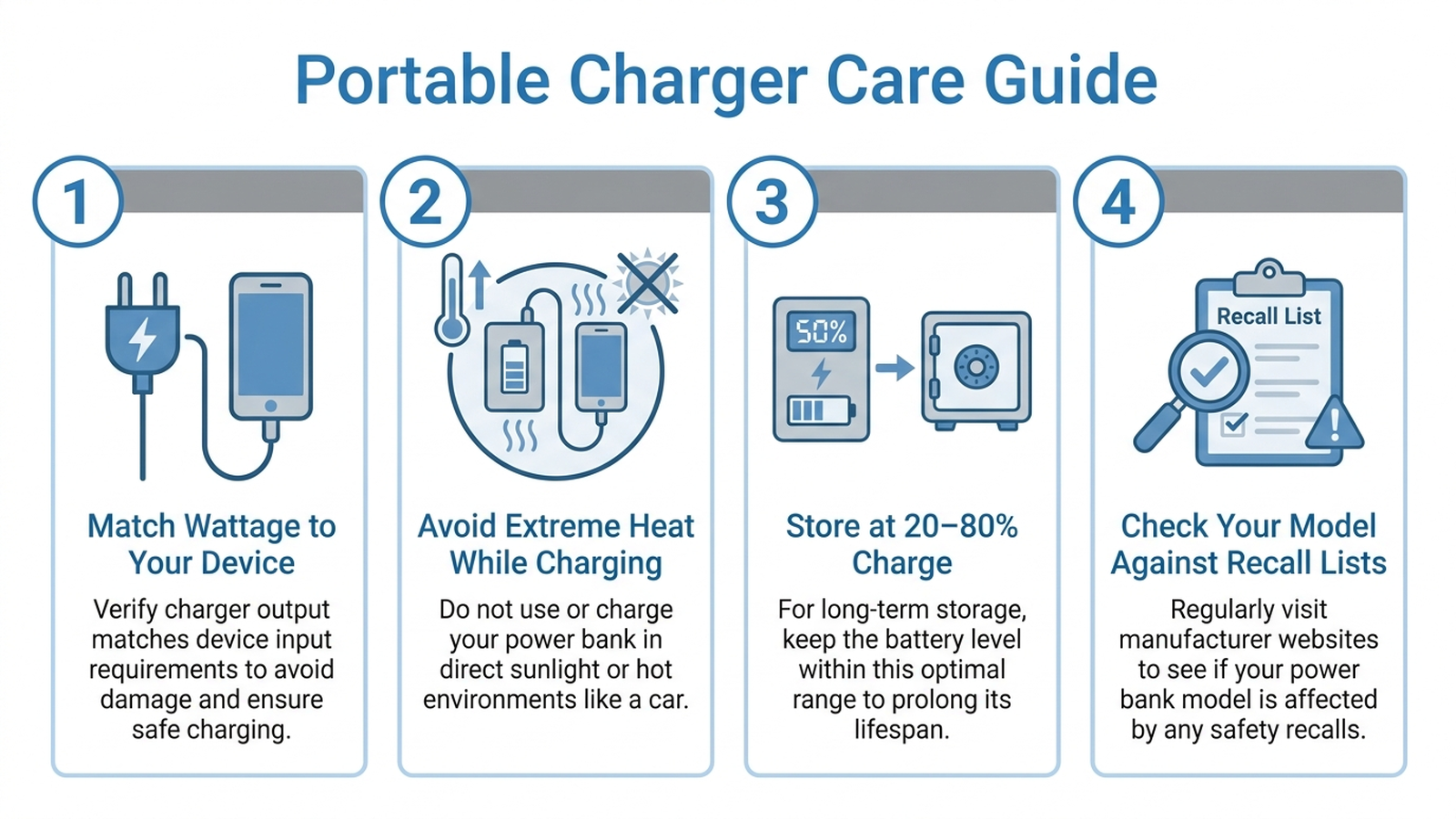
A few habits apply regardless of brand. Match wattage to your actual device — a 100W-rated bank won’t charge a phone any faster than its own charging limit allows, so buy for your most demanding device (usually a laptop), not your phone. Avoid charging the bank itself in direct sun or a hot car; lithium-ion cells degrade faster and, in rare cases, can be a contributing factor in the overheating incidents regulators have flagged (see below). For long-term storage, keep the bank around 20–80% charged rather than fully drained or fully topped off, which is the storage range most lithium-ion battery manufacturers recommend to slow capacity loss. And before buying either brand, check your model number — or the one you already own — against the current CPSC recall list.
Safety Record: What the CPSC Recalls Actually Cover
Both brands carry an active U.S. Consumer Product Safety Commission recall, and treating them as equivalent “both brands had issues” footnotes undersells what’s actually documented. Anker’s September 2025 recall covers roughly 481,000 power banks sold between August 2023 and June 2025 under model numbers A1647, A1652, A1257, A1681, and A1689 — outputs ranging from 7.5W to 30W, all distinct from the higher-wattage current models (A1383, the Prime series) covered in this comparison. The CPSC recorded 33 fire and explosion reports, four minor burn injuries, and one report of substantial property damage tied to those units. Baseus’s recall, issued in mid-2024, covers about 132,000 magnetic wireless-charging power banks under model numbers PPCXM06 and PPCXW06 — again a distinct product line from the Blade and 25,000mAh models reviewed here — linked to 132 reports of battery bulging or swelling, 39 fires, and 13 burn injuries. Neither recall covers the specific ASINs recommended in this article, but the pattern itself — lithium-ion power banks from both leading brands experiencing real-world overheating failures at meaningful scale — is a legitimate reason to register any power bank you own with the manufacturer and to stop using any unit that feels unusually hot, swells, or smells unusual during charging.
Side-by-Side Comparison
| Model | ASIN | Tier | Capacity | Max output | Amazon rating | Approx. price (as of 2026-10-01) |
|---|---|---|---|---|---|---|
| Baseus Picogo | B0DHRYDNXL | Everyday | 10,000mAh | 45W | 4.5★ (~320 reviews) | $18–$40 |
| Anker Nano Power Bank | B0C9CJKCH3 | Everyday | 10,000mAh | 30W | Not individually disclosed; brand favored in Tom’s Guide coverage | $25–$35 |
| Baseus Blade | B0DK8V9LSV | Laptop-capable | 20,000mAh | 100W | 4.3★ | $51–$70 |
| Anker Power Bank (A1383) | B0CXDXP8VR | Laptop-capable | 20,000mAh | 87W | Not individually disclosed | $50–$70 |
| Baseus 25,000mAh (145W) | B0GXZHFNV6 | Flagship | 25,000mAh (91.25Wh) | 145W | Mixed; see CCC note above | $45–$60 |
| Anker Prime | B0BYP2F3SG | Flagship | 27,650mAh (99.54Wh) | 250W | 4.7★ (211 reviews) | $99–$180 |
Wattage and capacity figures are manufacturer specifications; Amazon ratings reflect aggregated customer review data at the time of writing. Prices fluctuate significantly with sales — verify the current amazon.com price before buying.
Market Context: A Category Still Growing Fast
The global power bank market was valued at roughly $16.46 billion in 2026 and is projected to keep growing at a compound annual rate in the high single digits through the early 2030s, according to Fortune Business Insights — one of several market-research firms tracking the category, with estimates varying from roughly $9.7 billion to $20.9 billion depending on how each firm defines the product category and region. That growth is driven partly by rising USB-C laptop adoption pushing buyers toward higher-wattage banks like the Blade and Prime models in this comparison, and partly by ongoing smartphone battery-life pressure that keeps even budget 10,000mAh banks selling in high volume. Within that growth, the CPSC recalls on both leading brands are a reminder that the category’s push toward higher capacity and higher wattage carries real safety engineering tradeoffs, not just marketing ones.
How to Decide
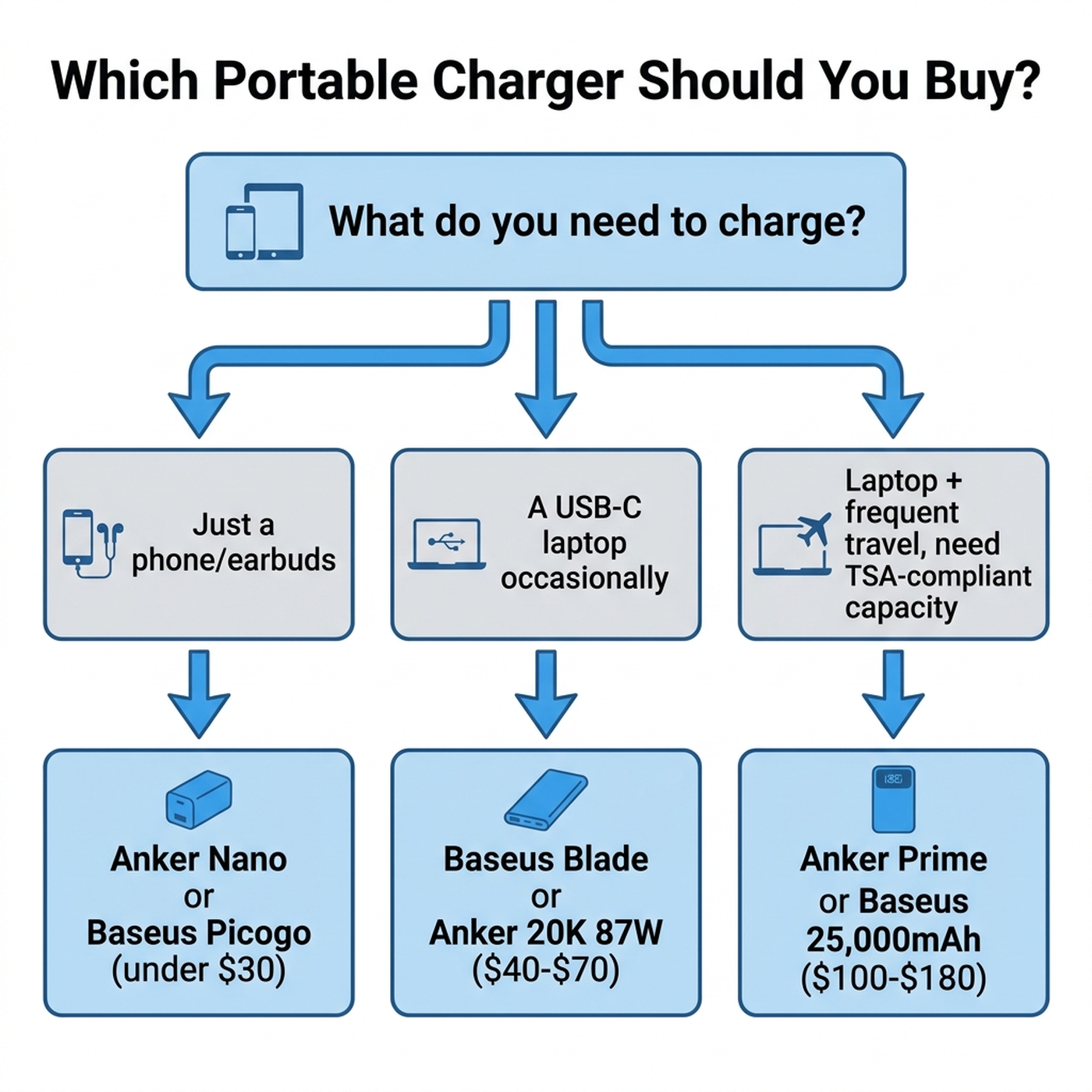
Start with what you actually need to charge. If it’s just a phone and maybe earbuds, both the Anker Nano and Baseus Picogo cover that at under $35, and the decision comes down to whether you’d rather pay slightly more for Anker’s longer independent-review track record or save a few dollars with Baseus’s higher advertised wattage. If you regularly need to top off a USB-C laptop on the go, move to the $50–$70 tier — the Baseus Blade’s 100W edges out the Anker A1383’s 87W on paper, but check your laptop’s actual charging requirement before paying for watts you won’t use. If you travel frequently and want a single bank that handles a laptop, phone, and tablet across a multi-day trip while staying TSA-compliant, the Anker Prime’s higher sustained output and companion app justify its price premium for buyers who travel often enough to amortize the cost; the Baseus 25,000mAh model gets most travelers 80% of the way there for roughly a third of the price.
Editorial Recommendation by Use Case
- You want the safest bet with the deepest independent-review history: the Anker Nano Power Bank, drawing on the track record of a product line Tom’s Guide has repeatedly favored.
- You want the most wattage per dollar at everyday-carry size: the Baseus Picogo, which undercuts the Nano on price while advertising higher peak output.
- You need to charge a laptop on a budget: the Baseus Blade, the highest-wattage option under $70 in this comparison.
- You travel often and want the most capable all-around bank: the Anker Prime, the only model here with a companion app, bi-directional charging, and a 4.7-star rating across 211 reviews.
Limitations
This analysis relies on publicly available Amazon review data, CPSC recall records, and manufacturer specifications; we did not independently lab-test these units for actual sustained wattage, charge cycles, or thermal performance. Wattage, capacity, and certification claims are manufacturer specifications unless explicitly attributed to Tom’s Guide or the CPSC, and individual unit performance can vary with cable quality, ambient temperature, and the specific device being charged. Amazon review sentiment reflects aggregated public feedback at the time of writing and can shift as new reviews accumulate or as newer SKUs replace the ones covered here. Prices and availability were accurate to our research at the time of writing and change frequently, often significantly during sales events — verify current specs and pricing on the product page before buying.
Before you buy either brand’s charger, it pays to check whether a listing’s reviews are genuine and whether a sale price is a real discount or an inflated “was” price. That is exactly what Arekore does: paste the Amazon URL and our AI analyzes review authenticity, surfaces the most useful low-star feedback, and compares pricing in about five minutes — so you end up with the power bank that actually fits your trip, not just the one with the biggest wattage number on the box.