Amazon Warehouse Deals 2026: When Refurbished Is Worth It

Amazon Warehouse — technically rebranded “Amazon Resale” in the app, though most shoppers still search for it by the old name — sells the returns, open-box units, and shelf-pulls that come back through Amazon’s fulfillment network, at discounts that commonly run 20% to 70% off list price depending on category. The catch is that “Warehouse” isn’t one thing. It spans everything from an unopened box with a torn corner to a used blender with a missing lid, all sorted into four condition grades that most shoppers have never read the actual definitions of before checking out. Whether it’s worth it depends almost entirely on which grade is in the listing and what category the product is in.
This article is provided by Arekore, an AI shopping assistant. Paste a product URL and our AI checks review authenticity, digs into low-star feedback, and compares prices in about five minutes.
TL;DR / Quick Verdict
- Amazon Warehouse discounts typically run 20-70% off list price depending on category, with electronics closer to 30-50%, appliances 40-60%, and furniture or other bulky goods sometimes reaching 50-70% off, according to aggregated marketplace-tracking data.
- “Like New” and “Very Good” are the two grades worth buying; “Good” and “Acceptable” carry visible wear or missing parts and only make sense at a steep discount on something purely functional.
- Warehouse items keep the standard 30-day return window, not the 90-day window Amazon Renewed gets — a meaningfully shorter safety net than shoppers often assume.
- Missing accessories and incorrect condition grading are the most common complaints across seller and buyer forums, particularly on electronics with small bundled parts (cables, cartridges, chargers).
- Batteries are tested to a minimum of 80% of original capacity under Amazon’s stated inspection process, but that 80% floor is worth knowing before buying a battery-dependent device graded below “Like New.”
How We Reached These Conclusions (Methodology)
This is an editorial analysis, not a hands-on test of Amazon Warehouse purchases across every category. It synthesizes: (a) Amazon’s own published condition-grading definitions and stated 20-point quality inspection process for Warehouse/Resale listings; (b) e-commerce industry coverage of discount ranges and inventory volume from Tinuiti, SellerApp, AMZ Advisers, and SmartPickers; (c) comparative reporting on Amazon Renewed vs. Amazon Warehouse policy differences, including return-window and warranty distinctions; (d) aggregated buyer and seller sentiment from public forum threads (Slickdeals, Reddit’s r/amazon, and seller forums) describing missing-accessory and grading-accuracy complaints, sampled in August–September 2026; and (e) Consumer Reports’ and ConsumerAffairs’ independent guidance comparing open-box, refurbished, and used-electronics purchasing generally. We did not personally purchase or test specific Warehouse listings for this article; individual listing quality varies by item and by warehouse location.
The Four Condition Grades, and What Each One Actually Means
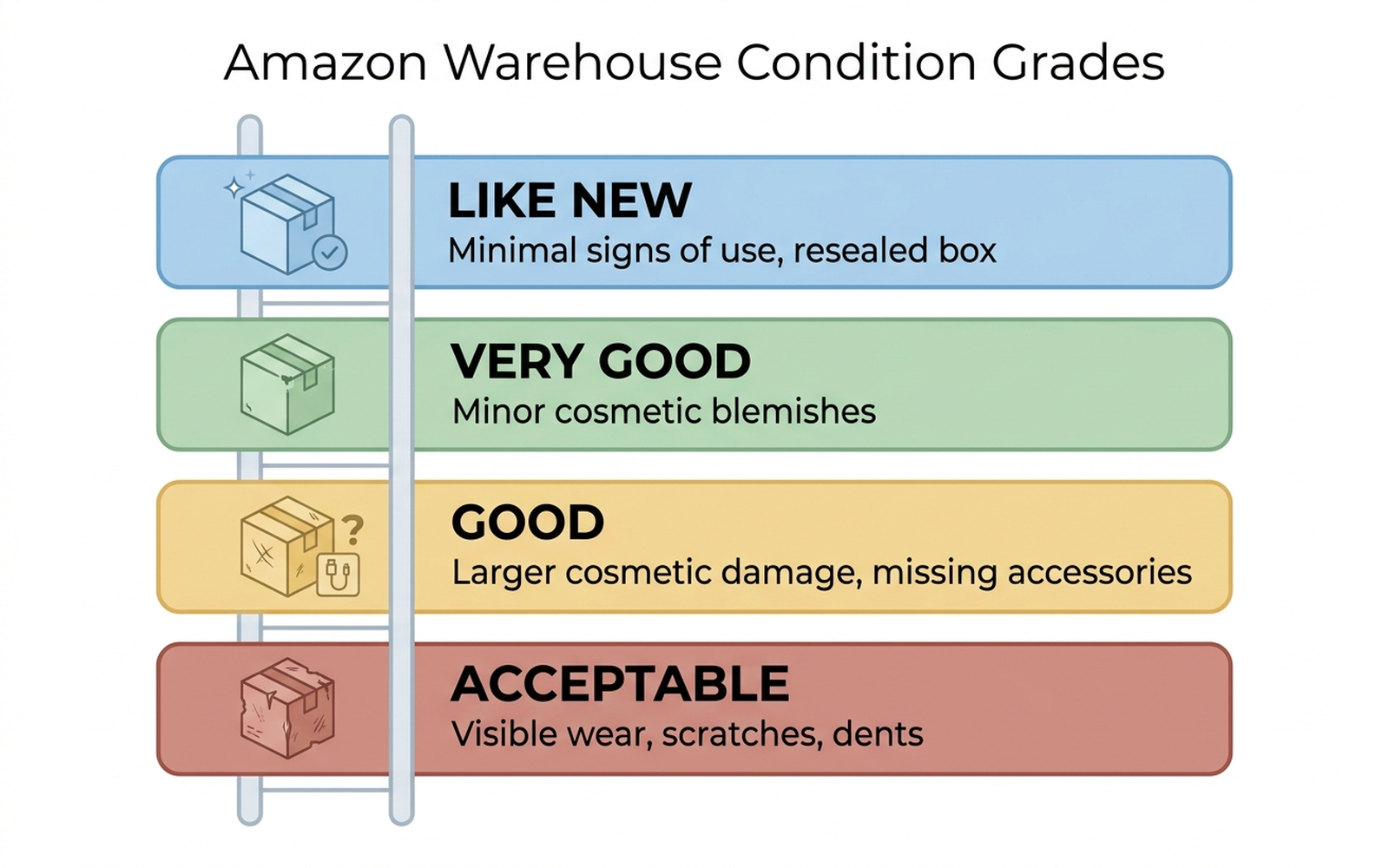
Amazon grades Warehouse inventory into four tiers, and the gap between the top and bottom of that ladder is bigger than the shared “used” label suggests:
- Like New: The product itself functions and looks essentially new; the only issue is packaging that’s been opened, resealed, or replaced, which disqualifies it from being sold as “new” under Amazon’s own listing rules. This is functionally the safest Warehouse tier to buy.
- Very Good: Minor cosmetic blemishes, slight signs of use, or a minor accessory that may be missing or substituted with generic packaging. Still a reasonable buy for most non-collectible purchases.
- Good: Larger cosmetic damage or blemishes, and/or missing accessories beyond the minor category. This tier is where “read the listing description carefully” starts to matter more than the discount headline.
- Acceptable: Visible wear — scratches, dents, other cosmetic issues — while remaining functional. These carry the deepest discounts and the highest chance the item won’t match a shopper’s mental image of “used but fine.”
Per Amazon’s stated inspection process (a manufacturer claim, not independently audited for this analysis), each item is checked against roughly 20 quality points before listing, and batteries are tested to confirm at least 80% of original capacity relative to new. That 80% floor matters most for anything battery-dependent bought below “Like New” — a cordless vacuum or power tool at 80% battery health will visibly run shorter cycles than a new unit, even though it technically passes inspection.
What the Discount Actually Buys, By Category
Aggregated marketplace-tracking data puts typical Warehouse savings at roughly 20-70% off list price across categories, with the widest spread at the extremes: electronics commonly land in the 30-50% range, appliances 40-60%, and furniture or other bulky goods sometimes 50-70% off, since bulky-item returns are expensive for Amazon to restock as “new” regardless of actual condition. One industry tracker also reports a customer satisfaction figure around 78% for Warehouse purchases overall — worth reading as a rough directional signal rather than a precise, independently audited statistic, since the methodology behind that number isn’t publicly documented.
That category spread is also where the “worth it” calculus changes fastest. A television or laptop graded “Like New” with a resealed box is close to a free discount — the electronics inside either work or they don’t, and Amazon’s return window catches most functional failures. A blender or coffee maker in “Good” condition with a missing lid, by contrast, may need a same-day trip to the manufacturer’s replacement-parts page to actually be usable, which erodes the savings once time and shipping are factored in.
Where It Goes Wrong: What Complaint Patterns Actually Say
Buyer and seller forum threads reviewed for this analysis converge on two recurring complaint types, not a broad “Warehouse is a scam” narrative. The first is missing or substituted accessories — small bundled items (a charging cable, a game cartridge, a screw, a specific attachment) that don’t make it into the resale box even when the main unit is intact and functional. The second is grading accuracy: some buyers report receiving items whose actual condition looks meaningfully worse than the stated grade, including — in less common but recurring reports — units with mismatched serial numbers or specs that don’t match the original listing, which points to a returned item being re-listed without a fully accurate inspection rather than routine cosmetic wear. Neither complaint type appears to be evenly distributed; both cluster more heavily on small-parts-heavy electronics than on single-piece furniture or simple kitchen tools, which lines up with the mechanical reality that a product with more removable pieces has more ways to arrive incomplete.
Warehouse vs. Renewed vs. New: The Comparison That Actually Matters
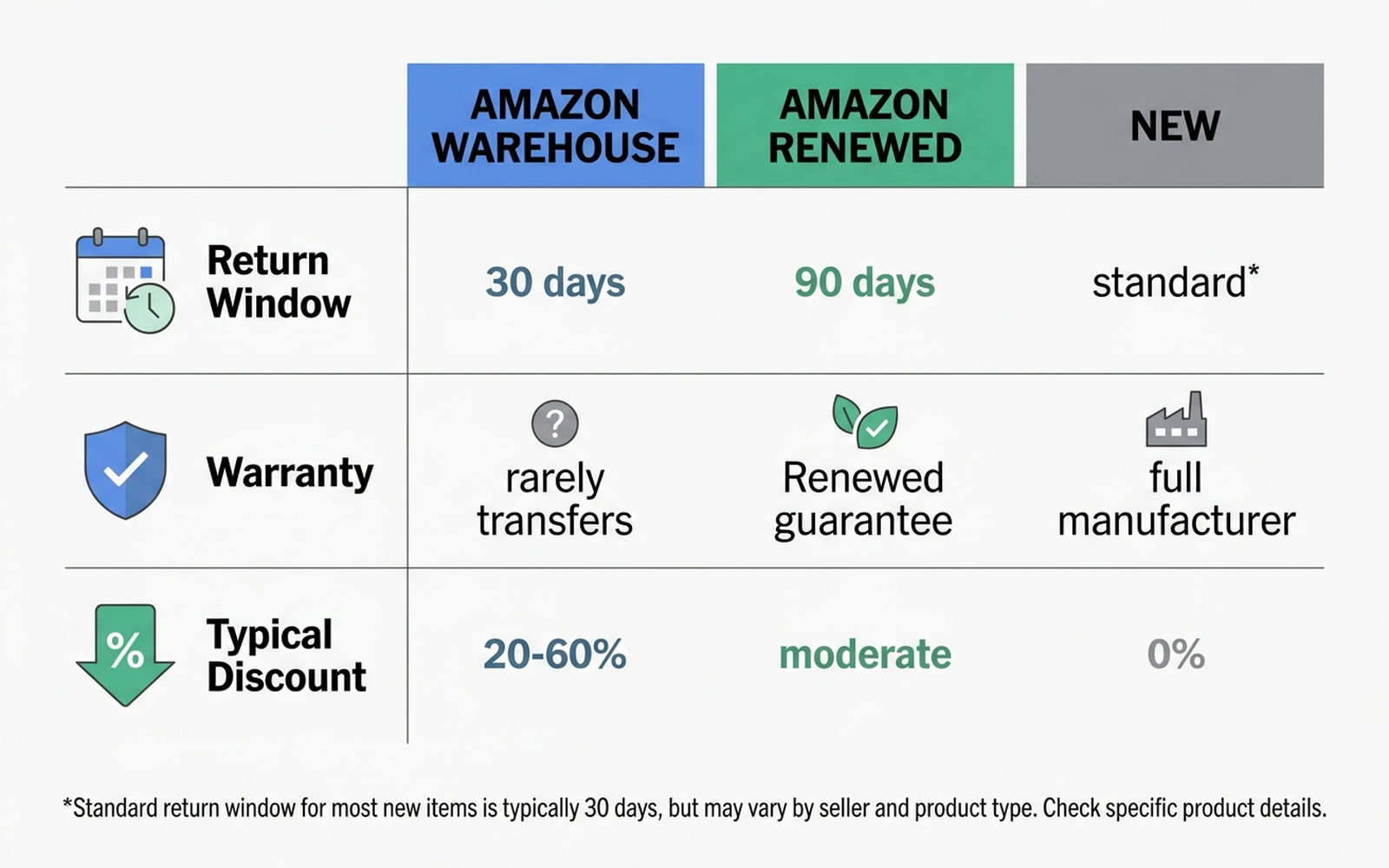
| Amazon Warehouse (Resale) | Amazon Renewed | New | |
|---|---|---|---|
| What it is | Used / open-box customer returns, graded as-is | Refurbished by a certified third-party technician program | Unopened, factory-sealed |
| Return window | 30 days (standard) | 90 days | Standard Amazon return policy |
| Manufacturer warranty | Rarely transfers | Amazon Renewed guarantee substitutes for it | Full manufacturer warranty |
| Inspection depth | Amazon’s own ~20-point check (manufacturer claim) | Full technician repair, testing, and cleaning | N/A |
| Typical discount vs. list | ~20-70% | Typically less steep than Warehouse, more than new | 0% (list price) |
| Best for | Shoppers comfortable with cosmetic imperfection on functional goods | Shoppers who want used-price savings with new-like reliability | Gift purchases, warranty-sensitive buys, anything battery- or safety-critical at full spec |
Is It Worth It? A Decision Framework
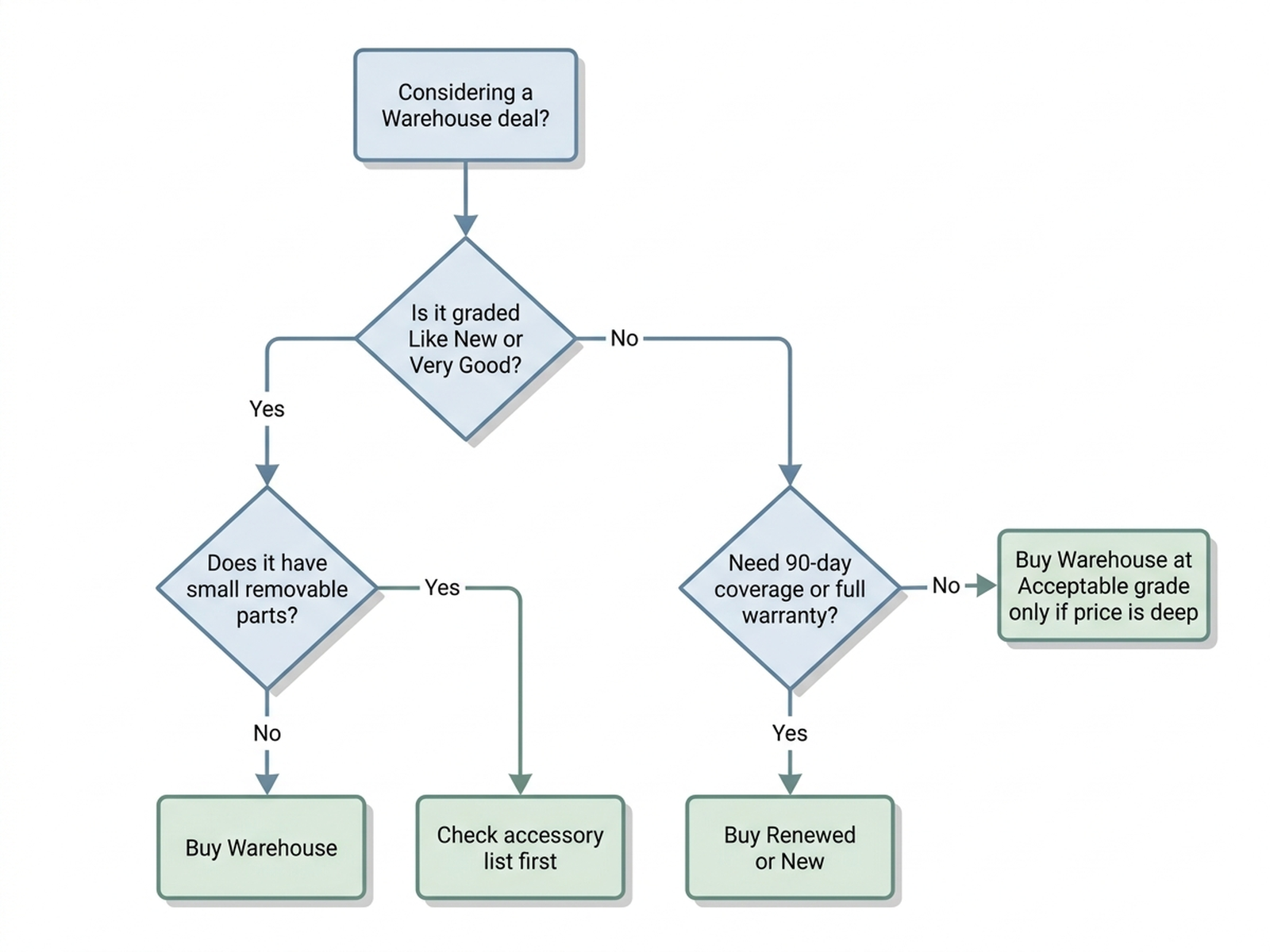
- Buying electronics or appliances graded “Like New” or “Very Good,” with no small bundled parts: Warehouse is usually the better value than paying full price, given the 30-day window and stated inspection process.
- Buying anything with lots of small accessories (a coffee machine with a portafilter and multiple baskets, a game console with a controller and cables): read the listing’s accessory list line by line before buying at any Warehouse grade below “Like New” — this is where the missing-parts complaints concentrate.
- Buying a battery-dependent device below “Like New”: factor in that the battery may be tested down to 80% of original capacity, which is a real but modest difference in runtime, not a defect.
- Wanting more than a 30-day safety net, or buying for a gift: Amazon Renewed’s 90-day window or a new purchase is the better fit, since Warehouse’s return window is the same as buying new despite the item itself being used.
- Buying a graded-”Acceptable” item: only makes sense at the deepest end of the discount range, and only for something where cosmetic wear genuinely doesn’t matter — a garage tool, a backup charger, anything that won’t be looked at, only used.
Limitations
This analysis relies on Amazon’s own published grading definitions and stated inspection process, third-party e-commerce industry reporting on discount ranges and satisfaction figures, and aggregated public forum sentiment, rather than a hands-on test of specific Warehouse listings. Amazon’s stated 20-point inspection process and 80% battery-capacity threshold are manufacturer claims that have not been independently audited for this article. Discount percentages, inventory mix, and complaint frequency vary by category, by individual warehouse location, and by day, since Warehouse inventory turns over based on what customers happen to return — the ranges cited here are directional, not a guarantee for any specific listing. Buyer and seller forum sentiment is not a scientifically sampled data set and may skew toward shoppers who had a problem worth posting about.
Bottom Line
Amazon Warehouse isn’t a single quality tier — it’s a spectrum from “practically new, just missing the box” to “functional but visibly worn,” and the discount headline alone doesn’t tell a shopper which end of that spectrum a specific listing sits on. The condition grade and the accessory list in the listing description do that job, and they’re worth reading in full before checkout, especially on anything with small bundled parts. For a straightforward, single-piece item graded “Like New” or “Very Good,” Warehouse is frequently a better deal than paying full price for new. For anything with a lot of small parts, a shorter 30-day return window that matters more than usual, or genuine warranty needs, Amazon Renewed or a new purchase is the more predictable choice.
Before you buy — new, Renewed, or Warehouse — paste the product link into Arekore: our AI assistant checks review authenticity, surfaces what the one-star reviews actually complain about, and compares prices, free, in about five minutes.