Amazon vs. Walmart vs. Target in 2026: Where to Buy Online for the Lowest Real Price

You found the thing you want. Now the only question left is where to click “buy.” For most American shoppers that means Amazon, Walmart, or Target, and most people default to whichever app is already on their phone. That habit can quietly cost money. The same item often carries a different sticker price at each retailer, and once you layer in membership shipping, card rewards, and sale timing, the “cheapest” listing is not always the cheapest purchase. This guide breaks down how the three biggest US general retailers actually price, reward, and ship, so you can tell at a glance which one wins for a given order.
This article is provided by Arekore, an AI shopping assistant. Paste a product URL and our AI checks review authenticity, digs into low-star feedback, and compares prices in about five minutes.
TL;DR / Quick Verdict
- Lowest list prices, most often: Amazon. Independent tracking has ranked it the lowest-priced major retailer for nine straight years. 🛒
- Closest challenger: Walmart, now averaging only a few percent above Amazon, and frequently cheaper on groceries and household staples.
- Best for loyal in-store-and-online shoppers: Target, whose 5%-off Circle Card is the simplest guaranteed discount of the three.
- The real lesson: there is no single cheapest store. The winner changes by category, by membership, and by sale week, so compare the real price (sticker minus rewards minus shipping) rather than the sticker. 💡
How We Reached These Conclusions (Methodology)
This is an editorial analysis, not a hands-on shopping test. This guide synthesizes three kinds of public information: (a) published price-tracking studies, most notably Profitero’s annual US online pricing study; (b) the three retailers’ official membership, rewards, and price-match policies as stated on their own help pages in June 2026; and (c) US market and e-commerce data from the Census Bureau, Statista, and industry coverage from CNBC, NerdWallet, and Kiplinger. Where we cite a retailer’s own figure, such as a membership price or rewards rate, we label it as a stated policy rather than an independently verified outcome. Prices and program terms change frequently; treat every number here as accurate at the time of writing.
The US Online Retail Market in 2026
The stakes are large because online spending is now a mainstream habit, not a niche one. US e-commerce sales reached a record of more than $1.2 trillion in 2025, according to Census Bureau data. Online spending also climbed to roughly 23% of all US retail for the year and topped 25% of retail in the fourth quarter for the first time (Digital Commerce 360), with quarterly online sales passing $365 billion in a single quarter for the first time in Q4 2025.
That spending is highly concentrated. Among US online retailers in 2025, Amazon held about 40.5% of e-commerce, far ahead of any rival (Statista). Walmart ranked second at about 9.2%, and Target sat under 2%. The gap is wide, but the trajectory matters: Walmart’s online sales have been growing faster than Amazon’s off a smaller base, and the company says it now reaches 95% of US households with delivery in under three hours. In other words, the three retailers are not interchangeable, and the competition between them is exactly what creates the price and rewards gaps you can exploit.
The Three Retailers at a Glance (2026)
Before the details, here is the high-level picture.
| Factor | Amazon | Walmart | Target |
|---|---|---|---|
| US online retail share | ~40.5% (1st) | ~9.2% (2nd) | ~1.9% |
| Paid membership | Prime, $14.99/mo or $139/yr | Walmart+, $12.95/mo or $98/yr | Target Circle (free); Circle 360, $99/yr |
| Free shipping | All eligible items with Prime | Free with Walmart+; otherwise $35+ order | Free with $35+ order or Circle Card |
| Store credit card perk | Prime Visa: 5% back at Amazon | Walmart card / OnePay rewards | Circle Card: 5% off in-store and online |
| Signature strength | Selection, speed, lowest list prices | Groceries, everyday low prices, stores | Owned brands, in-store pickup, design |
| Best-known sale | Prime Day (July, plus a summer event) | Walmart Deals | Target Circle Deal Days / Circle Week |
The headline pattern: Amazon competes on selection and raw price, Walmart on groceries and value, and Target on a clean, guaranteed loyalty discount. The rest of this guide turns those tendencies into concrete numbers.
Rewards and Membership: Where the Real Difference Hides
The sticker price is only the start. What you actually pay depends on shipping, membership fees, and card rewards. This is the single biggest reason two shoppers can pay different real prices for the identical item.
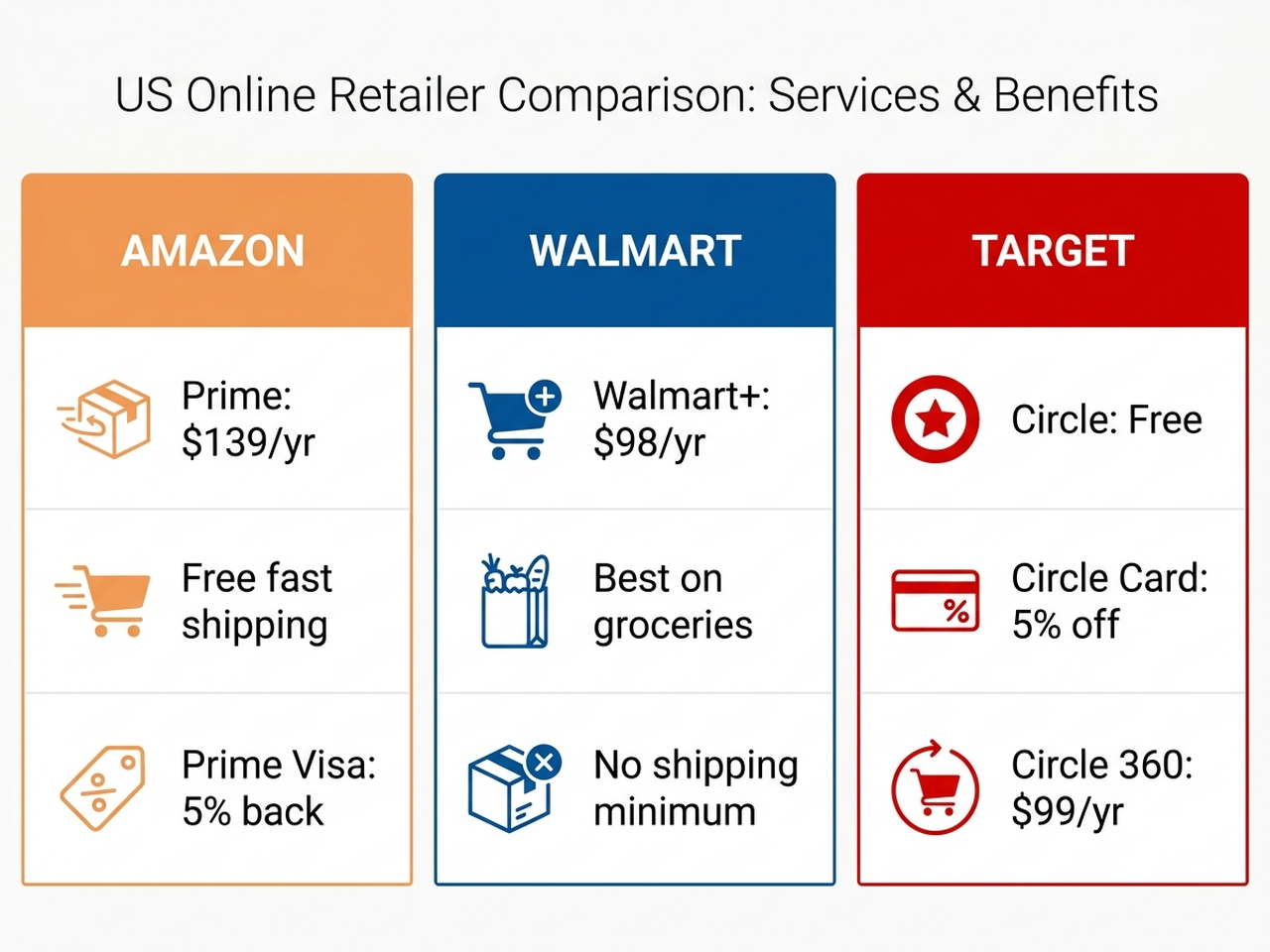
Amazon: speed and a strong store card, modest everyday rewards
Amazon’s value is built on logistics, not points. The core levers are:
- Prime membership: $14.99/month or $139/year, which unlocks free fast shipping, Prime Video, and member-only deals. Discounted tiers exist: Prime for Young Adults at $7.49/month or $69/year, and Prime Access at $6.99/month for qualifying government-assistance recipients.
- Prime Visa: for Prime members, this no-annual-fee card earns an unlimited 5% back at Amazon, Amazon Fresh, Whole Foods, and on Chase Travel (a card-issuer rewards rate, not a discount Amazon applies at checkout).
- Lowest list prices: Amazon’s biggest “reward” is simply that it tends to start lower. Profitero’s 2025 study found Amazon held roughly a 14% average price advantage over competitors.
If you do not have the Prime Visa, Amazon’s everyday rewards are thin. Its edge is the combination of a low starting price and shipping you have likely already paid for through Prime.
Walmart: cheapest membership, strongest on groceries
Walmart’s pitch is value plus a lower-cost membership.
- Walmart+: $12.95/month or $98/year, which is $41 a year cheaper than Prime. It includes free shipping with no order minimum, free grocery delivery, member fuel discounts, and a Paramount+ subscription. A reduced Walmart+ Assist tier runs $6.47/month or $49/year for government-assistance recipients.
- Everyday grocery pricing: the Profitero study found that food and beverage was the only category where Walmart (and Target) beat Amazon on price. If your cart is mostly pantry, household, and fresh items, Walmart is frequently the real-price winner.
- Closing the gap: Walmart narrowed its average price difference versus Amazon to about 4% in 2025, down from 5% the year before, and matched or beat Amazon in categories like video games and pet supplies.
For weekly essentials and grocery-heavy orders, Walmart’s lower membership and competitive everyday prices add up.
Target: the simplest guaranteed discount
Target’s rewards are the easiest to understand because they are an upfront discount, not points to redeem later.
- Target Circle: free to join, with member pricing, personalized deals, and earnings you can apply to future trips.
- Target Circle Card (the renamed RedCard): 5% off almost every purchase, in-store and online, plus free shipping on many items and an extended return window. That 5% is taken at checkout, so there is nothing to redeem.
- Target Circle 360: a paid membership at $99/year (often discounted for cardholders) that adds unlimited same-day delivery on eligible orders.
One caveat: Target’s list prices tend to run higher to begin with. Profitero found Target averaging about 13% above Amazon. The 5% Circle Card discount narrows that gap but rarely erases it outside of Target’s own sales and owned brands.
Putting It Together: Compare the Real Price, Not the Sticker
The practical skill is converting a sticker price into a real price: list price, minus card rewards, minus shipping, adjusted for any membership fee you are already paying. The examples below are illustrative scenarios, not live quotes, to show how the math can flip the ranking.
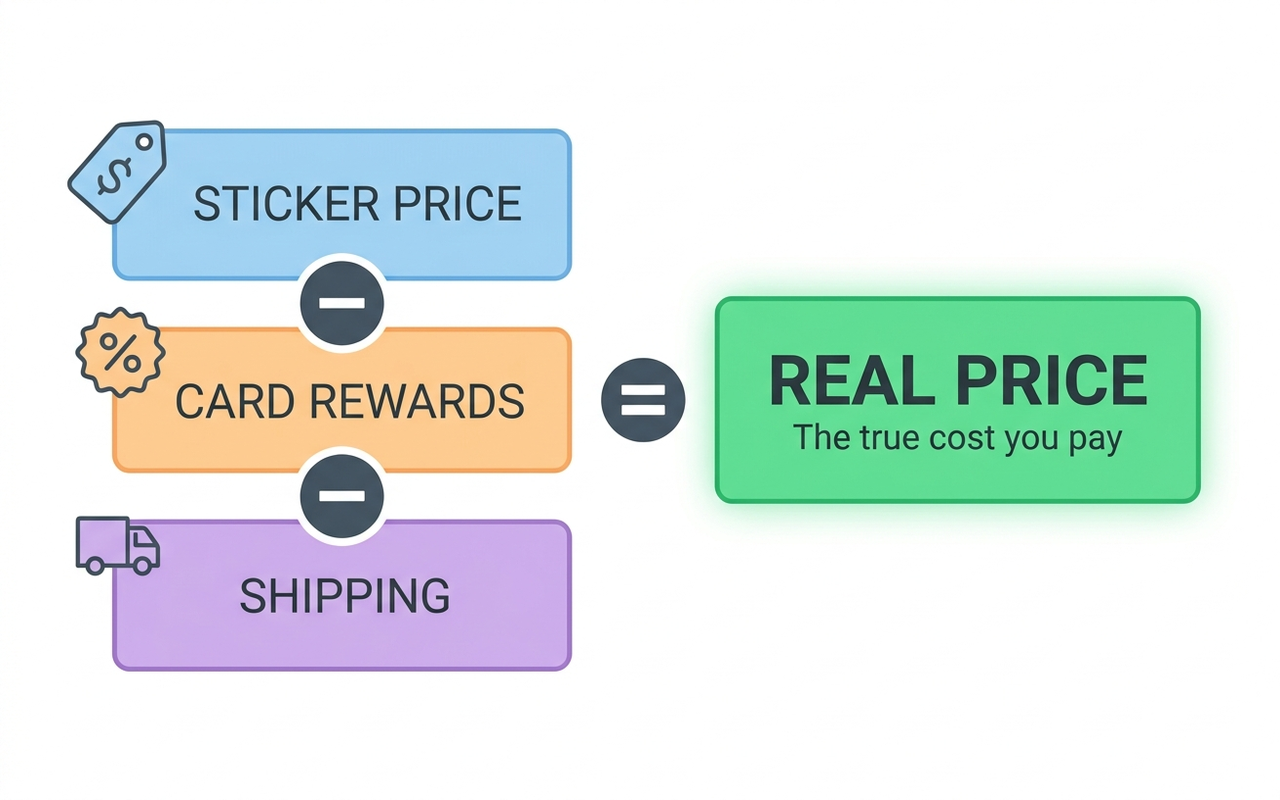
Example 1: a $120 pair of headphones
| Line item | Amazon | Walmart | Target |
|---|---|---|---|
| Sticker price | $118 | $124 | $129 |
| Shipping | Free (Prime) | Free (Walmart+) | Free ($35+ order) |
| Card reward / discount | −$5.90 (5% Prime Visa) | — | −$6.45 (5% Circle Card) |
| Real price | $112.10 | $124.00 | $122.55 |
Amazon’s lower start plus the Prime Visa wins here, but a Target Circle Card shopper still beats Walmart despite Target’s higher sticker.
Example 2: a $90 grocery and household haul
| Line item | Amazon | Walmart | Target |
|---|---|---|---|
| Sticker price | $93 | $86 | $91 |
| Shipping | Free (Prime) | Free (Walmart+) | Free ($35+ order) |
| Card reward / discount | −$4.65 (5% Prime Visa) | — | −$4.55 (5% Circle Card) |
| Real price | $88.35 | $86.00 | $86.45 |
Groceries are Walmart’s home turf. Even without a rewards card, its lower starting prices keep it competitive against Amazon’s and Target’s card discounts.
Example 3: a single $22 item, no membership
| Line item | Amazon | Walmart | Target |
|---|---|---|---|
| Sticker price | $22 | $23 | $24 |
| Shipping | Free (Prime) or add-on | $6.99 (under $35) | $5.99 (under $35) |
| Real price | $22.00 | $29.99 | $29.99 |
For small, one-off purchases, Amazon Prime’s no-minimum free shipping is the decisive factor. At Walmart and Target, a sub-$35 order can nearly double in cost once shipping is added unless you have their membership or hit the order minimum.
The takeaway: the cheapest sticker and the cheapest checkout are often different stores, and the answer depends on your cart size and which membership you already hold.
The 2026 Sale Calendar: When You Buy Matters as Much as Where
Timing can move prices more than the choice of retailer. The three big players now deliberately overlap their summer events, which is good for shoppers.
| Event | 2026 dates | Who gets it | Best for |
|---|---|---|---|
| Amazon Prime Day | June 23–26 | Prime members | Tech, Amazon devices, small appliances |
| Walmart Deals | June 22–28 | Everyone (extra early access for Walmart+) | Groceries, home, electronics |
| Target Circle Deal Days | June 23–26 | Circle members (free) | Apparel, beauty, home, toys |
| Black Friday / Cyber Monday | Late November | Everyone | Year’s broadest discounts |
| Holiday sales | December | Everyone | Last-minute gifts, electronics |
Two practical rules follow. First, the summer events run head-to-head, so for a planned purchase in late June you can genuinely cross-shop all three within the same week. Second, the deepest discounts of the year still cluster around Black Friday and Cyber Monday for most categories. If a purchase can wait, those windows usually beat a random Tuesday.
The Reality of Price Matching in 2026
A few years ago, you could often buy at one store and have it match a competitor’s lower price. That era is largely over.
- Amazon: no formal price-match policy. It discontinued price matching in 2016 and instead adjusts prices dynamically and frequently.
- Walmart: as of 2026, Walmart matches only its own prices, specifically, an in-store purchase matched to a lower Walmart.com price for the identical item. It does not match Amazon, Target, or other competitors.
- Target: after a July 28, 2025 policy change, Target matches only within its own ecosystem (Target.com, the Target app, in-store, and Circle deals). It no longer matches Amazon or Walmart.
The lesson is blunt: you cannot rely on a retailer to find you the lowest price anymore. Comparison shopping before you check out is now the only reliable way to capture the best deal, which is exactly the gap that automated tools exist to fill.
So Where Should You Buy? A Shopper-Type Guide
There is no universal answer, but your habits point to a default.
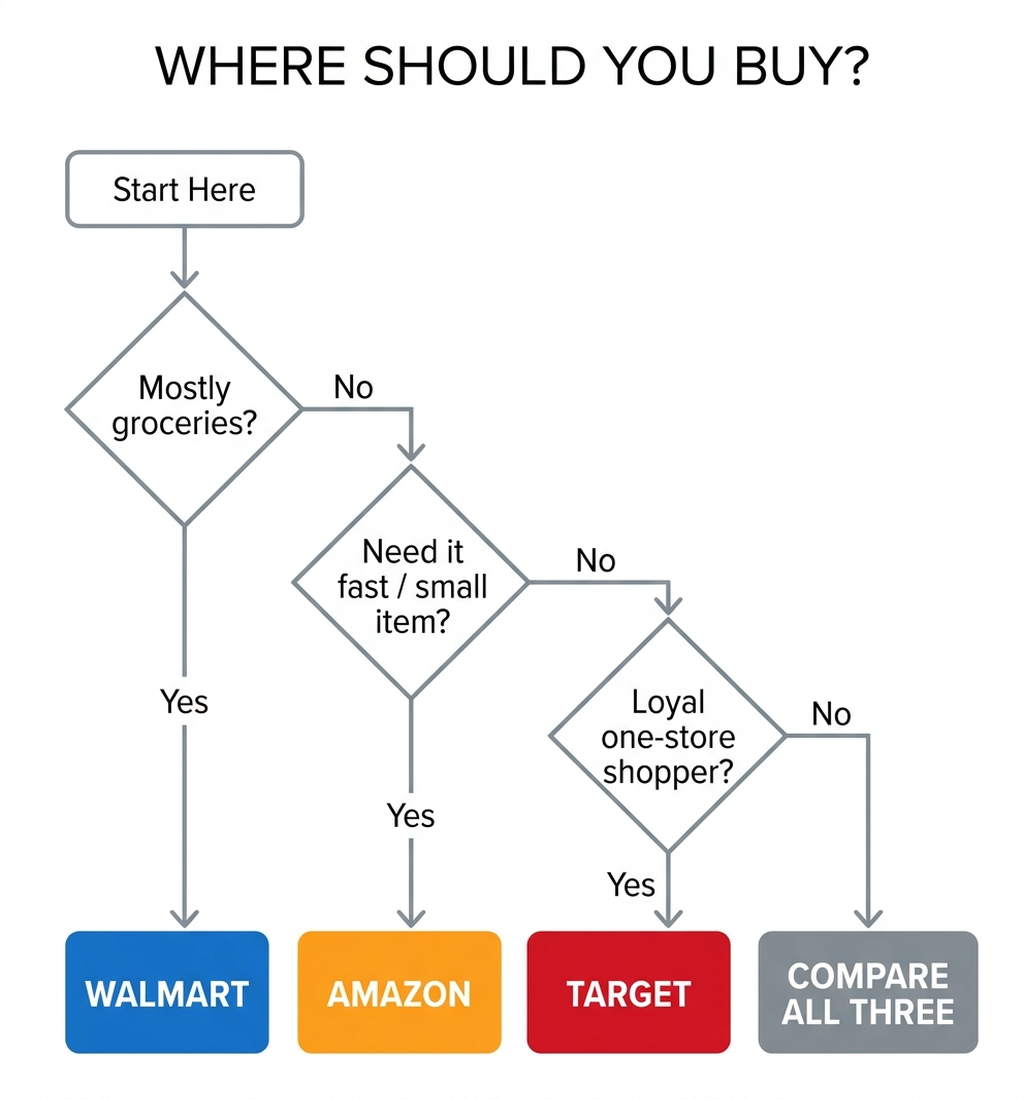
| Your situation | Best default | Why |
|---|---|---|
| You want the widest selection and fastest shipping | Amazon | Largest catalog, no-minimum Prime shipping, usually the lowest sticker |
| Your cart is mostly groceries and household staples | Walmart | Cheapest membership and the one category where it beats Amazon on price |
| You shop one store loyally, in person and online | Target | The 5% Circle Card discount is a simple, guaranteed saving |
| You buy small, single items often | Amazon | No order minimum for Prime free shipping |
| You want the absolute lowest price on a big purchase | Compare all three | The winner shifts by category and sale week |
| You are not a member anywhere | Whoever clears the $35 free-shipping minimum | Shipping fees can outweigh small sticker differences |
For most households, the honest answer is “it depends on the order.” Memberships make one store cheaper for some carts and not others, which is why a quick per-purchase check beats blind loyalty.
How to Automate the Comparison
Realistically, checking three sites, applying each rewards rate, and accounting for shipping on every purchase is tedious. Most people skip it and just buy out of habit, which is how the small overpayments add up over a year.
This is the kind of repetitive comparison that automation handles well. With Arekore, you paste a product name or URL and the AI compares prices across retailers, factors in the real cost rather than the sticker, and flags whether reviews look trustworthy, so “cheap but questionable quality” stops being a gamble.
Want to know the real lowest price on something you are eyeing? Check it with Arekore. A multi-retailer comparison takes about five minutes.
Limitations
This analysis relies on published price studies, retailer-stated policies, and public market data, not on real-time scraping of live prices. Sticker prices, membership fees, rewards rates, sale dates, and price-match rules change frequently and can vary by item, region, and promotion. The worked examples are illustrative scenarios chosen to show how real-price math works, not live quotes for specific products. Always confirm the current price, shipping cost, and applicable rewards on each retailer’s own page before you buy. Card rewards described here are issued by the card networks and banks, not the retailers, and depend on approval and individual terms.
Sources
- Largest online retailers in the U.S. 2025 — Statista
- Quarterly retail e-commerce sales — U.S. Census Bureau
- Ecommerce accounts for 25% of total retail sales for first time in Q4 2025 — Digital Commerce 360
- Amazon retains lead in lowest online prices as Walmart narrows the gap — Profitero
- Amazon Prime vs. Walmart+: costs, perks, credit card offerings — CNBC Select
- What to know about Target Circle and Target Circle 360 — NerdWallet
- Prime Visa card benefits: 5% back for Amazon Prime members — Clark.com
- Walmart, Target counterprogram Prime Day with their own sales — Retail Dive
- Walmart price match policy 2026 — DontPayFull
- Target ends longtime price-matching policy: what to know — ABC News