Amazon Return Policy 2026: What Actually Changed

The return process hasn’t visibly changed for most shoppers — same app, same “Return or Replace Items” button. But underneath it, 2026 brought the most substantial rewrite of Amazon’s return system in years: a mandatory prepaid-label program for third-party sellers, a shorter inspection window before refunds trigger automatically, and a new warning system that flags shoppers whose return rate looks high compared to their purchase history. None of it was announced with a press splash. Most of it surfaced first in seller forums and only later in mainstream coverage.
This article is provided by Arekore, an AI shopping assistant. Paste a product URL and our AI checks review authenticity, digs into low-star feedback, and compares prices in about five minutes.
TL;DR / Quick Verdict
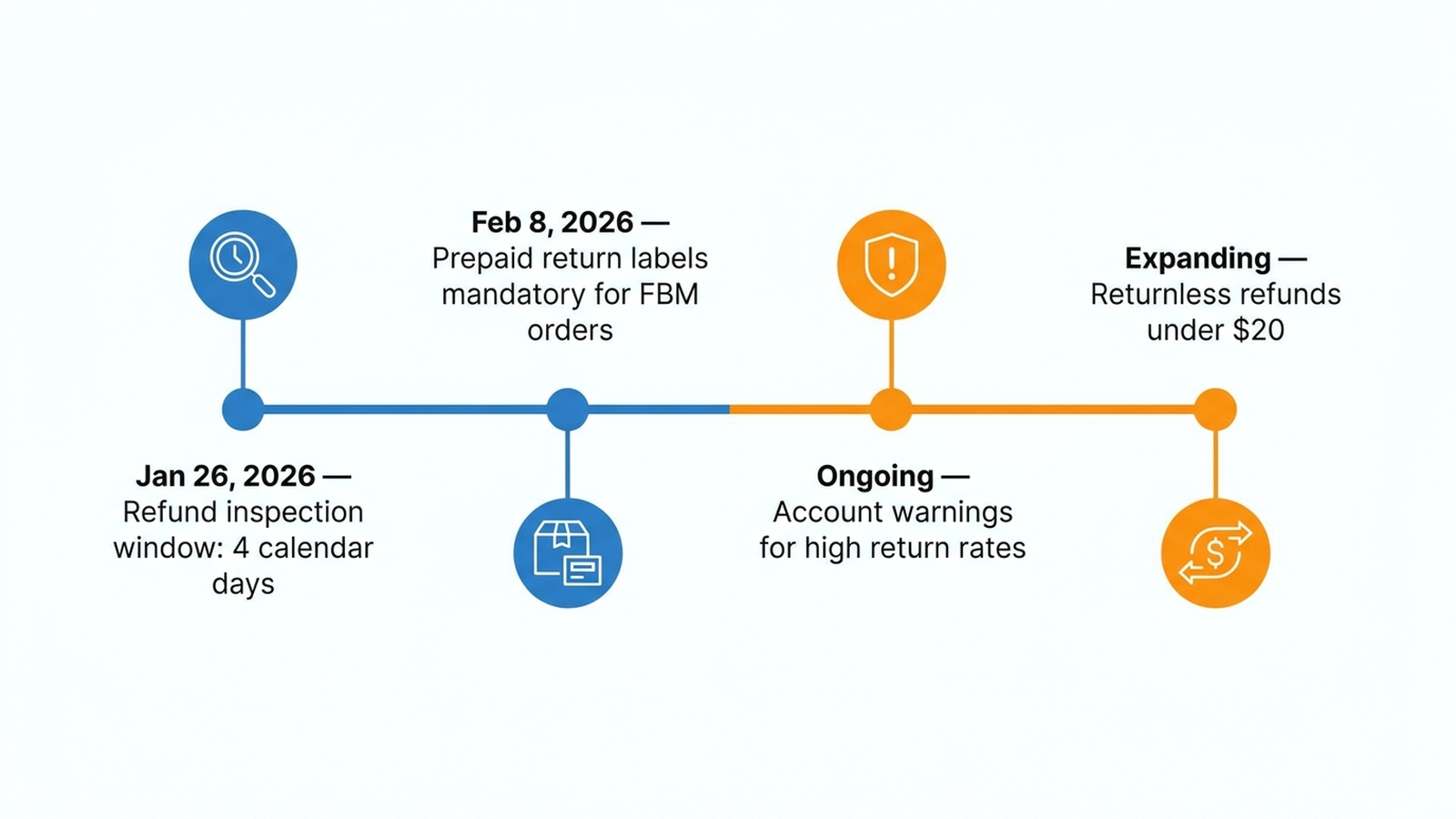
- Prepaid return labels are now mandatory for nearly all seller-fulfilled (FBM) orders, effective February 8, 2026 — the previous “High-Value Return Exemption,” which let sellers skip covering return shipping on expensive items, was eliminated.
- Sellers get less time to inspect a return before a refund fires automatically: the window moved from 2 business days to 4 calendar days as of January 26, 2026 — actually a modest extension in raw days, but now counted on weekends too.
- Restocking fees can run up to 20% on non-defective returns and up to 50% on items returned used or damaged, a structure sellers have always had access to but are enforcing more visibly in 2026.
- Amazon is now warning individual customer accounts when their return, cancellation, or refund pattern looks high relative to total purchases — a new behavior-flagging layer that didn’t exist in this form before 2026.
- Returnless refunds are expanding for items under roughly $20–25: for cheap or bulky items, Amazon increasingly refunds without asking for the item back at all.
- The 2025 holiday return window still applies through January 31, 2026 for most items purchased between November 1 and December 31, 2025 — Apple products are the notable exception, cut off January 15, 2026.
How We Reached These Conclusions (Methodology)
This is an editorial analysis, not a hands-on test of every return scenario described. It synthesizes: (a) Amazon’s own published Help pages and seller-forum announcements on the Prepaid Return Label program, refund-timing rules, and restocking-fee policy; (b) About Amazon’s own published holiday-return-window page, and third-party tech-news coverage of the account-warning system (Komando.com, Storyboard18, and similar outlets tracking the rollout); (c) e-commerce operations coverage from Jarvio, ALFI, Titan Network, and LitCommerce documenting the exact effective dates of the seller-side changes; (d) the National Retail Federation and Happy Returns’ 2025–2026 Retail Returns Landscape report for return-rate and dollar-value statistics; and (e) aggregated customer and seller sentiment from public forum threads (Amazon seller forums, Reddit’s r/amazon) discussing the practical effects of these changes, sampled in August 2026. We did not personally trigger an account warning or file a high-value return to test the new system. Figures are attributed to their source; policy effective dates reflect the public record at time of writing and Amazon can revise them without a formal announcement.
What Actually Changed, Rule by Rule
Prepaid labels are no longer optional for sellers
Before February 2026, sellers fulfilling their own orders (FBM, not Fulfilled by Amazon) could invoke a “High-Value Return Exemption” and decline to provide a prepaid shipping label on expensive items, instead asking the buyer to arrange and sometimes front the cost of return shipping. That exemption is gone. Every FBM order placed in the US now qualifies for an Amazon-generated prepaid label, with the cost to the seller running roughly $3–$8 depending on package weight and shipping distance. For shoppers, the practical effect is straightforward: if a seller is stalling on providing a label, that’s now a policy violation, not a gray area.
The refund clock changed — and picked up a new $1 line item
Sellers previously had 2 business days to inspect a returned item before Amazon auto-issued the refund if they didn’t act. As of January 26, 2026, that window moved to 4 calendar days — which sounds longer, but because it counts weekends, it doesn’t meaningfully extend a seller’s inspection time in most cases. Separately, Amazon introduced a $1 fee for customers who drop off a return at a UPS location when a closer free drop-off option (Whole Foods, Kohl’s, Amazon Locker) was available — a small nudge toward its preferred no-cost return network rather than a broad new cost.
Restocking fees exist, and they’re being enforced more visibly
Amazon’s Marketplace policy has long allowed sellers to charge a restocking fee on returns that aren’t the seller’s fault — up to 20% for a non-defective item returned in resalable condition, and up to 50% if it comes back used, damaged, or missing parts. What changed in 2026 isn’t the cap itself but visibility: more sellers are applying it by default rather than case-by-case, and shoppers who buy an item, use it once, and return it are more likely to see a fee actually deducted from the refund than in prior years.
Amazon is now watching your return rate, not just each individual return
This is the change with the most direct consumer impact. Amazon has begun surfacing in-app warnings to a subset of customers whose returns, cancellations after shipping, or refund requests look disproportionately high relative to their total order volume — even when every individual return technically complies with the stated return window and condition rules. According to reporting reviewed for this analysis, continued high-return behavior after a warning can lead to reduced return privileges or, in escalated cases, a full account block, which cuts off active orders, gift card balances, Amazon Pay funds, and linked services like Prime. This is a pattern-level review, not a per-return rule, which means a shopper who has never violated an individual return policy can still receive a warning if their aggregate ratio triggers the algorithm.
Returnless refunds are quietly expanding
For inexpensive items — Amazon’s public commentary and third-party trackers point to roughly the $20–$25 threshold — the platform is increasingly issuing a refund without asking for the product back at all, particularly for damaged, bulky, or low-margin categories like personal care items and small houseware. This isn’t guaranteed or selectable by the customer; it’s triggered by Amazon’s internal cost-benefit modeling, which weighs the cost of return shipping and restocking against the item’s resale value.
Holiday returns still run on the extended calendar
Most items bought between November 1 and December 31, 2025, remain returnable through January 31, 2026, under the standard extended holiday window Amazon has offered in some form for several years. Apple-brand products are the standing exception, with a shorter cutoff of January 15, 2026 — a detail worth checking specifically if a holiday gift was an iPhone, iPad, AirPods, or Apple Watch.
What Sellers and Shoppers Are Saying
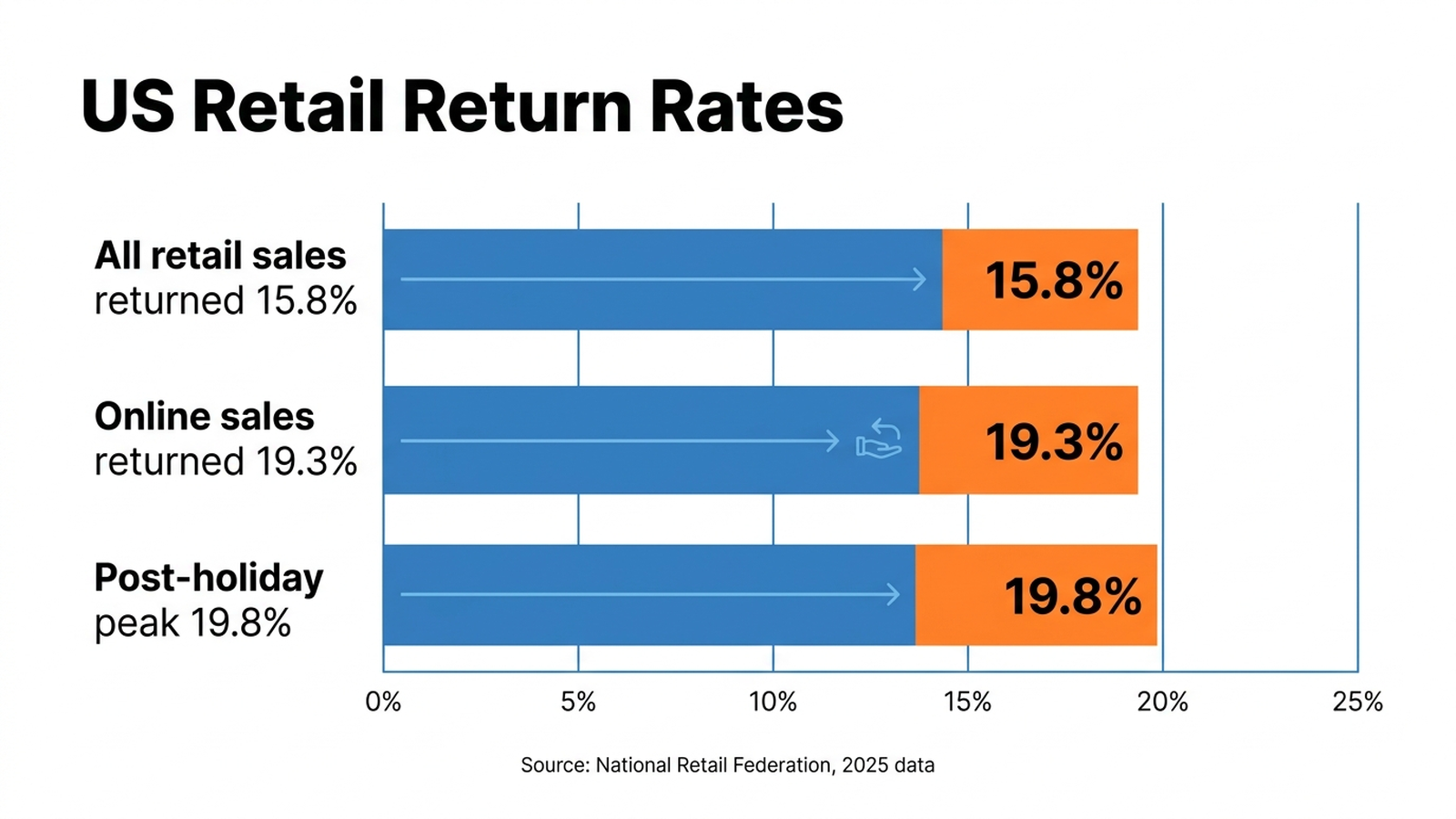
Seller-forum threads on r/AmazonSeller and Amazon’s own Seller Central discussion boards, reviewed for this analysis, converge on frustration with the removed high-value exemption specifically — sellers of electronics and appliances describe the mandatory prepaid label as absorbing margin on categories where return rates already run higher than average. On the shopper side, discussion on r/amazon centers overwhelmingly on the account-warning system: threads describe confusion at receiving a warning while still inside the standard 30-day return window on every flagged order, since the policy is explicitly about aggregate pattern, not any single transaction. The National Retail Federation and Happy Returns’ 2025–2026 Retail Returns Landscape report puts the scale of the underlying problem in context: retailers expected roughly $850 billion in returned merchandise in 2025, with online sales returned at a 19.3% rate versus 15.8% for retail overall, and a post-holiday six-week peak return rate of 19.8%. That volume is the direct commercial pressure behind both the account-warning system and the more consistently enforced restocking fees.
What This Means for You, by Situation
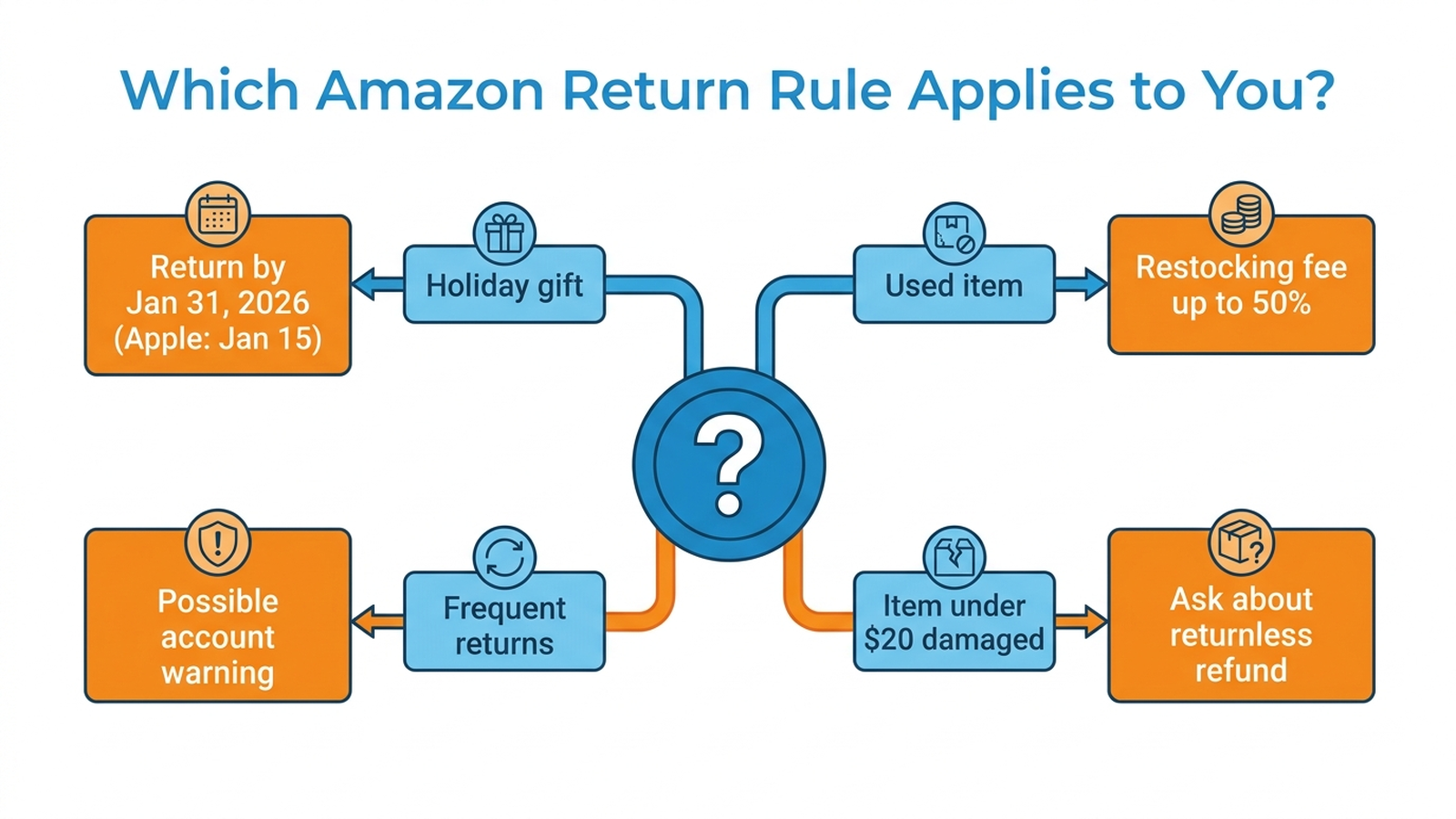
- Holiday gift returns: confirm the item falls in the November 1–December 31, 2025 purchase window and return by January 31, 2026 — January 15 if it’s an Apple product.
- Buying something you might return: keep original packaging and avoid using an item beyond what’s needed to test it, since a used or damaged condition is what triggers the higher end of the restocking-fee range (up to 50%, versus up to 20% for resalable condition).
- Returning often across many different orders: a pattern of frequent returns can trigger an account warning even if each individual return is within policy — the fix, per Amazon’s own guidance, is shopping more deliberately (reading full specs and reviews before ordering) rather than assuming each return is evaluated in isolation.
- A cheap item arrives damaged: it’s worth contacting customer service directly rather than starting a standard return — for items under roughly $20–$25, Amazon increasingly issues a refund and lets the customer keep or discard the item rather than processing a return shipment.
- A seller won’t provide a return label on an expensive item: that’s no longer a gray area for FBM orders placed after February 8, 2026 — the high-value exemption sellers used to invoke has been removed, and a prepaid label should be available.
Comparison Table: Before vs. After
| Rule | Before 2026 | As of 2026 |
|---|---|---|
| Prepaid label for FBM high-value items | Sellers could claim “High-Value Exemption” and skip it | Mandatory for nearly all FBM orders (effective Feb 8, 2026) |
| Seller inspection window before auto-refund | 2 business days | 4 calendar days (effective Jan 26, 2026) |
| Restocking fee cap | Up to 20% (non-defective) / 50% (used/damaged) | Same caps, more consistently applied |
| Account-level return monitoring | Individual-return policy checks only | Pattern-level warnings for high aggregate return rate |
| Returnless refunds | Case-by-case, mostly high-cost-to-ship items | Expanding to most items under ~$20–$25 |
| UPS drop-off fee | None | $1 if a closer free option was available |
| Holiday return window | Varies by year | Nov 1–Dec 31, 2025 purchases returnable to Jan 31, 2026 (Apple: Jan 15) |
Limitations
This analysis relies on Amazon’s published Help pages, seller-forum announcements, third-party e-commerce operations reporting, mainstream news coverage, and aggregated public forum sentiment, rather than a hands-on test of triggering an account warning, filing a high-value FBM return, or receiving a returnless refund. Amazon’s return policy is not uniform across every product category, seller type, and marketplace, and it can change or be enforced inconsistently without a public announcement — the effective dates and thresholds cited here (the 4-calendar-day window, the roughly $20–$25 returnless-refund threshold, the 20%/50% restocking-fee caps) reflect the public record as of August 2026 and may not match what an individual account or order sees. Return-rate statistics are aggregated across all US retail and e-commerce, not Amazon-specific figures, since Amazon does not publish its own return-rate data publicly.
Bottom Line
None of Amazon’s 2026 return changes amount to a single dramatic policy shift — they’re a set of smaller adjustments that together tighten the system around a return volume the industry now measures in the hundreds of billions of dollars. For most shoppers who buy something, occasionally return it in original condition, and don’t cancel orders after they’ve shipped, little changes in practice. The two rules worth actually keeping in mind are the account-level pattern warning, which can trigger even when every individual return is compliant, and the shrinking exemption list for high-value sellers, which should make prepaid labels the default rather than something to negotiate for.
Before you buy, paste the product link into Arekore — our AI assistant checks review authenticity, surfaces what the one-star reviews actually complain about, and compares prices, free, in about five minutes.