Best Air Purifiers for Fall Allergies in 2026
TL;DR
Ragweed pollen affects an estimated 50 million Americans each fall, and 2026’s season is running long — peaking in September and stretching into October in much of the country. For most bedrooms, the Coway Airmega AP-1512HH Mighty is the safest recommendation: it has been Wirecutter’s top allergy pick for roughly a decade, carries independently verified AHAM CADR ratings, and holds up well over years of daily use according to aggregated reviews. Anyone furnishing a small room on a tight budget should look at the Levoit Core 300S, which delivers respectable CADR numbers for about half the price. Households dealing with pet odor or cooking smells on top of allergens should consider the Winix 5510, whose PlasmaWave ionizer and pelletized carbon filter are reported to outperform the other two on odor control, in a unit that covers more square footage.
Methodology
This analysis synthesizes (a) aggregated Amazon US customer reviews for the Coway Airmega AP-1512HH, Levoit Core 300S, and Winix 5510, sampled in September 2026 — Amazon does not expose a fixed review count per product, so we cannot report a precise N, but each listing had several thousand ratings visible at the time of sampling — (b) AHAM VERIFIDE Clean Air Delivery Rate (CADR) certification data published by each manufacturer, (c) independent testing and comparative reviews referenced by RTINGS, Wirecutter (NYT), and HouseFresh, and (d) allergy-season data from the Asthma and Allergy Foundation of America (AAFA) and market data on the air purifier category. We did not personally test the products covered here.
Technical Approach: Three Different Filtration Strategies
All three units use a HEPA-class filter as their core, but they differ meaningfully in filtration stages, coverage, and how they handle odor — not just in CADR numbers.
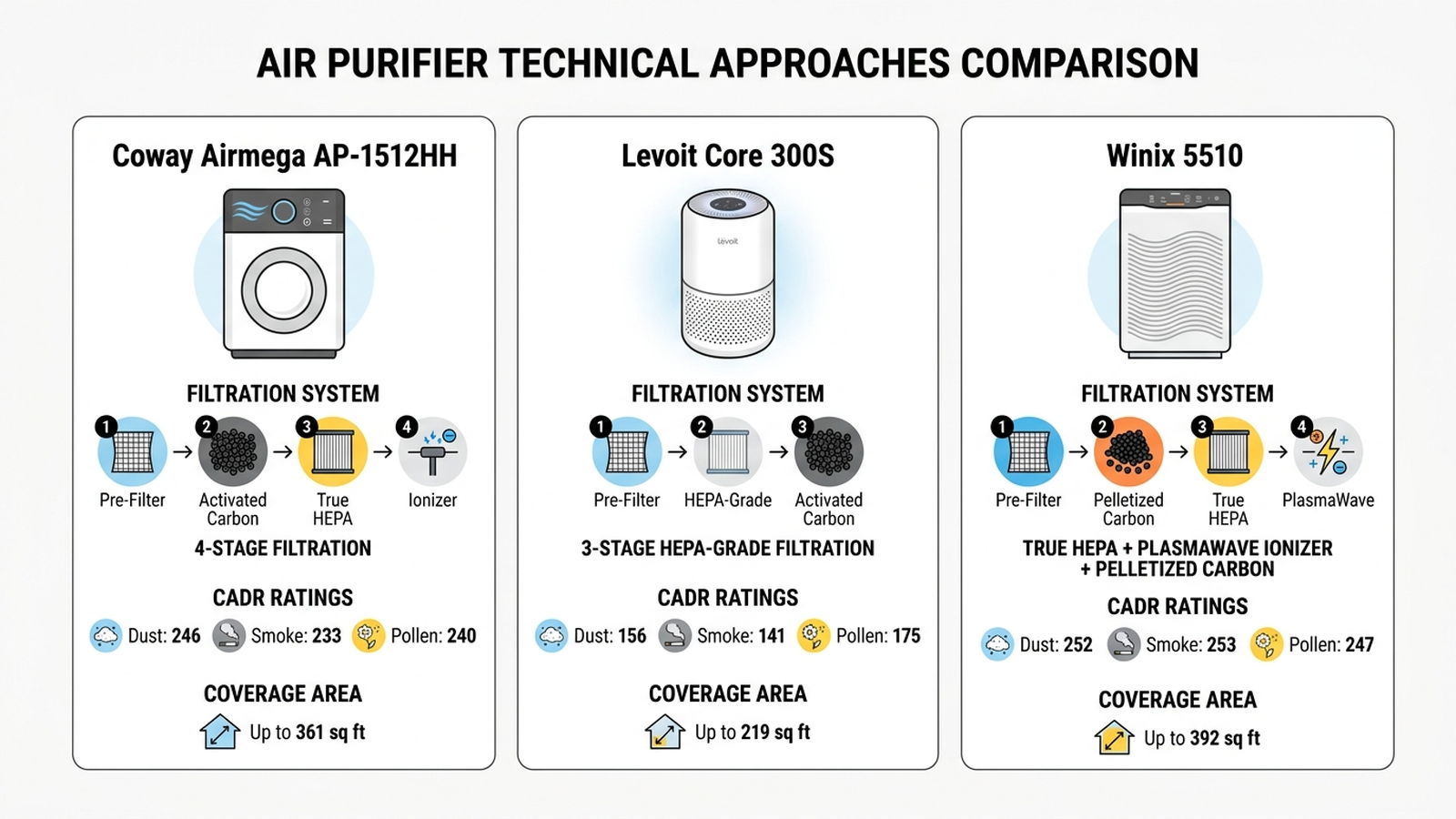
- Coway Airmega AP-1512HH (4-stage True HEPA + activated carbon): A pre-filter, deodorization filter, True HEPA filter, and vital ion filter run in sequence. Its AHAM-certified CADR is 246 (dust), 233 (smoke), and 240 (pollen), rated for rooms up to about 361 sq ft at the AHAM-standard air-change rate — smaller than the manufacturer’s separately advertised “up to 1,748 sq ft” figure, which describes a single air change in one hour rather than the more relevant 4–5 changes per hour AHAM uses for CADR.
- Levoit Core 300S (3-stage filtration): A pre-filter, H13-grade filter, and activated carbon filter. Levoit has stopped labeling this filter “True HEPA” on current listings, instead describing “HEPA-grade” 3-in-1 filtration. Independent testing credits it with CADR of 156 (dust), 141 (smoke), and 175 (pollen), rated for rooms up to roughly 219 sq ft.
- Winix 5510 (True HEPA + PlasmaWave + pelletized carbon): Adds an ionizing PlasmaWave stage on top of a True HEPA filter and a pelletized (rather than sheet) activated carbon filter, which independent reviewers report handles pet and cooking odors better than the sheet-carbon designs in the other two units. CADR is reported at 252 (dust), 253 (smoke), and 247 (pollen), for rooms up to about 392 sq ft.
Manufacturer Details
Coway positions the Airmega AP-1512HH (“Mighty”) as its long-running entry model, with a real-time air quality indicator that changes color, an Eco mode that powers down the fan when air is already clean, and energy use as low as 4.9 watts in that mode. Coway backs the unit with a 3-year warranty, longer than either competitor here — a detail independent reviewers connect to its multi-year reputation for mechanical reliability rather than just filtration performance.
Levoit markets the Core 300S around smart-home integration: Wi-Fi control, Alexa compatibility, and an app that reports real-time PM2.5 readings. The company backs it with a 2-year warranty. Levoit’s own current listing avoids the term “True HEPA,” a change from earlier Core 300 marketing, and instead describes the filter as capturing “up to 99.97%” of particles at 0.3 microns — the same threshold True HEPA certification uses, without the manufacturer applying that specific label to this model’s filter on the current listing.
Winix frames the 5510 as the direct successor to its long-selling 5500-2 (which the company has confirmed is being discontinued in the US), adding smartphone app support while keeping the same core filtration approach. Winix states the PlasmaWave ionizer can be switched off independently of the fan, for households concerned about ionizer byproducts, and backs the unit with a 2-year warranty.
Customer Sentiment Synthesis
Aggregated Amazon reviews and independent comparison sites converge on a few consistent patterns:
- Coway Airmega AP-1512HH: The dominant praise theme is longevity — reviewers frequently report the unit still running well after 3–5 years of near-continuous use, and several independent sources cite Reddit threads describing it as durable and effective against allergens and smoke. The most common complaint is weaker odor control compared to carbon-heavy designs, particularly for strong cooking smells or litter-box odor.
- Levoit Core 300S: Reviewers commonly praise the low price-to-performance ratio and the sleep mode’s low noise (reported around 24 dB), calling it a strong choice for a bedroom. The recurring complaint cluster is that its smaller CADR numbers make it a poor fit for anything larger than a single bedroom or home office, and some reviewers note the app’s Wi-Fi setup can be finicky on the first connection.
- Winix 5510: The standout praise theme is odor performance — reviewers and independent testers repeatedly describe it as noticeably better than Coway or Levoit at handling pet smells and cooking odors, which several attribute to the pelletized carbon filter. The dominant complaint is filter replacement cost, with reviewers estimating combined HEPA and carbon (Filter Q) replacements running roughly $80 a year, higher than either competitor.
Comparison Table
| Model | Price (as of 2026-09-05) | CADR (Dust/Smoke/Pollen) | AHAM Room Coverage | Noise (Low/Sleep) | Warranty |
|---|---|---|---|---|---|
| Coway Airmega AP-1512HH | $179.99 | 246 / 233 / 240 | ~361 sq ft | ~24.4 dB | 3 years |
| Levoit Core 300S | $109.99 | 156 / 141 / 175 | ~219 sq ft | ~24 dB | 2 years |
| Winix 5510 | $179.99 | 252 / 253 / 247 | ~392 sq ft | ~23.5 dB | 2 years |
Prices shown reflect typical Amazon.com listing prices as of the stated date; Amazon frequently runs lightning deals and seasonal discounts on these SKUs (all three have been seen $20–$30 below list during Prime Day and Black Friday sales), so the checkout price may differ. Room coverage figures use the AHAM CADR-based standard (roughly 4–5 air changes per hour), not the larger “square feet in one hour” figures some manufacturers advertise separately.
How to Use: Sizing and Running a Purifier for Allergy Season
Independent testers and allergy organizations agree that the biggest mistake buyers make isn’t choosing the wrong brand — it’s undersizing the unit for the room or running it on the wrong settings during peak pollen hours.
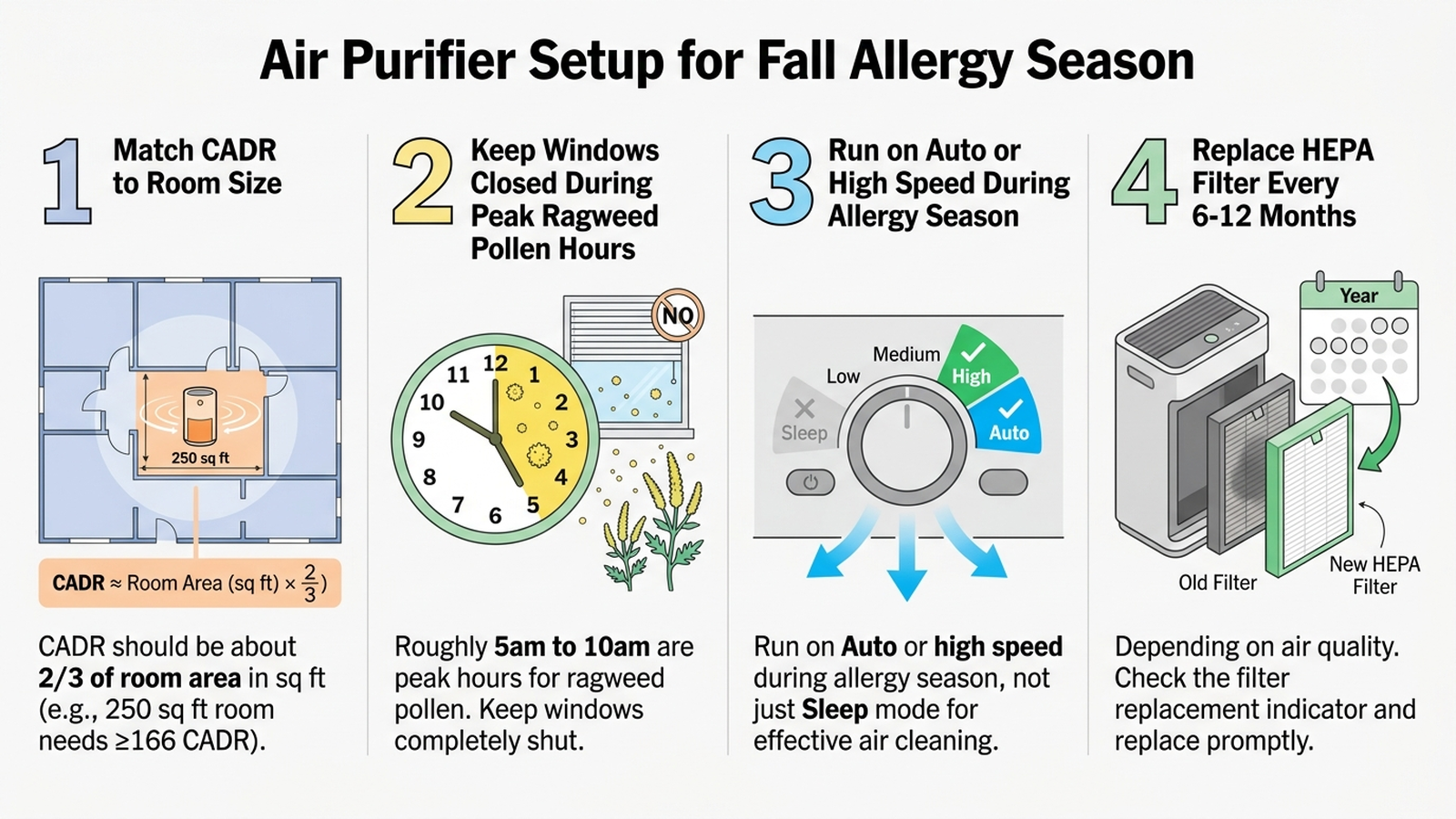
AAFA and pollen-forecasting sources note that ragweed pollen concentrations peak in the early morning, roughly 5 a.m. to 10 a.m., which is the highest-value window to keep windows closed and let the purifier run at a higher speed rather than Sleep mode. As a sizing rule of thumb, independent reviewers recommend a unit whose CADR rating is at least two-thirds of the room’s square footage — undersizing is the most common reason buyers report disappointing results despite a “HEPA” label on the box. HEPA filters should be replaced on the manufacturer’s stated schedule (commonly 6–12 months) regardless of whether airflow feels reduced, since particle capture can degrade before the fan noticeably slows.
Which One Should You Buy?
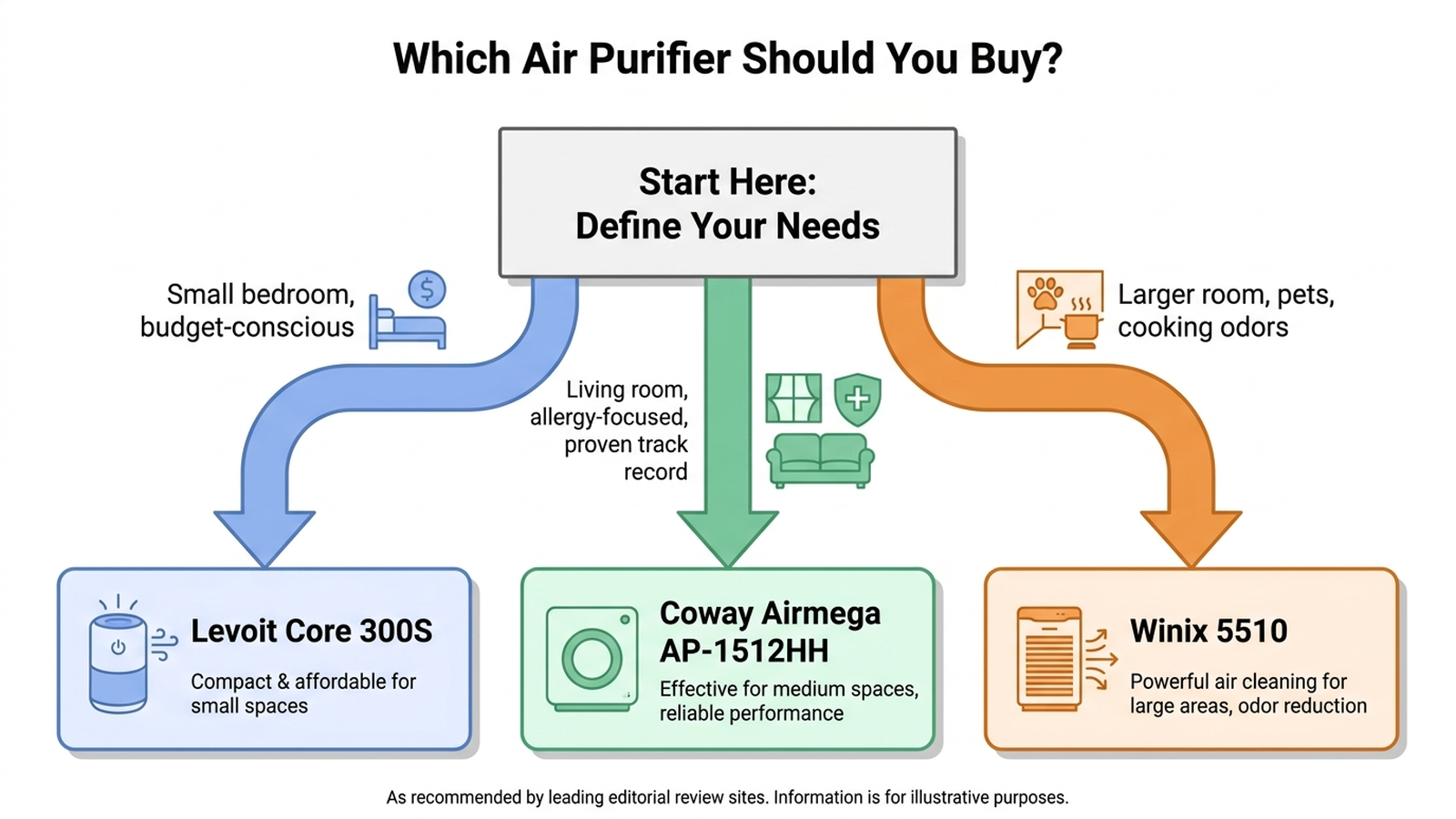
- Best for most bedrooms and allergy sufferers: Coway Airmega AP-1512HH — a decade-long independent-review track record, a 3-year warranty, and CADR numbers that comfortably cover a typical bedroom or home office.
- Best budget pick for a small room: Levoit Core 300S — roughly 40% cheaper than the other two, with CADR sized appropriately for a single bedroom rather than an open living space.
- Best for pets, cooking odors, or larger rooms: Winix 5510 — the highest CADR of the three and independently reported to lead on odor control, at the cost of a higher annual filter budget.
Limitations
This analysis relies on manufacturer-published CADR and AHAM certification data, aggregated Amazon customer reviews, and independent reporting referenced from RTINGS, Wirecutter, and HouseFresh. Room-coverage figures assume typical ceiling height and open floor plans; rooms with high ceilings, poor air circulation, or heavy furniture may need a higher-CADR unit than the size alone suggests. Individual allergy symptom relief varies by the specific allergen mix in a household’s air, local pollen counts, and factors an air purifier cannot address, such as pollen tracked in on clothing or pets. This article does not substitute for medical advice on allergy treatment.
As an Amazon Associate, Arekore earns from qualifying purchases. The Amazon product links in this article include our affiliate tracking ID and may earn us a commission if you buy through them, at no additional cost to you. See our Links Policy for details on how we select products and how commissions do not influence our recommendations.
Products Mentioned
- Coway Airmega AP-1512HH Mighty True HEPA Air Purifier
- LEVOIT Core 300S Smart Air Purifier
- WINIX 5510 True HEPA Air Purifier with PlasmaWave
Verify current pricing, availability, and specifications on the Amazon product page before purchasing — we do not guarantee prices stay current after publication.