Air Purifier Running But Air Still Smells? 5 Real Causes
TL;DR. A running air purifier that still leaves odor behind is almost never broken. The five most commonly documented causes are a saturated activated carbon filter, a HEPA-only unit that was never built to touch odors in the first place, a unit whose CADR rating is too low for the room, a continuous odor source (cooking, litter box, mold) that outpaces the unit, or mold and bacteria growing inside the unit itself. Replacing the carbon filter and matching CADR to room size resolves the majority of cases without buying a new purifier.
A note on links and methodology
As an Amazon Associate, Arekore earns from qualifying purchases. The Amazon product links in this article include our affiliate tracking ID and may earn us a commission if you buy through them, at no additional cost to you. See our Links Policy for details on how we select products and how commissions do not influence our recommendations.
We did not personally test the specific units or replacement filters named below. Every cause and fix in this article is an editorial synthesis of manufacturer documentation, independent testing, and aggregated public data, cited inline.
Methodology
This is an editorial analysis based on publicly available data collected in October 2026. We did not run controlled air-quality tests ourselves; instead we synthesized:
- Independent product testing — RTINGS’ air purifier test bench, which has tested over 55 models and names the Winix 5530 its pick for most people on strength of filtration and room coverage, alongside Consumer Reports’ air purifier buying guide.
- Manufacturer troubleshooting documentation — Blueair’s published “7 Reasons Your Air Purifier Isn’t Working” guide and manufacturer filter-replacement schedules from Levoit and Winix.
- Filtration-science sourcing on the mechanical difference between HEPA and activated carbon filtration, drawn from manufacturer technical pages (Oransi, Alen, TruSens) that explain why particle filters and gas-adsorbing filters are not interchangeable.
- AHAM/ENERGY STAR CADR sizing guidance, the industry standard that a purifier’s Clean Air Delivery Rate should be at least two-thirds of a room’s square footage to hit a meaningful number of air changes per hour.
- Market and technology-share data from Grand View Research (U.S. air purifier market estimated at roughly $4.98 billion in 2026) and industry reporting that HEPA-only filtration still holds the largest share of units sold versus HEPA-plus-carbon combination units — context for why so many owners discover the odor gap after they’ve already bought a HEPA-only model.
- Aggregated Amazon customer review sentiment on amazon.com for the specific units and replacement filters referenced below, read via each product’s “Top reviews” and “Customers say” panels in October 2026. We do not report a precise review-count N because Amazon’s review panels do not expose a stable, verifiable count; a fabricated number would be misleading.
We deliberately do not simulate a specific personal troubleshooting story or invent a fake reviewer persona. The advice below is a synthesis of manufacturer documentation, independent testing, and aggregated review patterns — treat it as a starting framework, not a substitute for a manufacturer’s own diagnostic tool.
1. Five reasons the smell doesn’t go away
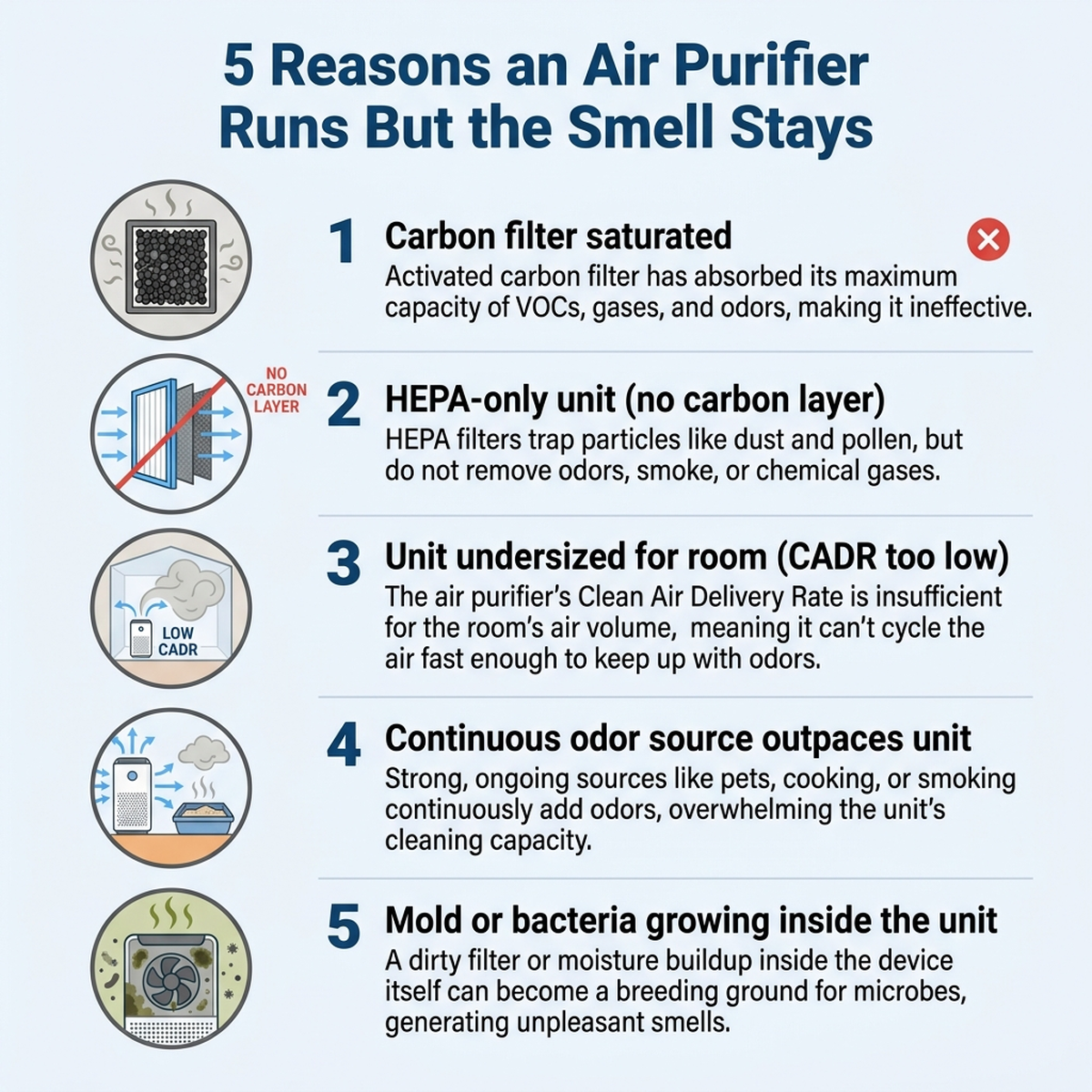
A purifier that’s clearly running — fan audible, air moving, indicator lights normal — and still leaves a smell behind usually maps to one of five well-documented causes:
| Cause | What it looks like | Fixable at home? |
|---|---|---|
| Carbon filter saturated | Smell that was gone for weeks or months has gradually returned | Yes — replace the carbon filter |
| HEPA-only unit | Smell was never meaningfully reduced, even when new | Only by adding carbon or upgrading the unit |
| Unit undersized for room (CADR too low) | Works near the unit, smell lingers a few feet away | Yes — upgrade to a higher-CADR unit |
| Continuous odor source | Smell returns within hours of cleaning/cooking/litter changes | Partially — source must also be addressed |
| Mold/bacteria inside the unit | Sour, musty, or “wet dog” smell distinct from the room odor | Yes — clean or replace prefilter |
The single most common cause, per manufacturer filter-replacement documentation, is the first one: a saturated activated carbon filter. Unlike a HEPA filter, which visibly clogs with dust and slows airflow, a carbon filter gives almost no physical warning when it’s full. There’s no indicator light tied to carbon saturation on most consumer units, no change in airflow, and no visible buildup — the only symptom is that odors the unit used to handle start getting through again. Carbon filters in a kitchen with daily cooking can saturate in as little as 4-6 months, while the same filter in a low-odor bedroom may last 12-18 months, according to filter-manufacturer maintenance guidance.
2. Why “HEPA” on the box doesn’t mean odor control
A surprising number of odor complaints trace back to a unit that was simply never designed to remove smells in the first place. HEPA filters trap particles mechanically, using a dense mesh of fibers that physically blocks dust, pollen, and pet dander as air passes through. Odor and VOC molecules are a different kind of pollutant entirely: they’re gaseous, not particulate, and they pass straight through a HEPA mesh without being captured, regardless of how fine the mesh is or how high the filter’s particle-capture rating reads on the box.
Removing odor requires activated carbon, which works by adsorption — gas molecules stick to the enormous internal surface area of the porous carbon rather than being mechanically filtered out. Manufacturer technical documentation from filtration companies including Oransi and Alen is consistent on this point: a HEPA-only unit will keep working on dust and allergens indefinitely while doing essentially nothing for cooking smells, smoke, or pet odor, because it was never carrying the filter media that handles gases.
This matters because HEPA-only filtration still accounts for a majority share of units sold in the US market, with HEPA-plus-carbon combination units a meaningfully smaller slice — so a non-trivial number of “my air purifier doesn’t work” complaints are really “I bought a particle filter to solve a gas problem.”
- Check what’s actually in your unit. If the filter is single-stage HEPA with no separate carbon layer or carbon-impregnated mesh listed in the spec sheet, it is not designed to remove odors regardless of condition or age.
- Combination units list both filter types explicitly — look for “True HEPA + Activated Carbon” in the product name or filter part number, which is how Winix and Levoit both label their odor-capable lines.
3. The CADR-to-room-size gap
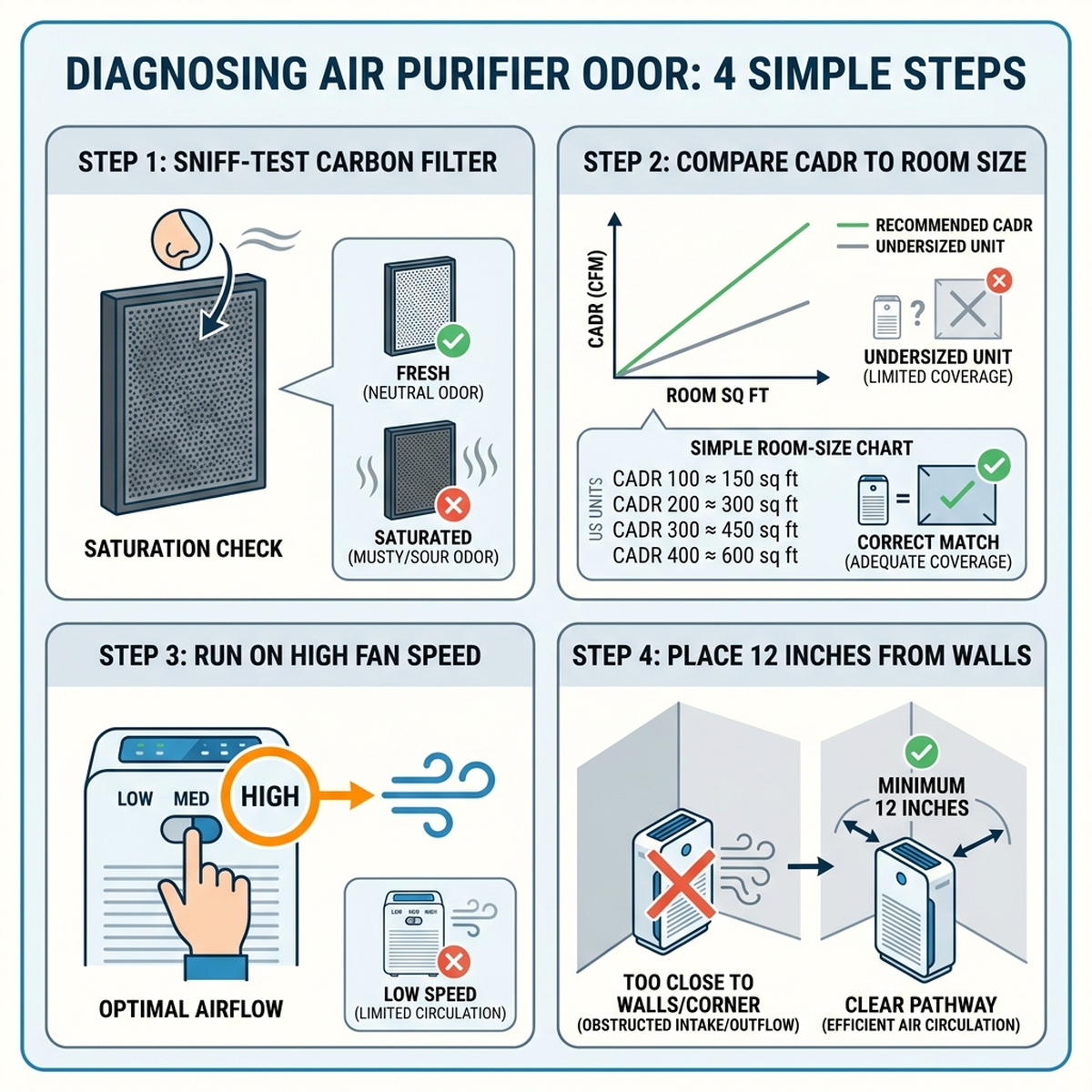
The second most commonly cited cause in manufacturer and independent testing guidance is a mismatch between the unit’s Clean Air Delivery Rate (CADR) and the room it’s placed in. CADR measures how much filtered air a purifier delivers per minute, and the sizing rule used by AHAM (the industry certification body) and ENERGY STAR is that a purifier’s CADR should be at least two-thirds of the room’s square footage to achieve a meaningful number of air changes per hour.
A unit rated for a 300-square-foot room will run continuously in a 600-square-foot open-plan living and kitchen space and still never catch up to a strong, recurring odor source — not because it’s defective, but because it’s circulating the room’s air too slowly relative to the space. This is the scenario independent buying guides flag most often when readers report a purifier that “runs constantly and still doesn’t work”: the unit isn’t too weak, it’s too small for the room it’s in.
Fan speed compounds the problem. Manufacturer troubleshooting documentation from Blueair notes that low fan speed settings are intended for maintaining already-clean air, not for actively clearing an existing odor — running a unit on low in a smelly room can look identical to a CADR mismatch even when the unit is correctly sized.
4. When the odor source is the real problem
An air purifier removes odor molecules from air that’s already in the room — it does not stop new odor molecules from being generated. A strong, continuous source (a litter box placed next to the unit, daily high-heat cooking, mold growing inside an HVAC duct, a recently installed carpet off-gassing) can generate odor faster than any consumer-grade unit can adsorb it, regardless of CADR or carbon filter freshness.
Placement compounds this: Blueair’s own troubleshooting documentation recommends keeping a unit at least 12 inches from walls and furniture and out of corners, where restricted airflow on the intake side reduces the volume of air the unit can actually process per minute — a purifier sitting in a cramped corner next to the odor source it’s meant to fix will underperform even with a fresh filter and correct CADR. The same documentation also notes a purifier performs best with doors and windows closed, since it’s only filtering the air in the enclosed space rather than competing against a constant influx of fresh (and re-odorized) air from elsewhere in the home.
Practical implication: if odor returns within hours of changing the carbon filter, the realistic fix is addressing the source directly — moving the litter box, running a range hood while cooking, or having an HVAC system inspected for mold — rather than cycling through filters indefinitely.
5. When the unit itself is the smell
A distinct and less obvious cause is moisture buildup inside the purifier, independent of carbon saturation. When humidity collects in a prefilter or housing that isn’t dried out between uses, it creates conditions for mold, mildew, or bacterial growth directly on the filter media — and the unit then pushes air through that growth and distributes a sour, musty, or “wet dog” odor into the room that’s distinct from whatever smell the owner was originally trying to remove.
This is diagnosable by smell alone: an odor that’s sour or musty, rather than a continuation of cooking or pet smell, points to the unit itself rather than the room. The fix is cleaning or replacing the prefilter and ensuring the unit isn’t run in a consistently damp location (a basement laundry room, for example) without more frequent prefilter maintenance than the manufacturer’s default schedule assumes.
What to actually do, in order
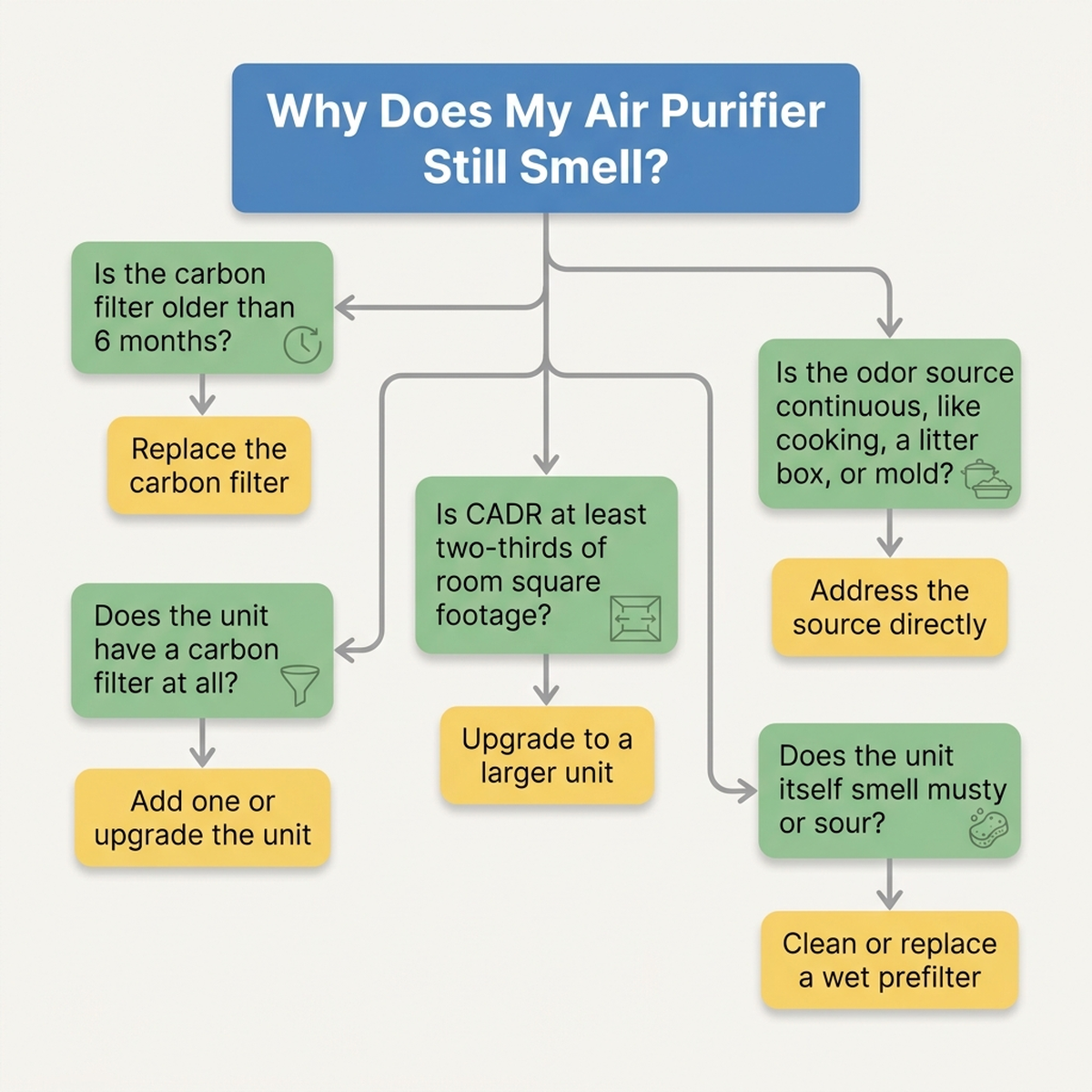
- Confirm the unit has a carbon filter at all. If the spec sheet or filter part number lists HEPA only, no amount of maintenance will fix an odor complaint — the unit needs a combination filter or a different unit entirely.
- Replace the carbon filter if it’s past 4-6 months in a high-odor room (kitchen, near a litter box) or 12-18 months in a low-odor room. There’s no indicator light for this on most units; a returning smell is the signal.
- Check CADR against room square footage. If CADR is less than roughly two-thirds of the room’s square footage, the unit is undersized for the space — upgrade rather than troubleshoot further.
- Run the unit on a higher fan speed when actively trying to clear an odor; reserve low speed for maintaining already-clean air.
- Reposition the unit at least 12 inches from walls and out of corners, and close doors/windows in the room being treated.
- Address continuous odor sources directly (litter box placement, range hood use while cooking, HVAC mold inspection) rather than expecting the purifier alone to outpace them.
- If the smell is sour or musty rather than the original odor, clean or replace the prefilter — the unit itself, not the room, is the source.
If a carbon filter replacement is the fix: current options
Editorial recommendation, not personal testing.
- Genuine Levoit Core 300-P Replacement Filter — manufacturer-made 3-in-1 True HEPA plus activated carbon replacement for the Core 300 series; the carbon layer is the component that handles odor, not the HEPA layer.
- Genuine Winix 116130 Filter H — original replacement filter for the Winix 5500-2, combining a True HEPA layer with a washable AOC (Advanced Odor Control) carbon layer specifically rated for cooking, pet, and smoke odor.
If the unit is undersized or HEPA-only: current options
- Winix 5530 Air Purifier — RTINGS’ current pick for most people, combining True HEPA with a manufacturer-rated high-deodorization carbon filter and coverage up to roughly 1,882 sq. ft. per hour at the manufacturer’s stated air-change rate.
- Levoit Core 600S-P Smart Air Purifier — manufacturer-rated CADR in the 390-410 CFM range, with coverage manufacturer-stated at roughly 2,909 sq. ft. at a once-per-hour air change rate, or roughly 606 sq. ft. at the faster ~4.8 ACH rate most allergists and AHAM/ENERGY STAR sizing guidance actually recommend — a meaningfully larger footprint than entry-level units for anyone whose current purifier is simply too small for an open-plan space. Prices as of October 2026 (fluctuate frequently by retailer and sale cycle, so treat as directional): Core 300-P replacement filter ~$30-40, Winix 116130 filter ~$40-55, Winix 5530 ~$135-220, Levoit Core 600S-P ~$245-300 — check amazon.com for current pricing.
Independent testing from RTINGS and Consumer Reports’ buying guide both treat room-size matching and combination filtration as scored categories, not marketing claims — worth checking directly against a unit’s spec sheet before assuming any single brand solves an odor problem outright.
The bottom line
Most “my air purifier runs but the smell won’t go away” complaints trace back to a saturated or missing carbon filter, a CADR rating too low for the room, a continuous odor source outpacing the unit, or moisture buildup inside the unit itself — not a defective purifier. Replacing the carbon filter and matching CADR to actual room square footage resolves more cases than any other single step. If the smell is sour or musty rather than the original odor, check the prefilter for moisture before replacing anything else.
Limitations of this analysis
To be explicit about what this article does not establish:
- We did not personally reproduce these odor issues on the specific units named here. The causes and fixes described are drawn from manufacturer troubleshooting documentation, independent testing methodology, and aggregated forum/review patterns, not from a controlled test we ran ourselves.
- Carbon filter saturation timelines (4-6 months high-odor, 12-18 months low-odor) are general manufacturer guidance and vary by household odor load, humidity, and specific filter media.
- The two-thirds CADR-to-square-footage sizing rule is AHAM/ENERGY STAR industry guidance, not a guarantee of performance in every room layout, ceiling height, or ventilation configuration.
- Unit coverage and CADR figures are manufacturer-published claims, not independently verified in our own testing, though cross-checked against RTINGS’ and Consumer Reports’ published test categories where available.
- Amazon review sentiment was read from each ASIN’s public review panels in October 2026 and reflects aggregated impressions, not a scientific sample.