Air Fryer Smoking When You Cook? 5 Real Causes (2026)
TL;DR. Most air fryer smoke is white, smells like food or oil, and comes from rendered fat or leftover grease hitting a hot heating element — not a defect. The five most documented causes are fatty food dripping onto the element, a dirty basket or tray from a previous cook, an overcrowded basket blocking airflow, oil with a low smoke point used at high heat, and — far less common but serious — a wiring fault that produces dark, acrid smoke. Cleaning the basket and element, spacing out food, and choosing a higher-smoke-point oil resolves the large majority of documented cases; dark smoke or a burning-plastic smell means unplug immediately rather than troubleshoot.
A note on links and methodology
As an Amazon Associate, Arekore earns from qualifying purchases. The Amazon product links in this article include our affiliate tracking ID and may earn us a commission if you buy through them, at no additional cost to you. See our Links Policy for details on how we select products and how commissions do not influence our recommendations.
We also did not personally reproduce this issue on the specific machines named below. Every cause and fix in this article is an editorial synthesis of manufacturer support documentation, a federal safety recall record, and aggregated public troubleshooting reports, cited inline.
Methodology
This is an editorial analysis based on publicly available data collected in September 2026. We did not run a controlled test ourselves; instead we synthesized:
- Manufacturer support documentation — Cosori’s official “Safety while air frying” help article, Ninja’s heating-element cleaning guidance distributed through its customer support channel, and the Instant Vortex Plus user manual’s troubleshooting section.
- A federal safety record — the U.S. Consumer Product Safety Commission’s February 2023 recall notice covering roughly 2 million Cosori air fryers, issued after 205 reports of units catching fire, smoking, or overheating due to a wire connection defect.
- Owner troubleshooting Q&A archives — JustAnswer threads specific to Ninja units smoking after cleaning, and brand-specific guides (Miss Vickie, KitchenTact, Air Fryer World) covering Cosori and Instant Vortex smoking patterns.
- Aggregated Amazon customer review sentiment for the accessories referenced below, read via each product’s public “Customers say” panel on amazon.com in September 2026. We do not report a precise review-count N because Amazon’s review panels do not expose a stable, verifiable count; a fabricated number would be misleading.
- Market and category data — per market.us and Statista’s 2026 air fryer category research, US household penetration for air fryers now exceeds 45%, up from a novelty appliance just a few years earlier, which is part of why smoke-related troubleshooting questions are common enough to have dedicated support articles at every major brand.
We deliberately do not simulate a specific personal cooking mishap or invent a fake reviewer persona. The advice below is a synthesis of manufacturer documentation, a public safety record, and aggregated troubleshooting patterns — treat it as a starting framework, not a substitute for your specific model’s manual or an active safety concern.
1. Five reasons an air fryer smokes
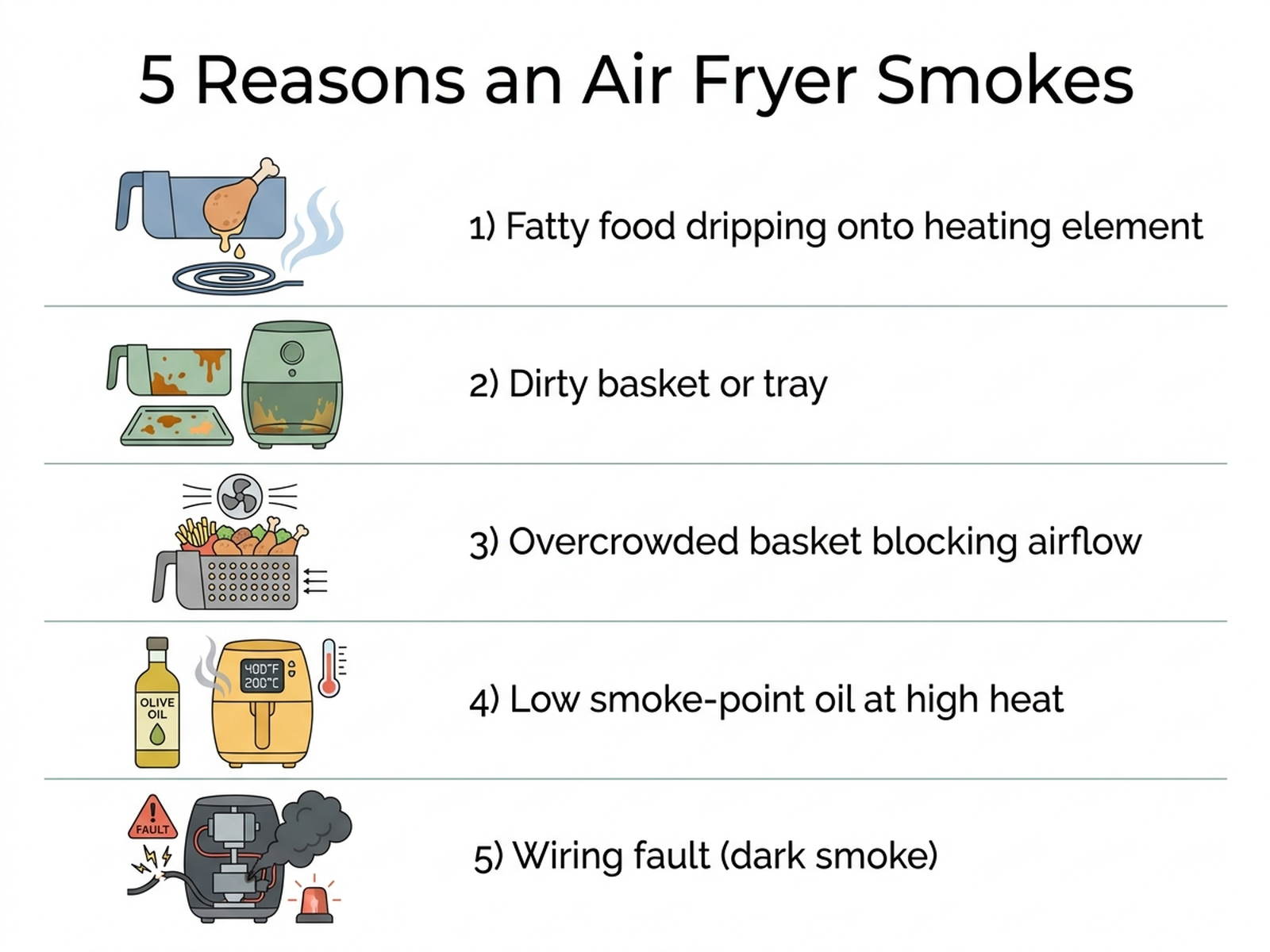
Before assuming the unit is broken, it helps to know that most smoke reports trace back to one of five causes, and four of them are cooking conditions rather than hardware failures:
| Cause | What it looks like | Fixable at home? |
|---|---|---|
| Fatty food dripping onto the element | White smoke, smells like food or grease, common with bacon, sausage, wings | Yes — lower fat content or temp |
| Dirty basket or tray | Smoke appears even with lean food; residue visible on tray | Yes — clean thoroughly |
| Overcrowded basket | Uneven cooking, smoke concentrated in one spot, weak airflow | Yes — cook in smaller batches |
| Low smoke-point oil at high heat | Smoke starts soon after preheat, before food browns much | Yes — switch oils |
| Wiring fault | Dark or black smoke, burning-plastic smell, unit smokes even when empty and clean | No — unplug and contact support |
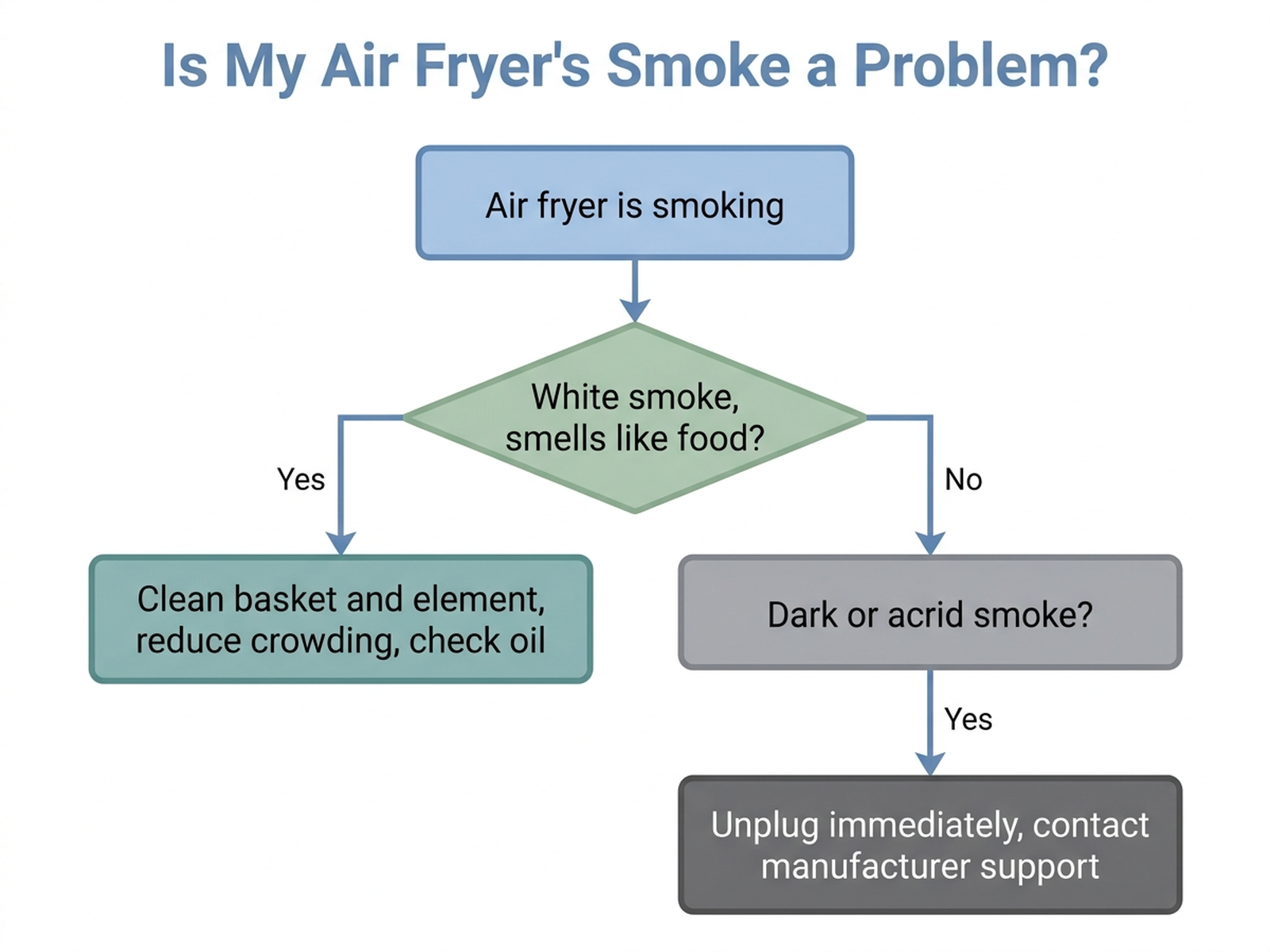
According to Cosori’s own safety guidance, white smoke caused by heating fat or food splatter is a normal, manageable occurrence, while dark smoke signals that food is burning or there is a circuit problem. That same distinction — white smoke as a cooking byproduct versus dark smoke as a hazard signal — is the throughline across every manufacturer and independent source surveyed for this article.
2. Why grease is the most common trigger
Air fryers cook by circulating hot air at temperatures typically between 350°F and 450°F around food suspended above a heating element. When that food renders fat — as bacon, sausage, marinated meats, and chicken thighs reliably do — the fat drips downward. In most countertop models, including Ninja’s DualZone line, the heating element sits at the top of the cooking chamber, so airborne grease splatter and drip-through residue land directly on or near a surface hot enough to vaporize it. What’s rising out of the vents at that point is usually oil vapor, not combustion — which is why it smells like food rather than smoke from a fire.
Old residue compounds the same failure mode. Even food that isn’t especially fatty will leave a thin film of oil on the basket, tray, or element after each use; skip a cleaning cycle or two and that film accumulates to the point where it starts smoking on its own, independent of whatever you’re currently cooking. Cosori’s help center specifically calls out grease buildup as the most likely cause of visible white smoke, and recommends cleaning the basket after each use rather than waiting for a deep-clean interval.
Overcrowding worsens the same mechanism in a different way: a packed basket blocks the airflow the appliance depends on, so heat and rendered fat concentrate in fewer spots instead of dispersing, and food in the crowded zones is more likely to scorch and add burnt-food smoke on top of the grease smoke.
3. Brand-specific patterns worth knowing
Cosori. Cosori’s official guidance draws a hard line between white smoke (normal, from heating fat or food splash — clean the basket to reduce it) and dark smoke (a burning or circuit problem — stop and investigate). That distinction carries extra weight for this brand specifically: in February 2023, the CPSC recalled roughly 2 million Cosori air fryers after 205 reports of units catching fire, melting, overheating, or smoking due to a wire connection that could overheat. Cosori resolved the recall with free replacements for affected model numbers; it is a documented precedent for why persistent smoke on any air fryer — not just visibly damaged units — is worth taking seriously rather than dismissing as routine.
Ninja. Owner support content and Ninja’s own customer-service guidance point to the top-mounted heating element as the part most exposed to rising grease and splatter on DualZone-style models. Ninja’s cleaning guidance recommends a full wipe-down of the heating element every 3–4 uses using a soft, damp cloth — never metal tools or oven cleaner, which can damage the element’s coating — and instructs owners to contact Ninja customer support directly if smoke continues after a thorough cleaning, since that pattern can indicate grease that has worked its way into a spot a routine wipe-down can’t reach.
Instant. The Instant Vortex Plus troubleshooting documentation lists a dirty heating element and overcrowding as expected causes, consistent with the other two brands. Instant’s guidance adds one design-specific tip not found in the Ninja or Cosori material: on models with a water tray beneath the basket, keeping a small amount of water in that tray during fatty cooks gives dripping oil somewhere to pool instead of contacting the hot element directly, which reduces smoke without changing the food itself.
Cross-brand. Across every brand surveyed, manufacturer and independent troubleshooting content converges on the same order of operations: identify whether the smoke is white/food-smelling or dark/acrid first, then check grease buildup and crowding, and only treat the unit as potentially faulty if dark smoke or a burning-plastic smell shows up on a clean, uncrowded, empty-basket test run.
4. What to actually do, in order
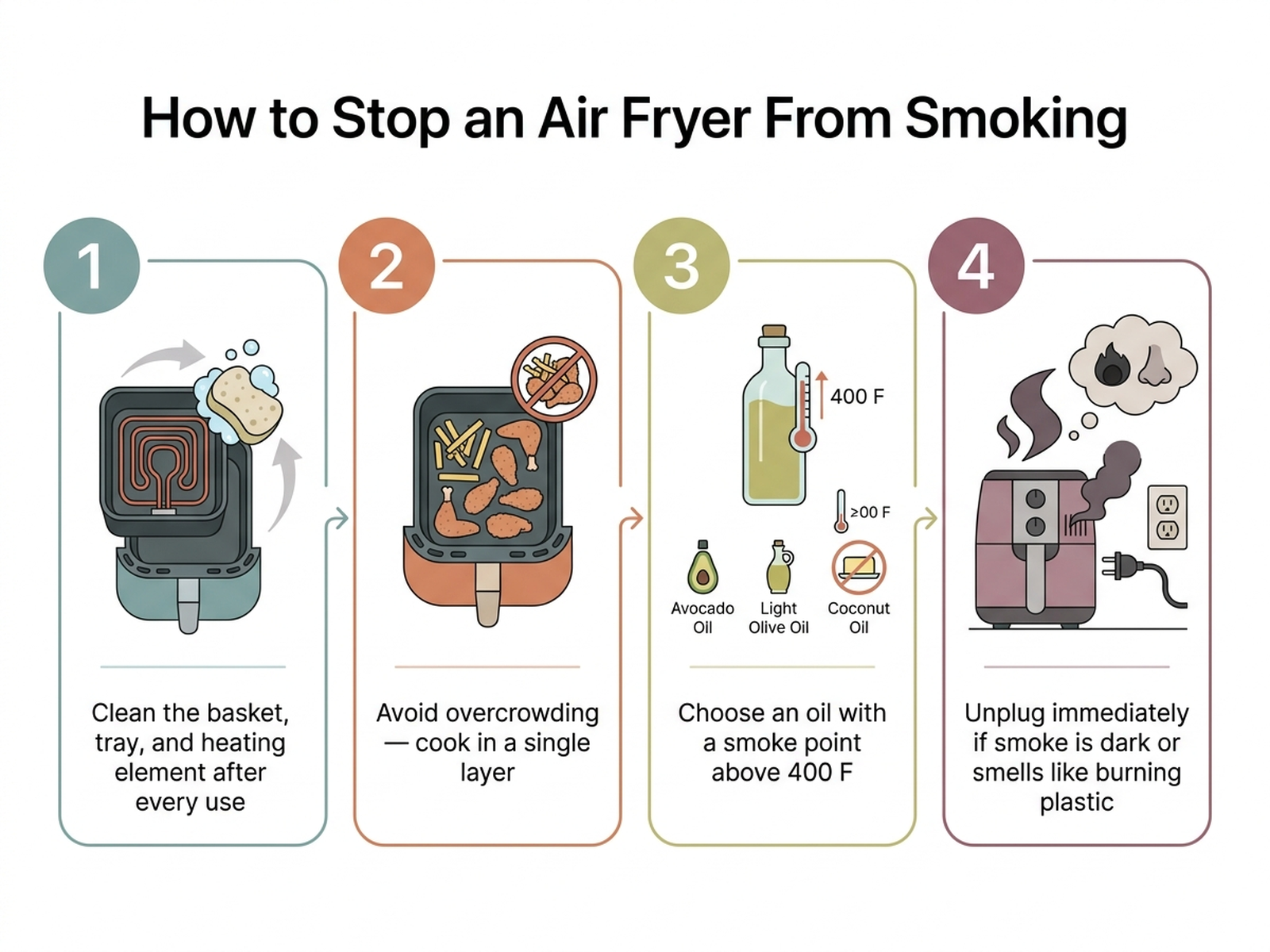
- Note the smoke color and smell before doing anything else. White smoke with a food or grease odor is the routine case below. Dark or black smoke, or a burning-plastic smell, means skip straight to step 6.
- Cancel, unplug, and let the unit cool if smoke is heavy enough to be alarming, even if it looks like the routine white/grease type — this is standard guidance across every brand surveyed and avoids any risk while you assess.
- Clean the basket, tray, and heating element thoroughly. Manufacturer guidance across Cosori, Ninja, and Instant lists leftover grease as the single most commonly cited cause; a soft cloth with warm water and mild dish soap is sufficient, and metal scrubbers or oven cleaner can damage the element’s coating.
- Reduce batch size and spread food in a single layer. An overcrowded basket restricts the airflow the appliance is designed around and concentrates both heat and dripping fat in fewer spots.
- Switch to a higher-smoke-point oil for high-temperature cooks. Oils with lower smoke points (many extra-virgin olive oils sit lower than refined oils) can start smoking on their own well before 400°F; a refined oil rated for higher heat gives more margin at typical air-fryer temperatures.
- If smoke is dark, smells like burning plastic, or appears on a clean, empty, uncrowded unit, stop using it and contact manufacturer support rather than continuing to troubleshoot — that pattern is consistent with the wiring-fault scenario documented in the Cosori recall, not a cooking-condition issue.
5. If the fix is better grease management: current options
Editorial recommendation, not personal testing. Several of the causes above come down to giving dripping fat somewhere to go besides the heating element.
- Air Fryer Disposable Parchment Paper Liners, Unbleached, PFAS-Free — a basket liner that catches grease before it can drip onto or near the heating element, aligned with the cleaning-forward guidance every brand surveyed gives as the first fix.
6. If it’s time for a new unit: current options
If persistent smoke traces back to a hard-to-reach grease trap on an aging unit, current-generation air fryers documented by their own manufacturers address element exposure directly.
- Ninja Foodi 6-Quart 5-in-1 DualZone 2-Basket Air Fryer — a current DualZone model from the brand whose own support guidance this article draws on for heating-element cleaning cadence.
7. The decision flowchart
8. The bottom line
An air fryer that smokes mid-cook is, in the large majority of documented cases, reacting normally to rendered fat, leftover grease, or an overcrowded basket meeting a hot heating element — not a sign of a defective unit. Cleaning the basket and element, cooking in smaller batches, and picking a higher-smoke-point oil resolves most reported cases without a service call or replacement. The one pattern that isn’t routine is dark or black smoke, or a burning-plastic smell, especially on a clean and uncrowded unit — that combination matches the wiring-fault scenario behind Cosori’s 2023 recall, and it’s the point where unplugging and contacting manufacturer support is the right call rather than continuing to adjust cooking habits.
Limitations of this analysis
To be explicit about what this article does not establish:
- We did not personally reproduce this issue on the specific machines named here. The causes and fixes described are drawn from manufacturer support documentation, a public CPSC safety record, and aggregated troubleshooting-thread patterns, not from a controlled test we ran ourselves.
- The Cosori recall applies to specific model numbers sold between June 2018 and December 2022 and does not mean current-generation Cosori units share the same defect; we cite it as documented precedent for taking dark smoke seriously, not as an ongoing risk assessment of the brand’s current lineup.
- Smoke-point figures for cooking oils vary by refinement level and brand even within the same oil type, so “use a higher smoke-point oil” is directional guidance, not a guarantee tied to one specific product.
- Amazon review sentiment was read from each ASIN’s public review panels in September 2026 and reflects aggregated impressions, not a scientific sample.
- Market penetration figures are current industry estimates that vary somewhat across research firms; we cite them as directional context, not a precise figure.