AeroPress Go Review 2026: Is the Travel Version Worth It?

The AeroPress Go is a strange product on paper: it holds less coffee than the original AeroPress, uses the same brewing mechanism, and yet costs about $10 more at manufacturer list price. That is not how travel-sized versions of a product usually work — the smaller one is supposed to be cheaper. So we pulled apart the manufacturer specs, aggregated owner reviews, and independent lab testing to figure out whether the Go’s integrated travel mug justifies the premium, or whether most buyers are better off with the Original plus a cheap case.
As an Amazon Associate, Arekore earns from qualifying purchases. The Amazon product links in this article may include our affiliate tracking ID and may earn us a commission if you buy through them, at no additional cost to you. See our Links Policy for details on how we select products and how commissions do not influence our recommendations.
TL;DR / Quick Verdict
- The Go costs more than the Original for less capacity — $49.95 vs. $39.95 at manufacturer list price, for 8 oz instead of 10 oz per brew — because the premium pays for the integrated travel mug and case, not for more brewing performance.
- The core brewing mechanism is identical across every AeroPress model. Independent testing from Consumer Reports found the AeroPress format itself produces smooth coffee quickly with easy cleanup, regardless of which size you buy.
- The Go earns its price mainly for people who actually travel with it. If you brew at a kitchen counter every day and never leave the house with it, the Original or the larger Go Plus make more practical sense.
- It is not a true espresso machine, despite marketing language about “espresso-style” coffee — it produces a concentrated, low-bitterness cup closer to a strong pour-over than shots pulled under real espresso-machine pressure.
How We Reached These Conclusions (Methodology)
This is an editorial analysis, not a hands-on review; we did not personally test the products covered here. It synthesizes three kinds of public information: (a) manufacturer specifications published by AeroPress for the Original, Go, and Go Plus models; (b) independent third-party lab testing from Consumer Reports, which brought the AeroPress format into its labs alongside the Fellow Duo and Oxo Cold Brew; and (c) aggregated sentiment from long-form owner reviews across independent coffee-gear publications and Amazon product listings. We did not personally test the products covered here, and we avoid citing a specific unverified Amazon review count, since exact totals fluctuate. Manufacturer figures (weight, dimensions, brew time) are labeled as such. Prices are amazon.com and manufacturer figures at the time of writing and change frequently, especially around sales events.
Why the Go Costs More for Less Coffee
The AeroPress Original brews up to 10 oz per cycle and lists for $39.95 (manufacturer). The Go brews up to 8 oz and lists for $49.95 — a $10 premium for 20% less capacity. That gap is not a pricing mistake; it reflects what you’re actually buying.
The Go’s price covers an integrated, microwave-safe travel mug with a sealing lid that doubles as the brewing chamber’s carrying case, plus a compact filter holder that stores 25 micro-filters inside the kit. According to AeroPress’s published specs, the fully packed Go weighs 11.4 oz and measures 4.5 inches tall by 3.6 inches wide — small enough to fit in most daypack side pockets or a car cup holder. The Original does not include an equivalent case; owners who want to travel with it typically buy a separate bag or container, which narrows the real-world price gap once you factor that in.
There’s also a third option: the AeroPress Go Plus, released as a step up from the Go, which lists for $89.95 and restores the full 10 oz capacity while keeping the integrated tumbler-and-case format. It targets people who liked the Go’s portability but found 8 oz too small for a daily-sized cup.
Technical Approach: Original vs. Go vs. a True Portable Espresso Maker
All three AeroPress models use the same core mechanism — a plunger forces hot water through coffee grounds and a paper or metal micro-filter using hand pressure, roughly comparable to a syringe. That is fundamentally different from how a device like the Wacaco Minipresso works, which is worth understanding before assuming “portable coffee maker” means the same thing across brands.
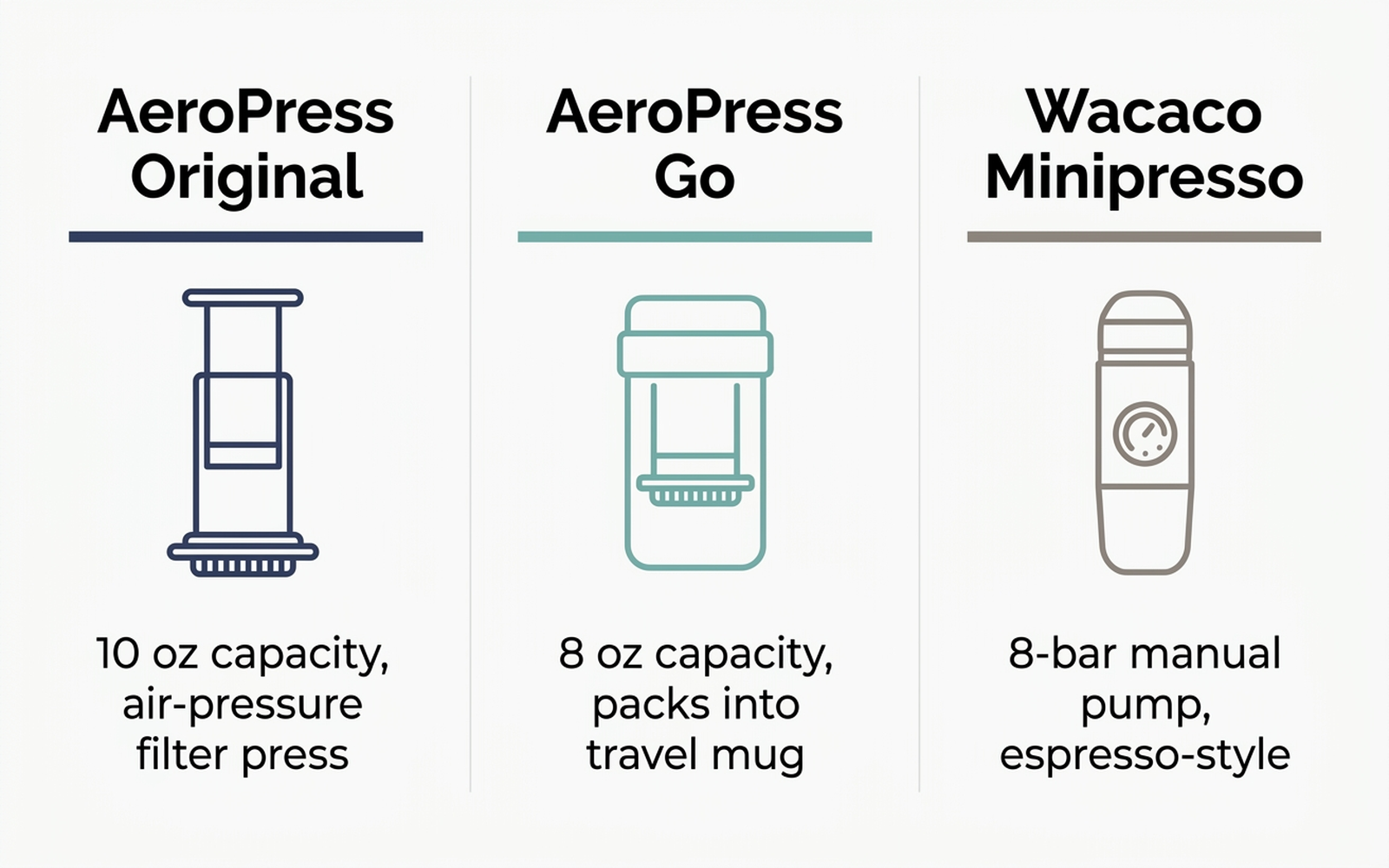
- AeroPress Original uses a wide chamber and plunger for a 10 oz brew, optimized for a kitchen counter rather than a bag. Consumer Reports’ lab testing found the AeroPress format brews rapidly once water reaches the right temperature, with the least prep time of the three brewers it tested (AeroPress, Fellow Duo, Oxo Cold Brew), though its single-serving-sized output was flagged as a limitation for households that drink multiple cups.
- AeroPress Go uses a narrower 8 oz chamber sized to nest inside its own travel mug, trading some capacity for pack-down size.
- Wacaco Minipresso takes a different approach entirely: a manual pump builds roughly 8 bar of pressure, similar to a countertop espresso machine, to pull true espresso-style shots with crema. Independent testing from outlets including TechRadar and Tom’s Guide describes the Minipresso as producing a more authentic espresso shot than any AeroPress model, at the cost of more moving parts to clean and a steeper learning curve. Reviewers at Seattle Coffee Gear, comparing the two brands directly, describe the AeroPress as the more foolproof and versatile option for a smooth, easy-to-drink cup, and the Minipresso as the choice for buyers who specifically want espresso-style intensity.
The practical distinction: if “portable espresso” is a priority, the AeroPress line — Original, Go, or Go Plus — is not actually an espresso maker despite marketing language; it’s a manual immersion-and-pressure brewer that makes a smooth, low-bitterness cup. Buyers who want real crema and higher-pressure extraction should compare against a pump-based device like the Minipresso instead.
How to Brew With the AeroPress Go
The brewing steps are identical across every AeroPress model; only the amount of coffee and water changes with the Go’s smaller 8 oz chamber.
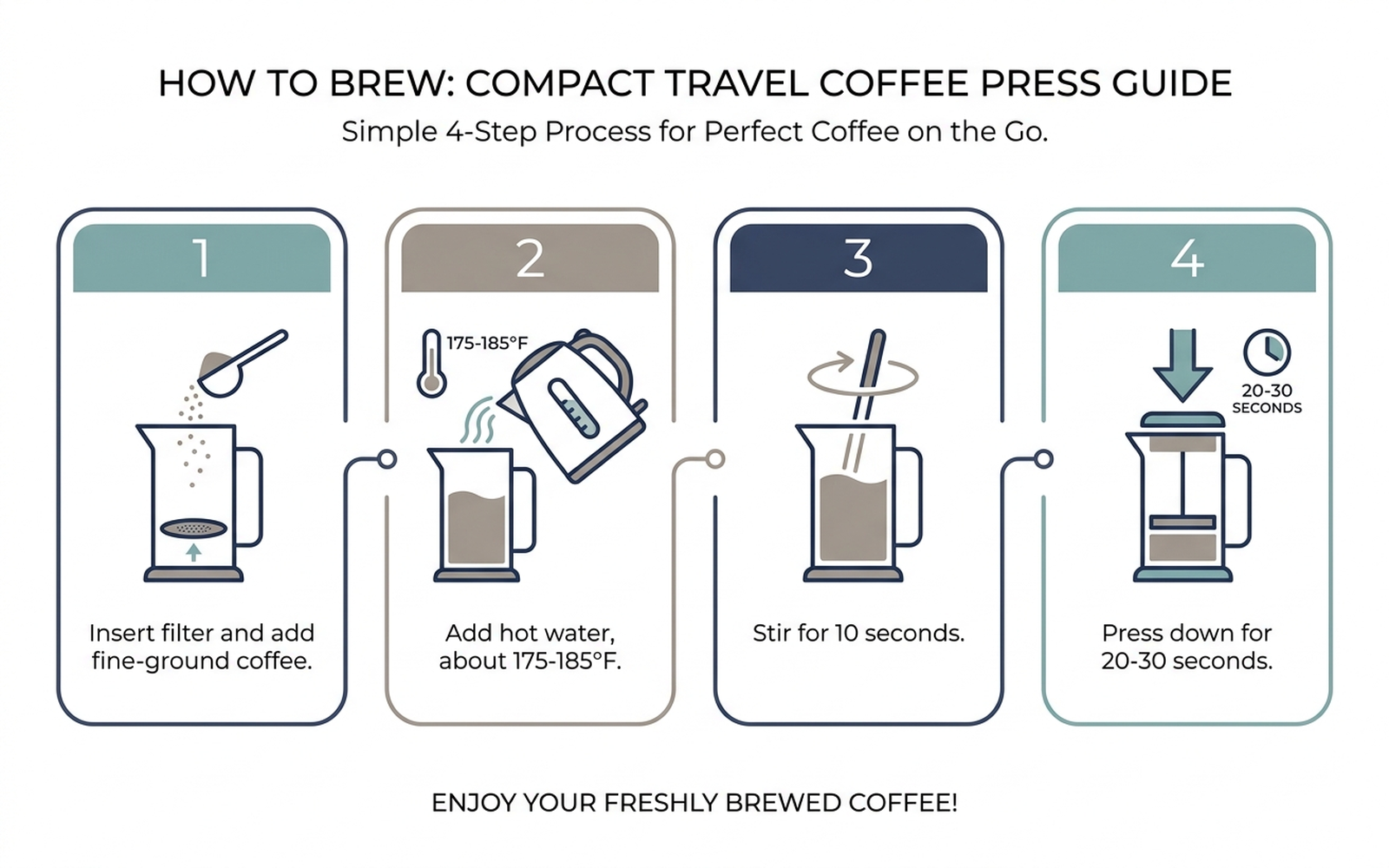
- Insert a paper or metal micro-filter into the filter cap and add finely ground coffee (a grind between drip and espresso works well, per manufacturer guidance).
- Add water heated to about 175–185°F — AeroPress recommends slightly below boiling, since fully boiling water can over-extract and add bitterness.
- Stir for about 10 seconds to saturate the grounds evenly before pressing.
- Press down steadily for 20–30 seconds until you hear a hissing sound, which signals the brew chamber is empty.
The most common mistake reported in aggregated long-form reviews is pressing too hard, too fast, which can push grit through the filter or cause the chamber to tip on a narrow mug — a complaint Consumer Reports also flagged, describing the AeroPress as feeling “unsteady poised atop your mug” during pressing. The Go’s own travel mug is wider and shorter than a typical coffee mug, which several independent reviewers note makes it noticeably more stable during the press than balancing the Original on a household mug.
Comparison Table
Prices are amazon.com and manufacturer figures at the time of writing (August 2026) and fluctuate, especially during sales events; some AeroPress Go listings have shown intermittent out-of-stock periods on Amazon in 2026, with availability shifting between the manufacturer’s own listing and third-party sellers.
| Model | ASIN | List price | Capacity | Packed weight | Best for |
|---|---|---|---|---|---|
| AeroPress Original | B000GXZ2GS | $39.95 | 10 oz | ~14.5 oz (mfr.) | Home counter, daily use |
| AeroPress Go | B07YVL8SF3 | $49.95 | 8 oz | 11.4 oz (mfr.) | Travel, camping, hiking |
| AeroPress Go Plus | B0D369SKPK | $89.95 | 10 oz | Heavier (larger tumbler, mfr.) | Travel with full-size cups |
Editorial Recommendations by Use Case
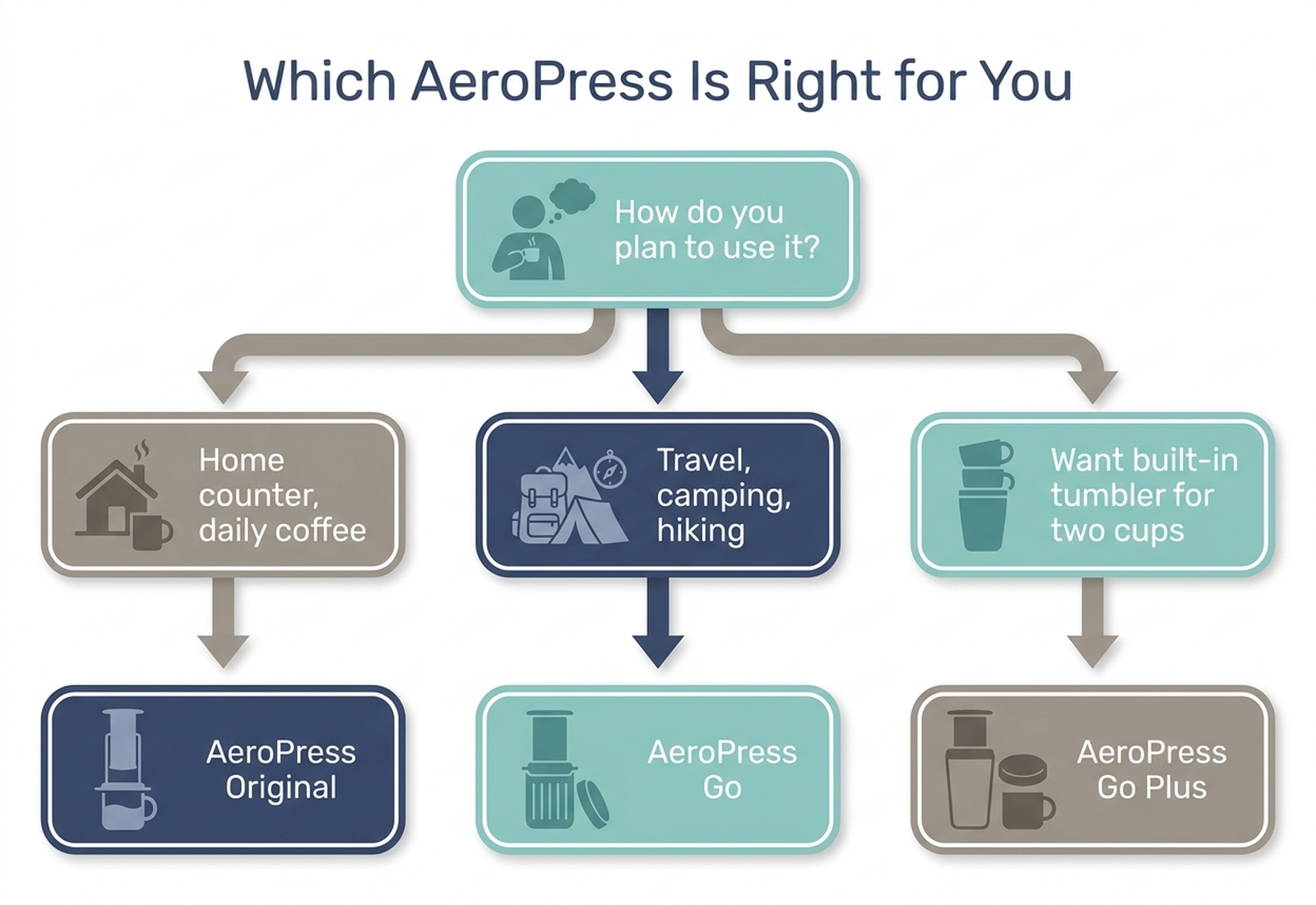
- Best for most people who only brew at home: the AeroPress Original — full 10 oz capacity at the lowest price, with no reason to pay for a travel case you won’t use. Check the AeroPress Original on Amazon
- Best for backpacks, hiking, and hotel rooms: the AeroPress Go — the integrated mug-and-case format is the entire reason this model exists, and it earns its premium specifically in this use case. Check the AeroPress Go on Amazon
- Best for travelers who find 8 oz too small: the AeroPress Go Plus — same portable format as the Go, with the Original’s full 10 oz capacity, for buyers willing to pay the largest premium of the three. Check the AeroPress Go Plus on Amazon
- If you specifically want espresso-style shots with crema: none of the AeroPress models are the right tool — a pump-based device like the Wacaco Minipresso is built for that job instead.
Durability and Warranty
AeroPress backs its coffee presses with a 1-year manufacturer warranty, and the Go’s body is made from BPA-free polypropylene with a silicone mug lid, dishwasher-safe on the top rack per the manufacturer. Long-term owner reviews aggregated across independent coffee-gear sites commonly cite multi-year daily use without mechanical failure, since the design has few moving parts beyond the rubber plunger seal — a component several long-term reviewers note eventually wears and can be replaced separately rather than requiring a full replacement unit. Confirm current warranty terms on the product page, as coverage details are occasionally updated.
Limitations of This Analysis
This analysis relies on manufacturer specifications, aggregated owner reviews from independent coffee publications, and Consumer Reports’ lab testing; we did not personally test these products, and individual experience varies with grind size, water temperature, and personal taste preference. We deliberately avoid citing a specific unverified Amazon review count, since exact totals fluctuate and are not something we independently verified. Market-size figures for the camping-specific coffee maker segment — estimated at $2.14 billion in 2024, growing at a 6.7% CAGR toward roughly $3.89 billion by 2033 by one industry research estimate — come from third-party research firms whose methodologies differ, so we present them as directional market context rather than precise figures specific to any single AeroPress model. Prices, ASIN availability, and warranty terms change frequently — always confirm current details on the product page before buying.
The Bottom Line
The AeroPress Go is not a cheaper, smaller version of the Original — it is a different product built around portability, and its $10 premium over the Original buys a travel mug and case rather than better coffee. For anyone who will genuinely take it out of the house, that trade makes sense; for a kitchen-counter brewer who never travels with it, the Original’s larger capacity and lower price are the more practical buy. Whichever you lean toward, check the current price and read the most recent reviews before buying — and if you want a second opinion on a specific listing, paste the URL into Arekore and let the AI scan the reviews and price history for you in about five minutes.