$500 Wasted: 3 Smart Home Gadgets That Didn't Deliver

TL;DR. Across three of the fastest-growing smart home categories — sprinkler controllers, pet feeders, and water shutoff valves — the same complaint shows up in aggregated reviews and independent lab tests: the device does the opposite of what it was bought to prevent. Sprinkler controllers that are supposed to save water overwater or underwater due to rain-skip misses. Pet feeders that are supposed to guarantee a meal jam or drop offline. Water shutoff valves that are supposed to stop damage trigger false alarms and lock out the water supply instead. Combined, these three categories can easily run past $500 for a household that buys one of each — and the fix in most cases is not “avoid smart home gadgets,” it’s choosing models with a documented track record and understanding the failure mode before it happens in your house.
A note on links and methodology
As an Amazon Associate, Arekore earns from qualifying purchases. The Amazon product links in this article include our affiliate tracking ID and may earn us a commission if you buy through them, at no additional cost to you. See our Links Policy for details on how we select products and how commissions do not influence our recommendations.
We did not personally own or test the devices named below. Every failure pattern and product claim in this article is an editorial synthesis of public data, cited inline.
Methodology
This is an editorial analysis based on publicly available data collected in October 2026. We did not run our own controlled reliability tests; instead we synthesized:
- Consumer Reports’ smart water shutoff system lab testing, which evaluated five models priced $350–$700 (Flo by Moen, Phyn, StreamLabs, LeakSmart, Guardian by Elexa) for leak-detection accuracy and shutoff reliability.
- Independent buying-guide coverage from Wirecutter (NYT), which has named the Rachio 3 its top smart sprinkler controller for ten consecutive years, and consumer review roundups covering current automatic pet feeders.
- Manufacturer support documentation and public incident reporting on the 2019 Petnet SmartFeeder outage, reported by Gearbrain, in which a cloud-service failure left feeders undispensing food for roughly a week.
- Aggregated customer review sentiment on amazon.com and homedepot.com for the specific products named below, read via each listing’s “Top reviews” and customer Q&A sections in October 2026. We do not report a precise review-count N for most individual listings because retailer summary panels do not expose a stable, independently verifiable count, and a fabricated figure would be misleading.
- Market data from Statista and industry trackers on US smart home adoption, cited for category-growth context, not as a representative sample of the specific products discussed.
We deliberately do not simulate a specific personal ownership story or invent a fake reviewer persona. Treat the analysis below as a framework for evaluating connected-gadget risk before a purchase, not a substitute for reading a specific product’s current reviews yourself.
1. Three categories, three distinct failure patterns
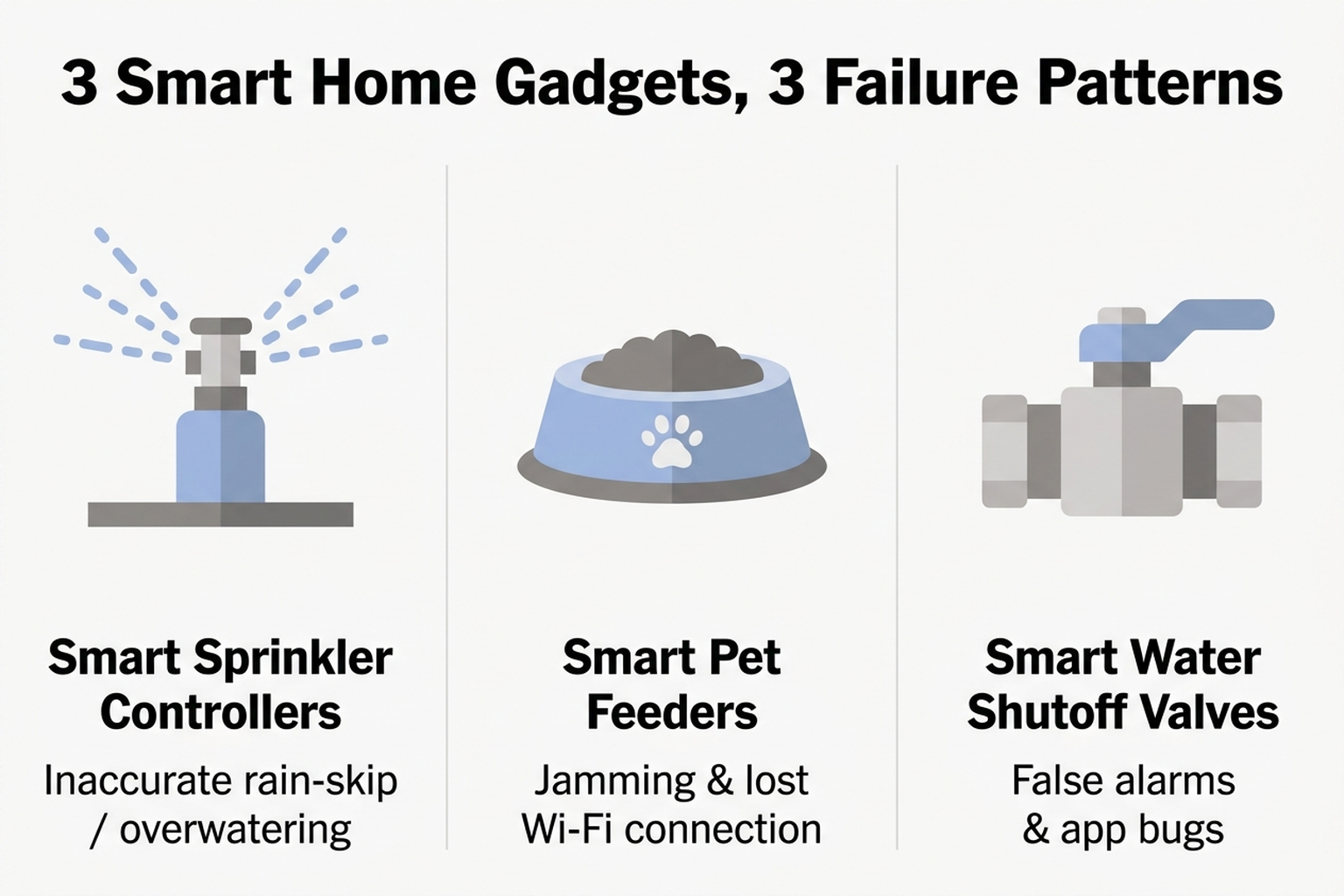
US households now average between 7 and 10 connected devices, up from roughly 5 in 2021, according to industry trackers citing Statista’s smart-home adoption data — and more than 77 million US homes, over half of all households, now use at least one smart home device. That growth has pulled low-stakes convenience categories (lighting, plugs) into higher-stakes ones: devices that control water, food, and irrigation unattended. The three categories below sit squarely in that higher-stakes group, and each fails in a way specific to what it automates:
- Smart sprinkler controllers promise to save water by skipping cycles before rain and adjusting for local weather. When the weather intelligence misses, the result is the opposite of the sales pitch: a lawn that gets watered during a storm, or one that goes dry during a heat wave because the system was too conservative.
- Smart pet feeders promise a guaranteed meal on schedule, with a camera and an app for peace of mind. When the hardware jams or the Wi-Fi drops, the guarantee becomes the opposite: a missed meal, discovered only when you check the app and see it never fired.
- Smart water shutoff valves promise to catch a leak and shut the water off before it floods a basement. When the sensor misreads a false positive, the device does what it’s designed to do — shut off the water — at the wrong time, for the wrong reason, sometimes with no way to turn it back on from the app.
The pattern across all three: the device’s single point of failure (a weather API, a cloud server, a moisture sensor) sits between the gadget and the one job it was bought to do. When that single point fails, there’s often no graceful fallback — which is also the main criterion for picking a better model in each category, covered section by section below.
2. Smart sprinkler controllers: when rain-skip misses
Rachio’s smart controllers have been named Wirecutter’s top pick in the category for ten consecutive years, and Wirecutter credits the design to an app that’s “by far the best-designed and easiest-to-use” among competitors, with Flex Daily scheduling that adjusts watering based on live local weather data. That track record is also the clearest evidence of how uneven the rest of the category is: independent coverage of competing models repeatedly flags the same accuracy complaint in different forms.
The Netro Sprite has documented reports of flaky Wi-Fi connectivity paired with inaccurate weather intelligence. Rachio’s own rain-skip feature, while generally well-reviewed, can still miss a hyperlocal storm that dumps rain on one block while missing the weather station a mile away that the app is pulling data from — a structural limitation of weather-API-based skipping, not a bug specific to one brand. Orbit’s B-hyve line draws a different complaint: its smart weather monitoring is conservative by design during extreme heat, which means some owners manually boost watering time during heat waves rather than trusting the automated schedule, and its moisture-sensor add-on has drawn mixed reviews — some owners turn the physical sensors off entirely after a couple of weeks and fall back to weather-only scheduling. Rain Bird’s ARC8 has drawn reports of accidentally running multiple zones at once, which wastes water in exactly the way the device is marketed to prevent.
None of this makes smart sprinkler controllers a bad category — Rachio’s water-savings claims (widely cited at 30-50%, a manufacturer figure, not independently verified for every household) are large enough that the category is worth using. It does mean the brand and the setup quality matter more than the “smart” label alone: a controller fed an accurate soil type, sun exposure, and zone configuration performs very differently from the same hardware fed a guess.
3. Smart pet feeders: jamming and the worst-case outage
Automatic feeders fail in two distinct ways, and the aggregated complaint pattern across budget-tier models traces to one of them in almost every case: a mechanical jam in the portion-dispensing auger (commonly triggered by humidity causing kibble to swell and clog the chute, or a piece of kibble wedging the wheel and burning out the motor), or a connectivity failure that drops the scheduled feeding from the cloud side even though the hardware itself is fine.
The starkest documented example of the connectivity failure mode is the Petnet SmartFeeder, reported on by Gearbrain: a cloud-service outage in 2019 left feeders failing to dispense food for roughly a week, with some owners reporting dozens of unanswered support emails during the outage. The product carried an average 2.5-star rating from 560 customers at the time, and because the feeding logic depended entirely on Petnet’s own servers rather than running locally on the device, a working Wi-Fi connection at home wasn’t enough to guarantee a meal — the company’s cloud infrastructure was the real single point of failure. Petnet is no longer sold; we cite it as a documented cautionary example of cloud-dependency risk, not as a product to avoid buying today.
Current-generation budget feeders carry a related but more mundane complaint: reviews describing a device that stops connecting to Wi-Fi reliably, combined with reports that the company is slow or unresponsive when owners raise the issue. The mechanical jam pattern shows up independently of brand — any auger-driven dry-food dispenser can jam on a swollen kibble piece or trapped debris — which is why clog-resistant chute design, not just camera resolution or app polish, is the detail worth checking in current reviews before buying.
On the more reliable end, the PETLIBRO Granary line is frequently cited in current buying guides for pairing app scheduling with a clog-prevention auger mechanism and a dual power backup (so a power blip doesn’t skip a feeding), while WOPET’s camera-equipped feeders are positioned as a lower-cost option in recent comparisons that covers the same core functions (scheduling, two-way audio, night vision) with a narrower but real gap in night-vision quality and build polish.
4. Smart water shutoff valves: Consumer Reports’ own test results
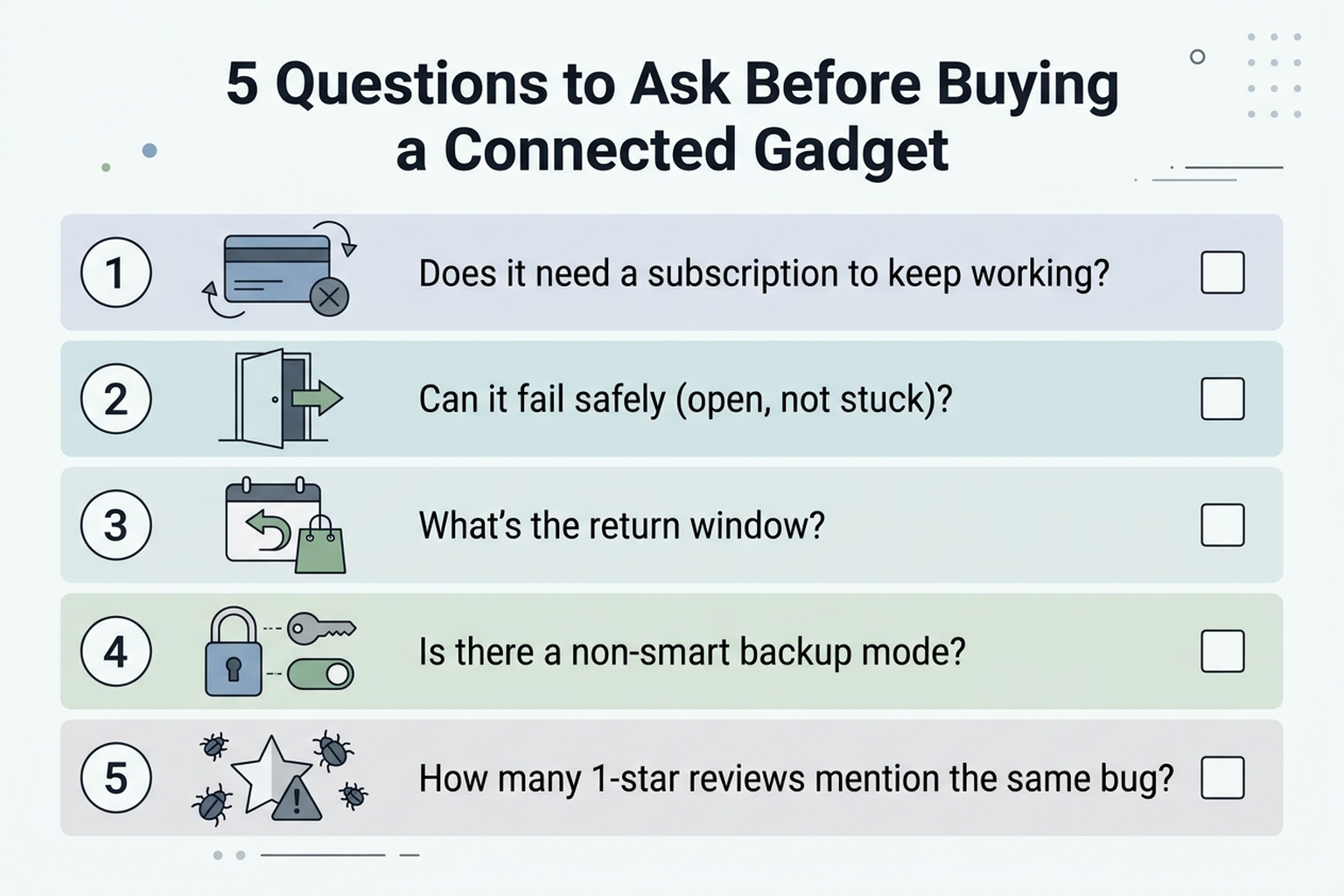
Of the three categories in this article, smart water shutoff valves carry the highest price tag and the highest stakes — a false shutoff is an inconvenience, but a missed real leak is a flooded basement. Consumer Reports tested five systems priced $350-$700 (Flo by Moen, Phyn, StreamLabs, LeakSmart, and Guardian by Elexa), including professionally installed models (among them, Flo by Moen, Phyn, and LeakSmart) and DIY options, simulating both large leaks and slow drip leaks under controlled lab conditions.
Flo by Moen is the most-reviewed model in the category and the one most often cited for reliability complaints in real-world use, despite Consumer Reports including it in its tested lineup. Aggregated owner reviews describe three recurring issues: Wi-Fi pairing difficulty (with some owners going through multiple rounds of technical support calls to get the unit connected), false shutoffs during normal household activity (one widely cited example: a running humidifier mistaken for a slow leak over roughly two hours, triggering an automatic shutoff), and app reliability problems — including a reported case where the in-app control to turn water back on was greyed out, forcing a manual reset at the valve itself. A home-services professional cited in owner discussions describes false alarms as a common complaint with the product, not an isolated defect.
This doesn’t mean the category doesn’t work — it means the device’s core trade-off needs to be understood going in: a shutoff valve that’s sensitive enough to catch a real slow leak will also be sensitive enough to occasionally misread a humidifier, a long shower, or an appliance cycle as a leak. The practical question for a buyer is less “which brand never false-triggers” (none fully avoid it) and more “how do I turn the water back on in 30 seconds when it inevitably does” — which is as much an app-design question as a sensor-accuracy one, and where Flo’s reported app issues are the more concrete complaint than the false-positive rate itself.
For households not ready for a full shutoff-valve installation, a cheaper standalone leak sensor (no automatic shutoff) removes the false-shutoff risk entirely at a fraction of the cost — it alerts your phone but doesn’t touch the plumbing, trading “automatically prevents damage while you’re away” for “can’t accidentally shut your water off by mistake.”
5. Cost and risk compared
Prices as of 2026-10-30; amazon.com listings for specific models fluctuate frequently and should be checked before buying.
| Product | Approx. price (USD) | What it automates | Documented failure mode |
|---|---|---|---|
| Orbit B-hyve XR 8-Zone | ~$130 | Sprinkler scheduling + weather skip | Conservative watering in heat; mixed moisture-sensor reviews |
| Rachio 3, 16-Zone | ~$280 | Sprinkler scheduling + hyperlocal weather | Occasional rain-skip miss on hyperlocal storms (lower complaint volume than competitors per Wirecutter’s 10-year pick) |
| WOPET Camera Feeder for Two Cats | ~$90 | Scheduled meals + camera | Lower night-vision/build quality vs. premium tier; connectivity complaints common in budget tier |
| PETLIBRO Granary Camera Feeder | ~$100 | Scheduled meals + clog-prevention auger + power backup | Lower jam rate reported than basic augers; still cloud-dependent for remote scheduling |
| Govee WiFi Water Leak Detector, 3-pack | ~$35 | Leak alerting only, no shutoff | Can’t prevent damage while you’re away; no false-shutoff risk since it doesn’t touch plumbing |
| Flo by Moen Smart Water Shutoff (3/4”) | ~$450 | Leak detection + automatic shutoff | False shutoffs on normal water use (humidifiers, long showers); reported app/reconnect issues |
6. Warranty and support context
Sprinkler controllers (Rachio, Orbit) typically carry a one- to two-year manufacturer warranty on the controller hardware; weather-service-related misses are not a hardware defect and generally aren’t covered, since the controller is functioning as designed even when the underlying weather data is wrong for a specific yard. Pet feeders in the $70-$130 range typically carry one-year warranties, and mechanical jams caused by food type or humidity are generally treated as a use issue rather than a defect — manufacturer documentation for clog-prone designs usually recommends specific food shapes or regular auger cleaning to avoid it. Smart water shutoff systems carry the most significant stakes if something goes wrong physically: Flo by Moen’s hardware warranty is separate from any homeowner’s insurance claim process, and a false shutoff causing indirect inconvenience (no water during a shower, for example) is not something a product warranty typically compensates for — only hardware-level defects are.
7. Editorial recommendation by use case
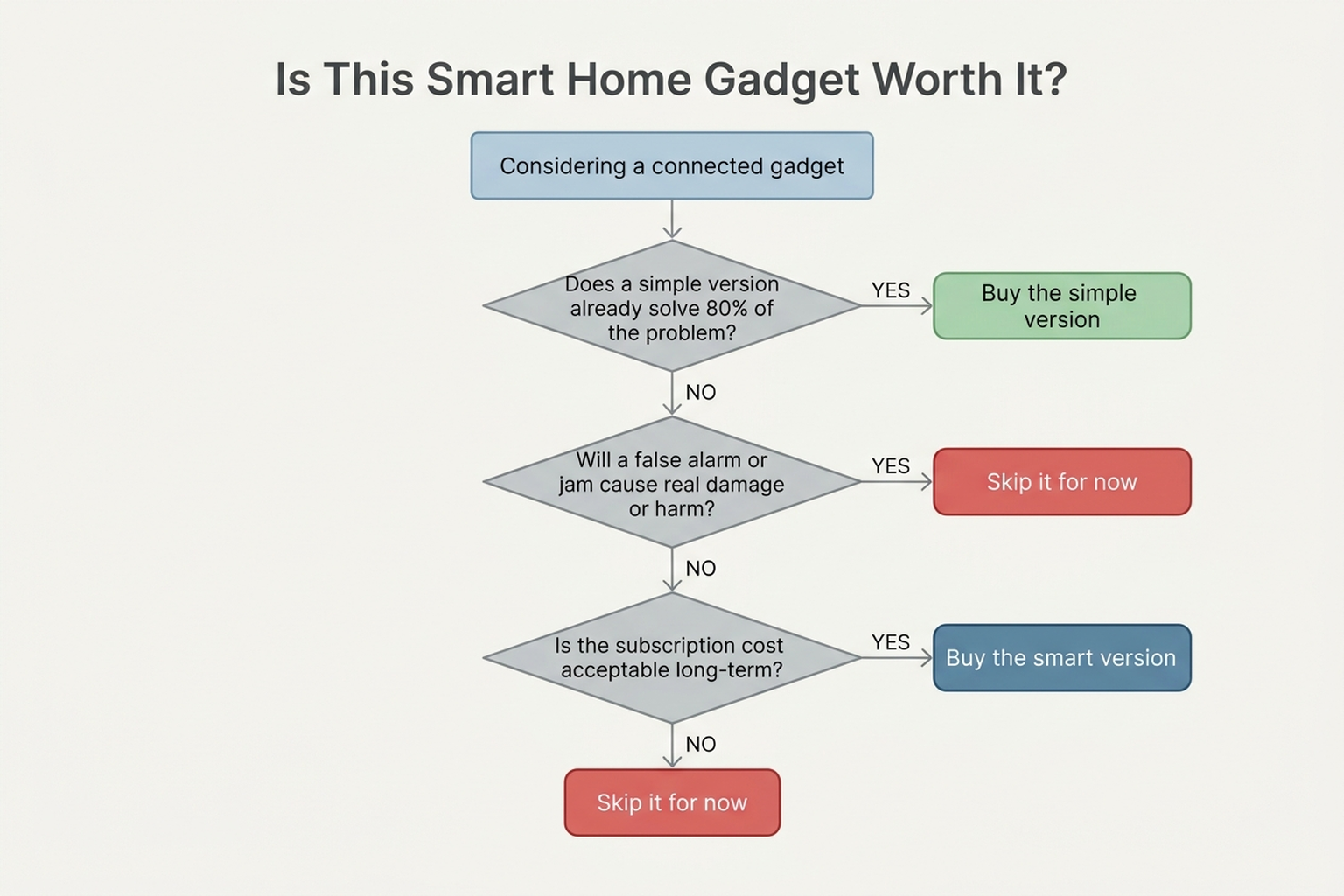
Large yard, variable local weather: A higher-end controller with a strong independent track record (Rachio 3) is worth the premium over budget alternatives — rain-skip accuracy is the single feature most tied to the category’s most common complaint, and it’s the feature that varies most by brand.
Multi-pet household, frequent travel: A feeder with a clog-prevention auger and power backup (PETLIBRO Granary tier) is worth the extra $20-$30 over a basic model — the jam failure mode is the one most likely to leave a pet without food specifically while no one is home to notice.
Renting, or not ready for plumbing work: Skip the full shutoff-valve installation. A standalone Wi-Fi leak sensor under a water heater, washing machine, and dishwasher catches the same leaks for alerting purposes at roughly one-tenth the cost and zero false-shutoff risk.
Own the home, have had a leak before: A shutoff valve is still worth it despite the false-positive rate — but budget time for the setup process (professional installation is common for whole-home models) and read the current app reviews for the specific model, since app reliability is the more fixable half of the complaint pattern and changes faster than hardware does.
Limitations
This analysis relies on publicly available lab testing, independent buying guides, manufacturer documentation, and aggregated customer review sentiment; we did not personally test the products covered. The Petnet outage and the specific owner complaints cited for Flo by Moen and budget pet feeders are documented examples, not a statistically representative sample of every unit sold — individual experience varies by installation quality, local Wi-Fi conditions, climate, and unit-to-unit variance. Pricing reflects approximate amazon.com listings at time of writing and changes frequently; verify current price and specific model number before buying.
Weighing a connected gadget for your home? Visit Arekore to compare current options and verify pricing before you buy.