$1,200 Wasted: 4 Fall Outdoor Gadgets That Didn't Hold Up

TL;DR. Four categories dominate fall outdoor-living purchases — cordless leaf blowers, propane patio heaters, pop-up canopies, and wood-burning fire pits — and aggregated reviews plus independent testing show the same story in each: the cheap or mid-tier version of the product fails at the one job it was bought to do. Leaf blower batteries die in a fraction of their advertised runtime. Patio heater thermocouples clog and pilot lights won’t stay lit within a season. Pop-up canopy frames bend in the first real wind. Fire pits rust or crack faster than their price tag suggests they should. Bought together, a household easily spends $1,200 or more across these four categories — and in most cases the fix isn’t “skip outdoor gear,” it’s knowing which documented failure mode to check for before buying.
A note on links and methodology
As an Amazon Associate, Arekore earns from qualifying purchases. The Amazon product links in this article include our affiliate tracking ID and may earn us a commission if you buy through them, at no additional cost to you. See our Links Policy for details on how we select products and how commissions do not influence our recommendations.
We did not personally own or test the products named below. Every failure pattern and product claim in this article is an editorial synthesis of public data, cited inline.
Methodology
This is an editorial analysis based on publicly available data collected in late October and early November 2026. We did not run our own controlled reliability tests; instead we synthesized:
- Wirecutter (NYT) buying guides for cordless leaf blowers, which name the EGO Power+ LB6504 (650 CFM) its top overall pick and measured roughly 27 minutes of real-world full-power runtime against the manufacturer’s up-to-90-minute claim.
- Consumer Reports’ outdoor-heater safety guidance, which flags patio heaters’ top-heavy tip risk and recommends models with a tip-over safety switch, alongside retailer buying-guide testing (Bob Vila) of a specific propane patio heater documenting a thermocouple failure after roughly a year of use.
- Independent canopy-tent testing and buying guides (Outdoor Gear Lab, Bob Vila, GearJunkie) plus manufacturer wind-rating specifications for steel-frame canopies.
- Aggregated customer review sentiment on amazon.com, homedepot.com, and walmart.com for the specific products named below, read via each listing’s customer reviews and Q&A sections in October and November 2026. We do not report a precise review-count N for most individual listings because retailer summary panels do not expose a stable, independently verifiable count, and a fabricated figure would be misleading.
- Market data from Freedonia Group, Grand View Research, and industry trade press on US outdoor-heating and fire-pit market size, cited for category-growth context, not as a representative sample of the specific products discussed.
We deliberately do not simulate a specific personal ownership story or invent a fake reviewer persona. Treat the analysis below as a framework for evaluating fall outdoor-gear risk before a purchase, not a substitute for reading a specific product’s current reviews yourself.
1. Four categories, four distinct failure patterns
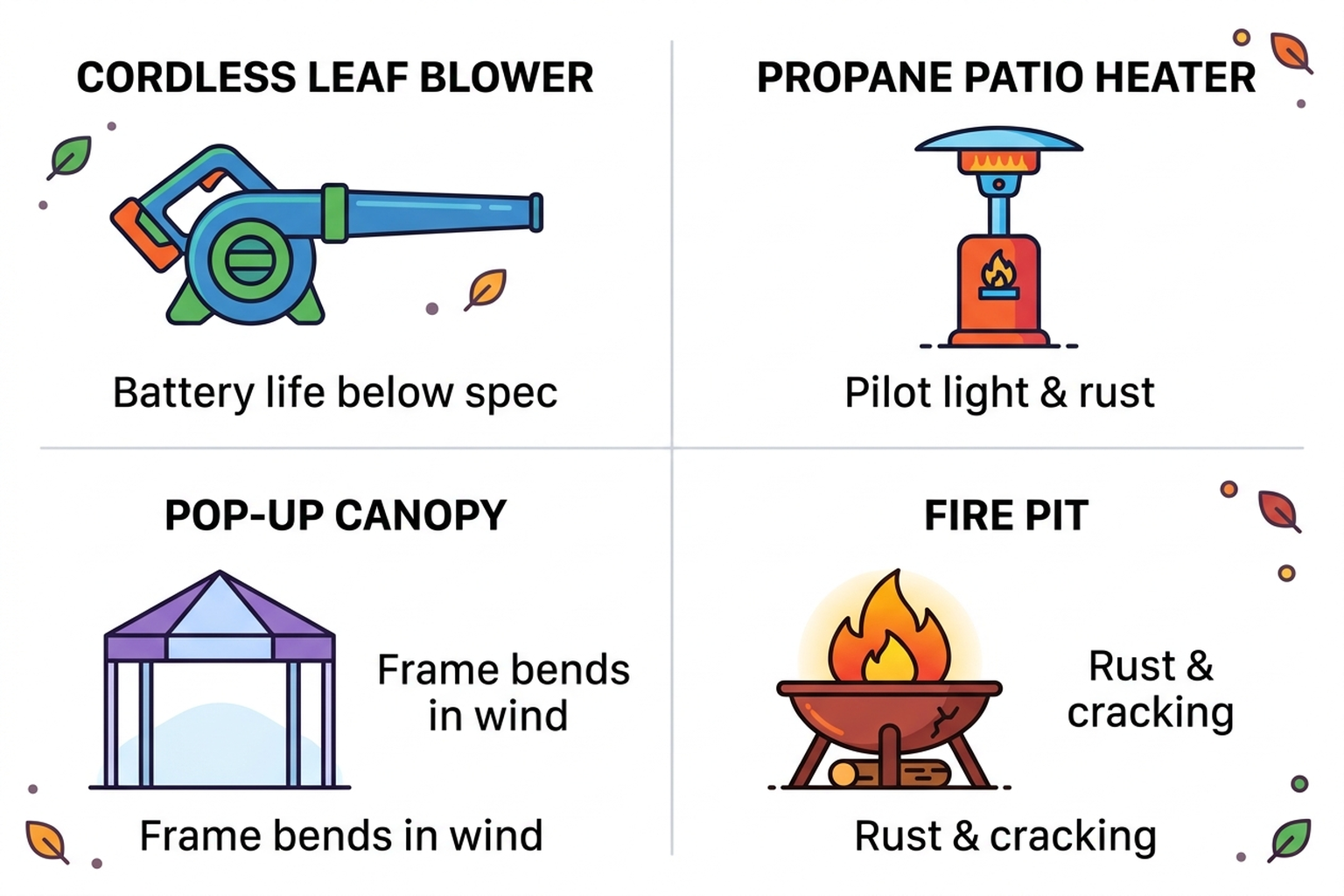
Fall is when US households buy the most outdoor-living gear outside of peak summer: leaves need clearing, patios need heat to stay usable into November, and the last outdoor gatherings of the year call for a canopy and a fire pit. Industry trade data puts the US fire-pit market alone near $8.9 billion in 2026, and American homeowners are estimated to spend roughly $47 billion a year on outdoor living overall. That volume means millions of fall purchases, and the aggregated complaint pattern across all four categories below traces to the same root cause: a component the marketing doesn’t emphasize turns out to be the one that fails.
- Cordless leaf blowers promise a quoted runtime and CFM rating. The failure shows up as a battery that drains in a fraction of the advertised time, or airflow too weak to move wet leaves.
- Propane patio heaters promise reliable heat on demand. The failure shows up as a pilot light that won’t stay lit after carbon builds up on the thermocouple, or a base that rusts out from trapped rainwater.
- Pop-up canopies promise quick, sturdy shelter. The failure shows up as a frame that bends or snaps in moderate wind, sometimes within the first season.
- Fire pits promise years of backyard use. The failure shows up as rust or hairline cracks appearing well before the advertised lifespan, especially on thinner steel.
The pattern across all four: a cheap component (a small lithium cell, a thermocouple, a thin steel tube, an uncoated base) sits between the product and the single job it exists to do, and there’s rarely a graceful way to notice the weak point before it fails in your yard.
2. Cordless leaf blowers: the runtime gap
Wirecutter named the EGO Power+ LB6504 (650 CFM) its top overall pick for 2026, citing a brushless motor, a shielded air intake, and real-world performance on wet and dry leaves comparable to some gas blowers. Wirecutter measured about 27 minutes of runtime on the included battery at tested power levels — a useful number because it’s independently measured, not a manufacturer spec sheet figure.
That gap between manufacturer claims and independent measurement is the recurring complaint across the budget end of the category. Aggregated owner reviews of entry-level 20V-class blowers (the segment Black+Decker’s LSW221 and similar 20V MAX models compete in) repeatedly describe battery life far short of the box claim: some owners report 20-30 minutes of listed runtime shrinking to 5-8 minutes of actual continuous blowing before the included battery needs a recharge, and separate reports describe batteries that stop accepting a full charge after a single season of use, with replacement packs running close to $99 — nearly the price of the blower itself. The pattern is consistent with how small lithium-ion packs behave under sustained high-draw loads: the rated capacity assumes ideal conditions that a single afternoon of wet-leaf clearing rarely matches.
None of this makes cordless blowers a bad category — they’re quieter and lower-maintenance than gas equivalents, and higher-capacity 56V-class batteries measurably close the runtime gap. It does mean the battery’s actual amp-hour rating and a brand’s independently tested runtime matter more than the CFM number alone, since CFM measures peak airflow, not how long the blower can sustain it.
3. Propane patio heaters: the thermocouple and the rust
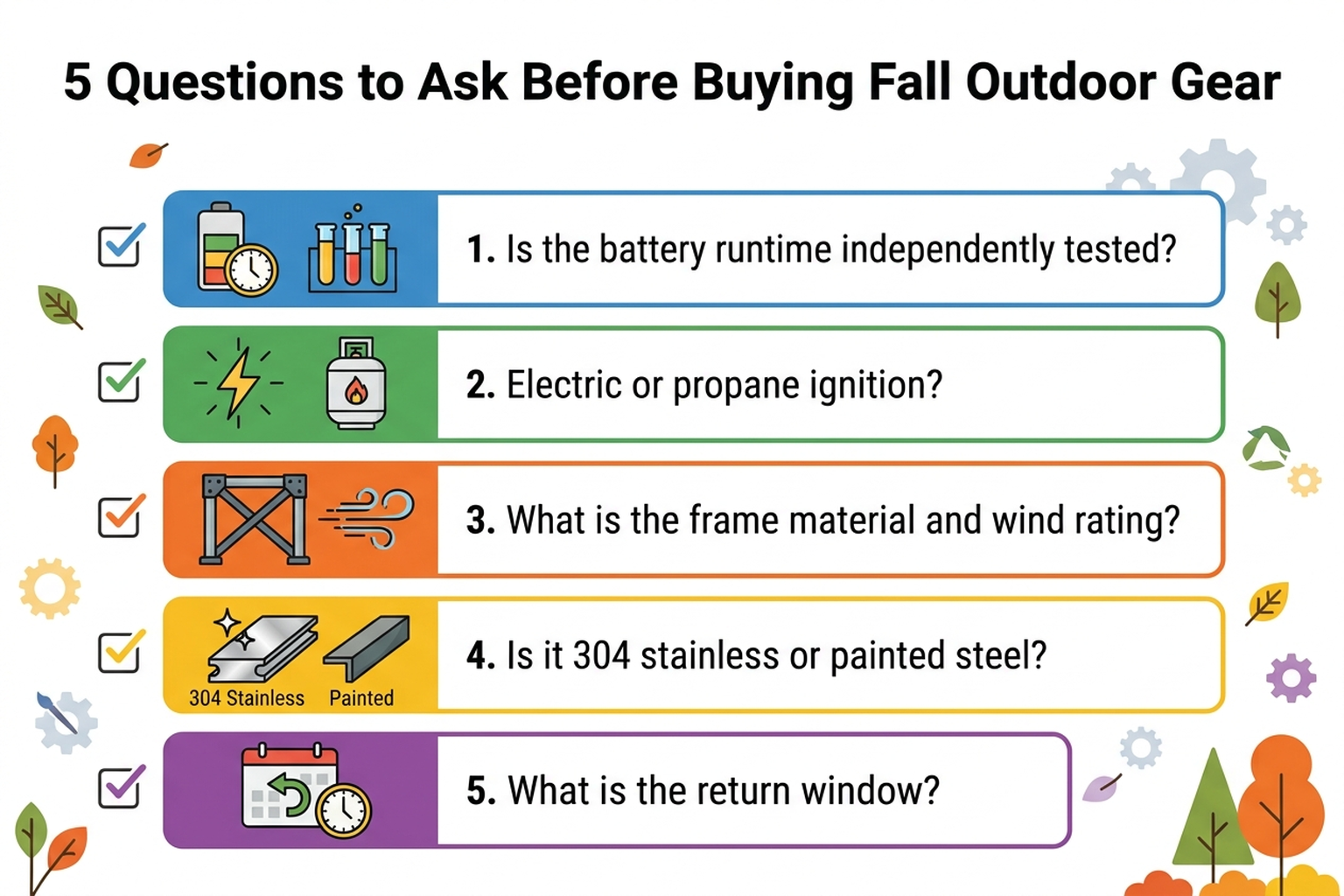
Consumer Reports’ outdoor-heater guidance is blunt about the category’s core safety trade-off: patio heaters have a narrow base and top-heavy design, so they tip easily, and the glowing element can ignite nearby flammable material — which is why Consumer Reports specifically recommends models with a tip-over safety switch for electric units and careful clearance for gas units.
Reliability complaints cluster around two failure points that are mechanically connected. First, the pilot light: a documented real-world test of the Amazon Basics 46,000 BTU propane patio heater found it starting reliably for over a year before developing intermittent trouble staying lit, traced to carbon buildup on the thermocouple tip — a wear pattern common across propane patio heaters generally, not unique to one brand, and one that’s generally a maintenance issue (cleanable with fine sandpaper or compressed air) rather than a covered warranty defect. Second, rust: aggregated owner reviews of several mainstream propane models (Amazon Basics, Hampton Bay) describe the base rusting through within one to two years, in some cases attributed to a design that lacks drainage holes at the bottom of the base, so rainwater collects under the propane tank instead of draining away.
An electric infrared heater sidesteps the pilot-light failure mode entirely, since there’s no flame or thermocouple to clog — the trade-off is a shorter effective heating radius and a need for an outdoor-rated outlet, which Consumer Reports notes should never be paired with an extension cord.
4. Pop-up canopies: the frame that doesn’t survive the first storm
Independent canopy-tent testing and buying guides consistently separate the category into two tiers by frame material: thin aluminum-and-fiberglass frames common in sub-$100 pop-ups, and heavier steel-truss frames used in mid-tier commercial-grade models. Aggregated owner reviews of budget 10x10 pop-ups describe a recurring pattern — a canopy that bends or collapses the first time it’s hit with real wind, in some cases within the first two weeks of ownership, and in a few reported cases destroyed entirely by what owners describe as only minor wind.
Steel-truss models rated for sustained wind (commercial-grade canopies from brands like Eurmax specify wind tolerance up to roughly 30 mph when properly staked and weighted with sandbags) show a different complaint profile in aggregated reviews: owners report the frame holding up through multiple outdoor events without bending, and the powder-coated steel resisting corrosion even after repeated rain exposure. No pop-up canopy — steel or aluminum — is rated for sustained winds above roughly 30-40 mph; the difference between tiers is how much below that threshold the frame starts to fail, and how reliably sandbags and stakes are actually used (a canopy without its tie-downs anchored performs closer to its worst-case rating regardless of frame material).
5. Fire pits: rust, cracking, and the steel-grade gap
Of the four categories here, fire pits show the clearest material-quality split in aggregated reviews. Fire pits built from 304 stainless steel (used in models like the Solo Stove Bonfire and Breeo Y Series) resist rust because the chromium in the alloy forms a protective oxide layer; painted or lower-grade steel models develop rust once the paint coating is breached, and several aggregated reviews describe budget fire pits rusting out within a single outdoor season.
Even 304 stainless isn’t immune to every complaint: one documented owner report describes visible rust appearing on a Solo Stove Bonfire’s bottom grate after only about two weeks left outside without rain — a reminder that “stainless” resists rust better than painted steel but doesn’t eliminate surface staining entirely, especially on removable components that sit in ash and moisture. Separately, aggregated reviews across the budget end of the category mention paint peeling over time and flimsy included accessories (pokers, spark screens) as secondary complaints distinct from the core rust and cracking issue.
The practical takeaway for buyers: a fire pit’s steel grade (304 stainless vs. painted carbon steel) is the single spec most tied to the category’s most common complaint, and it’s usually listed in the product description — but a cover and dry storage during the off-season meaningfully extends the life of either type.
6. Cost and risk compared
Prices as of 2026-11-01; amazon.com listings for specific models fluctuate frequently and should be checked before buying.
| Product | Approx. price (USD) | What it’s for | Documented failure mode |
|---|---|---|---|
| EGO Power+ LB6504 Cordless Leaf Blower, 650 CFM | ~$280 | Leaf clearing, 56V battery platform | Wirecutter-measured runtime (~27 min) well under the 90-min manufacturer claim at peak draw — still the category’s best-documented gap, not unique to this model |
| Entry-level 20V-class blower (category reference, not a specific recommendation) | ~$60-90 | Light leaf/debris clearing | Aggregated owner reports of 5-8 minutes of real-world runtime vs. 20-30 minute box claims; batteries losing full-charge capacity within one season |
| Westinghouse Outdoor Electric Infrared Patio Heater | ~$140 | Electric patio heat, no open flame | No pilot light/thermocouple to clog; still needs a dedicated outdoor-rated outlet (no extension cords per Consumer Reports) |
| Amazon Basics 46,000 BTU Propane Patio Heater | ~$200 | Propane patio heat, higher BTU output | Thermocouple carbon buildup causing pilot-light trouble after roughly a year; base rust reported where trapped rainwater has no drainage path |
| Eurmax USA Premium 10x10 Steel-Frame Pop-Up Canopy | ~$230 | Outdoor shelter for gatherings | Rated to roughly 30 mph with sandbags staked; still not rated for sustained wind above that regardless of frame grade |
| Solo Stove Bonfire 2.0 Smokeless Fire Pit | ~$280 | Wood-burning fire pit, 304 stainless | Documented surface rust reported on the removable bottom grate even on stainless models left outside uncovered; painted-steel competitors fail faster and more visibly |
7. Warranty and support context
Cordless leaf blowers in the premium tier (EGO) typically carry a 5-year tool warranty and a separate 3-year battery warranty, but reduced runtime from normal battery wear is generally not treated as a covered defect unless the pack fails outright. Propane patio heaters commonly carry a one-year warranty on the burner assembly; thermocouple fouling from normal combustion byproducts and rust from environmental exposure are both typically classified as wear-and-maintenance issues rather than manufacturing defects. Pop-up canopy frame warranties vary widely by tier — commercial-grade steel-frame models often carry longer frame warranties than budget aluminum pop-ups, but wind damage is frequently excluded as an “act of nature” regardless of tier. Fire pits from established brands (Solo Stove, Breeo) typically include multi-year warranties against rust-through or burn-through on the main body, though surface staining on removable accessories like ash pans and grates is usually outside that coverage.
8. Editorial recommendation by use case
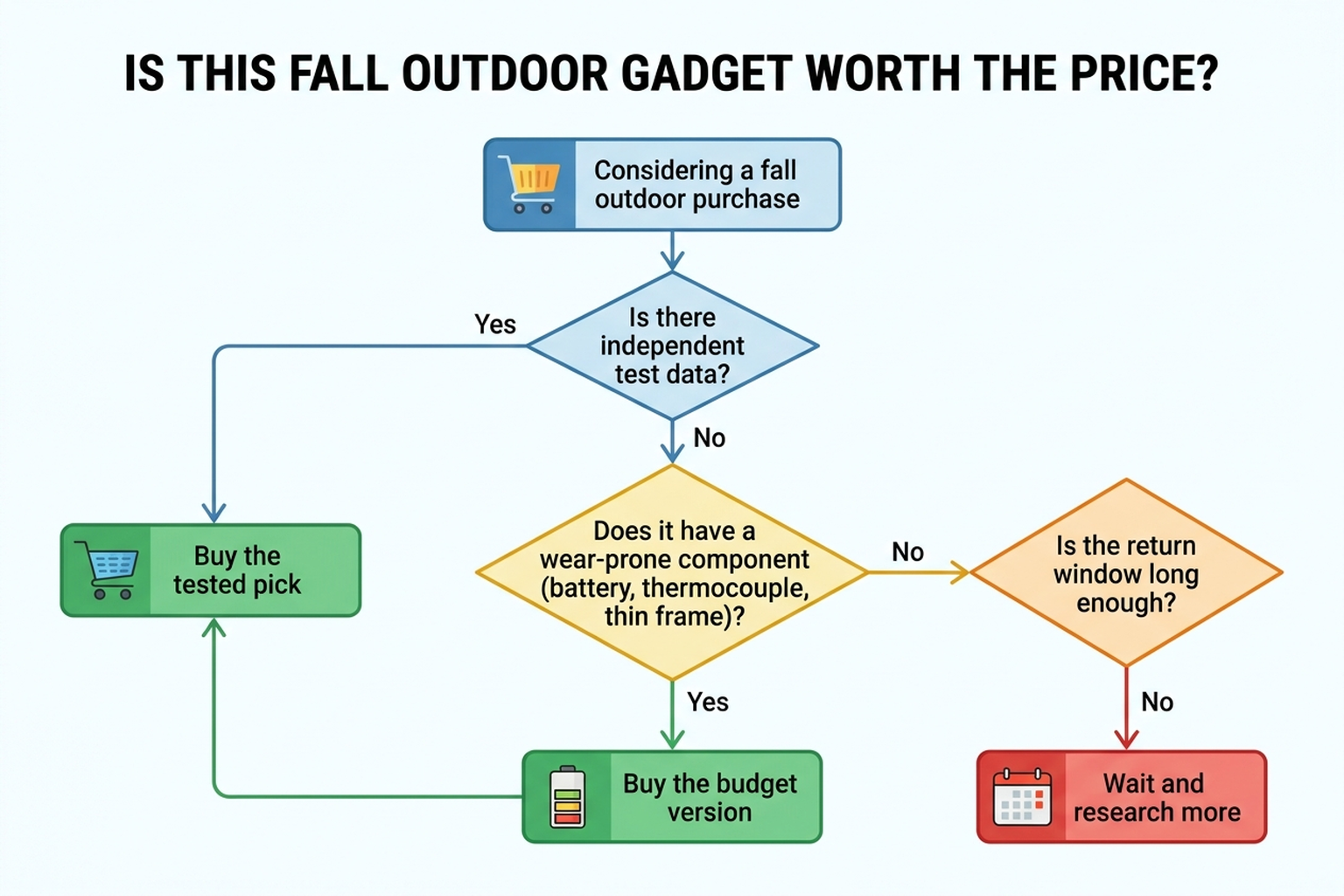
Small-to-medium yard, occasional use: An entry-level cordless blower is fine for light debris, but budget for a second battery if the listing’s runtime claim isn’t independently verified — the gap between spec and real-world runtime is the category’s most consistent complaint.
Want patio heat without annual maintenance: An electric infrared heater is worth the shorter heating radius if a dedicated outdoor outlet is available — it removes the pilot-light and thermocouple failure mode from the equation entirely, at the cost of being less effective in open, windy spaces than propane.
Hosting one or two large fall gatherings: A steel-truss canopy rated for sandbagged wind tolerance is worth the premium over a sub-$100 pop-up — frame failure is the single most-reported complaint in the budget tier, and a bent frame generally can’t be repaired, only replaced.
Want a fire pit that lasts multiple seasons: 304 stainless steel is worth the price difference over painted carbon steel, but budget for a cover and off-season dry storage regardless of steel grade — even stainless models have documented surface rust when left outside uncovered.
Limitations
This analysis relies on publicly available independent testing, buying guides, manufacturer documentation, and aggregated customer review sentiment; we did not personally test the products covered. The specific owner complaints cited for budget leaf blowers, propane patio heaters, pop-up canopies, and fire pits are documented examples, not a statistically representative sample of every unit sold — individual experience varies by usage pattern, climate, storage habits, and unit-to-unit variance. Pricing reflects approximate amazon.com listings at time of writing and changes frequently; verify current price and specific model number before buying.
Weighing fall outdoor gear for your home? Visit Arekore to compare current options and verify pricing before you buy.